For two decades, the Biodiversity Heritage Library (BHL) has served as the world’s preeminent digital repository for natural history literature, transforming fragile paper volumes, handwritten field journals, and obscure archival manuscripts into globally accessible open-source data. As the BHL celebrates its milestone 20th anniversary through its ongoing commemorative series, BHL at 20: Treasures from the Biodiversity Heritage Library, institutions across its global consortium are spotlighting remarkable, often-overlooked works from their collections.
Recently, at the Academy of Natural Sciences of Drexel University in Philadelphia, Pennsylvania, a routine digitization project unexpectedly unlocked a profound piece of hidden scientific history. While processing 83 historical scientist notebooks and field journals for inclusion in the BHL, cataloging staff confronted a pervasive, systemic issue that plagues archival research concerning women in the natural sciences: historical erasure masked by institutional shorthand.
A handwritten 19th-century entomological notebook, originally cataloged simply under the generic, depersonalized moniker of "Mrs. Aaron," threatened to slip quietly into the digital ether. Thanks to the vigilant intervention of Academy Archivist Jessica Lydon, however, the manuscript was correctly attributed to Carrie Baily Aaron—an astute 19th- and 20th-century entomologist, essayist, and long-standing correspondent of the American Entomological Society (AES).
This discovery catalyzed a comprehensive digital rescue mission. By bridging traditional archival practices with modern linked data frameworks—establishing a dedicated BHL Creator ID and linking it directly to Wikidata—the Academy transformed an anonymous historical artifact into a vibrant, traceable node of scientific heritage. Enhanced by concurrent digitization efforts funded by Dr. William Day and the AES, encompassing Aaron’s extensive correspondence with entomologist Henry Skinner, modern researchers now have unprecedented access to the intellect, travels, and tribulations of a pioneering woman who deliberately stepped away from a male-dominated scientific establishment. This case study underscores how modern digital infrastructure does not merely preserve history; it actively repairs it, restoring marginalized voices to the scientific canon.
Detailed Chronology: The Life, Work, and Rediscovery of Carrie Baily Aaron
To fully appreciate the significance of Carrie Aaron’s recovered notebook, one must trace the convergence of late 19th-century scientific ambition, institutional record-keeping, and 21st-century digital humanities.
The Mosquito Eradication Contest of the Late 19th Century
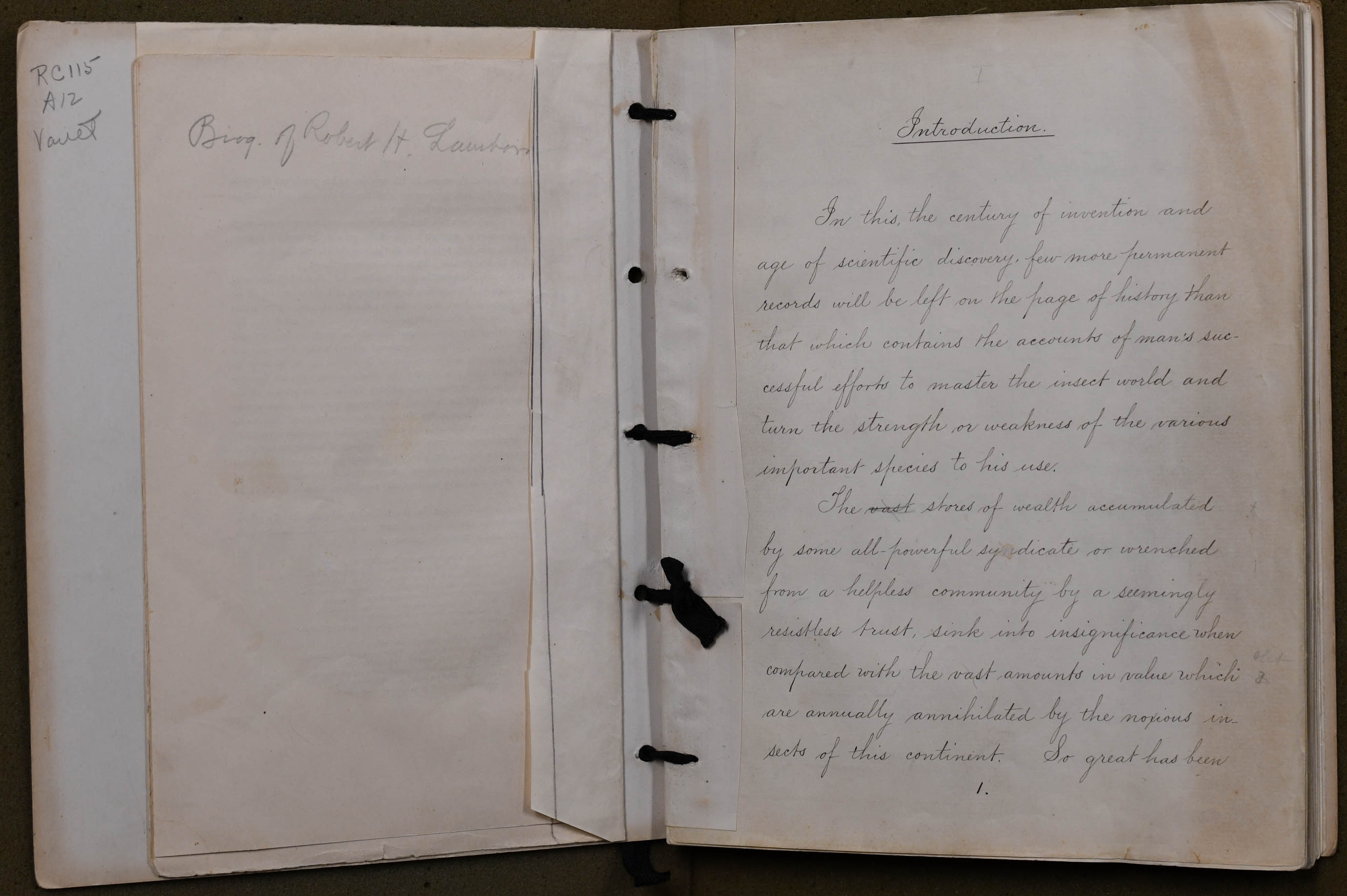
The story of Aaron’s primary entomological surviving work begins with an industrialist’s acute discomfort. As Aaron meticulously documented in her biographical notes concerning Robert Henry Lamborn—a prominent figure involved in the construction of the Lake Superior Railroad—Dr. Lamborn suffered so severely from the relentless attacks of swarming mosquitoes that he resolved to spur scientific inquiry into their eradication. To achieve this, Lamborn established a public contest, offering substantial monetary prizes for the three best essays proposing practical methods to eliminate or mitigate the mosquito pest.
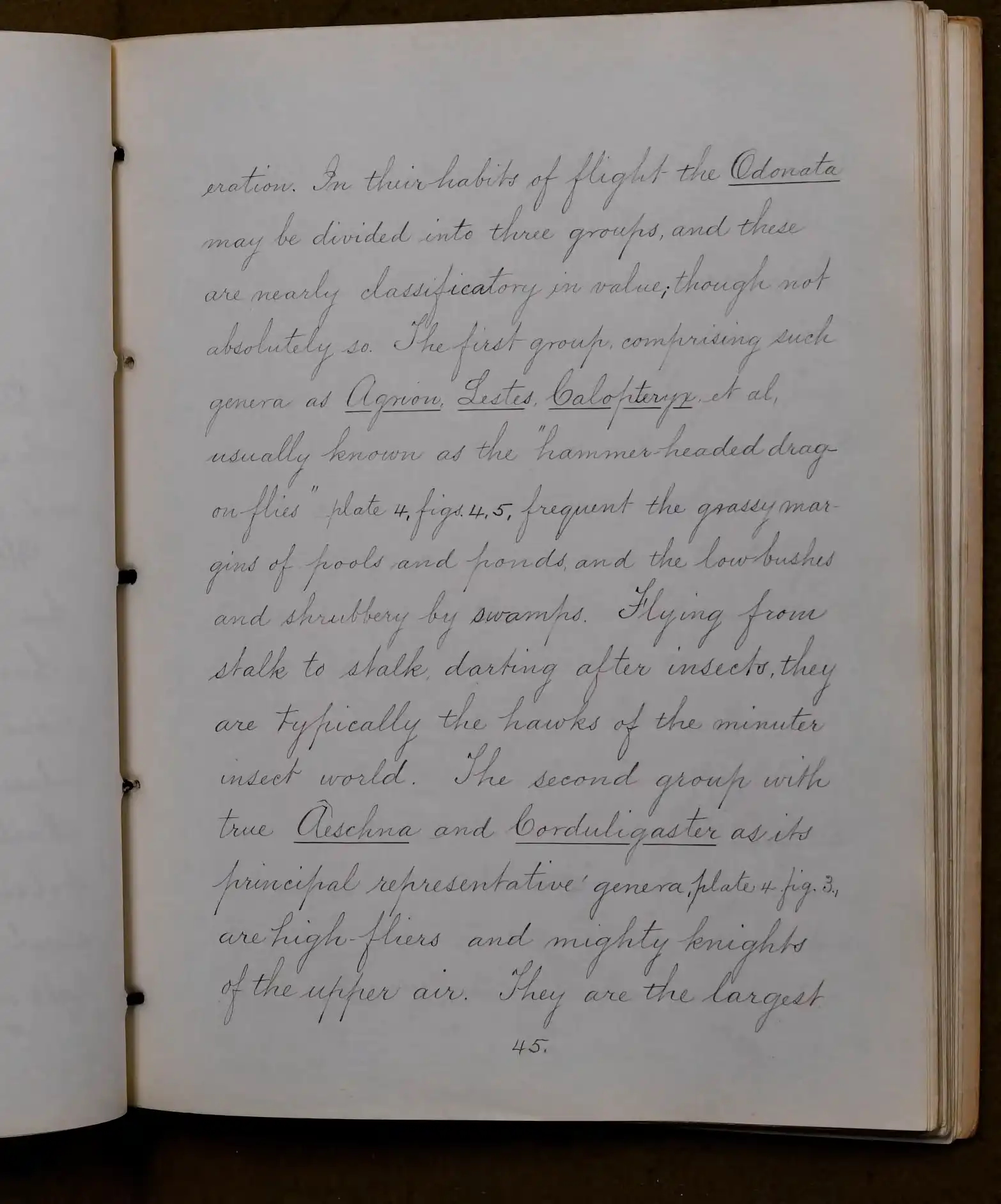
Seizing the challenge, Carrie Aaron formulated a comprehensive, highly detailed entomological essay. Submitted under her own name, the essay showcased an impressive command of insect morphology and behavior. Within its pages—now digitized and freely available via the BHL—Aaron analyzed various biological mechanisms for reducing mosquito populations. Notably, she championed the predatory prowess of dragonflies, which she poetically and precisely characterized as "the hawks of the minuter insect world."
Demonstrating a hands-on, rigorous empirical approach to her research, Aaron and her contemporaries even attempted to self-inoculate using what was then believed to be poisonous droplets extracted from mosquitoes. Although this bold experiment ultimately failed—a shortcoming Aaron wryly attributed to the "inferiority of the needle as an injector, compared with the delicate hypopharynx" of the insect—it highlighted an intrepid commitment to firsthand scientific observation.
Following the contest, Aaron’s essay was selected for publication alongside other elite submissions in the notable volume Dragon Flies vs. Mosquitoes: Can the Mosquito Pest be Mitigated?, appearing under the evocative title "The Dipterous Enemies of Man."
Recognition and Disillusionment: The AES Correspondence
Following her success in the Lamborn contest, Aaron’s burgeoning scientific reputation caught the attention of prominent entomologists. Among the treasures preserved in the Academy’s archives is a congratulatory letter penned by Henry Skinner, a towering figure in American entomology, confirming that Aaron’s professional standing within the field should "now be well established."
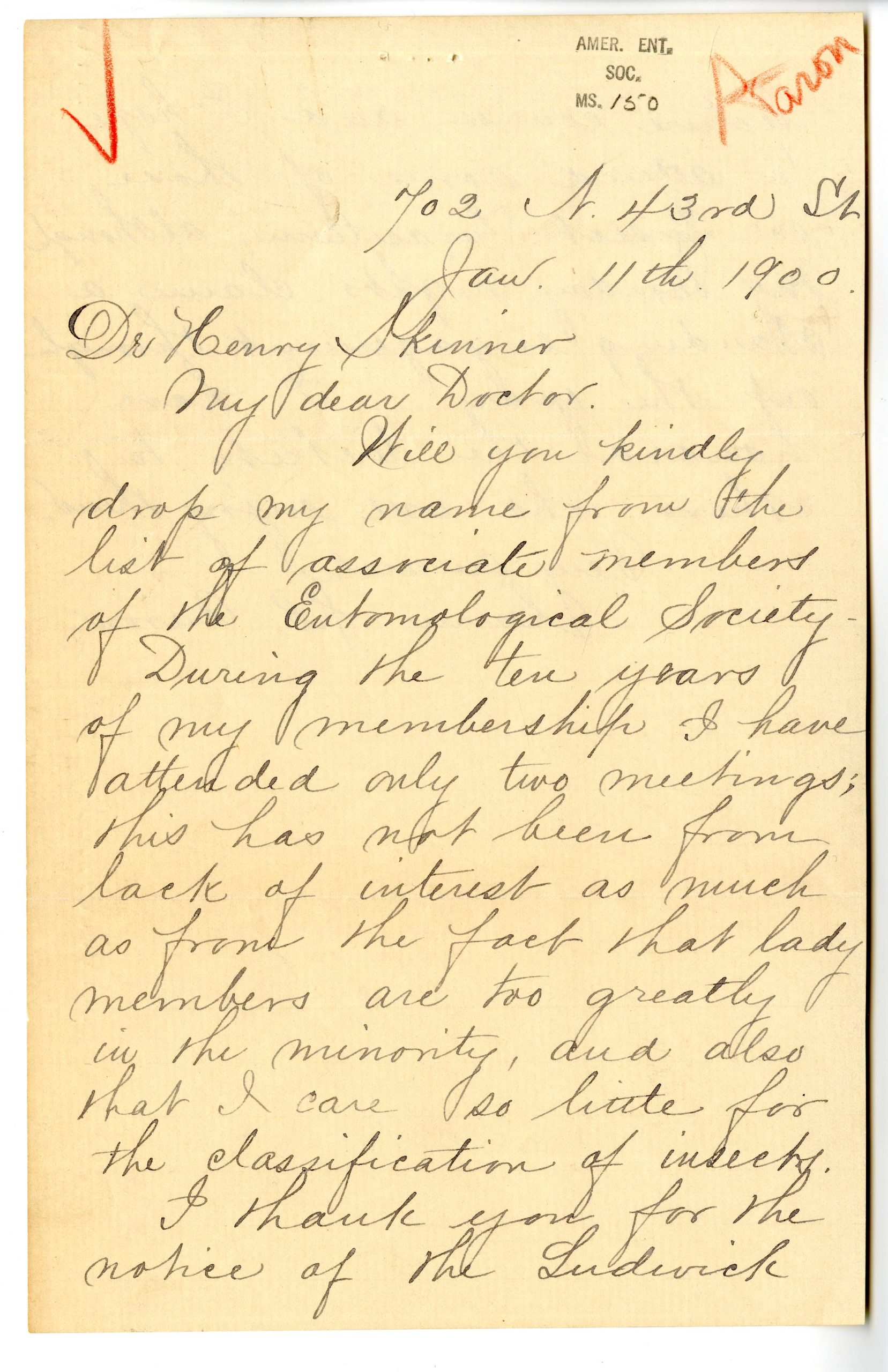
Yet, the institutional realities of late-Victorian and Edwardian science presented formidable barriers for female researchers. Ten years after receiving Skinner’s praise, on January 11, 1900, Aaron penned a resolute letter to him, formally requesting that her name be stricken from the active roster of associate members of the American Entomological Society. Her stated reasons offer a poignant window into the gendered dynamics of turn-of-the-century scientific societies:
"During the ten years of my membership I have attended only two meetings; this has not been from lack of interest as much as from the fact that lady members are too greatly in the minority, and also that I care so little for the classification of insects."
Despite her withdrawal from formal society meetings, Aaron maintained a profound, respectful intellectual dialogue with Skinner. A subsequent letter written in 1923 explicitly thanked him for a "more than thirty year sympathetic friendship," proving that her departure from the AES stemmed from institutional alienation rather than a diminished passion for the natural world.
California Travels and the Search for the "Only Woman Curator"
Later correspondence uncovered through the ongoing digitization of the AES collection—processed by Drexel University student intern Will Le—reveals Aaron’s later life and travels. Relocating or visiting Santa Monica, California, Aaron described the region in evocative prose as "the land of perpetual bloom and uninterrupted sounds of birds and insects."
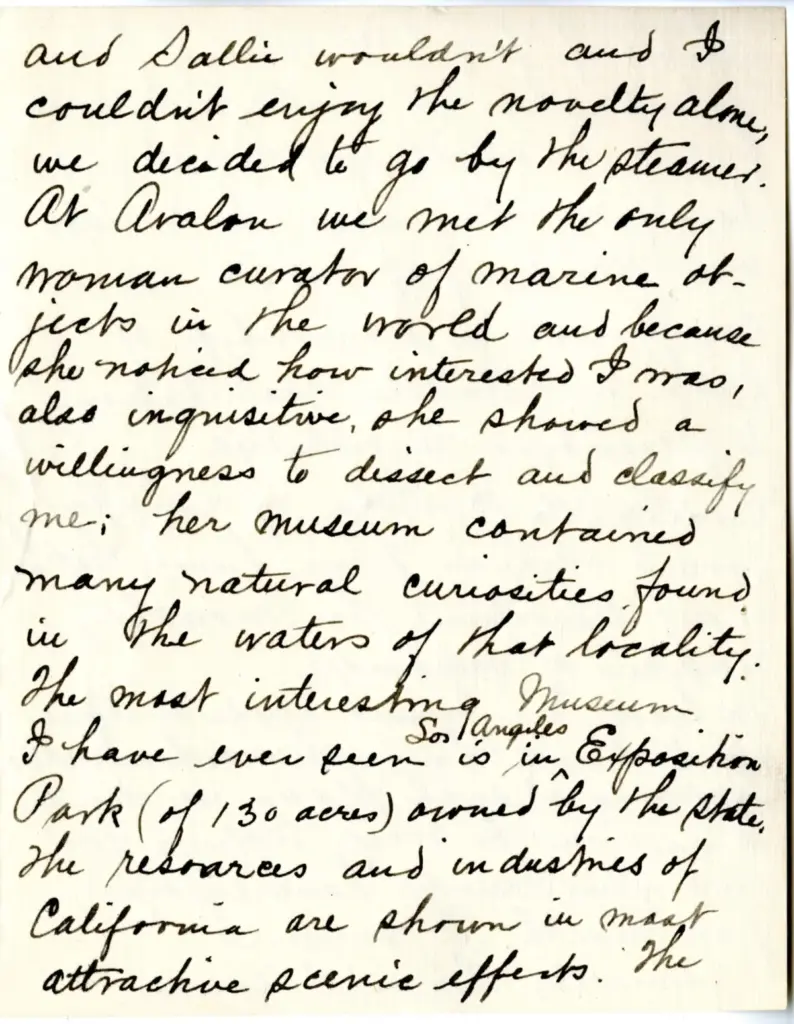
Her letters also chronicled her visits to West Coast repositories. In a March 8, 1926 letter to Skinner, Aaron recounted a remarkable encounter:
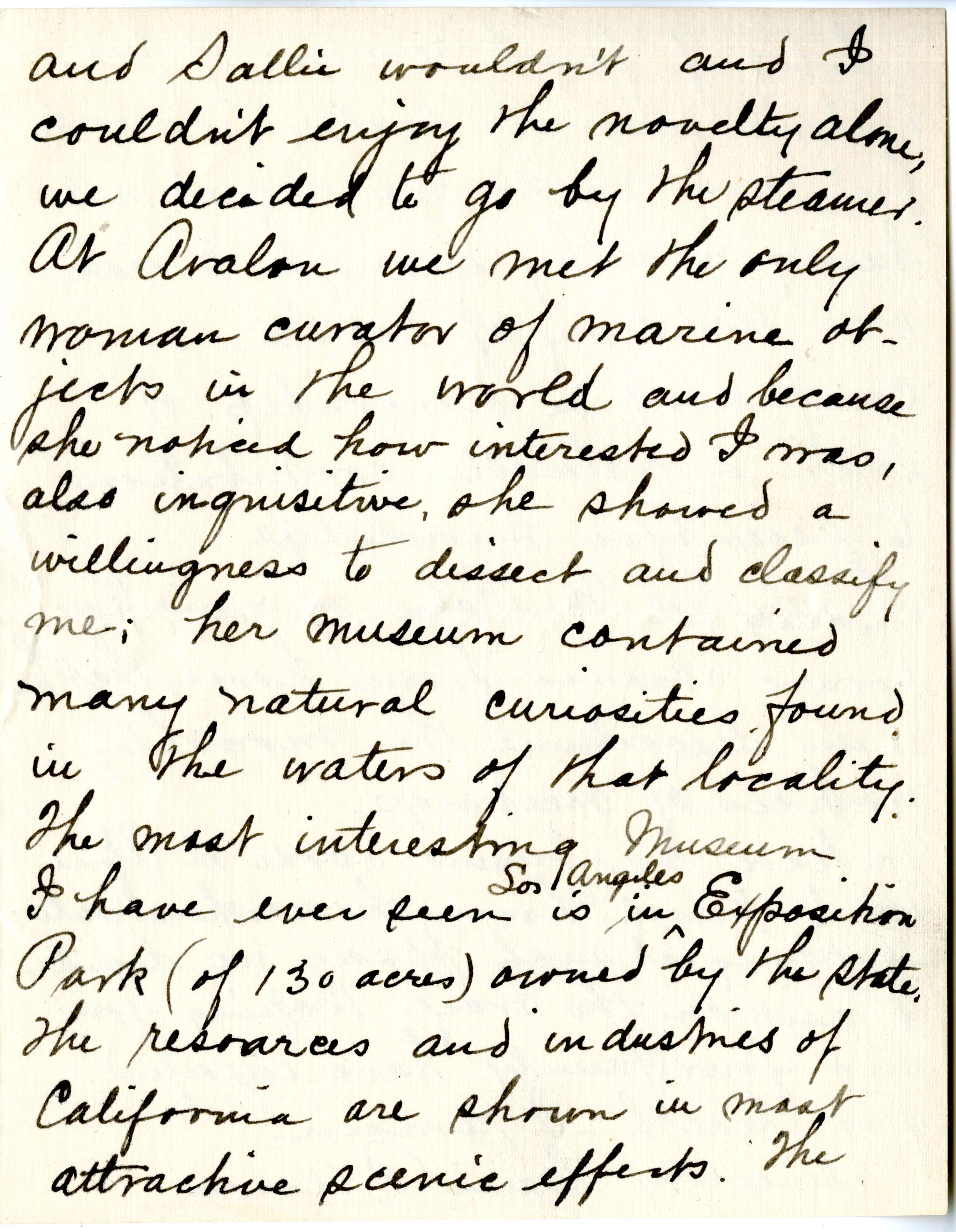
"At Avalon we met the only woman curator of marine objects in the world and because she noticed how interested I was, also inquisitive, she shared a willingness to dissect and classify me; her museum contained many natural curiosities found in the waters of that locality. The most interesting museum I have ever seen is in Los Angeles, Exposition Park (of 130 acres) owned by the state, the resources and industries of California are shown in most attractive scenic effects. The exhibit of fossil remains of prehistoric animals really is wonderful, and made me regret not being healthy enough to make our Academy of Nat. Sci. a competitor in ownership of such a valuable contribution to scientific knowledge."
This tantalizing reference to an anonymous female marine curator has since sparked a brand-new investigative pursuit for modern archivists, demonstrating how archival discovery feeds directly into ongoing historical research.
The 21st-Century Digital Rescue
The modern arc of Carrie Aaron’s rediscovery culminated during preparations for the BHL’s 20th anniversary. Staff at the Academy Library and Archives—including Cataloging and Digital Resources Librarian staff, Archivist Jessica Lydon, and student interns—prioritized Aaron’s surviving notebooks and letters.
Before upload, her primary finding aid record was frustratingly opaque, listing her simply as "Mrs. Aaron." Recognizing that this cataloging practice effectively erased her individual identity, Lydon supplied the necessary biographical context. The cataloging team subsequently generated a dedicated BHL Creator ID for Carrie Aaron, cross-referencing and permanently linking it to her official Wikidata identifier (Q125503946).
Concurrently, a separate digitization initiative funded by Dr. William Day and the American Entomological Society enabled the processing of the entire AES correspondence collection, publishing high-resolution scans to PA Photos and Documents. What began as an anonymous historical footnote is now a fully indexed, interconnected, and globally searchable cornerstone of biodiversity history.
Supporting Context & Metrics
The digitization and cataloging workflow that brought Carrie Aaron to light is part of a massive, ongoing international effort to document, preserve, and open access to natural history literature.
Metric / Operational Category
Data Point / Description
BHL Milestone
Celebrating 20 years of continuous operation as the world’s largest open-access literature repository for biodiversity.
Academy Project Scope
83 historical scientists’ handwritten notebooks and field journals digitized and transcribed for BHL integration.
Aaron Notebook Artifacts
A notebook containing an entomological essay by Carrie Aaron (1889, 1890, 1901), housed in Small Collections and Individual Manuscripts Box 4 (ANSP-Coll-0156).
AES Correspondence Collection
Entire institutional correspondence archive digitized via funding from Dr. William Day and the American Entomological Society, hosted on PA Photos and Documents.
Linked Data Infrastructure
Implementation of a unique BHL Creator ID (350311) mapped directly to Wikidata entity Q125503946.
Collaborative Personnel
Led by the Academy’s Cataloging and Digital Resources Librarian, Archivist Jessica Lydon, student digitization assistants, and intern Will Le.
The technical transition from legacy finding aids to modern semantic web architecture is critical. In historical archives, women were frequently cataloged under their husbands’ names prefixed with honorifics (e.g., "Mrs. John Doe" or "Mrs. Aaron"). This practice not only stripped them of their autonomous legal and professional identities but also broke relational database links in modern search engines. By establishing persistent identifiers like Wikidata Q-numbers and BHL Creator IDs, institutions like the Academy of Natural Sciences are actively future-proofing archival records against historical amnesia.
Official Statements & Institutional Perspectives
The intersection of archival stewardship, feminist historiography, and digital infrastructure has drawn high praise from the professionals orchestrating these projects.
Reflecting on the transformative nature of her work with the Academy’s rare materials, the Cataloging and Digital Resources Librarian noted the irresistible pull of primary source research:
"After working with archival notebooks and reading Carrie Aaron’s letters, I’m thrilled to see how digitization and public access to collections spur research into lesser-known individuals and uncover more potential research subjects! I don’t consider myself a historian, but it’s difficult to resist historical research when presented with easily accessible primary sources and when given the tools to link subjects across different platforms. I hope to continue this energizing work at the Academy of Natural Sciences in collaboration with BHL for years to come."
Emphasizing the core mission of the international repository, representatives from the Biodiversity Heritage Library highlighted the broader societal value of these preservation efforts:
"For 20 years, BHL has helped uncover the people and stories hidden within biodiversity literature and archives, making them freely available for new generations to discover. Your support helps us continue digitizing, connecting, and sharing collections like Carrie Aaron’s notebook—and ensures that more overlooked voices and histories can be found."
Future Outlook
The rediscovery of Carrie Aaron’s entomological essay, correspondence, and personal reflections is not merely a retrospective celebration; it acts as a dynamic springboard for future academic inquiry.
Unresolved Archival Mysteries: The immediate research horizon includes identifying the enigmatic "only woman curator of marine objects in the world" whom Aaron encountered in Avalon, California, in 1926. Archivists and historians are currently cross-referencing West Coast museum registries from the early 20th century to put a name to this pioneering marine scientist.
Expanding Linked Open Data: The success of mapping Carrie Aaron’s BHL Creator ID to Wikidata serves as an institutional pilot. The Academy of Natural Sciences plans to audit and remediate additional legacy finding aids where women and minority scientists were obscured by patriarchal cataloging conventions.
Student-Driven Archival Integration: By embedding student interns like Will Le into core digitization workflows, academic institutions are training the next generation of digital humanists and archivists, ensuring that funding from entities like the American Entomological Society yields maximum public educational value.
BHL at 20 and Beyond: As the Biodiversity Heritage Library enters its third decade, collaborative partnerships between independent archives and global digital aggregators will continue to prove that history is never truly finished—it is simply waiting for the next digital link to be forged.