

Executive Overview
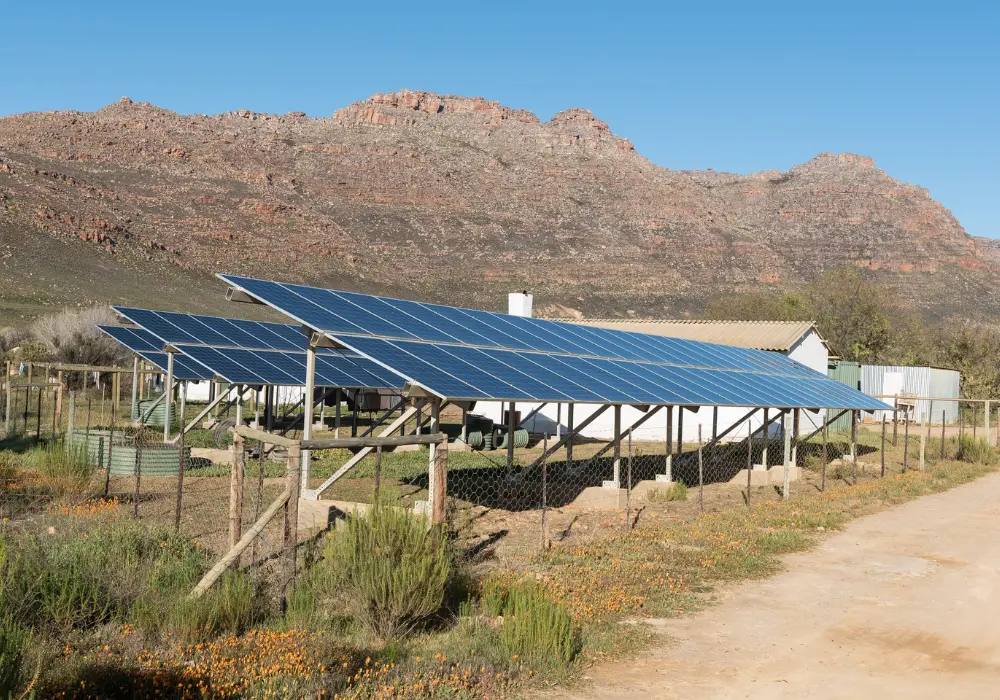
In a remote agricultural pocket of Syria, 24 households have achieved what the national energy grid can no longer guarantee: round-the-clock electricity. For a monthly fee of just US$0.20, these families draw uninterrupted power from a cluster of photovoltaic panels bolted to their local community center. The system drives water pumps, preserves perishable food in refrigerators, and allows children to study after nightfall—breathing life back into a rural economy shattered by more than a decade of armed conflict.
Yet the village of Khirais is not merely a localized feel-good anecdote. It is a striking microscale preview of a macroscale phenomenon unfolding across fragile and conflict-affected states worldwide. As traditional state infrastructure collapses under the weight of war, sanctions, and fiscal bankruptcy, ordinary citizens are bypassing public utilities entirely. Driven by necessity rather than environmental idealism, a decentralized solar boom has taken root in Syria, transforming rooftops, open lots, and agricultural lands into an informal, patchwork grid.
This improvised green transition exposes profound systemic vulnerabilities. While decentralized solar offers an indispensable lifeline, it simultaneously threatens to entrench a two-tier energy divide. Families with access to foreign remittances, dollar-denominated wages, or upfront capital can buy climate resilience and shield themselves from volatile diesel prices. Meanwhile, lower-income households—unable to afford thousand-dollar startup costs, batteries, or poorly regulated components—remain tethered to toxic diesel generators or left in total darkness.
As international donors, policymakers, and financial institutions contemplate the future of post-conflict reconstruction in Syria and beyond, Khirais and its broader context pose an urgent question: When populations construct their own energy systems in the ashes of state failure, how can public policy and institutional finance bridge the gap to build an equitable, sustainable recovery?
Detailed Chronology: The Collapse and the Solar Pivot
To understand Syria’s current energy landscape, one must trace the steep decline of its centralized infrastructure and the organic grassroots mobilization that followed.
Pre-Conflict Baseline and Institutional Decay
Before the outbreak of armed conflict in 2011, Syria possessed a relatively robust, centralized electricity network. Total installed generation capacity stood at approximately 9.5 gigawatts, serving the vast majority of the population with reliable, heavily subsidized public power.
Years of intense warfare, infrastructure targeting, fuel shortages, and economic isolation systematically dismantled this capacity. By the end of 2023, available generation capacity had plummeted to roughly 1.6 gigawatts. For millions of citizens, public electricity availability dwindled to less than two hours a day. The human and economic tolls were immediate: municipal water systems faltered, agricultural irrigation ground to a halt, commercial refrigeration failed, and local production lines went silent.
The Grassroots Reconstruction (2021–Present)
As displaced populations began trickling back to rebuild communities like Khirais in 2021, they faced a stark reality: waiting for the national grid to be restored meant waiting in the dark. Public budgets were non-existent, and international reconstruction financing for state-owned utilities was heavily constrained by geopolitical roadblocks and sanctions.
Stepping into this institutional vacuum, regional non-profits, international aid organizations, and resourceful local populations initiated a pivot toward decentralized renewables. In Khirais, panels mounted on community infrastructure brought stability back to daily life.
On a national scale, this individual and community-level agency catalyzed an unprecedented off-grid solar market. Because data is largely generated by private, unregistered transactions, exact figures remain difficult to verify. However, industry estimates suggest that Syria’s nominal off-grid solar capacity surged from a modest 250 megawatts in 2022 to over two gigawatts by 2025. Today, analysts estimate that roughly one-quarter of Syrian households utilize some form of private solar equipment to mitigate crippling blackouts.
Remarkably, academic research indicates a direct statistical correlation between conflict intensity and the rapid adoption of renewables. One study found that a 1% increase in local conflict intensity in Syria was associated with a 9.71% short-term increase in decentralized renewable energy production. This surge was not driven by climate policy targets, but by pure survival instinct: as grid damage and fuel scarcity peaked, the demand for localized generation skyrocketed.
Supporting Context & Metrics: Fragility, Finance, and the Two-Tier Risk
The Global Fragility Deficit
Syria’s plight is emblematic of a broader global crisis in energy access. According to the Council on State Fragility, more than 80% of the estimated 800 million people worldwide who currently live without electricity reside in "fragile" and conflict-affected settings.
While these regions are projected to account for a massive share of future global electricity-demand growth, international climate and energy finance rarely reaches them. To illustrate the disparity: in 2025, the Green Climate Fund approved a record $3.26 billion in new project approvals, yet fragile and conflict-affected states received only about $500 million—roughly 15% of the total.
Experts argue that conventional, centralized infrastructure models are fundamentally unsuited for these high-risk environments. Distributed renewable energy (DRE) systems—such as rooftop solar panels, local battery storage units, and mini-grids—disperse systemic risk. By generating and consuming power locally, these systems reduce dependence on vulnerable central power plants, fragile fuel supply lines, and easily sabotaged transmission corridors.
The Danger of a Two-Tier Energy Market
Despite its life-saving utility, Syria’s decentralized solar boom has birthed a deeply unequal energy landscape. Because solar hardware must be imported and paid for in hard currency, access is heavily skewed.
"The households best placed to buy panels were often those being paid in wages priced to the dollar, primarily, because this stuff was all imported," explains Hayley Schuler-McCoin, a senior research fellow at the Carboun Institute, a think tank specializing in energy policy and geopolitics in southwest Asia and North Africa.
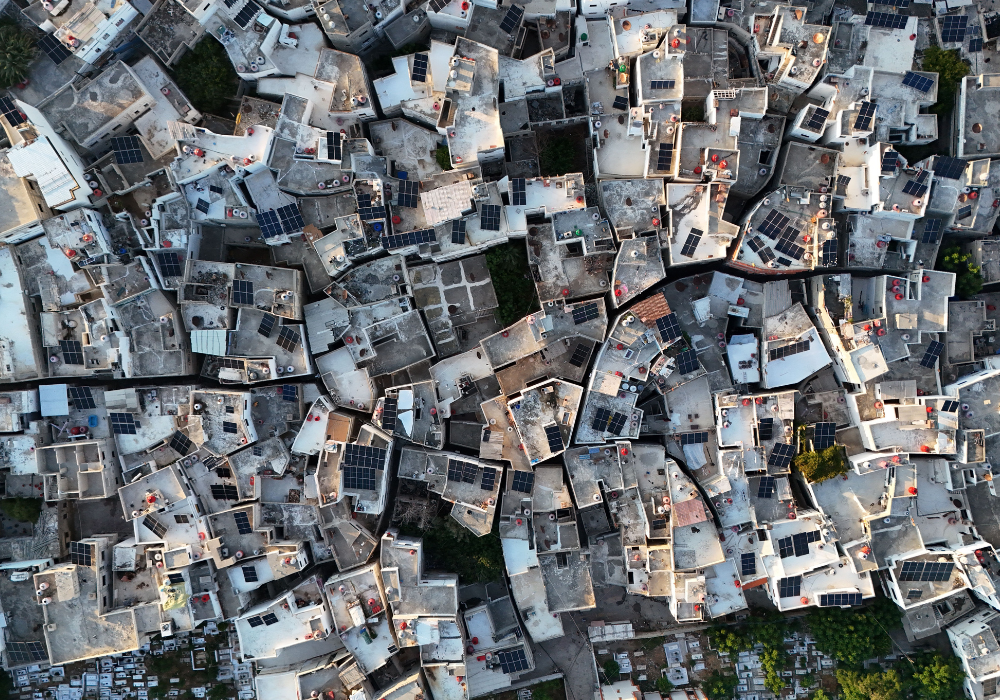
Households integrated into strong international remittance networks or supported by international NGOs could readily absorb high upfront capital costs. Conversely, families without access to foreign currency remain locked out. According to Schuler-McCoin, these marginalized groups are "still largely… limited to diesel generators and fuel or going without." In a war-scarred economy, thousand-dollar startup costs are insurmountable, and even when low-income communities attempt to pool resources, maintenance expenses, battery replacements, and a proliferation of low-quality, poorly regulated market components introduce immense financial risk.
Without deliberate regulatory intervention and inclusive financing models, this dynamic risks cementing a permanent two-tier system: moneyed elites and remittance-backed families enjoy clean, reliable power and insulation from diesel price shocks, while the impoverished majority remains trapped in a cycle of toxic pollution, exorbitant fuel prices, and chronic energy poverty. Schuler-McCoin warns that this polarization extends to commercial and agricultural investments as well. If a factory or farm secures public or concessional funding to build a solar plant, it must be legally "paired with" power-sharing provisions for adjacent neighborhoods, or stark socioeconomic disparities will only widen.
Official Statements & Expert Analysis
Industry analysts and institutional researchers emphasize that while decentralized solar is a vital crisis bridge, it cannot completely substitute for a modernized national grid.
Shafiqul Alam, lead analyst for Bangladesh energy at the Institute for Energy Economics and Financial Analysis (IEEFA), highlights the sheer speed of grassroots deployment compared to state-led reconstruction:
"Distributed systems can be built fast, very fast. Rebuilding grid connectivity, by contrast, will take time, a lot of time. If energy becomes unaffordable, people can take it into their own hands."
Alam points to structural financing innovations in countries like Bangladesh—such as the Infrastructure Development Company Limited (IDCL), which combined capital subsidies with delivery through trusted local partner organizations—as a blueprint for overcoming credit barriers. In fragile markets, traditional commercial banks demand established credit histories and collateral that vulnerable populations simply do not possess. Capital subsidies, credit guarantees, and pre-financing models are essential to make systems accessible.
At the same time, international agencies caution against abandoning high-voltage transmission infrastructure. The International Energy Agency (IEA) maintains that public grids remain "essential for bringing power to industry, citizens and services," serving as the foundational backbone required to integrate large-scale renewables and balance power systems. Microgrids and storage units are vital complements, but they cannot single-handedly run a national economy.
Schuler-McCoin echoes this sentiment regarding reconstruction priorities:
"The very immediate issues are going to be getting investors to prioritize the grid and not just the supply of energy."
She stresses that international donors must direct grant funding toward the unglamorous, foundational elements of grid repair: transmission lines, substations, metering, technical safety standards, maintenance capacity, and network flexibility.
Future Outlook: Bridging Decentralization and Centralized Recovery
As Syria and other conflict-scarred nations look toward long-term stabilization, the path forward requires an integrated strategy that harmonizes grassroots innovation with institutional grid rehabilitation.
The Role of Public Policy and Emergency Funding
Initial steps are underway. For instance, the World Bank’s $146 million Syria Electricity Emergency Project represents a critical acknowledgment of structural needs, focusing on repairs to high-voltage interconnectors and substations near major demand centers. However, such initiatives are merely a drop in the ocean compared to the vast capital required to restore national capacity.
To maximize the impact of future investments, experts advocate for several strategic policy shifts:
- Net-Metering and Revenue Integration: If regulatory frameworks incorporate robust net-metering provisions, households, farms, and small businesses with surplus solar generation can feed clean power back into the public grid once localized lines are restored. As Shafiqul Alam notes, this integration turns passive consumers into active producers, creating predictable revenue streams while minimizing wasted generation.
- Inclusive Financial Intermediation: Central banks and international financial institutions must move beyond rigid commercial lending frameworks. By implementing targeted refinancing schemes, capital cost subsidies, and micro-loans channeled through trusted local cooperatives, policymakers can extend solar access down to low-income households.
- Equitable Neighborhood Mandates: Concessional loans and public grants awarded to agricultural and industrial entities for solar installations should be legally conditioned on community power-sharing agreements, ensuring that surrounding residential areas also benefit from the generated wattage.
- Data-Driven Analysis: Before rolling out sweeping tariffs, subsidies, or technical upgrades, governments and aid agencies must conduct granular, country-specific assessments analyzing real-time electricity prices, household demand curves, existing generator dependencies, and utility financial health.
Conclusion
The grassroots solar revolution in Syria—exemplified by the quiet resilience of villages like Khirais—proves that human ingenuity can forge light out of the deepest darkness. When official systems fail, communities will inevitably mobilize to electrify their own survival.
Yet, as international stakeholders design the architecture of post-conflict recovery, the ultimate test will not be how many solar panels are installed, but who they serve. By intelligently combining the rapid deployment of distributed renewable energy with the heavy lifting of national grid modernization—backed by inclusive, equity-driven finance—fragile states can transform emergency survival tactics into a durable, just, and climate-resilient economic future.



