

Executive Overview
The American biogas sector stands at a critical juncture, balancing legacy infrastructure with cutting-edge renewable natural gas (RNG) innovations. According to a landmark report released by the American Biogas Council (ABC), wastewater treatment plants continue to anchor the industry. Operating nearly half of all anaerobic digesters in the United States, wastewater facilities represent both the bedrock of current biogas generation and the most fertile ground for future expansion.
At the same time, the broader biogas and RNG ecosystem is maturing rapidly. Major waste management firms are nearing completion on long-standing landfill-gas-to-RNG commitments, prompting developers to pivot toward diversified end uses, co-digestion strategies, and non-traditional feedstocks such as agricultural waste. Concurrently, environmental credit markets—including D3 and D5 Renewable Identification Numbers (RINs) and West Coast carbon reduction programs—continue to fluctuate, dictating the financial viability of multi-million-dollar investments across the country.
This comprehensive report examines the structural growth of wastewater-based anaerobic digestion, outlines the prevailing regulatory and market metrics, and details key corporate developments from September 2026, featuring major industry players such as Montauk Renewables, Waga Energy, Casella Waste Systems, LRS, and Opal Fuels.
Detailed Chronology: September 2026 Industry Milestones
The month of September 2026 marked a period of intense project execution, strategic partnerships, and facility launches across the North American biogas sector. Companies accelerated their development timelines to capitalize on shifting market incentives and growing corporate demand for circular economy solutions.
Early September: Casella Waste Systems and Waga Energy Expand Pennsylvania Footprint
On September 3, 2026, French RNG developer Waga Energy and Casella Waste Systems jointly announced the operational launch of their third collaborative landfill gas project. Situated at Casella’s McKean Landfill in Mount Jewett, Pennsylvania, the facility represents a significant milestone in a multi-site partnership designed to monetize fugitive methane emissions.
The McKean facility is engineered to process 2,000 standard cubic feet per minute of raw landfill gas. Once running at full capacity, it is projected to yield up to 407,000 million British thermal units (mmBtus) of pipeline-grade RNG annually. As of early September, production at the site was actively ramping up. Under the structural terms of the partnership, Waga Energy fully finances the engineering and construction of each project, retaining ownership and operational control for a 20-year period, while the revenue generated from RNG sales is shared between Waga and Casella.
Mid-September: Montauk Renewables Unveils $200 Million Swine Waste Facility in North Carolina
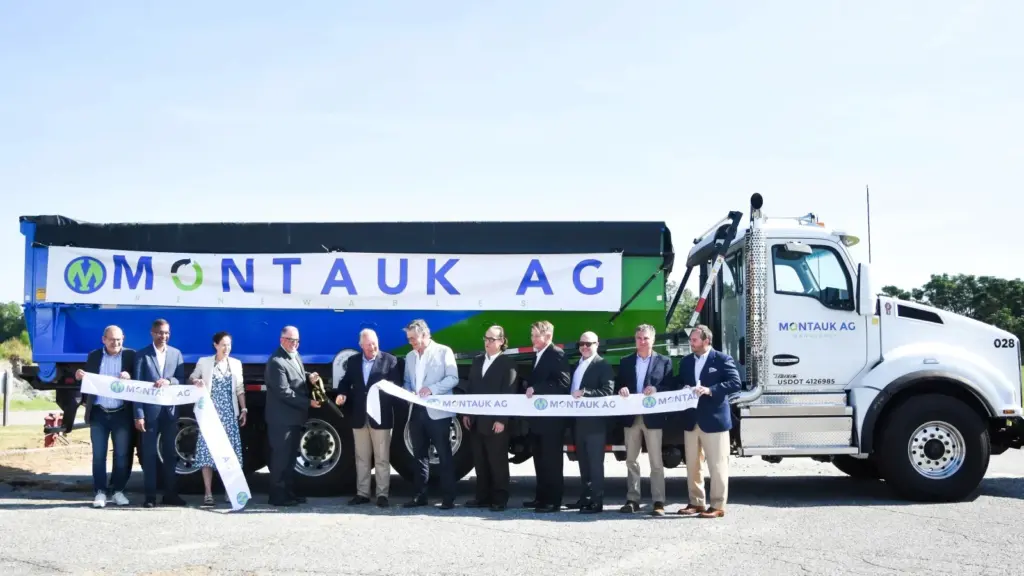
In one of the most capital-intensive agricultural biogas deployments of the year, executives from Montauk Renewables joined local dignitaries on September 15, 2026, to celebrate the official opening of a massive anaerobic digestion facility in Turkey, North Carolina. Montauk poured approximately $200 million into the project, which is designed to capture agricultural methane from swine manure to generate baseload electricity.
According to statements from Montauk Renewables CEO Sean McClain and the company’s 2025 annual report, the facility operates under long-term supply agreements spanning more than 80 individual farming locations in the region. To secure project economics, Montauk established a 10-year power purchase agreement alongside a secondary agreement with Duke Energy to sell roughly one-third of the facility’s generated renewable energy certificates (RECs). At maximum operational capacity, the Turkey facility is expected to pump out up to 41 megawatt-hours of electric power annually, while simultaneously churning out 870 tons of high-grade organic fertilizer alternatives per year—exemplifying a closed-loop nutrient recovery model.
Mid-September: Waga Energy Secures Major LRS Contract in Illinois
Continuing its aggressive North American expansion, Waga Energy scored a major procurement victory on September 15, 2026, when Chicago-area waste management giant LRS selected the firm to construct, own, and operate a high-efficiency RNG facility at the Eco-Hill Landfill in Atkinson, Illinois. The Eco-Hill site holds strategic importance for LRS as its sole owned landfill asset serving the greater Chicago metropolitan market.
The incoming facility is slated for an initial processing capacity of 3,000 standard cubic feet per minute, with projected annual RNG yields reaching up to 610,000 mmBtus. LRS will participate directly in the revenue generated from the commercial sale of the RNG produced on-site. Construction timelines place the commercial launch of the Eco-Hill facility in 2028, further entrenching Waga’s proprietary "Wagabox" upgrading technology within the U.S. waste infrastructure network.
Mid-September: Opal Fuels Renews Long-Term San Diego Agreement
Solidifying its footprint in municipal partnerships, Opal Fuels announced on September 16, 2026, the successful five-year renewal of its operating agreement with the City of San Diego. Under the renewed contract, Opal will continue managing and operating the landmark landfill-gas-to-energy project at the Miramar Landfill. Originally commissioned in 1998, the Miramar facility is a cornerstone of municipal renewable generation, converting captured methane into approximately 400,000 megawatt-hours of electricity annually.
This municipal renewal followed on the heels of an expansion completed in late August 2026 at Opal’s compressed natural gas (CNG) fueling station in Goshen, California. Following comprehensive engineering upgrades, Opal expanded the facility’s capacity by 1.7 million gasoline gallon equivalents (GGE) annually, incorporating renewable natural gas into the supply mix. These initiatives form a core component of Opal’s aggressive capital deployment strategy, which saw the company sink $52.7 million into its broader project portfolio through the first half of 2026.
Supporting Context & Metrics: The Wastewater Digestion Landscape
While agricultural and landfill projects command significant headlines, the American Biogas Council’s (ABC) 2026 Wastewater Report underscores that wastewater treatment plants (WWTPs) remain the foundational backbone of the North American biogas sector.
Wastewater Dominance in Biogas Infrastructure
WWTPs were the earliest pioneers of anaerobic digestion technology, utilizing engineered biological processes to stabilize municipal sludge while generating combustible biogas as a beneficial byproduct. According to the ABC report, released in September 2026, wastewater facilities operate 47% of all anaerobic digesters installed across the United States.
Since 2020, the sector has maintained steady organic growth, with 29 new wastewater-based digestion facilities coming online nationwide, bringing the national total to 1,213 active plants.
Untapped Potential and Expansion Economics
Industry analysts look to flow rates as the primary metric for project feasibility. Wastewater treatment plants processing a flow rate of at least 1 million gallons per day (MGD) are generally considered prime candidates for anaerobic digestion. However, the ABC report reveals that only 24% of qualifying facilities currently operate digesters.
This gap points to a massive runway for sector expansion. According to ABC Executive Director Patrick Serfass, the remaining unexploited facilities represent an opportunity to dramatically scale up national biogas production.
"Our survey shows there are opportunities to do more — by expanding anaerobic digestion where it makes sense and getting more value from the digesters already in place," Serfass noted in an official statement accompanying the report.
Currently, wastewater digesters capture in excess of 100 billion cubic feet of biogas annually. ABC modeling indicates that if the remaining qualifying municipal facilities were to adopt anaerobic digestion, the sector could capture an additional 70 billion cubic feet of biogas per year, substantially increasing domestic renewable energy supplies.
Technological Evolution: Beyond Power Generation
The operational profile of wastewater digesters is undergoing a profound structural evolution. Historically, WWTP digesters focused almost exclusively on combined heat and power (CHP) configurations to offset facility energy costs. However, data compiled since 2018 indicates a pronounced shift toward advanced monetization pathways:
- RNG Upgrading: An increasing number of plants are installing pressure swing adsorption, water scrubbing, or membrane separation systems to upgrade raw biogas into pipeline-compatible RNG.
- Co-digestion: Facilities are increasingly accepting high-strength organic wastes (such as food waste, fats, oils, and grease) alongside municipal wastewater sludge. Co-digestion supercharges biogas yields while generating lucrative tipping fee revenues for municipalities.
Environmental Credit Markets & Financial Snapshot
The financial health of the biogas and RNG industry remains tightly tethered to environmental credit pricing mechanisms and corporate balance sheets.
Credit Pricing Snapshot (As of October 7, 2026)
Regulatory credit markets provide the vital revenue stacking necessary to offset high capital expenditure costs for RNG projects:
- D3 RIN Prices (Cellulosic Biofuel): Trading at $2.294, experiencing a slight contraction from $2.380 in 2025. Despite the dip, D3 RINs remain a primary driver of project profitability for landfill and wastewater RNG producers.
- D5 RIN Prices (Advanced Biofuel): Trading at $2.085, marking a marginal increase from $2.060 in 2025.
- Oregon Clean Fuels Program (CFP): Priced at $81 per metric ton of carbon dioxide equivalent, incentivizing low-carbon fuel distribution in the Pacific Northwest.
- California Low Carbon Fuel Standard (LCFS): Priced at $88 per metric ton of carbon dioxide equivalent. California’s LCFS market remains a bellwether for national transportation fuel decarbonization strategies, rewarding projects with low carbon intensity scores.
Corporate Financial Health
Publicly traded biogas firms demonstrated resilience through mid-2026 financial disclosures:
- Montauk Renewables: Reported second-quarter revenue of $54 million, representing a robust 19.7% year-over-year increase. RNG production for the quarter reached 1.5 million mmBtus, up 3% compared to the same period in 2025.
- Opal Fuels: Posted a 4% year-over-year revenue increase in its second-quarter report released in August. For the first half of 2026, Opal’s total RNG production hit 2.4 million mmBtus, representing a 6% year-over-year volume expansion despite minor downward revenue adjustments across its broader energy portfolio.
Official Statements and Industry Insights
The convergence of regulatory shifts, technological enhancements, and municipal infrastructure demands has elicited strong commentary from industry leaders.
Patrick Serfass, Executive Director of the American Biogas Council:
"The data is clear: wastewater treatment facilities laid the groundwork for our industry decades ago, yet we have barely scratched the surface of their full economic and environmental potential. By optimizing existing digesters and deploying proven technology to the remaining 76% of qualifying plants, municipalities can transform waste liabilities into localized energy independence."
Sean McClain, CEO of Montauk Renewables (via shareholder communications regarding the Turkey, N.C. facility):
"Our long-term agreements with over 80 farming partners demonstrate that agricultural biogas is transitioning from a niche endeavor to an institutionalized component of the rural energy economy. By aligning waste management with utility-scale power off-takers like Duke Energy, we are delivering predictable, long-term cash flows while addressing complex agricultural runoff challenges."
Future Outlook
As the biogas industry looks toward the late 2020s, the strategic landscape is undergoing a definitive maturation phase. The initial gold rush of landfill-gas-to-RNG commitments made by major waste corporations is nearing completion, prompting developers to pivot toward sophisticated end-uses, complex co-digestion matrices, and localized microgrids.
Moving forward, several trends will dictate the sector’s trajectory:
- Municipal Infrastructure Integration: With municipal wastewater treatment plants operating under tighter carbon reduction mandates, federal funding and public-private partnerships (PPPs) will likely accelerate the adoption of anaerobic digestion among the unserved 76% of qualifying U.S. plants.
- Agricultural Diversification: Projects like Montauk’s North Carolina swine waste facility establish blueprints for handling concentrated animal feeding operation (CAFO) emissions, a major target for federal methane mitigation initiatives.
- Regulatory Adaptation: As LCFS and RIN markets adjust to shifting administration policies and supply-demand dynamics, developers will increasingly rely on carbon intensity (CI) score optimization to protect project margins.
In summary, the American biogas sector is successfully transitioning from a nascent waste-management auxiliary into an essential pillar of the nation’s clean energy infrastructure. Backed by billions in private capital, proven municipal assets, and expanding technological capabilities, biogas and RNG are poised to play an indispensable role in the future of North American energy production.



