In a revealing demonstration of how economic policy arguments can be compromised by mathematical error, a flagship policy booklet published by the UK Conservative Party has been found to present a wildly inaccurate cost for the nation’s net-zero transition. The policy document, titled The Right Way, asserts that the UK’s official independent adviser, the Climate Change Committee (CCC), had estimated the price tag of reaching net-zero greenhouse gas emissions at nearly £1 trillion—specifically £957 billion.
However, an analysis of the underlying data reveals that this central economic claim is off by exactly 100%. The CCC’s actual 2020 baseline net cost estimate was £478 billion over 30 years. The bloated £957 billion figure stems from an elementary spreadsheet blunder originating in a third-party think tank report, wherein annual expenditure totals were inadvertently added to their constituent category lines, double-counting the entire fiscal burden.
To compound the discrepancy, the Conservative publication relies on outdated 2020 estimates while disregarding the CCC’s dramatically reduced 2025 projections. Driven by rapid cost deflations in clean technology—most notably electric vehicles (EVs) and renewable energy generation—the official net cost forecast for achieving net-zero by 2050 has been revised downward to just £108 billion, representing less than 0.2% of projected UK gross domestic product (GDP).
The error arrives at an awkward moment for the opposition party. The Right Way frames its platform around policy competence, arguing that citizens demand a government capable of solving complex problems without over-relying on "sophisticated modeling." Instead, the inclusion of a double-counted spreadsheet figure highlights the fragile nature of economic arguments circulating within the UK climate policy discourse and raises pressing questions about data verification in high-level political manifestos.
Detailed Chronology: The Paper Trail of a Mathematical Misstep
To understand how a basic arithmetic mistake made its way into the official policy literature of a major UK political party, one must trace a paper trail stretching from government data releases to right-leaning commentariat blogs and think tanks.
+-----------------------------------------------------------------------------------+
| CHRONOLOGY OF A SPREADSHEET ERROR                                                 |
+-----------------------------------------------------------------------------------+
| Dec 2020 : CCC publishes Sixth Carbon Budget data (£478bn net cost).              |
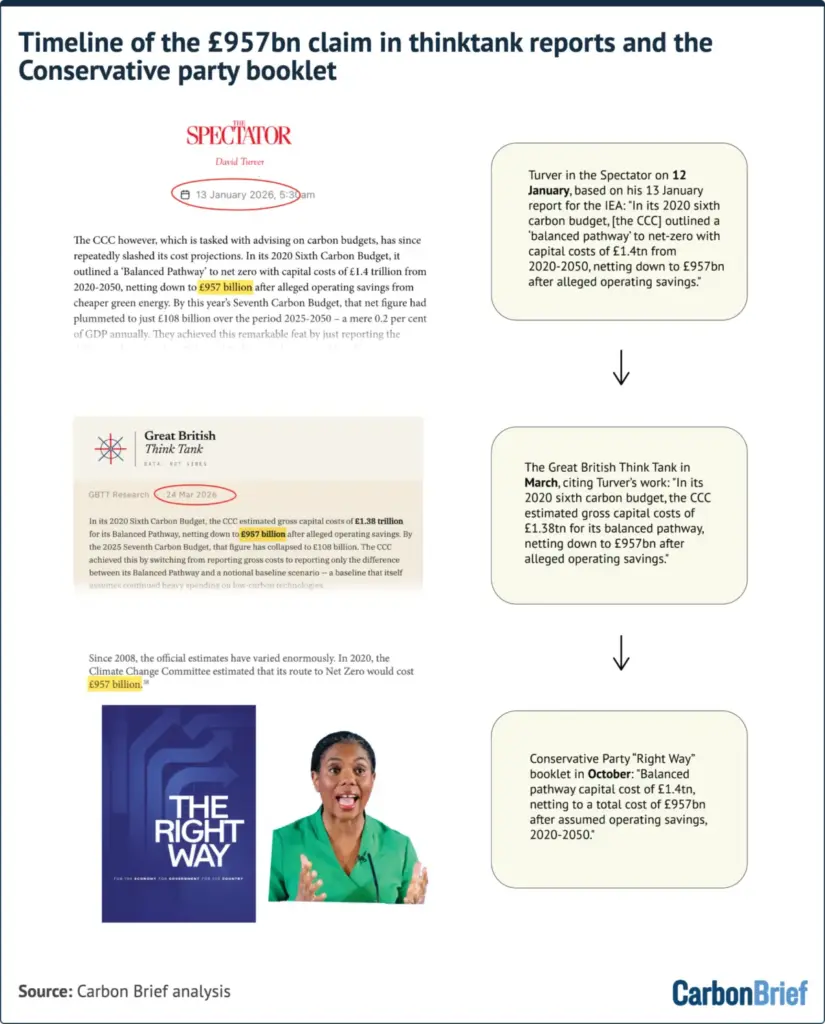
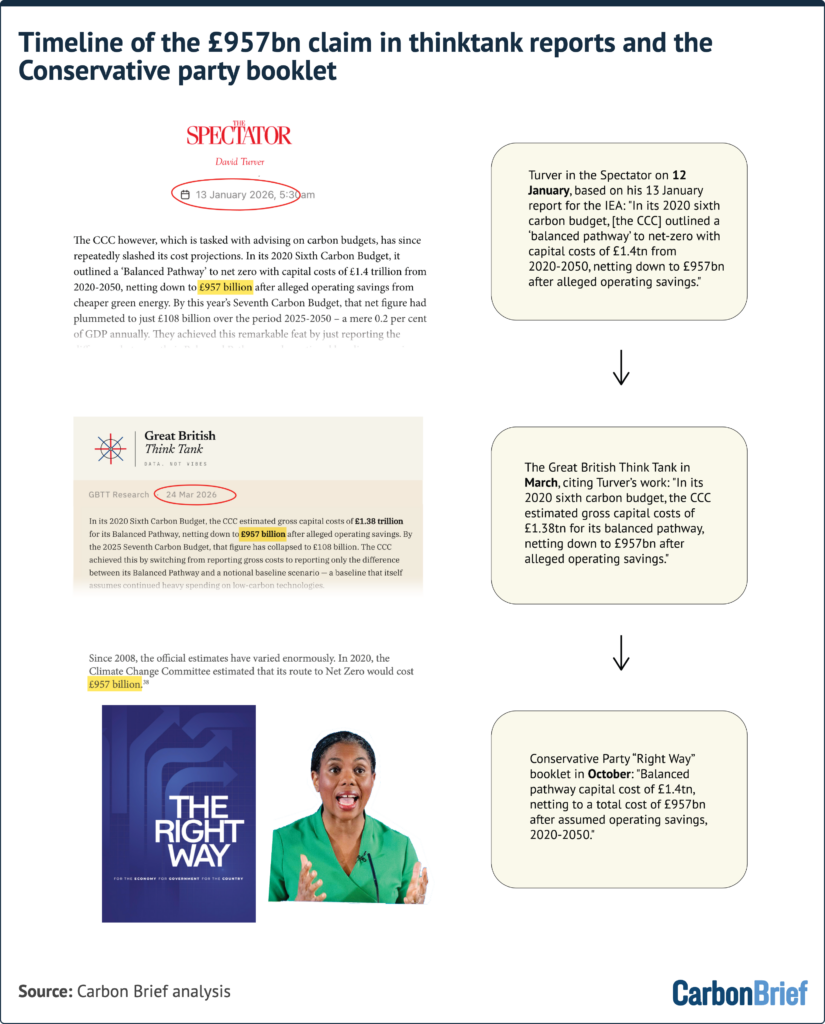
| Jan 12, 2026: David Turver publishes article in The Spectator (£957bn claim).     |
| Jan 13, 2026: Turver authors IEA report repeating £957bn & generating £7.6tn+ headline|
| Mar 2026 : Great British Think Tank repeats £957bn under "data, not vibes" mandate|
| Oct 2026 : Conservative Party publishes "The Right Way" including £957bn claim    |
+-----------------------------------------------------------------------------------+
December 2020: The CCC Baseline Dataset
In December 2020, the Climate Change Committee published its seminal advice on the UK’s Sixth Carbon Budget, setting out a technical roadmap for reaching net-zero by 2050. Accompanied by extensive data workbooks, the CCC provided an itemized breakdown of additional capital expenditure (CAPEX) alongside operational expenditure savings (OPEX).
Total Additional CAPEX (2020–2050): £1.38 trillion (investments in grid expansion, insulation, heat pumps, EV charging, and zero-carbon power generation).
Total Operational Savings (2020–2050): £0.90 trillion (reduced fossil fuel imports, lower maintenance, and superior energy efficiency).
True Net Cost:£478 billion (CAPEX minus OPEX over 30 years).
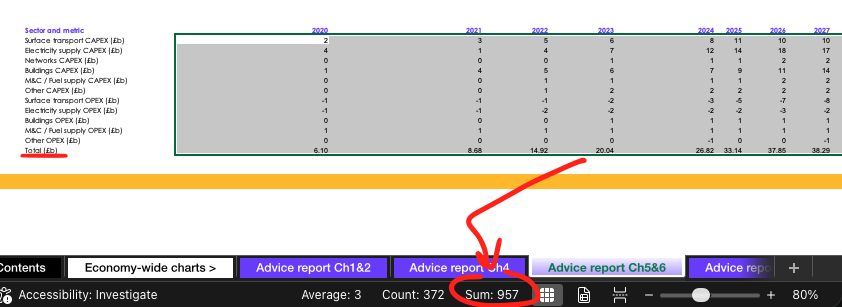
Within the CCC’s publicly accessible Excel spreadsheet (The-Sixth-Carbon-Budget-Charts-and-data-in-the-report.xlsb), the data table listed both the sector-by-sector annual figures and a dedicated "Total" row aggregating combined annual costs.
January 2026: The Initial Double-Counting Event
On January 12, 2026, David Turver, a retired engineer and self-described "accidental energy analyst," published an article in The Spectator questioning the financial viability of net-zero. A day later, on January 13, Turver authored a report published by the free-market think tank, the Institute of Economic Affairs (IEA).
In analyzing Figure 5.3 of the CCC’s 2020 dataset, Turver attempted to recalculate the cumulative figures. However, rather than summing the sector line items or taking the pre-calculated annual summary row, he inadvertently selected both simultaneously. By applying a standard =SUM() function across a range that contained both the broken-down inputs and the calculated totals, every single cost and saving was counted twice:
$$textErroneous Total = 2 times (textCAPEX – textOPEX) = 2 times £478textbn = £957textbn$$
The IEA publication amplified this mistake further, asserting headline gross figures ranging from £7.6 trillion to £9.0 trillion. These extraordinary numbers were constructed by making implicit baseline assumptions—such as treating all future fossil fuel supplies, traditional gas boilers, and internal combustion engine vehicles as if they were entirely cost-free to purchase and fuel over the next three decades.
March 2026: The Think-Tank Echo Chamber
Rather than being identified and rectified through peer review, the erroneous £957 billion figure entered wider conservative policy circles. In March 2026, the figure was cited by the "Great British Think Tank." Ironically, the group operates under the public slogan "data, not vibes" and claims that every figure in its work is "sourced directly from official public bodies." The organization repeated the £957 billion sum as definitive proof of the CCC’s alleged underestimation of transition costs.
October 2026: Institutional Adoption in The Right Way
By October 2026, the phantom number reached the top tier of UK political discourse. The Conservative Party formally published The Right Way, an official strategy booklet meant to chart a sensible, pragmatic opposition platform. In a chapter dedicated to questioning climate modeling and advocating for "political judgment" over technical forecasting, the authors explicitly wrote:
"In 2020, the CCC estimated that its route to net-zero would cost £957bn."
With that single sentence, a six-year-old spreadsheet calculation mistake completed its journey from a personal blog post to formal political dogma.
Supporting Context & Metrics: The Real Economics of Net-Zero
The publication of the doubled cost figure masks a far more dynamic underlying reality: the cost of achieving net-zero in the United Kingdom has dropped significantly since the CCC first drew up its Sixth Carbon Budget pathways in 2020.
The Shift in Net Costs (2020 vs. 2025/2026 Revisions)
When the CCC updated its comprehensive modeling framework in 2025, it incorporated real-world market trends from the preceding five years. The updated figures radically altered the long-term financial trajectory of the UK’s energy transition.
Metric
CCC 2020 Baseline (2020–2050)
CCC 2025 Revised Model (2025–2050)
Conservative Pamphlet Claim
Additional Capital Spending (CAPEX)
£1.38 Trillion
£670 Billion
Not Separated
Operational Fuel/Maintenance Savings (OPEX)
£0.90 Trillion
£562 Billion
Not Separated
Net Financial Cost over Period
£478 Billion
£108 Billion
£957 Billion(Double-Counted)
Cost as % of 30-Year GDP
~0.9%
< 0.2%
~1.8%
Technological Drivers of Cost Reduction
The dramatic collapse in net transition costs—from £478 billion down to £108 billion—is overwhelmingly attributable to structural market shifts across key decarbonization sectors:
Electric Vehicle Deflation: The capital cost of manufacturing EVs, particularly lithium-ion battery packs, has fallen at a rate exceeding the CCC’s early optimistic scenarios. Concurrently, operational savings have expanded. In the UK, total cost-of-ownership analyses show that driving an EV on off-peak grid electricity has become up to nine times cheaper per mile than operating an equivalent petrol or diesel vehicle.
Renewable Generation Efficiency: Offshore wind and utility-scale solar installations have maintained low marginal operational costs, insubordinating expensive open-cycle gas turbines (CCGTs) from the daily price-setting stack.
Macroeconomic Fuel Shock Protection: In the wake of global energy crises caused by international supply disruption, domestic clean power generation serves as an economic hedge. The CCC’s updated modeling shows that achieving net-zero protects the UK economy from international fossil fuel price spikes, providing systemic risk reduction valued at approximately £110 billion per year in avoided macroeconomic damages.
     Net Cost Estimates for UK Net-Zero Pathway (2020-2050/2025-2050)

  £1,000bn +---------------------------------------------------------+
           |                                                        |
    £800bn |                                 [£957bn]               |
           |                              Conservative Party        |
    £600bn |                                Pamphlet Claim          |
           |                               (Spreadsheet Error)      |
    £400bn |   [£478bn]                                             |
           |   CCC 2020                                             |
    £200bn |   Actual Net                                           |
           |                                           [£108bn]     |
       £0  +------------------------------------------- CCC 2025 ----+
               2020 Estimate                        Revised Model
Official Statements and Discrepancy Analysis
The Irony of the Political Narrative
The inclusion of an unverified spreadsheet error creates a stark contrast between the text of The Right Way and its real-world execution. The Conservative policy document relies on a central premise:
"What people ultimately want is a government competent enough to solve the problems for which it takes responsibility… sophisticated modeling should not be a substitute for political judgment."
Yet, by adopting the £957 billion figure without auditing its primary sources, the authors fell prey to the very problem they sought to criticize: accepting secondary quantitative claims without exercising basic judgment or empirical verification.
Institutional Responses
The Climate Change Committee: While the CCC traditionally refrains from commenting directly on partisan political publications, official committee communications have repeatedly clarified their financial accounting metrics. Representatives from the CCC confirmed that at no point in their 2020 Sixth Carbon Budget documentation did net costs approach £1 trillion, re-emphasizing that net-zero represents a net investment strategy that delivers long-term operational savings and an estimated 2% net expansion of UK GDP over the baseline.
Energy Economists & Analysts: Independent energy research firms have expressed concern over the persistent propagation of double-counted figures. Leading energy economists noted that mistaking gross capital outlay for net economic cost—and then doubling that figure through a spreadsheet addition error—distorts national discourse over grid decarbonization, industrial policy, and household heating costs.
The Broader Ecosystem of Policy Misinformation
This spreadsheet error is not an isolated incident within the UK’s broader climate politics. Analytical reviews of political campaign literature across the spectrum have identified a growing trend of misquoting primary economic sources. Recent fact-checking exercises aimed at political parties, such as Reform UK, revealed over 40 false or misleading claims regarding grid stability, wind farm subsidies, and EV running costs circulating in mainstream public debates.
The quick adoption of Turver’s double-counted metric demonstrates how easily dubious data points can pass through ideologically aligned policy networks—moving from a personal analysis to think-tank white papers and finally into official opposition manifestos—without undergoing basic quantitative verification.
Future Outlook: Misinformation and the Policy Landscape
The exposure of the £957 billion spreadsheet error carries broader implications for UK economic planning and climate diplomacy as the nation approaches future budget cycles.
1. Risk to Private Capital Allocation
The primary engine of the net-zero transition is private sector investment. Over 80% of the required £670 billion capital spending outlined in the CCC’s updated plan must come from commercial funds, institutional infrastructure investors, and private energy developers. When major political parties rely on inflated, double-counted cost estimates, it creates political risk, signaling potential policy reversals or legislative hostility toward clean-tech subsidies and grid connections.
2. Mandatory Fact-Checking for Strategic Documents
This oversight is likely to prompt calls for stricter, non-partisan oversight of financial figures included in official policy booklets and opposition green papers. Just as government budgets are audited by the Office for Budget Responsibility (OBR), political parties may face mounting pressure from research institutions and the electorate to submit their statutory strategy papers to independent verification bodies before publication.
3. Re-Anchoring the Debate on Real Execution Challenges
Beyond the political fallout over basic arithmetic, energy experts emphasize that the nation cannot afford to spend time debating fabricated figures. The true economic challenges of net-zero do not lie in fictitious £1 trillion price tags, but in the practical mechanics of implementation:
Streamlining planning permission for high-voltage transmission lines.
Scaling up the domestic supply chain for heat pump installation.
Mitigating localized grid congestion.
Managing aviation sector emissions—where expansions, such as those proposed at Heathrow Airport, threaten to consume up to 80% of the UK’s remaining 2050 carbon budget unless zero-emission fuels scale rapidly.
As the UK navigates its decarbonization trajectory, the political debate will require greater precision. Moving past spreadsheet errors toward verified empirical data will be essential if policymakers hope to maintain public trust while delivering a stable, cost-effective transition to a net-zero economy.