As the global community confronts the compounding crises of rapid climate change and severe biodiversity loss, the scientific world is increasingly looking backward to move forward. Historical baselines—meticulously recorded by naturalists centuries ago—offer irreplaceable data points that map how ecosystems have shifted in response to anthropogenic pressures. For two decades, the Biodiversity Heritage Library (BHL) has stood at the vanguard of this archival resurrection. Celebrating its 20th anniversary, the BHL has expanded into the world’s largest open-access digital library for biodiversity literature and archives, housing an astonishing corpus of over 64 million pages.
Yet, vast digital stacks alone cannot save species. Hidden within these millions of historical pages lie unstructured, handwritten troves of biodiversity data: population counts, migration dates, micro-habitat observations, and species occurrences scribbled in margins and field journals. Extracting this analog intelligence has historically been a monumental bottleneck for researchers.
Enter a groundbreaking pilot initiative at Harvard University’s Ernst Mayr Library (EML) of the Museum of Comparative Zoology (MCZ). By merging the digitization power of the Harvard Library Collections Digitization Program with cutting-edge artificial intelligence, the EML has successfully transcribed over 2,200 pages of rare, mid-to-late 19th- and early 20th-century ornithological field notes authored by Harvard zoologist and curator Walter Faxon. Spearheaded by 2026 Pforzheimer Fellow Mohit Mandal, this project illuminates both the profound potential and the current limitations of AI-driven transcription, paving the way for these historical observations to feed directly into the Global Biodiversity Information Facility (GBIF). This initiative represents a vital technological bridge, transforming brittle historical manuscripts into actionable data to inform modern conservation science.
Detailed Chronology: From 19th-Century Fieldwork to 21st-Century AI
To understand the weight of the Faxon collection, one must trace its origins across more than a century of scientific evolution, institutional stewardship, and technological innovation.
The Life and Observational Rigor of Walter Faxon (1848–1920)
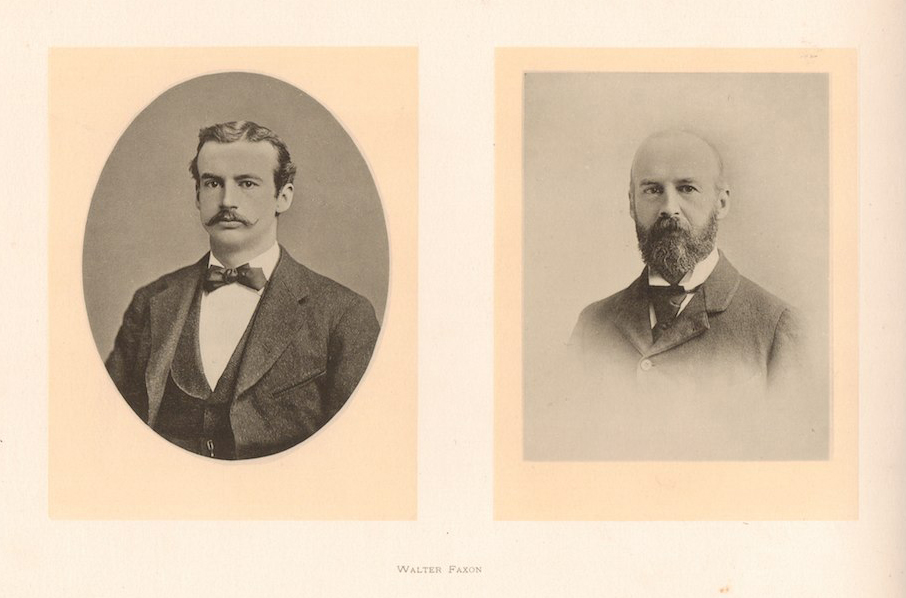
Born in Massachusetts on February 4, 1848, Walter Faxon established himself as a premier American zoologist. Serving as an Assistant Professor of Zoology at Harvard University from 1872 to 1886, Faxon dedicated an astonishing 46 years (1874–1920) as the Curator of the Invertebrate Department at Harvard’s Museum of Comparative Zoology, focusing his professional career on Crustacea and Mollusca.
However, ornithology was Faxon’s lifelong avocation—one he pursued with the exact methodological rigor of a professional taxonomist. A Fellow of the American Ornithologists’ Union, Faxon spent nearly 60 years in the field. Contemporaries noted that his sharp senses, combined with an obsessive caution against making errors, made him one of the most reliable field ornithologists of his era. When Faxon identified a bird, his record was never questioned.
The Accumulation of Data (1886–1919)
Spanning 33 years, Faxon’s accumulated field journals, bird lists, and notebooks (totaling 1,640 pages) captured thousands of localized bird observations. Each entry recorded species names, dates, localities, and population counts, frequently annotated with details regarding sex, life stage, and vocalizations. These records were not merely pleasant nature diaries; they were hyper-local ecological censuses of New England’s avifauna during a period of accelerating industrialization and habitat modification.
Digitization and Fellowship Implementation (2025–2026)
2025: Supported by the Harvard Library Collections Digitization Program under its designated Climate Change theme, the Ernst Mayr Library digitized the entire Faxon manuscript collection, integrating it into digital workflows designed to expose hidden archival content.
June 1 – August 31, 2026: Mohit Mandal, a Harvard PhD candidate in Anthropology, stepped into the role of the 2026 Pforzheimer Fellow at EML. Tasked with unlocking the text of Faxon’s manuscripts, Mandal initiated a comparative evaluation of leading generative AI platforms, including OpenAI’s ChatGPT and Google Gemini.
Late August 2026: Mandal successfully completed the transcription of nearly 2,000 manuscript pages. Utilizing a multi-model validation pipeline—initial transcript generation via ChatGPT followed by cross-verification using Anthropic’s Claude—Mandal achieved unprecedented text capture, readying the data for integration into the BHL book viewer and subsequent export to GBIF.
Supporting Context & Metrics: The Scale of the Enterprise
Evaluating the success of the Faxon transcription project requires examining both the quantitative scope of the materials and the technical metrics of the AI integration process.
Collection Dimensions
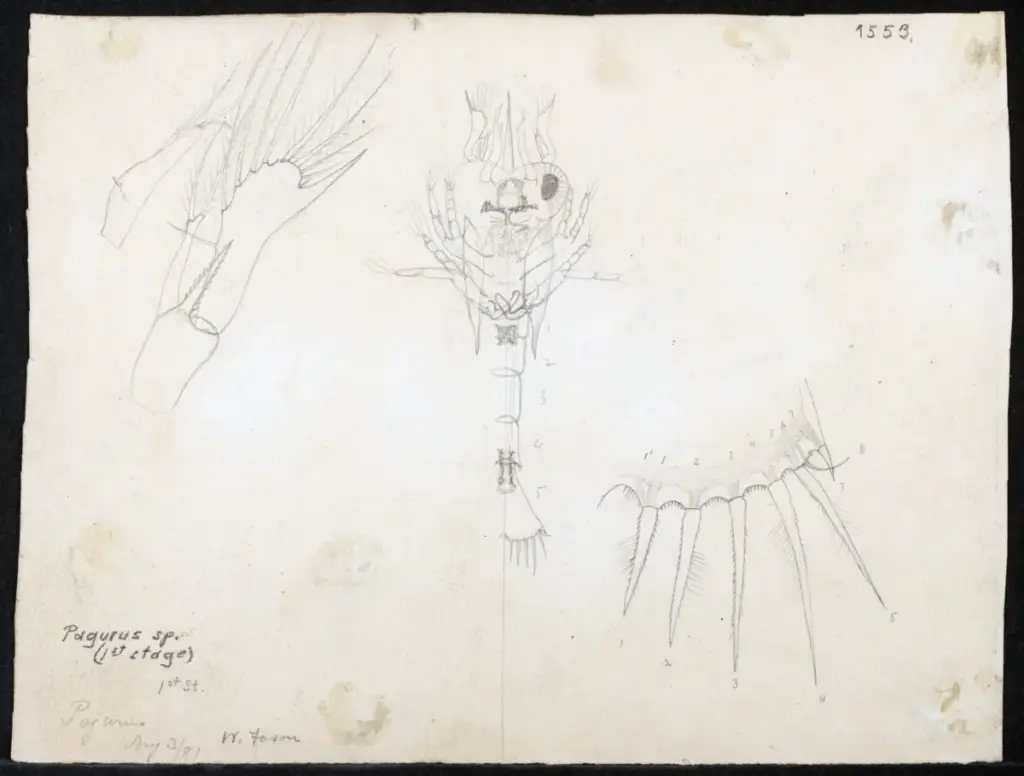
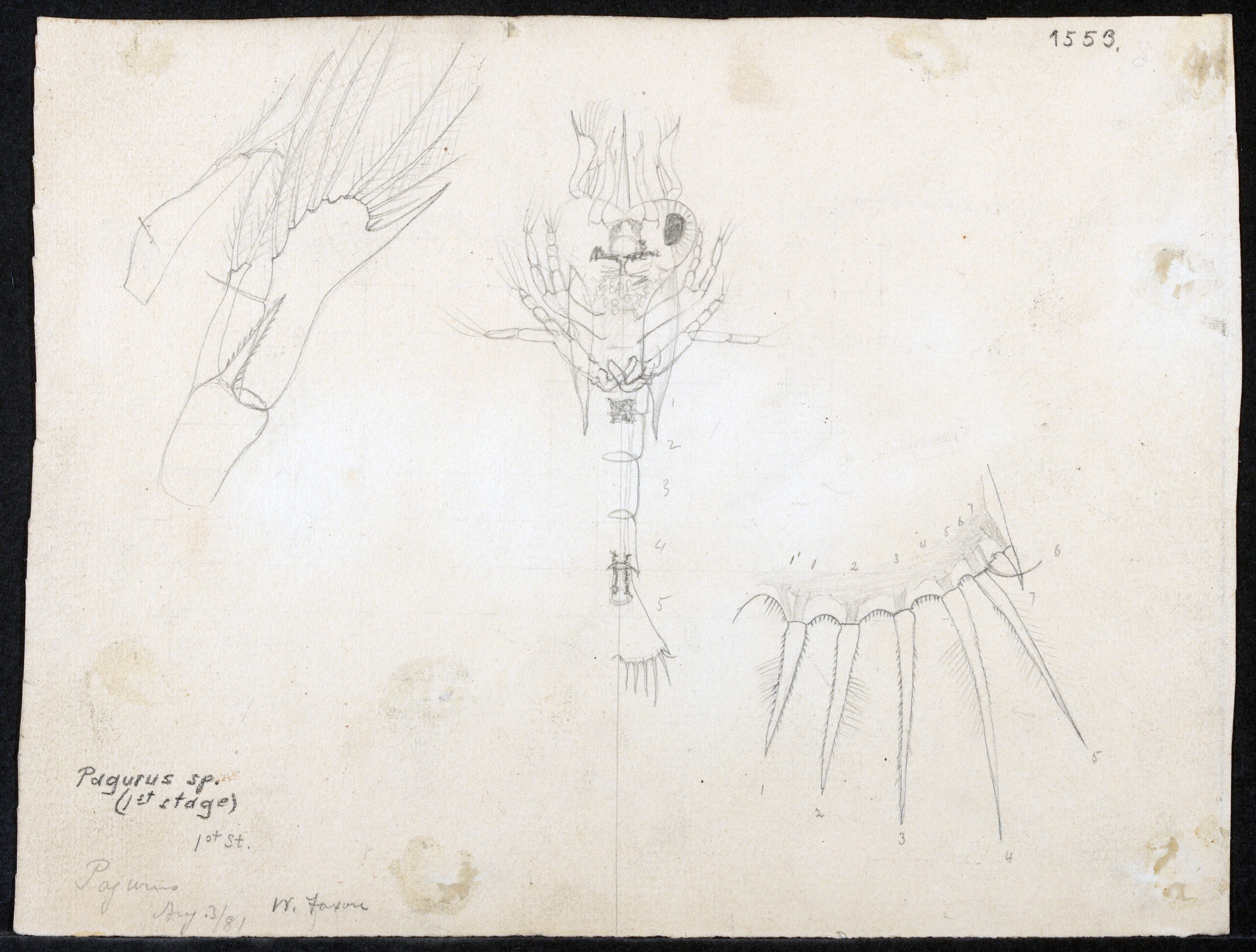
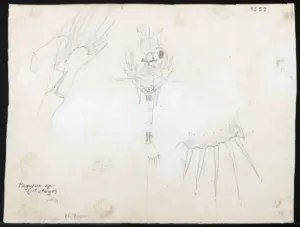
Total Manuscript Pages: ~2,200 pages, encompassing field journals, bird lists, field notebooks, correspondence, and eight detailed pencil drawings of Arthropoda and Crustacea.
Ornithological Observations: 1,640 pages dedicated specifically to bird tracking spanning 1886 to 1919.
Archival Networks: Alongside Faxon’s personal papers, the EML houses the extensive collection of William Brewster’s papers, which includes 145 critical pieces of correspondence exchanged between Brewster and Faxon, offering valuable peer-validation of their field observations.
Exceptional raw optical character recognition (OCR) and handwriting accuracy.
Constrained file upload limits; rigid ecosystem integration (restricted to Google Workspace).
Evaluated; runner-up.
OpenAI ChatGPT
Highly flexible conversational prompting; easily trained and fine-tuned for specialized formatting rules.
Prone to occasional text "hallucinations" on difficult cursive or marginalia.
Primary transcription engine.
Anthropic Claude
Superior contextual cross-referencing and editorial nuance.
Used sequentially rather than concurrently for primary ingestion.
Secondary validation engine.
Technical Challenges in Manuscript Transcription
Translating 19th-century cursive and field shorthand into clean digital text presented several classic archival hurdles alongside novel technological roadblocks:
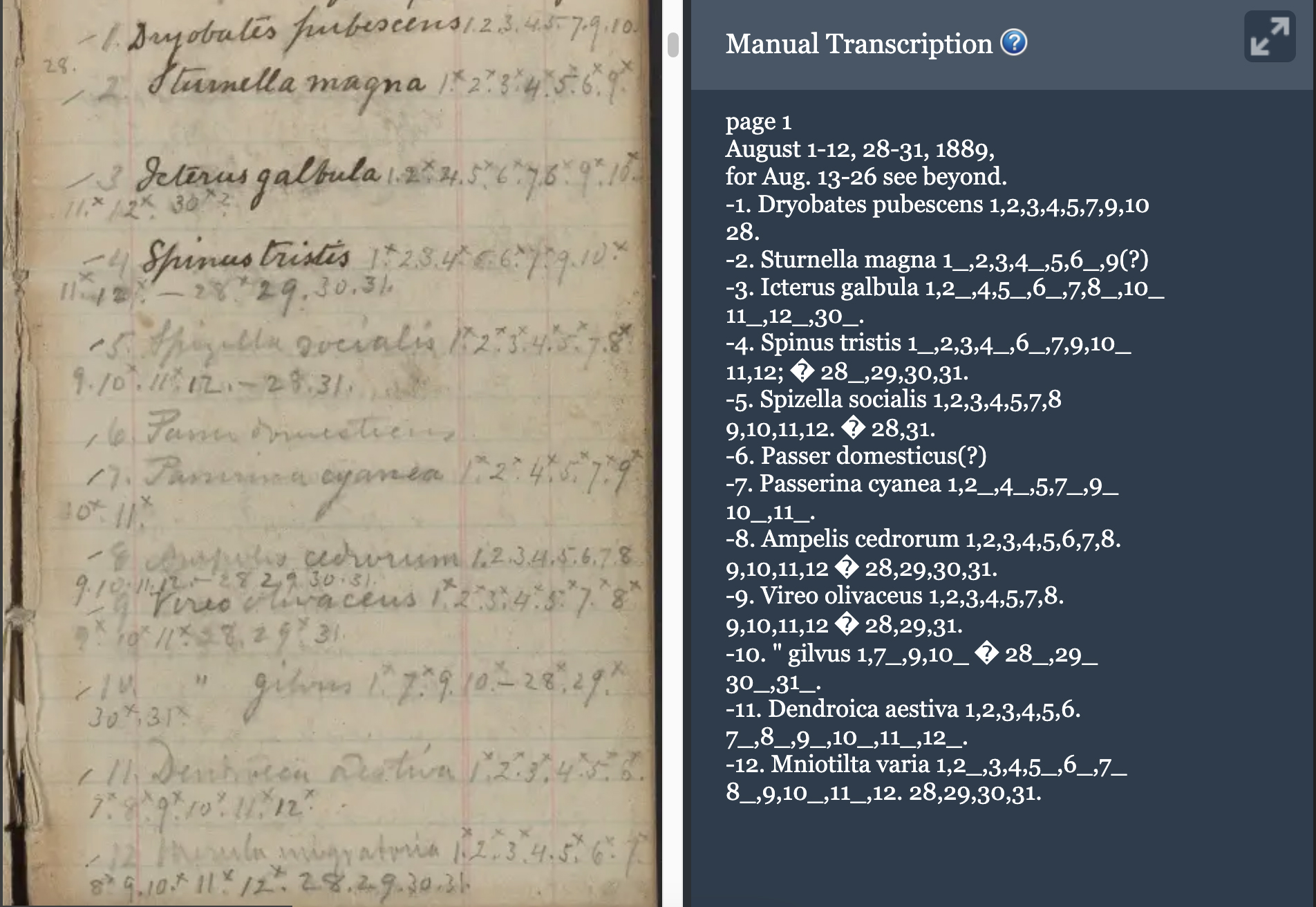
Faded Media and Smudges: Pencil-written notes, subject to decades of physical handling, exhibited severe smudging that confounded basic automated text extraction.
Marginalia and Angled Text: Notes scrawled vertically or diagonally along page margins were frequently ignored or missequenced by standard line-reading algorithms.
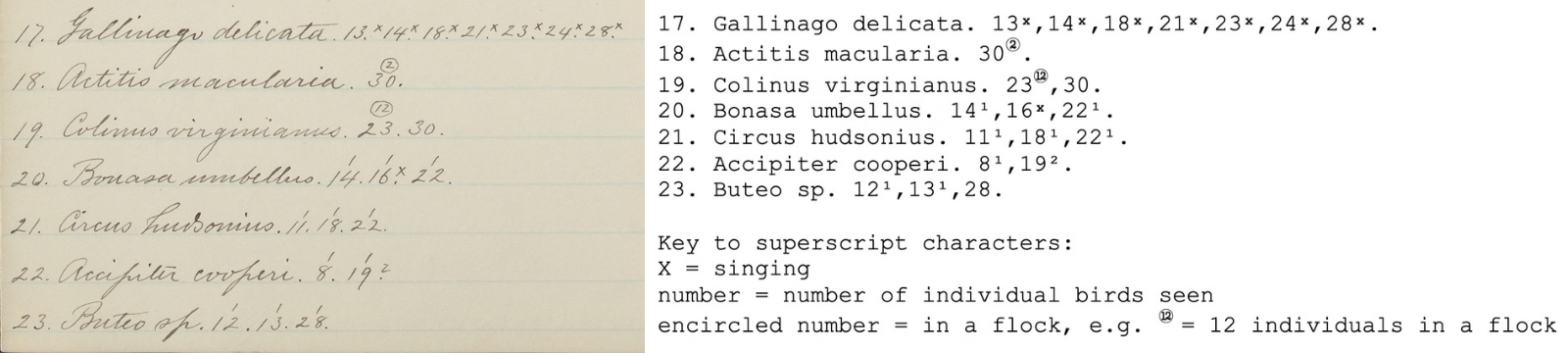
Interlinear Notation: One of Faxon’s signature habits was writing tiny numbers and symbols between the primary lines of text to denote flock sizes, singing behavior, or specific behavioral codes. Standard word processing environments (like Microsoft Word or Google Docs) struggled to maintain these vertical constraints, frequently dropping or misplacing the data. Mandal ultimately solved this by training ChatGPT to systematically format these annotations as superscript text.
Official Statements and Expert Insights
Reflecting on the completion of the fellowship and the broader implications of the project, project leaders and institutional stakeholders emphasized the irreplaceable synergy between human expertise and machine intelligence.
Joseph deVeer, Digital Projects Manager at the Ernst Mayr Library and Co-Secretary of the BHL Executive Committee, underscored the long-term vision of the repository:
"For 20 years, BHL has made biodiversity knowledge freely accessible to the world. Your support helps us preserve treasures like Walter Faxon’s field journals and unlock the valuable biodiversity data they contain."
Reflecting on the methodological lessons learned during the three-month fellowship, Pforzheimer Fellow Mohit Mandal emphasized the necessity of human oversight in computational archive projects:
"The human element remains central to guide the goals and direction of the project, without which A.I. tools—at least at this stage of their development—often falter in accuracy, especially when handling complex page layouts and difficult handwriting."
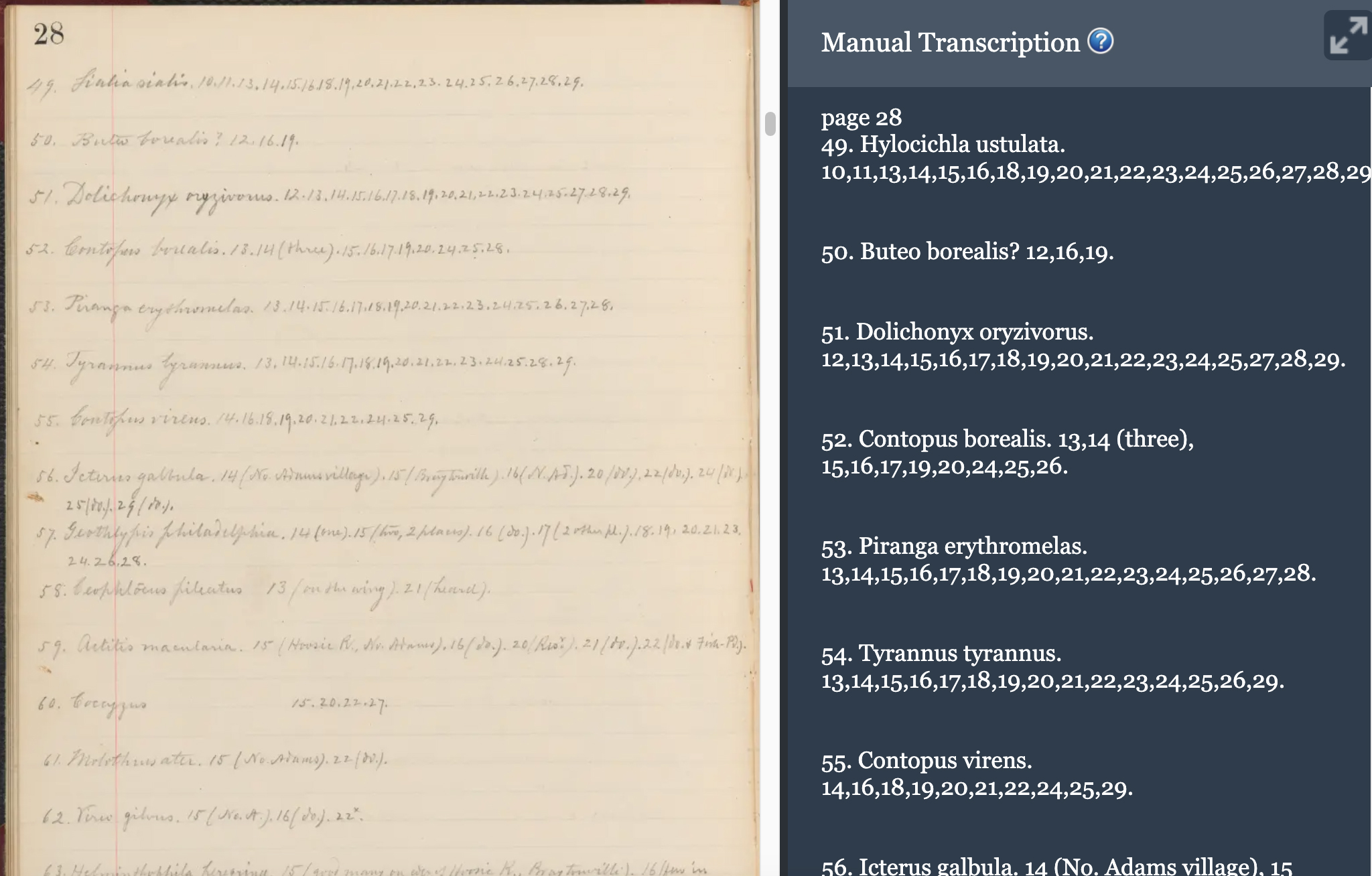
Mandal pointed to instances where advanced models, such as ChatGPT-5.5 Pro and Thinking variants, suffered from occasional semantic "hallucinations"—for instance, transcribing Faxon’s handwritten Sialia sialis (Eastern Bluebird) as Hylocichla ustulata (Swainson’s Thrush), or Merula migratoria (American Robin) as Mniotilta varia (Black-and-white Warbler). These errors highlight why human-in-the-loop verification remains non-negotiable when preparing historical scientific data for ecological modeling.
Future Outlook: From BHL to GBIF and Global Conservation
The successful transcription of Walter Faxon’s ornithological records marks much more than an archival milestone for Harvard University; it serves as a blueprint for global biodiversity data rescue.
Feeding the Global Biodiversity Information Facility (GBIF)
The ultimate destination for data trapped in historical notebooks is aggregation within global data-sharing networks like GBIF. By structuring Faxon’s 33-year longitudinal dataset into machine-readable formats, the EML is enabling researchers anywhere in the world to query historical species occurrences by precise geographic coordinates and temporal stamps. When combined with modern bird-monitoring datasets (such as eBird or Breeding Bird Surveys), these 19th-century baselines allow conservation biologists to quantify exactly how climate change, habitat fragmentation, and urbanization have altered migratory patterns, geographic ranges, and population densities over the last 150 years.
Next-Generation Platforms and Sustainable Archiving
As the Biodiversity Heritage Library prepares for its next architectural modernization phase, the integration of AI-assisted transcription tools will become increasingly automated. Lessons learned from handling Faxon’s interlinear notes, marginalia, and complex tabular bird lists will directly inform automated pipelines across other BHL partner institutions holding similar manuscript collections.
The convergence of historical naturalism and modern artificial intelligence demonstrates that the past is not merely a static monument to be preserved in glass cases, but an active, breathing reservoir of ecological truth. Through projects like the Faxon transcription initiative at Harvard’s Ernst Mayr Library, the silent observations of 19th-century naturalists are finding new voice—equipping 21st-century scientists with the historical depth required to understand and protect life on Earth.