

Executive Overview
In a landmark revelation that has sent shockwaves through the global mammalogy and conservation communities, scientists have officially described a brand-new species of wild cat: the tilcayo (Leopardus tilcayo). Hailing from the misty, rugged Yungas cloud forests of Bolivia, this tiny feline represents the first discovery of a living, novel cat species to be formally named and documented in over a hundred years. The last milestone of this magnitude occurred in 1923 with the description of the Uruguayan pampas cat (Leopardus fasciatus).
Weighing a mere 1.4 kilograms (about 3 pounds)—making it even smaller than the average domestic housecat—the tilcayo is characterized by its slender body, rounded ears, and a distinctive coat adorned with large, striking spots. Yet, beneath its unassuming and remarkably diminutive exterior lies an evolutionary titan. Genetic sequencing revealed that the tilcayo diverged from other South American tiger cat lineages approximately 1.4 million years ago—an evolutionary split that occurred long before modern humans diverged from Neanderthals.
The formal description of Leopardus tilcayo, published in the journal Current Biology, is the result of years of painstaking genetic detective work. Led by National Geographic Explorer Paola Nogales-Ascarrunz, a researcher at the Universidad Mayor de San Andrés in La Paz, the international research team dismantled the outdated "tiger cat" umbrella category (Leopardus tigrinus), which had long lumped several distinct South American felines into a single, confusing taxonomic group.
Crucially, the discovery hinged on an unlikely protagonist: a rescued kitten named Tigrino, kept unwittingly as a household pet by a Bolivian family before finding its way to a wildlife sanctuary. By honoring both cutting-edge molecular science and local indigenous knowledge—adopting the name "tilcayo" by which locals already whispered of its existence—this discovery bridges the gap between grassroots conservation and elite academic taxonomy, opening a fresh chapter in the study of Neotropical biodiversity.
Detailed Chronology: From a Backyard Stray to a Zoological Milestone
The path to uncovering the tilcayo reads like a classic modern conservation narrative, blending serendipity, rural folklore, and advanced biotechnology.
The Taxonomic Confusion of South America’s Small Cats
For decades, field biologists and taxonomists suspected that South America’s small, spotted felines—collectively referred to as tiger cats or oncillas—were far more complex than standard classifications suggested. Traditionally, these cats were grouped broadly under the species banner Leopardus tigrinus. However, differences in fur patterns, skull morphology, and patchy geographic distributions hinted that multiple cryptic species might be hiding in plain sight across the continent’s diverse biomes, ranging from Brazilian savannas to Andean cloud forests.
Researchers had long acknowledged the presence of an enigmatic small cat inhabiting the damp, high-altitude Yungas cloud forests of Bolivia. Yet, due to the dense, inaccessible terrain and the animal’s notoriously secretive, nocturnal habits, specimens were exceptionally rare, leaving the cat formally undescribed by science.

The 2017 Breakthrough: Enter Tigrino
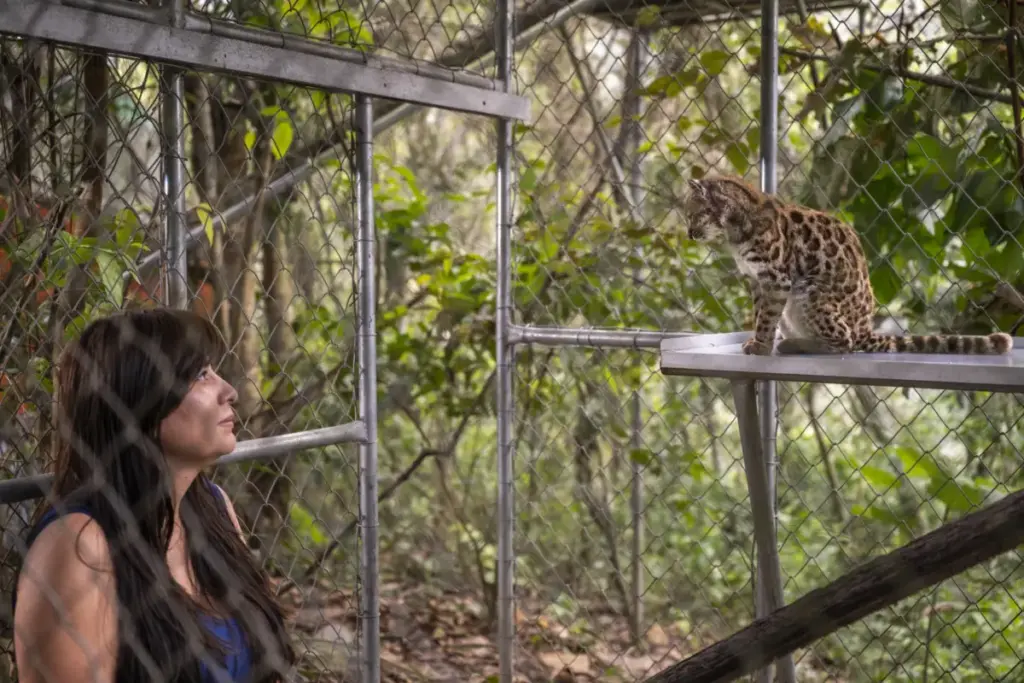
The tide turned around 2017 when a local Bolivian family brought a small, unusual feline to the Senda Verde Wildlife Sanctuary, located near La Paz. The family had rescued the animal as a helpless kitten, assuming it was simply an unusually marked domestic cat.
The illusion quickly faded as the kitten matured. True to its wild ancestry, the tiny feline began demonstrating predatory behaviors far beyond the scope of a housecat, most notably by systematically stalking and hunting their neighbor’s chickens. Recognizing that they were housing a wild predator, the family did the right thing, surrendering the animal to Senda Verde. Sanctuary staff named the young cat Tigrino.
Genetic Revelations
Tigrino’s arrival provided researchers with an unprecedented opportunity. While studying the broader genetics of the Leopardus genus, Paola Nogales-Ascarrunz and her colleagues analyzed biological samples taken from Tigrino, alongside a rare hair sample collected from a separate wild tilcayo that had been rehabilitated and successfully returned to its native habitat.
The scientists anticipated finding some genetic variations—perhaps identifying the Yungas cat as a distinct subspecies of tiger cat. Instead, the laboratory results shattered expectations.
DNA sequencing proved that Leopardus tilcayo was genetically isolated from all other known cat species by a wide margin. Further phylogenetic clock calculations indicated that the lineage leading to the tilcayo branched off from its closest feline relatives roughly 1.4 million years ago. This monumental revelation elevated the animal from a regional oddity to an entirely distinct, ancient species.
Supporting Context & Metrics: Unraveling the Numbers
To fully grasp the magnitude of the tilcayo discovery, it is helpful to examine the biological metrics, historical timelines, and taxonomic shifts that define this breakthrough.
Physical and Ecological Profile
- Common Name: Tilcayo
- Scientific Name: Leopardus tilcayo
- Body Weight: Approximately 1.4 kilograms (3 pounds), placing it among the smallest wild felids in the world.
- Physical Traits: Slender frame, rounded ears, and a soft coat patterned with large, distinctive spots adapted for camouflage in dappled cloud forest light.
- Habitat: The Yungas cloud forests of Bolivia—a humid, mountainous transition zone characterized by dense vegetation, constant mist, and exceptionally high biodiversity.
Evolutionary Timeline
- Divergence Date: ~1.4 million years ago.
- Comparative Milestone: For chronological context, modern humans (Homo sapiens) and Neanderthals diverged from a common ancestral lineage approximately 800,000 years ago. The tilcayo’s ancestral split predates human-Neanderthal separation by hundreds of thousands of years.
- Previous Discoveries: The last newly described living cat species was the Uruguayan pampas cat (Leopardus fasciatus), which entered the scientific record in 1923.
The Leopardus Taxonomic Reshuffling
The publication on September 17 in Current Biology did not merely introduce the tilcayo; it systematically untangled the entire Leopardus tigrinus complex. Through rigorous DNA analysis, researchers confirmed that what was once thought to be a single widespread species is actually composed of at least four distinct species.

In modern mammalogy, such discoveries typically fall into two categories:
- Elevating an established subspecies to full species rank based on molecular evidence.
- Splitting a widely lumped species into multiple distinct taxa.
The tilcayo discovery, however, stands apart because the animal was an open secret among locals—who used the vernacular name "tilcayo"—yet remained entirely uncatalogued by formal science until now.
Official Statements and Perspectives
The discovery has elicited profound emotion and professional pride from the scientists and conservationists who brought the tilcayo to light.
Paola Nogales-Ascarrunz, the National Geographic Explorer who led the research and serves as a researcher at the Universidad Mayor de San Andrés in La Paz, expressed the gravity of the moment in an interview with Mongabay:
"I have the honor of naming a cat, and that’s a really big thing. We expected the tilcayo to maybe be a subspecies, or something like that, because it was different. Then we saw it was 1.4 million years ago that this cat separated from the others, and that was amazing because we didn’t expect that much separation."
Nogales-Ascarrunz and her co-authors deliberately chose to base the scientific species name (tilcayo) on the existing local terminology. This decision underscores a growing, vital recognition within the scientific community that traditional and indigenous ecological knowledge often maps accurately onto biological realities long before laboratories catch up. By preserving the local name, the researchers honored the communities that have coexisted with these elusive ghosts of the cloud forest for generations.
Fernando Faciole, whose photographic documentation captured Tigrino at the Senda Verde Wildlife Sanctuary, provided striking visual evidence of the only known living individual of the species currently in protective captivity. Tigrino serves not only as a living ambassador for his kind but also as a testament to the unexpected ways wildlife finds its way into the hands of researchers—transforming a domestic mishap into a watershed moment for conservation science.

Future Outlook: Conservation Challenges Ahead
While the formal description of Leopardus tilcayo is a triumph for taxonomy, it immediately raises critical questions regarding conservation and wildlife management.
Cloud forest ecosystems across the tropical Andes, including the Yungas region of Bolivia, face mounting anthropogenic pressures. Deforestation driven by agricultural expansion, illegal logging, road construction, and the broader impacts of climate change threaten to fragment and degrade these fragile, high-altitude habitats.
Because Leopardus tilcayo is known from very few confirmed samples and a single individual in captivity (Tigrino at Senda Verde), conservationists fear that the species may already be rare, localized, or highly vulnerable to extinction. Small body size combined with specialized habitat requirements often translates to low population densities and high sensitivity to environmental disturbance.
In the wake of this discovery, conservation priorities must swiftly pivot toward:
- Field Surveys and Monitoring: Deploying camera traps and non-invasive genetic sampling (such as scat and hair collection) across the Bolivian Yungas to map the true geographic range and population status of the tilcayo.
- Habitat Protection: Strengthening legal protections and management resources for the Yungas cloud forests to safeguard remaining tracts of pristine wilderness.
- Local Engagement: Partnering with rural communities and local landowners—much like the family that rescued Tigrino—to foster coexistence, prevent the illegal pet trade, and integrate local knowledge into grassroots conservation strategies.
The unmasking of the tilcayo reminds us that our planet still holds profound secrets. Yet, as humanity continues to reshape natural landscapes at an unprecedented pace, discovering a species after 1.4 million years of evolutionary independence also serves as an urgent reminder of what is at stake. Protecting the misty heights of the Yungas is no longer just about preserving a biome; it is about ensuring that this tiny, newly unveiled ghost of the cloud forest does not vanish almost as soon as we have learned its name.



