

Executive Overview
The American electric vehicle (EV) market stands at a precarious crossroads. Despite years of aggressive technological scaling and government-backed subsidies, battery-powered vehicles account for less than 10 percent of total new-vehicle sales nationwide, with adoption rates experiencing concerning stagnation. This downturn carries severe consequences from a climate perspective. The transportation sector remains the single largest source of greenhouse gas emissions in the United States, meaning that a sputtering EV transition directly undermines domestic and global decarbonization targets.
For years, the industry’s playbook was uniform: chase longer ranges, pack in luxury digital interfaces, and market oversized vehicles loaded with high-tech frills. This status quo, however, has failed to capture the broader consumer base. Into this market void steps Slate Auto, an audacious industry disruptor determined to rewrite the rules of American automotive retail.
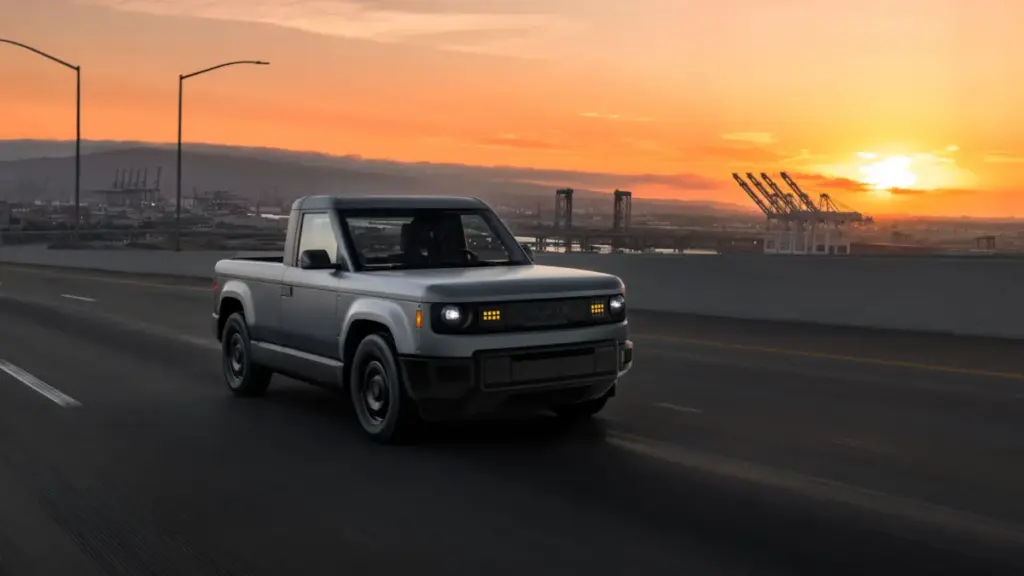
Slate is betting its future on a radically contrarian philosophy: extreme minimalism. The company’s flagship offering is a tiny, two-door electric pickup truck that is actually shorter than a Honda Civic. It strips away the excess that has come to define modern American automaking, right down to its hand-crank windows. By pairing a modest 65-kilowatt-hour lithium iron phosphate battery with a tightly budgeted design, Slate has engineered a base-model EV that will retail for under $25,000.
This price point shatters the baseline of the current market, where the average new vehicle costs roughly $50,000. Backed by $1.4 billion in venture funding from high-profile investors like Jeff Bezos and buoyed by an acute national cost-of-living crisis, Slate is asking a foundational question of American drivers: Are you willing to trade away range anxiety and superfluous digital displays for a vehicle that you can actually afford? As preorders climb into the tens of thousands ahead of a late 2026 delivery window, the automotive industry is watching closely to see if austerity will finally spark the mass-market EV revolution.
Detailed Chronology: The Rise, Fall, and Reimagining of the American EV
The False Dawn of the Heavy-Battery Era (2021–2022)
To understand Slate’s radical departure from industry norms, one must examine the missteps of the previous era. Just a few years ago, the undisputed champion of US automotive electrification was supposed to be the Ford F-150 Lightning. Unveiled to immense fanfare in 2021, the Lightning was marketed as the ultimate bridge to a clean-energy future—an electric adaptation of America’s best-selling vehicle for decades.
When customer shipments commenced in 2022, the F-150 Lightning initially generated substantial momentum. However, structural flaws in its design philosophy quickly surfaced. To meet consumer expectations for traditional American truck utility and reassure buyers plagued by range anxiety, Ford engineered the vehicle to deliver nearly 300 miles of driving range. Achieving this metric required a massive battery pack—roughly double the capacity of the power unit inside Slate’s upcoming truck.
The Perfect Storm: Inflation, Policy Shifts, and Price Spirals (2023–2025)
This obsession with oversized battery capacity carried severe financial ramifications. While the base model of the Lightning initially launched with a price tag hovering around $40,000, manufacturing realities and soaring raw material costs quickly eroded profit margins. By the time the vehicle entered its final production year, market prices had climbed past $54,000, pricing out working-class buyers.
External regulatory and macroeconomic pressures compounded these engineering challenges. Following the transition to the second Trump administration, federal policy shifted dramatically. Sweeping legislative changes slashed consumer tax credits and dismantled regulatory support systems explicitly designed to accelerate domestic EV adoption.
The convergence of escalating manufacturing costs, disappearing federal subsidies, and soaring consumer inflation delivered a fatal blow to heavy-battery, high-cost electric trucks. In December 2025, just four years after its high-profile introduction, Ford officially discontinued the F-150 Lightning. The conventional playbook of scaling up traditional vehicle formats into expensive EVs had officially hit a wall.
The Pivot to Minimalism: Slate Auto’s Emergence (2026 and Beyond)
Recognizing that the traditional luxury-and-range strategy was alienating the average buyer, Slate Auto took shape as an antidote to industry excess. Eschewing the conventional wisdom that American consumers will only accept full-size, feature-heavy SUVs and trucks, Slate went all-in on austerity.
The company focused its engineering resources on hyper-efficient packaging. By designing a compact, two-door pickup tailored for utility rather than status, Slate managed to slash production overhead. The company scheduled its initial factory rollout for late 2026, aiming for a production capacity of 100,000 vehicles in its inaugural year, with plans to scale to 150,000 units shortly thereafter.
Significantly, legacy automakers are already scrambling to adapt to this shift. Observing Slate’s early momentum and the changing macroeconomic climate, Ford announced plans to re-enter the affordable segment, developing a compact electric truck slated for a 2027 debut at an estimated retail price of $30,000.
Supporting Context & Metrics: The Reality Gap in Range and Affordability
The Myth of the Daily Long-Distance Commute
The automotive industry’s relentless pursuit of 300-plus-mile battery ranges is largely disconnected from actual driving habits. While American motorists have historically prioritized maximum distance capabilities—often purchasing vehicles tailored for their most infrequent annual road trip rather than their daily routine—empirical data tells a vastly different story.
According to federal transportation data, the average American driver puts fewer than 35 miles on their odometer in a single day. Furthermore, nearly 90 percent of all personal vehicle trips in the United States cover distances of 20 miles or less.
Consumer behavior studies corroborate this data. A comprehensive analysis by automotive research group Recurrent revealed that typical EV owners utilize less than 20 percent of their vehicle’s total battery range on an average day. By packing vehicles with massive, expensive battery packs to satisfy hypothetical long-distance scenarios, manufacturers have inadvertently priced everyday consumers out of the market.
The Affordability Crisis Meets the Electrified Future
This structural mismatch between vehicle cost and actual utility has collided with a severe macroeconomic reality. A recent Harris poll indicates that approximately 95 percent of Americans believe the country is currently mired in an affordability crisis, with roughly half the population struggling to pay for basic necessities such as groceries, housing, and gasoline.
In this economic climate, the psychological appeal of an inexpensive vehicle that completely eliminates trips to the pump is powerful. Slate’s base model—priced under $25,000—provides an accessible entry point. While customers retain the option to customize their vehicles with modular add-ons such as Bluetooth sound systems, vinyl wrap body styling, or power windows, the total out-the-door cost remains thousands of dollars below the national new-car average.
A Global Comparison: How Other Markets Win on Affordability
The viability of lower-range, lower-cost electric vehicles is not merely theoretical; it has already been proven on a massive global scale. China, currently the world’s most advanced EV market, boasts over 40 million electric vehicles and plug-in hybrids on its roads. Today, approximately half of all new vehicle sales in China are fully electric.
Crucially, Chinese automakers achieved this milestone by embracing efficiency over excessive battery capacity. In 2025, the average range of a new EV sold in China was just 247 miles. By comparison, the average range for a new EV sold in the United States during the same period stood at a bloated 329 miles, with European models falling in the middle at 281 miles. By shedding unnecessary battery mass, international markets unlocked affordable mobility—a blueprint Slate is now importing to the United States.
Official Statements and Industry Perspectives
The paradigm shift represented by Slate Auto has generated robust discussion among industry analysts, financial backers, and corporate leaders.
Financial markets have signaled strong confidence in this stripped-down approach. Over three major funding rounds, institutional backers—most notably billionaire investor Jeff Bezos—have injected nearly $1.4 billion into Slate Auto. Market analysts interpret this capital infusion as a clear vote of confidence that the future of mass adoption lies in utility and cost reduction rather than luxury feature creep.
Industry insiders point out that the media’s fascination with Slate’s retro features—such as its hand-crank windows—misses the broader strategic brilliance of the manufacturing design. By utilizing modular, interchangeable components and eliminating complex digital displays from the base architecture, Slate significantly reduces supply chain vulnerabilities and assembly line bottlenecks.
Commenting on the shifting strategic landscape, automotive market researchers have emphasized that legacy manufacturers can no longer afford to ignore the sub-$30,000 segment. Ford’s decision to fast-track its upcoming compact electric truck—internally tracked under development pipelines like the Fathom project—serves as tacit acknowledgment that Slate’s thesis is correct.
As automotive executives re-evaluate their product roadmaps, the consensus among forward-thinking designers is clear: the era of the $60,000 halo EV is giving way to pragmatic, utility-driven electric motoring designed for the working class.
Future Outlook: Can Minimalism Save the American EV Transition?
As Slate Auto prepares to deliver its first preordered vehicles in late 2026, the company stands at the vanguard of a potential market correction. The success or failure of this venture will serve as a definitive litmus test for the American consumer psyche.
The primary question facing Slate is whether modern drivers can overcome decades of marketing conditioning that equates vehicle value with size, weight, and digital complexity. Can the American driver accept a vehicle with hand-crank windows and a 205-mile range if it costs half the price of a standard crossover and liberates them from the volatility of fossil fuel prices?
Current indicators suggest the answer is affirmative. With thousands of preorders already secured, a production pipeline capable of scaling to 150,000 units annually, and a national population desperate for relief from an unrelenting cost-of-living squeeze, Slate’s timing could not be more precise.
If Slate succeeds, it will force a fundamental restructuring of the US automotive sector. Legacy giants will be compelled to dismantle their high-margin, heavy-battery strategies in favor of lightweight efficiency. More importantly, an affordable, accessible electric vehicle market will finally give the United States a fighting chance to slash its transportation emissions, proving that sometimes, less is infinitely more.



