

Executive Overview
In an era defined by a delicate balancing act between ecological preservation and the human desire to experience untouched nature, a paradigm shift is underway in architectural design. Traditional construction methods—often plagued by heavy machinery, extensive site disruption, and permanent environmental scars—are increasingly being re-evaluated. Enter Wiki World, an innovative architectural studio that has consistently pushed the boundaries of prefabricated and nomadic building systems. Their latest creation, the Red Submarine Cabin, represents a profound leap forward in sustainable, high-performance modular design.
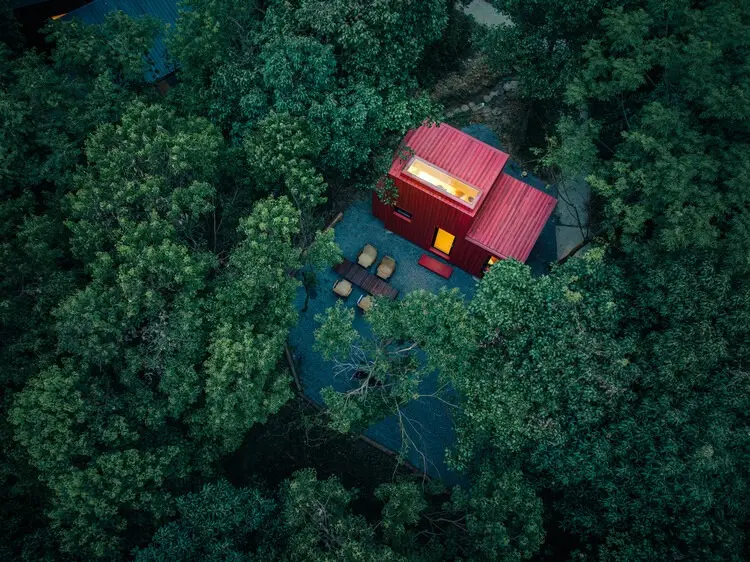
Curated by Han Shuang and captured through the lens of architectural photographer Xhot, the Red Submarine Cabin is far more than a striking structure tucked away in the forest. It is billed by its creators as the ultimate "Plug-in for the Wild." Powered by advanced Digital Wood technology, the cabin bridges the gap between the surgical precision of digital fabrication and the romantic, untamed spirit of nomadic freedom.

Designed as a high-performance, zero-footprint, plug-and-play dwelling, this project introduces versatile spatial arrangements and multi-functional capabilities adaptable to virtually any landscape. Whether perched dramatically on a jagged coastal cliffside, nestled discreetly within a dense forest, or sitting softly in an alpine meadow, the Wiki Cabin inhabits the planet’s most remote and fragile ecosystems without leaving a trace. By turning the "impossible" wilderness home into an instant reality, Wiki World is redefining what it means to build lightly on the earth.
Detailed Chronology: The Evolution of Wiki World and the Submarine Cabin Concept
To fully understand the significance of the Red Submarine Cabin, one must trace the trajectory of Wiki World and its continuous refinement of modular, eco-conscious spatial systems.

Phase I: The Ideation and Technological Foundations
Long before the physical assembly of the Red Submarine Cabin took place, the architectural team at Wiki World spent years researching the intersection of computational design and sustainable material science. Traditional timber construction, while renewable, often involves significant waste during the cutting and framing processes. Wiki World sought to eliminate this inefficiency by embracing Digital Wood technology.
This approach relies on parametric modeling and Computer Numerical Control (CNC) fabrication. Every single component of the Red Submarine Cabin is digitally mapped, prefabricated to millimeter precision off-site, and tagged for assembly. This digital-first methodology drastically minimizes material waste, optimizes structural integrity, and shortens assembly times on-site.

Phase II: Prototyping the "Plug-in for the Wild"
The conceptual foundation of the "Plug-in for the Wild" was born out of a necessity to create architecture that respects the carrying capacity of natural landscapes. Conventional cabins require deep foundations, concrete footings, and heavy logistical support, which inevitably disrupt local hydrology, flora, and fauna.
Wiki World’s response was a modular spatial system that functions independently of heavy infrastructure. The Red Submarine Cabin was designed to utilize adjustable, minimal-impact foundation piers or screw piles. This elevates the structure above the ground level, ensuring that soil compaction is avoided and natural water runoff patterns remain uninterrupted.

Phase III: On-Site Assembly and Materialization
The physical manifestation of the Red Submarine Cabin showcases the culmination of these technological and philosophical frameworks. Transported in modular components that can be easily maneuvered without the need for large cranes or destructive road clearings, the cabin is assembled by hand using lightweight mechanical joints.
The striking red exterior finish—reminiscent of maritime submersibles navigating deep, uncharted waters—serves a dual purpose. Aesthetically, it creates a bold, poetic contrast against the verdant greens and earthy browns of the forest canopy. Functionally, the high-grade weather-resistant coating protects the underlying engineered wood from harsh UV rays, heavy precipitation, and extreme temperature fluctuations, ensuring longevity in remote environments.

Supporting Context & Metrics: Redefining Sustainable Performance
The architectural community is increasingly measuring success not just by aesthetic or spatial qualities, but by hard ecological metrics. The Red Submarine Cabin excels across several critical performance indicators that set a new benchmark for nomadic and prefabricated architecture.
Zero-Footprint Engineering
- Foundation Impact: By employing elevated screw-pile systems, the cabin achieves a near-zero ground disturbance footprint. Soil biology, root systems, and ground-dwelling fauna remain largely undisturbed during both installation and eventual deconstruction.
- Reversibility: True sustainability in remote landscapes requires circularity. The Red Submarine Cabin is completely reversible. Should the site need to be returned to its pristine state, the cabin can be disassembled piece by piece and relocated without leaving permanent concrete residues or structural waste behind.
Material Science and Digital Wood
- Timber Efficiency: Utilizing advanced mass timber and engineered wood products, the cabin sequesters carbon throughout its lifecycle. The digital fabrication process ensures a material optimization rate exceeding 95%, virtually eliminating construction-site waste.
- Thermal Performance: Despite its compact, pod-like scale, the cabin is engineered as a high-performance thermal envelope. Advanced insulation materials sandwiched between the timber layers ensure interior comfort year-round, minimizing the need for active heating and cooling systems.
Spatial Versatility and Metrics
- Modular Grid: The interior layout is organized around a flexible spatial grid that maximizes functional utility within a compact footprint.
- Plug-and-Play Integration: The cabin incorporates modular utility pods that handle off-grid power generation (such as photovoltaic integration), greywater filtration, and composting sanitation, allowing it to function autonomously for extended periods.
Official Statements & Design Philosophy
The philosophy driving the Red Submarine Cabin speaks to a broader movement within modern design: architecture as an invited guest in nature, rather than a permanent conqueror.

"Architecture has historically treated nature as a canvas to be dominated," notes the curatorial notes provided by Han Shuang. "With the Red Submarine Cabin, Wiki World flips this narrative. We view the wilderness not as a site for construction, but as a sanctuary to be respected. Our digital wood technology allows us to deliver a high-performance, comfortable human habitat to the most unreachable corners of the earth with the gentlest possible touch."
The design team emphasizes that the name "Submarine" is more than just a playful nod to its vibrant colorway and compact, cylindrical-inspired efficiency. It serves as a conceptual metaphor. Just as a submarine operates self-sufficiently in an alien, high-pressure environment without disrupting the ocean around it, the Red Submarine Cabin operates as an isolated, self-contained vessel in the vast expanse of the wilderness. It protects its inhabitants from the elements while maintaining a strict boundary of non-interference with the surrounding ecosystem.

Future Outlook: The Implications for Nomadic and Remote Architecture
As cities become denser and climate pressures mount, the allure of the wilderness grows stronger. However, unmanaged tourism and poorly planned remote construction pose severe threats to fragile ecosystems worldwide. Projects like the Red Submarine Cabin offer a compelling blueprint for the future of eco-tourism, remote research stations, and low-impact residential retreats.
1. Scaling Off-Grown Communities
The success of Wiki World’s modular system demonstrates that prefabricated timber architecture can scale without sacrificing architectural integrity or environmental ethics. Future iterations of the "Plug-in for the Wild" concept could see clustered modular cabins forming temporary, low-impact research villages or community retreats that adapt dynamically to seasonal changes.

2. Advancing Circular Building Codes
Municipalities and environmental agencies struggling to regulate building in protected natural parks may find a welcome ally in zero-footprint technologies. Because structures like the Red Submarine Cabin challenge traditional definitions of permanent real estate—falling instead into the category of removable, low-impact spatial products—they could pave the way for progressive building codes that encourage temporary, sustainable habitation over permanent concrete sprawl.
3. The Democratization of Remote Living
By streamlining the logistics of building in inaccessible locations—such as dense forests, steep mountain ridges, or remote islands—digital fabrication democratizes access to nature. People can experience profound wilderness immersion without requiring heavy infrastructure, road development, or environmental degradation.

Conclusion
The Red Submarine Cabin by Wiki World is much more than a picturesque architectural installation; it is a manifesto for the future of sustainable building. By seamlessly fusing the precision of digital wood technology with an uncompromising commitment to zero-footprint ecology, Wiki World has transformed the utopian dream of living lightly in the wilderness into an accessible reality. As this modular system makes its debut across remote landscapes, it challenges architects, designers, and nature enthusiasts alike to rethink our relationship with the earth: proving that humanity and pristine wilderness can coexist in perfect, harmonious balance.



