

Executive Overview
On Sunday, August 23, an extraordinary endurance feat concluded in Western Norway, crossing a monumental threshold not just for athletic achievement, but for environmental conservation. Over the course of 30 grueling stages averaging approximately 7 kilometers each, a dedicated team completed a continuous swim of the Sognefjord—the world’s longest ice-free fjord and its deepest abyss, plunging 1,308 meters at its maximum depth.
This historic journey shattered glass ceilings and cultural boundaries. The team became the first Norwegians to ever swim the entire length of the Sognefjord. Among them, Ingjerd achieved a historic global first as the first woman to conquer the 205-kilometer expanse. Meanwhile, Dan made history as the first Sámi person to swim the fjord, bringing a profound cultural dimension rooted in Northern Sea Sámi heritage and an ancestral, symbiotic relationship with the ocean.
Yet, this endeavor was never fundamentally about athletic accolades or setting records. Operating under the banner of Swim4Fjords—and proudly representing the Jæren Coast Mission Blue Hope Spot—the swimmers set out to sound a blaring alarm. They sought to expose the stark disparity between the Sognefjord’s breathtaking, postcard-perfect surface and the creeping ecological degradation festering beneath the waterline.
Armed with underwater cameras and freediving gear, the team documented a marine environment choked by industrial aquaculture runoff, smothered by invasive filamentous algae, and slowly suffocating from a 15% drop in deep-water oxygen levels over the past three decades. As a formal protection process for the Sognefjord gets underway, this harrowing expedition has transformed raw athletic endurance into urgent, science-backed environmental advocacy.
Detailed Chronology: 30 Stages Across 205 Kilometers of Water
The sheer scale of the Sognefjord demands absolute psychological and physical resilience. Stretching 205 kilometers inland from the Atlantic Ocean to the foot of towering mountains, the fjord presents an ever-shifting gauntlet of frigid temperatures, unpredictable weather patterns, and formidable tidal currents.
Breaking Down the Stages
Broken into 30 distinct daily stages of roughly 7 kilometers, the swim mirrored the complex geography of the waterway itself. The journey began at the inner reaches of the fjord—the vital nursery grounds where wild Atlantic salmon return to spawn—and traced their historic migration route westward toward the open sea.
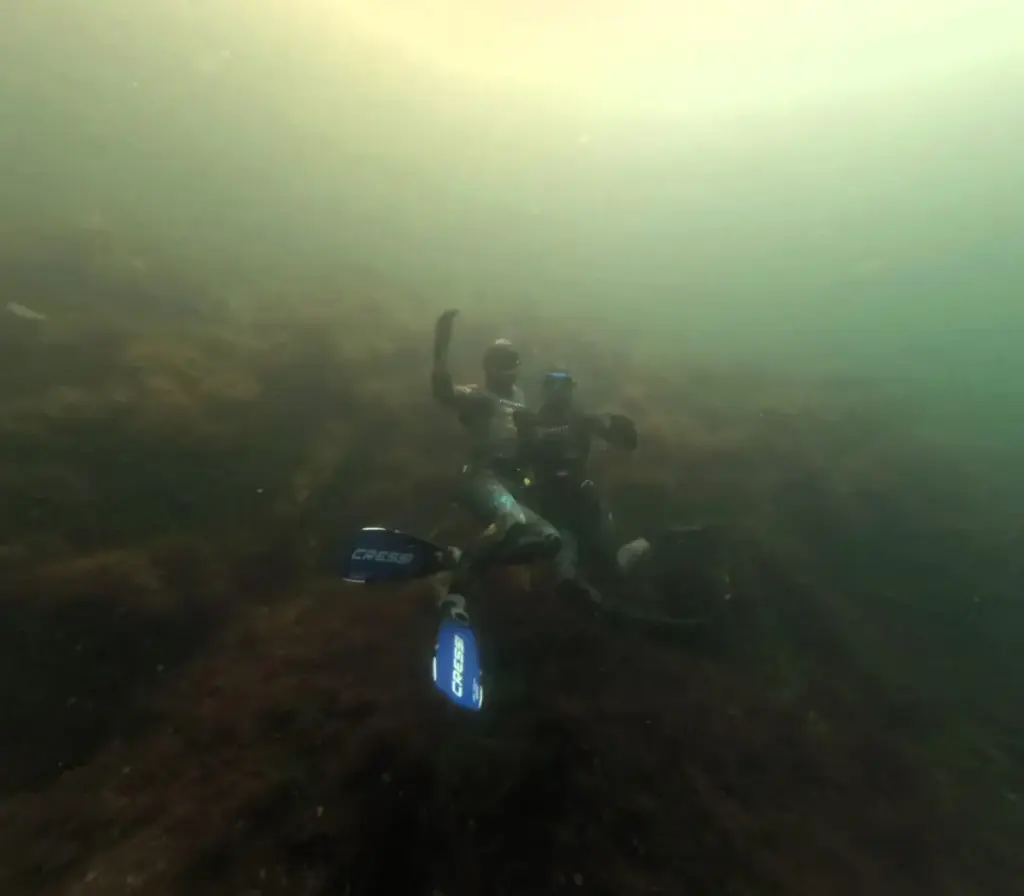
Every single day followed a rigorous protocol. After completing the grueling open-water swimming stage, the team transitioned to freediving beneath the surface. They captured high-resolution photographic and video documentation of the benthic zones, kelp forests, and pelagic environments, ensuring that every kilometer swum was matched by rigorous visual auditing.
Navigating the Tipping Point: The Halfway Mark
The physical challenges of the expedition peaked dramatically just past the 100-kilometer mark—precisely halfway through the fjord. Confronted by sudden, violent underwater currents that rendered open-water progression impossible, the swimmers were forced to hug the shallow coastal margins for a grueling final 2.5 kilometers of that stage.
What began as an emergency navigational adjustment turned into an unprecedented, up-close marine inspection. Swimming through the shallows, the team encountered a marine landscape utterly transformed: a continuous, suffocating carpet of filamentous algae—locally known as lurv—smothering the native kelp forests. It was a visceral, haunting reminder that the fjord was under severe biological stress.
The Symbolic Abyss
Near the conclusion of the 30-day odyssey, the team reached the deepest basin of the Sognefjord. Suspended over 1,300 meters of water, alongside Norwegian freediver Mari Aarbø, they executed a symbolic deep dive. Descending into the pitch-black column of water, they bore witness to a fragile, hyper-specialized deep-sea ecosystem of sponges, echinoderms, and cnidarians. More importantly, they brushed shoulders with the invisible pressures of climate change and nutrient loading that threaten to disrupt this ancient abyss permanently.
Supporting Context & Metrics: The Crisis Beneath the Surface
While tourists and cruise ships marvel at the sheer cliffs and glassy surface of the Sognefjord, marine scientists and environmental watchdogs warn that the ecosystem is flashing red. The Swim4Fjords expedition collected qualitative observations that directly mirror alarming quantitative data published by leading research institutions like the Norwegian Institute for Water Research (NIVA).
1. The Aquaculture Burden: Nutrients and Sewage Equivalents
It is virtually impossible to traverse the Sognefjord today without encountering industrial fish farms. While aquaculture is a cornerstone of Norway’s coastal economy, its environmental footprint has expanded beyond the carrying capacity of local fjord systems.
According to NIVA, aquaculture stands as by far the largest source of human-caused nitrogen and phosphorus emissions along the Norwegian coastline. The institute estimates that the nitrogen emissions generated by Norwegian aquaculture are equivalent to the untreated sewage output of more than 17 million people—a figure nearly triple the entire human population of Norway.
In a sill fjord like the Sognefjord—where a shallow 200-meter underwater threshold at the entrance severely restricts the flushing and exchange of deep water with the open ocean—these nutrient loads accumulate with devastating efficiency.
2. The Wild Salmon Crisis
The wild Atlantic salmon serves as the quintessential canary in the coal mine for Norwegian aquatic health. The numbers paint a harrowing portrait of decline:
- Total Wild Spawning Population: Estimated at a fragile 300,000 to 400,000 fish across all of Norway.
- The Farming Discrepancy: A single commercial salmon-farming cage can routinely house approximately 200,000 farmed salmon. Just two cages can hold a population roughly equal to the entire wild salmon spawning population of Norway, and these captive fish share the exact same fjord waters as their wild counterparts.
Beyond nutrient pollution and the direct genetic risks of escaping farmed fish, this dense concentration of aquaculture acts as an incubator for salmon lice (Lepeoptheirus salmonis). These parasitic copepods swarm outward from farms, inflicting fatal lesions and osmotic stress on migrating wild salmon and sea trout smolts. Furthermore, the routine cleaning of fish-farm nets discharges accumulated organic matter and heavy chemical residues directly into the water column, compounding the ecosystem’s systemic stress.
3. "Lurv": The Algal Smothering of Kelp Forests
The manifestation of this ecological imbalance is vividly apparent in the proliferation of lurv (filamentous algae). Normally held in balance by grazing marine herbivores and nutrient-poor waters, these algae explode in growth when fed by agricultural and aquacultural runoff.
During the swim, thick, felt-like layers of lurv were documented covering entire kelp forests. This algal carpet blocks essential sunlight from reaching the kelp, destroying the foundational nurseries and feeding grounds for countless fish species, crabs, and invertebrates. Local residents along the Sognefjord corroborated these findings, sharing childhood memories of bustling fisheries and crystal-clear waters—a stark contrast to today’s depleted stocks and quiet harbors dominated by recreational motorboats and commercial cruise ships.
4. Ocean Deoxygenation: The Fjord Is Holding Its Breath
Perhaps the most alarming metric uncovered during the expedition is the steady suffocation of the Sognefjord’s deep waters. Over the past 30 years, the oxygen content in the deep basins of the Sognefjord has plummeted by approximately 15%.
NIVA research attributes roughly two-thirds of this oxygen depletion to excessive nutrient and organic matter loading, while the remaining one-third is driven by rising sea temperatures. As global heating warms the upper layers of the ocean, the density stratification of the water column strengthens, making the periodic renewal of deep, oxygen-rich ocean water increasingly rare.
The Sognefjord is essentially finding it harder to breathe. If deoxygenation trends continue unchecked, scientists warn of looming ecological tipping points where benthic communities could experience sudden, catastrophic collapses from which recovery is mathematically impossible.
5. The Deep-Sea Parasite: Anelasma squalicola
Highlighting how little humanity understands about the deep, the team’s dive into the abyss brought to light Anelasma squalicola—a bizarre, highly specialized barnacle found living on deep-sea sharks at depths ranging from 100 to 1,000 meters. Eschewing the filter-feeding lifestyle of shallow-water barnacles, Anelasma has evolved into a true parasite, embedding root-like tendrils directly into the flesh and tissue of sharks to extract nutrients. This living evolutionary marvel underscores both the fragility and the profound mystery of the deep fjord ecosystem—a world changing faster than science can catalogue it.
Official Statements and Advocacy
The Swim4Fjords initiative is built upon a foundation of rigorous scientific collaboration. The visual and physical data gathered during the 205-kilometer swim has been handed over to prominent marine biologist and researcher Hartvig Christie, ensuring that anecdotal observations are rigorously contextualized within peer-reviewed marine science.
Speaking on the cultural and environmental intersections of the journey, Dan emphasized the ancestral duty driving his strokes:
"As a Northern Sea Sámi, a deep connection to nature and the ocean is woven into my cultural heritage. Swimming the Sognefjord was never about personal glory; it was about speaking for a system that cannot speak for itself. When you spend 30 days immersed in these waters, you realize that the postcard image of Norway is masking a profound, systemic illness."
Ingjerd, reflecting on her historic swim and the broader regulatory battles facing Norwegian waters, pointed to the urgent need for systemic policy reform:
"We have swum the Lysefjord, Repparfjord, Varangerfjord, the Jæren Coast, and the Førde Fjord. In the Førde Fjord case, even after the Supreme Court ruled in June that industrial submarine disposal of mine tailings was unlawful, the government has failed to halt the dumping. Norway remains one of the very few nations on Earth that still permits mining companies to treat marine fjords as industrial waste dumps. We must protect these waters while there is still something left to save."
Future Outlook: A Turning Point for the King of Fjords
As the Swim4Fjords team steps ashore, their work enters its most critical phase. The comprehensive photographic logs, underwater video footage, and physical water observations compiled over 205 grueling kilometers are being formally submitted to the ongoing Sognefjord protection process.
The expedition has successfully transitioned from an athletic feat into a powerful public catalyst. By making the invisible visible—dragging the quiet suffering of algal-choked kelp forests, suffocating deep-water basins, and struggling wild salmon runs into the blinding light of public scrutiny—the team has provided conservationists and policymakers with an undeniable evidentiary baseline.
Every fjord possesses a biological tipping point. The 15% drop in deep-water oxygen, the unchecked expansion of industrial aquaculture emissions, and the ongoing threats of coastal mining underscore a sobering reality: time is running out.
The historic swim of the Sognefjord serves as a clarion call to the Norwegian government, industry leaders, and the global community. Protecting the King of Fjords requires immediate, decisive action to curb nutrient pollution, reform aquaculture practices, ban toxic marine waste disposal, and restore the ecological integrity of Norway’s coastal waters. For the Sognefjord—and for the wild creatures that call its dark, magnificent depths home—every stroke truly matters.



