

Executive Overview
Extreme heat is widely recognized as one of the deadliest climate hazards facing humanity, yet its operational footprint is undergoing a profound and dangerous transformation. According to a landmark global study published in AGU Advances by lead author C. Ivanovich and colleagues (2026), extreme heat is no longer confined within the traditional bounds of summer. Across more than half of the Earth’s land surface, extreme heat events are actively spilling over into the "shoulder seasons"—the months immediately preceding spring and following autumn.
Crucially, this expansion is not uniform. The research reveals an asymmetric pattern: in certain regions, dangerous temperatures are creeping predominantly into early spring, catching human populations and municipal infrastructure off guard before cooling mechanisms are activated. In other regions, extreme heat is extending late into autumn, compounding thermal stress on human bodies, ecosystems, and power grids already exhausted by months of summer heat.
       TRADITIONAL HEAT SEASON                 EMERGING REALITY
  [Spring]   [  SUMMER  ]   [Autumn]    [Spring]   [  SUMMER  ]   [Autumn]
     |          |  80%+ |      |                     |       |      /
     |          |  Heat |      |            ===> Asymmetric Creep <===/
     |          [  Days ]      |        (Pre-season)          (Post-season)
By analyzing 45 years of high-resolution atmospheric reanalysis data, the researchers demonstrated that uniform global warming alone cannot account for this asymmetric seasonal drift. Instead, complex localized climate drivers—ranging from shifting soil moisture levels and altered precipitation patterns to land-use change and multidecadal oceanic oscillations—are altering the seasonal calendar of extreme heat. These findings demand a fundamental reassessment of global climate adaptation strategies, public health protocols, and emergency response frameworks.
Detailed Chronology & Analytical Methodology
To understand how heat seasons are evolving, the research team established a rigorous baseline using climate data spanning 1980 through 2024. Traditional meteorology often relies on fixed calendar months—defining summer as June through August in the Northern Hemisphere and December through February in the Southern Hemisphere. However, because local climate dynamics vary significantly across geographical regions, these arbitrary windows fail to capture localized heat risks accurately.
To overcome this limitation, the authors developed a dynamic metric known as the "local heat season."
METHODOLOGICAL TIMELINE & DATASETS

1980–1989 Baseline Decade                       2015–2024 Modern Comparison
  |                                               |
  +-- Defined 3-month peak "Local Heat Season"    +-- Measured relative shift in heat days
  +-- Established shoulder seasons (+/- 2 mos)    +-- Standardized via MERRA2 & ERA5 data
1. Defining Local Baselines (1980–1989)
Using the NASA MERRA2 reanalysis dataset (and cross-verifying results against the ECMWF ERA5 reanalysis framework), the researchers identified the three consecutive months during the baseline decade (1980–1989) when extreme heat occurred most frequently at every point on Earth’s land surface. The two months preceding and following this three-month window were designated as the pre-season (spring-equivalent) and post-season (autumn-equivalent) shoulder seasons, respectively.
2. Measuring Long-Term Shifts (1980–2024)
The study evaluated changes by comparing heat day distribution in the baseline period (1980–1989) against the most recent decade (2015–2024). Comparing these opposing ends of the 45-year record enabled the team to quantify the cumulative impact of anthropogenic climate change while minimizing short-term noise.
3. Evaluating Dual Heat Metrics
Recognizing that heat impacts manifest differently depending on atmospheric moisture, the study separated extreme heat into two distinct categories:
- Dry Heat: Quantified using dry-bulb air temperature.
- Humid Heat: Quantified using Wet-Bulb Globe Temperature (WBGT), an international metric originally developed by the U.S. military in the 1950s that combines air temperature, relative humidity, wind speed, and solar radiation.
Supporting Context & Technical Metrics
Baseline Stability vs. Modern Dispersion
During the 1980s baseline decade, extreme heat was tightly restricted to the local heat season across almost the entire planet. Approximately 93% of the world’s land area experienced more than 80% of its annual extreme dry-heat days strictly within its defined three-month heat season. Surprising to researchers, this tight seasonal confinement was even observed across tropical zones, where seasonal temperature variance is historically subtle.
By the 2015–2024 period, however, the boundaries of these seasons began to blur significantly. Extreme heat days moved increasingly into the two-month shoulder windows on either side of the peak heat season.
GLOBAL HEAT SEASON SHIFTS (1980s vs. 2020s)

Metric                      1980–1989 Baseline          2015–2024 Observed
-------------------------------------------------------------------------------
Land Area with Heat         ~93% of global land         <50% maintaining strict
  Confined to Peak Season     area (>80% heat days)       seasonal boundaries
Shoulder Season Creep       Minimal / Isolated          >50% of global land area
  (Spring/Autumn)                                         experiencing expansion
Primary Drivers             Seasonal Solstice Dynamics  Anthropogenic Warming +
                                                          Soil Moisture & Circulation Shifts
The Spatial Asymmetry of Shoulder-Season Heat
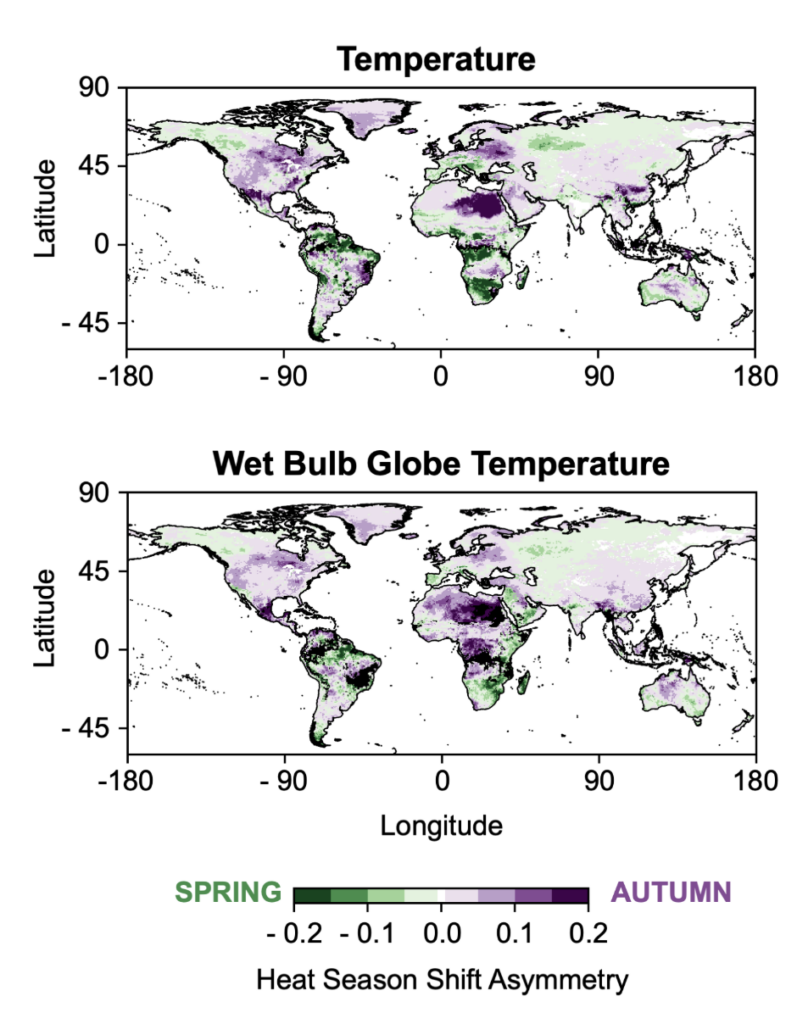
The study’s most striking revelation is that heat expansion into shoulder seasons is highly asymmetric. Regional geography determines whether extreme heat creeps earlier into spring or extends later into autumn.
                  EARLY CREEP (Spring Shift)
        Regions: Western Europe, Southern Africa, NW India
        Impacts: Unacclimatized populations, inactive cooling centers,
                 disrupted agricultural planting cycles.
                                 |
                                 v
        ====================================================
                                 ^
                                 |
                  LATE CREEP (Autumn Shift)
        Regions: United States, Eastern China, North Africa, Eastern Europe
        Impacts: Sustained infrastructure strain, compound wildfire/hurricane
                 hazards, extended agricultural drought.
Early Creep (Spring Expansion)
In regions shaded green on the study’s global mapping models—including Western Europe, Southern Africa, and Northwestern India—a significantly higher share of annual extreme heat days now occurs in the two months prior to the historical heat season. In these regions, high-stress heat events strike when human physiological acclimatization is low and public cooling protocols remain inactive.
Late Creep (Autumn Expansion)
In regions shaded purple—including much of the United States, Eastern China, Northern Africa, and Eastern Europe—extreme heat events are expanding predominantly into the months following the traditional summer window. Here, late-season heat waves prolong seasonal droughts and place continuous demands on power systems already weakened by months of summer cooling loads.
Dry vs. Humid Heat Offsets
The analysis also highlighted that extreme dry-heat and extreme humid-heat seasons rarely coincide perfectly. In many parts of the world, peak dry heat and peak humid heat are offset by approximately one month.
This divergence is particularly acute in monsoonal regions such as Northwestern Mexico and Central India. In these areas, the extreme dry-heat season peaks immediately prior to the arrival of monsoon rains, whereas the extreme humid-heat season peaks as moisture surges inland during the active monsoon phase.
MONSOONAL HEAT OFFSET DYNAMICS (e.g., Central India, NW Mexico)

  Month N-1                   Month N                    Month N+1
+---------------------------+--------------------------+---------------------------+
| Extreme DRY Heat Peak     | Monsoon Arrival          | Extreme HUMID Heat Peak   |
| High dry-bulb temperature | Moisture surge inland    | High Wet-Bulb Globe Temp  |
| Max ecosystem impact      |                          | Max human heat stress     |
+---------------------------+--------------------------+---------------------------+
The "Synthetic Model" Experiment: Uncovering the Mechanism
To determine why heat is expanding asymmetrically, the research team conducted a novel modeling experiment. They constructed a "synthetic" dataset by taking the 1980s baseline temperature data and applying a uniform upward shift equal to the average annual warming observed over the 45-year period.
                 SYNTHETIC MODEL EXPERIMENT

  [1980s Baseline]  +  [Uniform Global Warming]  =  [Synthetic Dataset]
                                                           |
                                                           v
  Result: Explained temperature spikes WITHIN summer heat season.
  FAILED to explain early-spring or late-autumn shoulder season asymmetry.
  Conclusion: Localized hydrological & atmospheric drivers must be responsible.
The synthetic model successfully replicated temperature intensification within the peak heat season. However, it completely failed to reproduce the asymmetrical expansion into the shoulder seasons. This critical negative result proved that simple, uniform global warming is insufficient to explain how heat seasons are evolving. Instead, secondary climate drivers must be altering local thermodynamics during transition months. Key mechanisms include:
- Soil Moisture Deficits: Reduced spring precipitation leads to drier soils, suppressing evaporative cooling and allowing early-season solar radiation to directly heat the air (spring heat creep).
- Land-Use Dynamics: Agricultural intensification, expanding irrigation networks, and urbanization modify local surface albedo and evapotranspiration rates.
- Low-Frequency Atmospheric Circulation: Multidecadal climate variations, such as the Pacific Decadal Oscillation (PDO) and Atlantic Multidecadal Oscillation (AMO), alter large-scale wind patterns and jet stream behavior during shoulder months.
Official Statements & Expert Synthesis
The findings published by Ivanovich et al. highlight profound vulnerabilities across public health, emergency management, and agricultural infrastructure. Expert analysis of the research underscores two major operational concerns:
The Early-Heat Physiological Trap
Health researchers emphasize that extreme heat events occurring early in the calendar year—during spring or early summer—carry disproportionately high mortality rates. Human physiological adaptation to heat requires several weeks of gradual exposure.
When unseasonably high temperatures occur in early spring, individuals have not yet developed heat tolerance. Furthermore, municipal infrastructure often compounds this biological vulnerability: public air-conditioned cooling shelters are typically kept closed, emergency response plans remain unstaffed, and urban schools or transit networks operate without active cooling systems.

The Late-Heat Exhaustion Cumulative Effect
Conversely, heat waves extending late into autumn subject human populations to prolonged, uninterrupted physiological stress. Cumulative thermal fatigue increases cardiovascular and renal stress, particularly among outdoor workers and vulnerable elderly populations.
From an operational perspective, late-season heat waves hit energy grids when maintenance schedules are typically underway, forcing utility providers to operate aging power infrastructure under high demand without standard seasonal downtime.
Future Outlook & Compound Hazards
The asymmetric expansion of heat seasons into spring and autumn drastically increases the risk of overlapping compound climate hazards. When heat events intersect with other seasonal disasters, their combined impacts scale non-linearly.
                     COMPOUND HAZARD INTERSECTIONS

       US WEST                                     US EAST
  [Autumn Heat Expansion]                     [Autumn Heat Expansion]
            +                                           +
    [Wildfire Season]                           [Hurricane Season]
            |                                           |
            v                                           v
  Enhanced fuel drying,                     Sustained sea-surface warmth,
  faster fire spread,                       power grid failure during
  overburdened fire crews.                  post-storm heat stress.
Overlapping Hazard Profiles
United States (West vs. East)
- Western U.S. (Heat + Wildfire): Autumn heat expansion overlaps directly with peak wildfire seasons. Prolonged high temperatures late in the year dry out forest fuels, extending fire danger into late autumn and overwhelming firefighting resources.
- Eastern U.S. (Heat + Hurricanes): Autumn heat expansion coincides with peak Atlantic hurricane activity. Elevated thermal exposure following severe tropical storms poses severe threats to communities suffering power outages, where air conditioning is unavailable for extended periods.
Global Agricultural Zones
- Spring Heat in Agricultural Belts: Unseasonal spring heat disrupts crop planting windows, increases early-season evaporative demand, and stunts initial crop development across critical grain-producing regions in Europe and Southern Asia.
- Autumn Heat in Pastoral Regions: Late-season thermal stress combined with dry-heat conditions degrades pasture quality and strains livestock water supplies before winter months arrive.
Adaptation Imperatives for Policymakers
To address the shifting seasonal boundaries of extreme heat, civil authorities and climate planners must transition from reactive summer emergency response to year-round operational readiness:
  TRADITIONAL FRAMEWORK                        ADAPTIVE FRAMEWORK
+------------------------+                   +------------------------+
| Summer-Only Readiness  |                   | Dynamic Year-Round     |
| (June - August)        | ===> SHIFT ===>   | Heat Protocols         |
| Fixed cooling shelter  |                   | Trigger-based alert    |
| operational dates      |                   | systems (Spring-Autumn)|
+------------------------+ +------------------------+- Dynamic Early Warning Systems: Heat alert protocols must be decoupled from fixed calendar months. Warning systems should trigger based on localized temperature thresholds regardless of whether they occur in April, July, or October.
- Year-Round Cooling Infrastructure: Municipalities must restructure municipal contracts to allow cooling centers and public hydration stations to open on short notice outside traditional summer operating schedules.
- Grid Maintenance Rescheduling: Energy utility managers must recalibrate power plant maintenance windows, shifting routine overhauls away from shoulder months that now carry significant heat-wave risks.
- Multi-Hazard Risk Modeling: Emergency management agencies must update disaster response plans to account for compound threats, ensuring resources are allocated for simultaneous heatwaves, wildfires, and tropical storms.
As the research by Ivanovich et al. makes clear, climate change is actively redefining the calendar. Protecting communities requires acknowledging that extreme heat is no longer a seasonal visitor—it is an expanding year-round threat.

Reference
Ivanovich, C. et al. (2026). Extreme dry- and humid-heat seasons are changing asymmetrically. AGU Advances, doi:10.1029/2026AV002516.



