


Executive Overview
Methane ($textCH_4$) is the second-largest driver of human-induced global warming after carbon dioxide ($textCO_2$), possessing a radiative forcing capability many times more potent than $textCO_2$ on a per-molecule basis. However, unlike $textCO_2$, which lingers in the atmosphere for centuries to millennia, methane degrades significantly after just a few decades. This unique physical profile makes methane abatement one of the most effective levers available to slow the rate of near-term surface warming.
Despite this physical reality, international climate policies, corporate decarbonization commitments, and Integrated Assessment Models (IAMs) historically merge distinct greenhouse gases into a single composite metric: "carbon dioxide equivalent" ($textCO_2texte$). By blurring the line between short-lived and long-lived climate pollutants, this aggregated approach obscures the true temperature impacts of atmospheric emissions.
A landmark study published in Communications Earth & Environment by Weber et al. (2026) demonstrates that masking methane within aggregate target-setting creates dangerous strategic blind spots. The researchers show that even under the world’s most ambitious net-zero $textCO_2$ trajectories, a failure to explicitly target methane will cause peak global warming to exceed 1.85°C above pre-industrial levels—breaching the core ambition of the Paris Agreement.
To prevent catastrophic temperature overshoots, the study advocates for a paradigm shift: fully "decoupling" $textCO_2$ and methane in climate accounting. By establishing target limits on peak warming first, policymakers can back-calculate the precise, mandatory methane cuts required to complement net-zero $textCO_2$ trajectories.
       ┌─────────────────────────────────────────────────────────────┐
       │                DECOUPLING CLIMATE TARGETS                   │
       └──────────────────────────────┬──────────────────────────────┘
                                      │
              ┌───────────────────────┴───────────────────────┐
              ▼                                               ▼
   ┌──────────────────────┐                        ┌──────────────────────┐
   │    LONG-LIVED GASES  │                        │ SHORT-LIVED GASES    │
   │    Carbon Dioxide    │                        │       Methane        │
   ├──────────────────────┤                        ├──────────────────────┤
   │ • Atmospheric Life:  │                        │ • Atmospheric Life:  │
   │   Centuries/Millennia│                        │   ~Decadal           │
   │ • Primary Driver of  │                        │ • Rapid Near-Term    │
   │   Long-Term Warming  │                        │   Warming Impact     │
   │ • Goal: Absolute Net-│                        │ • Goal: Rapid, Direct│
   │   Zero Trajectory    │                        │   Targeted Reductions│
   └──────────────────────┘                        └──────────────────────┘
The Pitfalls of "$textCO_2$ Equivalent" Accounting
For decades, international frameworks such as the United Nations Framework Convention on Climate Change (UNFCCC) have relied on conversion metrics like Global Warming Potential over 100 years ($textGWP_100$) to express various gases in terms of $textCO_2texte$.
While aggregating gases offers administrative simplicity, scientists compare converting methane to $textCO_2$ to attempting to establish an equivalence between spaghetti and chicken. One could equate the two based on calorie count, protein mass, or monetary cost, but each metric serves a completely different analytical purpose—no amount of carbohydrate-dense pasta is inherently identical to poultry. Similarly, because methane and $textCO_2$ operate on radically different temporal scales, converting one to the other depends entirely on arbitrarily chosen time horizons and baseline conditions.
               Spaghetti  <--- [Equivalence Metric?] --->  Chicken
              (Calories? Protein? Cost? None captures total reality)
                                      VS
               Methane    <--- [Equivalence Metric?] --->  Carbon Dioxide
             (Short-lived, high impact)               (Long-lived, cumulative)
Depending on the underlying assumptions baked into conversion factors:
- Methane abatement can be framed as an urgent, immediate priority; or
- Methane abatement can be dismissed as mathematically non-essential compared to long-term carbon dioxide removal.
Furthermore, IAMs—the primary computational tools used to design future emission pathways—routinely run optimization algorithms based strictly on economic cost-efficiency. Because these models treat different gases as interchangeable commodities via $textCO_2texte$, they routinely underplay non-cost-optimal pathways. In the real world, climate policy is driven by political feasibility, industrial regulation, and localized constraints rather than pure cost optimization. As a result, standard emission scenarios obscure the isolated impact of methane-specific regulations.
Currently, only a small minority of nations—including Japan, Mexico, and South Korea—have established explicit, standalone methane mitigation targets within their Nationally Determined Contributions (NDCs). The vast majority of the world continues to subsume methane under general net-zero targets, leaving global temperature projections vulnerable to miscalculation.
Detailed Chronology: The Evolution of Methane Science and Scenario Modeling
Understanding the shift toward decoupled methane target-setting requires tracing how global climate modeling and international frameworks have evolved over recent decades.
  2021: IPCC AR6 WG1           2023: Carbon Budget          2025: Methane Status         2026: Weber et al.
  Identifies methane's         Refinements                  Baseline Year                Decoupling Framework
  short-lived impact           Establishes ~1,000-1,150     Current policies show        Establishes direct link
  and fixes remaining          GtCO2 remaining budget for   +20% methane trend by        between CH4 cuts and
  carbon budgets.              2°C warming limit.           2050 (UNEP Report).          peak warming limits.
      │                            │                            │                            │
──────┼────────────────────────────┼────────────────────────────┼────────────────────────────┼───────►
2021: The IPCC Sixth Assessment Report (AR6)
The Intergovernmental Panel on Climate Change (IPCC) explicitly recognized that fast-acting short-lived climate pollutants (SLCPs), dominated by methane, dictate the trajectory of near-term warming over the coming two to three decades. The report established baseline carbon budgets, noting that keeping global warming below 1.5°C or 2.0°C requires simultaneous, dramatic reductions in both cumulative $textCO_2$ and short-lived gases.
2021–2023: The Global Methane Pledge and Budget Refinements
Launched at COP26, the Global Methane Pledge aimed to reduce global methane emissions by at least 30% below 2020 levels by 2030. Subsequent studies in Nature (2023) refined the remaining global carbon budget, calculating that from 2025 onward, holding global warming to 2.0°C would permit a remaining carbon budget of roughly 1,000 to 1,150 gigatonnes of $textCO_2$ ($textGtCO_2$). Crucially, these standard carbon budget calculations implicitly assumed that global methane emissions would simultaneously drop by 27% to 35% by 2050.
2025: Real-World Policy Divergence
By 2025, assessments from the United Nations Environment Programme (UNEP) and the International Energy Agency (IEA) revealed a stark disconnect between climate models and policy execution. Instead of falling, global methane emissions under existing national legislation were projected to increase by approximately 20% by 2050 relative to 2020 levels, driven by agricultural expansion, fossil fuel infrastructure leaks, and waste generation.
2026: Publication of the Weber et al. Decoupling Framework
In 2026, Weber et al. published their research in Communications Earth & Environment, providing a new framework that separates $textCO_2$ and methane trajectories starting from a 2025 operational baseline. By running simple, transparent climate models across thousands of linear mitigation pathways, the authors isolated the explicit temperature consequences of varying methane reduction rates independently of $textCO_2$ net-zero target dates.
Supporting Context & Core Metrics: Quantifying the Methane Imperative
The findings of Weber et al. (2026) establish a direct, quantitative relationship between explicit methane reduction targets, net-zero timeline goals, and peak global temperatures up to the year 2100.
       PEAK WARMING IMPACT BASED ON 2050 NET-ZERO CO2 TARGET

 2.2°C ─────────────────────────────────────────────────────────────────
       │
 2.0°C ┼─────────────────────────────────────────────── Peak > 2.0°C
       │                                               (Current Policy:
 1.8°C ┼─────────────────────── Peak > 1.85°C           +20% Methane)
       │                        (Zero Methane Cuts)
 1.7°C ┼─── Target Met
       │    (-69% Methane Cut)
 1.5°C ─────────────────────────────────────────────────────────────────
           Required Action             No Action         Current Trend
Key Analytical Findings
-
The 1.7°C Paris Ambition Threshold:
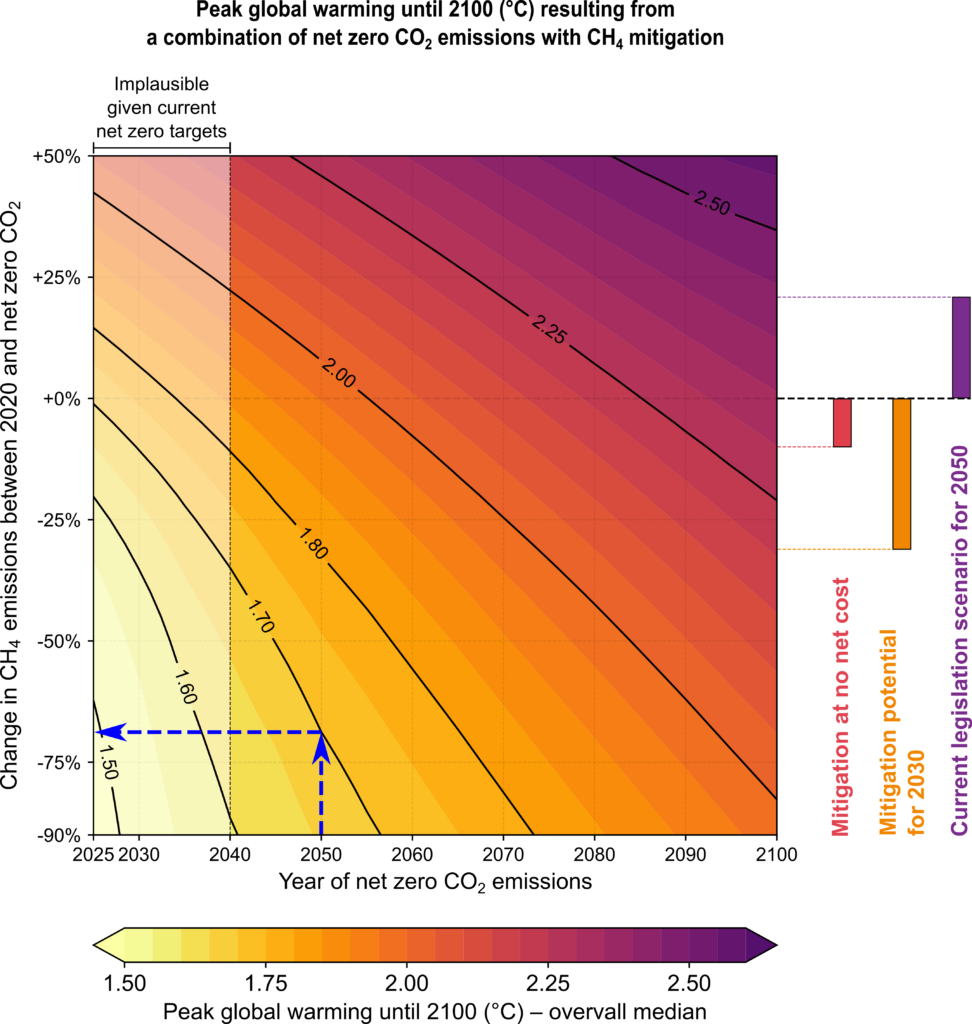
To restrict peak warming to 1.7°C (at a 50% likelihood) while achieving net-zero global $textCO_2$ emissions by 2050, global methane emissions must be reduced by at least 69% by 2050 relative to 2020 levels. If a country or entity targets net-zero across all greenhouse gases by 2050, the required methane reduction drops slightly to 63%. -
The Risk of Zero Methane Action:
If global methane emissions remain flat at 2020 levels while the world achieves net-zero $textCO_2$ by 2040 or later, peak warming will exceed 1.85°C. This level of atmospheric heating violates the "well-below 2°C" core mandate of the Paris Agreement. -
Current Policy Trajectory (+20% Methane):
Under current non-augmented policy scenarios where methane emissions rise by 20% by 2050, peak warming will exceed 2.0°C by mid-century—even if global $textCO_2$ emissions successfully reach net-zero by 2050.
-
Near-Term Mitigation Dividend:
Cutting methane emissions by approximately one-third by 2030 (aligning with the Global Methane Pledge) shaves 0.15°C off peak global warming. Importantly, data from the IEA indicates that 0.05°C of this temperature reduction can be achieved through zero-net-cost interventions—primarily by repairing gas leaks, stopping routine flaring, and capturing coal mine vent gas.
Required Methane Reductions vs. Peak Warming Limits
The following matrix illustrates the minimum mandatory methane cuts (or maximum allowable increases) between 2020 and the year of reaching net-zero, across various peak warming targets:
| Target Peak Warming (°C) | Net-Zero $textCO_2$ by 2050 | Net-Zero $textCO_2$ by 2060 | Net-Zero $textCO_2$ by 2100 | Net-Zero GHG by 2050 | Net-Zero GHG by 2060 | Net-Zero GHG by 2100 |
|---|---|---|---|---|---|---|
| 1.7°C | -69% | Unachievable | Unachievable | -63% | Unachievable | Unachievable |
| 1.8°C | -32% | -56% | Unachievable | -11% | -47% | Unachievable |
| 2.0°C | +8% | -8% | -83% | > +50% | +33% | -78% |
Note: Percentages denote required change relative to 2020 baseline levels. Values designated as "Unachievable" indicates that even with 100% methane elimination, the delayed $textCO_2$ net-zero date alone causes peak warming to exceed the specified threshold.
Severe Impacts on the Remaining Carbon Budget
The study highlights how methane policy directly dictates the size of the remaining allowable $textCO_2$ carbon budget:
- Standard IPCC Baseline: Assumes a 27% to 35% methane reduction by 2050, granting a remaining budget of ~1,000–1,150 $textGtCO_2$ for a 2.0°C limit.
- The $textGWP^*$ Metric Constraint*: If methane is cut only enough to prevent additional warming (as measured under the alternative metric $textGWP^$), the allowable 2.0°C carbon budget contracts by 30%, shrinking to roughly 750 $textGtCO_2$**.
- Zero Methane Abatement Scenario: If future methane emissions are not cut at all, the remaining global carbon budget for limiting warming to 1.7°C is completely exhausted.
Official Statements and Institutional Perspectives
The findings of the Weber et al. (2026) study have drawn significant attention from climate scientists, policy analysts, and international bodies responsible for assessing climate targets.
Writing in Communications Earth & Environment, the lead research team emphasized that bundling gases actively undermines real-world climate action:

"Decoupling $textCO_2$ and methane reductions provides a clear, unconflicted starting point for climate target setting. Instead of relying on arbitrary equivalence metrics that disguise atmospheric realities, states and corporations must first define their acceptable limit on peak global warming, and then determine the non-negotiable minimum methane cut required to support their net-zero $textCO_2$ target."
Reflecting on the findings, analysts from the International Energy Agency (IEA) highlighted the substantial, low-hanging fruit presented by fossil fuel operations:
"The research confirms that near-term methane abatement offers an irreplaceable insurance policy against overshooting global temperature limits. With a significant portion of methane reductions in the energy sector achievable at no net financial cost, failing to implement these direct controls represents an avoidable risk to global climate stability."
Furthermore, representatives assessing the UNEP Global Methane Status Report noted that relying solely on overall greenhouse gas targets creates systemic policy oversights:
"Treating methane as a secondary component within overall $textCO_2$-equivalent metrics has led many national strategies to defer action on agriculture and waste emissions. This research proves that without standalone, stringent methane targets running parallel to net-zero carbon plans, the world cannot limit peak warming to well-below 2°C."
Future Outlook: Redefining Climate Policy and Target-Setting
The realization that net-zero $textCO_2$ strategies are insufficient on their own is driving calls to reform international climate governance and corporate target frameworks.

       STRATEGIC ROADMAP FOR DECOUPLED CLIMATE TARGETS

 [ 1. National NDCs ] ──────► Establish explicit, standalone CH4 target
                              numbers alongside net-zero CO2 dates.

 [ 2. Corporate Governance ] ─► Separate Scope 1 & 3 CH4 tracking
                              from gross CO2 equivalency reporting.

 [ 3. Sectoral Deployment ] ──► Deploy immediate, zero-net-cost leak
                              detection in fossil fuel systems.
Key Reclassifications for Global Policy
-
Updating Nationally Determined Contributions (NDCs):
As countries submit updated national climate targets under the Paris Agreement framework, international bodies are pressing governments to adopt explicit, standalone methane mitigation percentages alongside their overarching net-zero timeline goals. Following the model used by Mexico, Japan, and South Korea, future NDCs must clarify exactly how much methane will be cut independently of $textCO_2$ offset schemes. -
Reforming Corporate Net-Zero Frameworks:
Standard-setting organizations (such as the Science Based Targets initiative – SBTi) face increasing pressure to update corporate accounting rules. Companies operating in agriculture, waste management, and fossil energy will likely be required to report and abate methane on a separate track rather than neutralizing methane footprints through long-term $textCO_2$ offset purchases. -
Targeting High-Impact Sectoral Levers:
- Energy Infrastructure: Enforcing rapid leak detection and repair (LDAR) protocols, eliminating non-emergency venting and flaring, and sealing abandoned wells. Because these interventions are cost-effective, they represent the primary mechanism for delivering the 0.05°C near-term warming reduction identified in the study.
- Agriculture: Accelerating dietary shifts, scaling feed additives for enteric fermentation in livestock, and reforming water management practices in rice cultivation.
- Waste Sector: Expanding landfill gas capture infrastructure and diverting organic waste streams away from anaerobic environment conditions.
Conclusion
The research by Weber et al. (2026) delivers a clear message to the international climate community: $textCO_2$ targets and methane targets are complementary, not interchangeable.
While reaching net-zero $textCO_2$ remains the absolute baseline requirement for stabilizing long-term global temperatures, stringent and immediate methane cuts serve as the only viable mechanism to suppress near-term heating spikes. Policy frameworks that decouple these two distinct gases offer a more accurate, transparent, and effective pathway to securing a climate-safe future.



