

Executive Overview
For decades, the global energy transition has marched steadily forward in the electricity and light transportation sectors. Wind turbines, solar arrays, and lithium-ion batteries have transformed how grids operate and how passenger vehicles travel. Yet, an elephant has remained in the room, stubbornly consuming roughly 20 percent of all global energy while continuing to belch massive quantities of greenhouse gases into the atmosphere: heavy industry.
The production of steel, aluminum, cement, glass, and specialized chemicals requires an immense amount of high-temperature thermal energy, colloquially known as "process heat." Historically, this thermal threshold—often exceeding 1,500 to 1,800 degrees Celsius—could only be achieved by burning fossil fuels, primarily coal and methane. Electrical resistance heating elements of the past simply could not survive these extreme temperatures, melting, burning out, or failing under the strain of continuous industrial duty. Consequently, heavy industries were branded as "hard-to-abate" sectors, seemingly locked into a permanent carbon-intensive future.
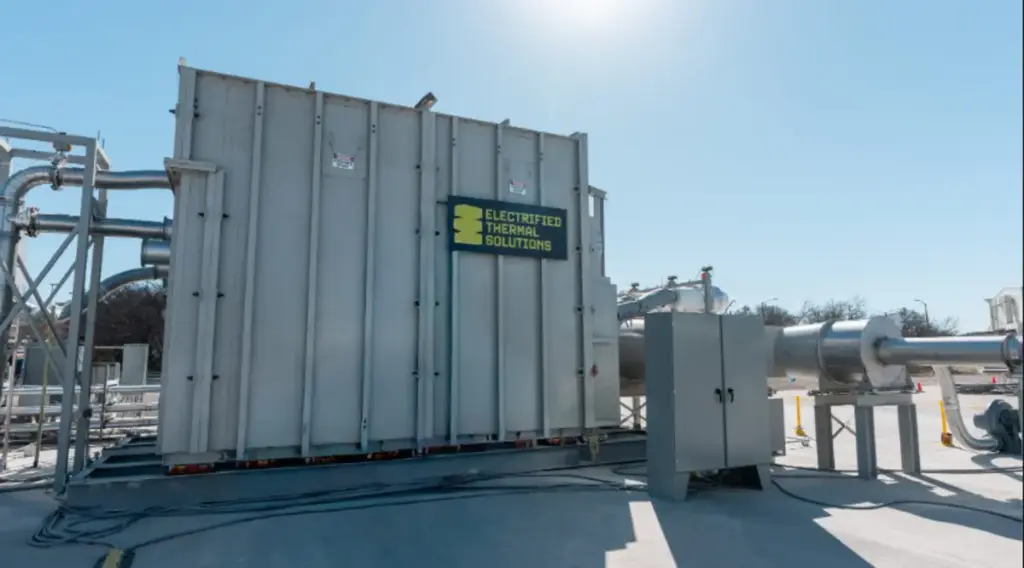
That paradigm is now fracturing. Electrified Thermal Solutions (ETS), an MIT spin-off born out of more than a dozen years of dedicated research, has successfully commercialized a revolutionary breakthrough: the Joule Hive thermal battery. By reformulating ordinary firebricks to make them electrically conductive without the use of exotic or degradable metals, ETS has created a direct-resistance heating system capable of safely reaching 1,800°C.
Operating at a staggering 95 percent efficiency, the Joule Hive acts as a thermal sponge, soaking up intermittent, cheap renewable energy during off-peak hours and safely storing it for up to three days. Following critical testing milestones—including a successful 1,000-hour operational demonstration at the Southwest Research Institute—the technology has officially leaped from the laboratory into the real world. Recent milestones include a major deployment by cement giant Holcim and a Department of Energy-backed installation at an Ashland chemical plant in Kentucky. This development signals a seismic shift: the electrification of heavy industry is no longer a theoretical ambition; it is an underway industrial revolution.
Detailed Chronology: From MIT Labs to Industrial Deployments
To understand the magnitude of the Joule Hive’s arrival, it is necessary to trace the timeline of innovation, validation, and commercialization that brought Electrified Thermal Solutions to the forefront of global decarbonization.
- The Genesis (Early 2010s): Researchers at the Massachusetts Institute of Technology begin foundational studies into electrified firebricks. Recognizing that process heat represents the single largest hurdle in industrial decarbonization, the team investigates ways to modify the chemical structure of standard ceramic bricks. Their goal: enable ordinary firebrick to act simultaneously as a structural thermal mass and a high-temperature electrical heating element.
- Company Formation & R&D Maturation: Co-founders Daniel Stack and his colleagues officially launch Electrified Thermal Solutions. Over the next several years, they perfect the chemistry, integrating metallic oxides into the firebrick matrix. Unlike traditional heating systems that rely on delicate metallic wires or graphite elements prone to oxidation and burnout, the ETS firebrick contains no exotic metals. It is chemically stable, robust, and designed to endure punishing industrial environments.
- The 2022 Horizon: Clean energy media spotlight the emerging technology as experts begin mapping out strategies to tackle industrial emissions. As global climate targets draw closer, the pressure mounts on heavy industry to look beyond incremental efficiency gains and adopt radical electrification strategies.
- The 2024 Department of Energy Milestone: Specialty chemical manufacturer Ashland wins a matching grant of up to $35 million from the U.S. Department of Energy (DOE). The funding is earmarked to deploy the world’s first commercial-scale Joule Hive system at its ISP Chemicals plant in Calvert City, Kentucky. In partnership with the Tennessee Valley Authority (TVA), the project is designed to replace aging, methane-fired steam boilers with clean, grid-charged thermal batteries.
- The 2025–2026 Proof of Concept: ETS erects its first commercial-scale Joule Hive demonstration system at the Southwest Research Institute in San Antonio, Texas. The unit undergoes rigorous trials, successfully logging more than 1,000 hours of continuous operation. This milestone provides critical operational verification, proving that the system can reliably deliver high-temperature output under realistic industrial loads.
- September 2026: The Holcim Commercial Breakthrough: Cement giant Holcim—one of the largest building materials producers in the world—announces the completion of the installation of two Joule Hive thermal batteries at one of its key production facilities. This marks the entry of ETS into the global cement market, establishing Holcim not only as an early-adopter customer but also as a strategic investment partner.
Supporting Context & Metrics: The Scale of the Challenge
To fully appreciate why the Joule Hive is capturing the attention of heavy industry executives and international climate bodies, one must examine the hard numbers defining industrial pollution.
The Anatomy of Process Heat
Approximately one-fifth of all global energy consumption is dedicated to generating process heat. While low-temperature heat applications—such as food pasteurization, commercial space heating, and low-pressure steam generation—can be readily electrified using commercial heat pumps, high-temperature operations demand an entirely different order of magnitude.
Making steel requires temperatures hovering around 1,500°C. Manufacturing glass requires sustained heat near 1,600°C. Producing cement clinker inside a rotary kiln demands internal temperatures reaching roughly 1,450°C (with flame temperatures inside burners soaring past 2,000°C). Until the advent of the Joule Hive, electricity could not practically or economically match these thermal thresholds at a scale required by continuous manufacturing plants.
Cement and Steel: The Heavyweights of Carbon
The building blocks of modern civilization carry a heavy climate footprint:
- Cement Production: Responsible for roughly 8 percent of global carbon dioxide emissions. The emissions profile is two-fold: half comes from burning fossil fuels to heat the kilns, and the other half is process emissions released chemically when limestone ($CaCO_3$) is thermally decomposed into lime ($CaO$) and $CO_2$. While innovators like MIT spin-off Sublime Systems are tackling the chemical decarbonization side, Electrified Thermal Solutions addresses the thermal energy side.
- Chemical Manufacturing: Facilities like Ashland’s Calvert City plant rely heavily on massive volumes of high-temperature steam to drive chemical synthesis and distillation processes. In 2022 alone, the Ashland plant emitted 72,000 tons of carbon dioxide from burning methane—the equivalent of the annual greenhouse gas emissions generated by 17,000 gasoline-powered passenger automobiles. In a tight-knit community of 2,500 residents, this singular facility represented a disproportionate share of local environmental pollution.
How the Joule Hive Works
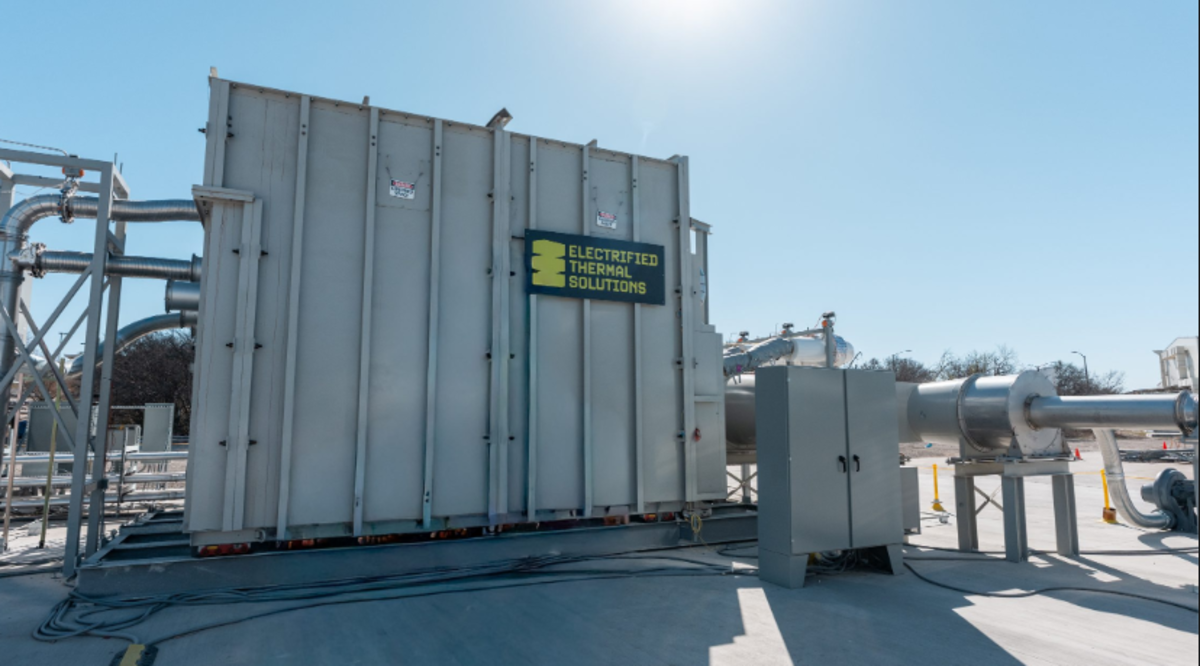
The mechanical elegance of the Joule Hive lies in its simplicity. ETS stacks modified, electrically conductive firebricks inside an elevator-sized, heavily insulated thermal enclosure.
When electricity from the grid—ideally sourced from cheap, abundant wind or solar generation during peak renewable production hours—is passed directly through the firebricks, electrical resistance causes the bricks to rapidly heat up. The system can reach temperatures as high as 1,800°C. Because the bricks themselves are the heating elements, there are no intermediary heating coils to degrade or fail.
The modular enclosure acts as a thermal battery, trapping the heat with minimal losses and storing it securely for up to three days. When process heat or steam is required on the factory floor, ambient air is blown through the core of the Joule Hive. The air superheats as it passes over the bricks and is subsequently channeled into industrial kilns, or used to boil water into high-pressure steam for chemical processing and electricity generation. Operating at a 95 percent round-trip thermal efficiency, the system turns variable renewable electricity into a reliable, dispatchable thermal commodity.
Official Statements and Industry Validation
The transition from lab curiosity to commercial reality requires validation from cautious, risk-averse industrial giants. Leaders from across the energy, chemical, and cement sectors have voiced strong endorsement for the ETS technology.
Daniel Stack, co-founder and CEO of Electrified Thermal Solutions, emphasized the profound shift represented by recent commercial agreements:
"Holcim’s decision to deploy our technology validates years of work to bring electrified heat to high-temperature industrial-scale applications that no other technology or company can achieve. This agreement follows the recent turn-on and successful 1,000+ hours of operation of our commercial demonstration system and shows that global industrial producers are ready to move this technology from demonstration to deployment. We look forward to expanding this relationship with Holcim over time."
Describing the mechanical purity and durability of the system, Stack noted in earlier statements to Inside Climate News:
"There’s no exotic metals in here, there’s nothing that’ll burn out."
For multinational building materials producers like Holcim, the stakes are exceptionally high. Ram Muthu, head of operational excellence at Holcim, contextualized the partnership within the company’s broader corporate sustainability roadmap:
"Electrifying high-temperature industrial heat is one of the advanced technologies we are incorporating in our decarbonization strategy, and this deployment allows us to evaluate its potential. Working with Electrified Thermal gives us a path to accelerate decarbonization as part of our industry-shaping sustainability road map."
The integration of industrial electrification must also be managed carefully at the grid level to prevent infrastructure bottlenecks. Curt Jawdy, a senior manager with the Tennessee Valley Authority—a key utility partner on the Department of Energy grant supporting the Kentucky deployment—highlighted the grid-balancing benefits of thermal storage:
"Simpler is always better. The fact that the brick is also the heating element, and you just supply electricity to the brick itself, simplifies the system significantly. The ability to charge thermal batteries during off-peak hours allows industrial facilities to decarbonize without placing greater strain on the utility’s electric grid."
According to U.S. Department of Energy projections, the deployment of the Joule Hive system at the Calvert City facility is slated to slash greenhouse gas emissions associated with steam generation at the plant by nearly 70 percent.
Future Outlook: Reshaping the Global Industrial Landscape
As Electrified Thermal Solutions moves past its initial commercial validations, the horizon for high-temperature industrial electrification opens up dramatically. The implications of the Joule Hive extend far beyond individual cement plants or specialty chemical facilities.
Scaling Up and Sector Expansion
With active deployments now established in Texas, Kentucky, and through Holcim’s global facilities network, ETS has proven that its technology is modular, scalable, and adaptable. The company’s customer pipeline now actively targets the three most difficult sectors to decarbonize:
- Cement and Concrete: Replacing fossil fuel burners in raw material calciners and pre-calciners.
- Steel and Metallurgy: Supplying high-temperature pre-heat and process support for electric arc furnaces and direct reduced iron (DRI) processes.
- Chemicals and Refining: Eliminating methane-fired steam methane reformers and auxiliary boiler systems.
Furthermore, ETS points out that steam is the fundamental driver behind traditional thermal power generation stations. By coupling Joule Hive thermal batteries with existing power plant infrastructure, legacy coal and gas power stations could theoretically pivot away from burning fossil fuels entirely. Instead of combusting hydrocarbons to generate steam, these plants could utilize excess renewable grid power to supercharge firebrick thermal batteries, converting old thermal power plants into zero-emission, grid-balancing storage hubs.
A Blueprint for Deep Decarbonization
The global race to net-zero carbon emissions cannot be won by tinkering solely at the edges of energy consumption. While light-duty electric vehicles and residential heat pumps capture the majority of public headlines, the true test of human ingenuity lies in cleaning up the heavy industrial processes that build our modern world.
By looking backward to ancient materials—firebrick and ceramics—and combining them with modern thermodynamic engineering, Electrified Thermal Solutions has bypassed the material-science dead ends that once constrained electrical heating. As these thermal batteries scale up across international manufacturing plants, they offer a tangible, highly efficient blueprint for dismantling the fossil-fuel dependency of heavy industry once and for all. The era of the electrified heavy industrial plant has officially arrived.



