Executive Overview
In July 2026, European coastal waters crossed a critical ecological threshold, recording unprecedented, staggering sea surface temperatures that shocked the scientific community. A rapid and comprehensive attribution study released by World Weather Attribution (WWA)—an international network of climate scientists specializing in quantifying the fingerprints of global warming on extreme weather events—has confirmed that this intense marine heat spike was overwhelmingly driven by human-induced climate change.
Pushing fragile marine ecosystems well past their physiological breaking points, the July 2026 marine heat waves materialized months ahead of the traditional seasonal peak. Typically, Mediterranean and Atlantic surface waters achieve their maximum annual warmth during late summer, specifically between August and September. By experiencing extreme anomalies as early as July, European seas have demonstrated a terrifying acceleration in ocean warming trends.
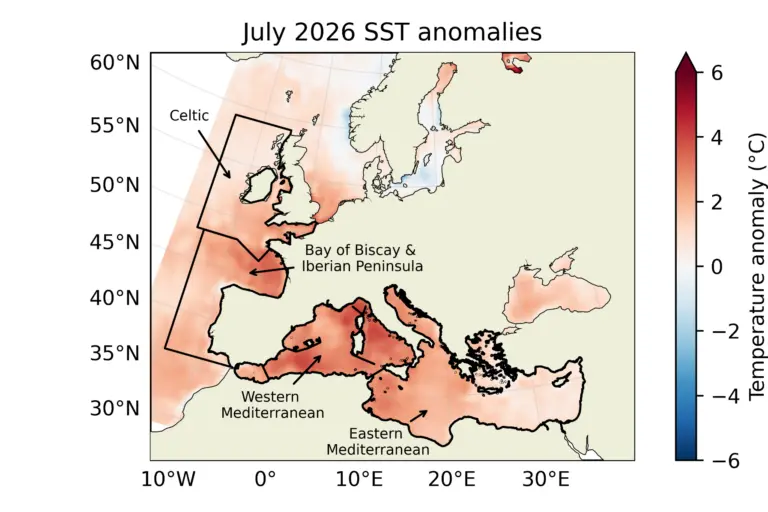
Across the four primary maritime zones analyzed in the study—the Celtic Sea, the Bay of Biscay and the Iberian Peninsula (BIP), and the western and eastern basins of the Mediterranean Sea—temperatures averaged a staggering 2.4°C (4.3°F) above historical July baselines. Individual basins experienced severe localized deviations; the Celtic Sea sat 1.9°C (3.4°F) above normal, while the Eastern Mediterranean surged by a remarkable 2°C (3.6°F) over typical conditions.
According to the WWA analysis, these extreme mid-summer temperatures would have been mathematically and physically "virtually impossible" in a preindustrial climate (which was roughly 1.4°C, or 2.5°F, cooler). Today, however, driven by decades of unchecked greenhouse gas emissions, such catastrophic marine heat events have become "relatively common." The findings serve as a stark, urgent warning: without an immediate, aggressive global transition away from fossil fuels, European waters are projected to heat by an additional 1.3°C to 1.9°C (2.3°F to 3.4°F) by the end of the 21st century, spelling near-total devastation for the continent’s marine biodiversity.
Detailed Chronology: Unpacking the July 2026 Marine Heat Wave
To understand the unprecedented nature of the July 2026 event, researchers had to pivot away from standard meteorological timelines. Marine heat waves are generally monitored across extended periods, but the WWA research team specifically targeted the warmest 14-day continuous periods occurring within July 2026.
By isolating this mid-summer window, scientists could precisely measure how early-season thermal accumulation has fundamentally shifted in response to systemic global warming. Historically, ocean basins require the cumulative, relentless solar radiation of both June and July to prime the waters for late-summer peak heating. In 2026, however, that trajectory was short-circuited. Prolonged atmospheric heat domes, compounded by weak localized winds and stagnant oceanic currents, trapped heat within shallow coastal shelves and enclosed basins far earlier than ever previously recorded.
The chronology of the event unfolded rapidly across regional sectors:
- Early July 2026: Unusually stagnant atmospheric conditions settled over the Iberian Peninsula and extended northward into the Bay of Biscay, initiating premature thermal stratification in the upper layers of the ocean.
- Mid-July 2026: Surface temperatures across the Western and Eastern Mediterranean violently detached from historical seasonal baselines. Within days, vast swaths of the sea turned into thermal incubators, triggering localized marine emergency alerts.
- Late July 2026: The anomaly pushed northward into the Celtic Sea, ensuring that virtually every major European coastal and shelf ecosystem was simultaneously grappling with unprecedented heat stress before the climatological summer peak had even begun.
This compressed timeline caught marine life completely off guard. Unlike terrestrial species, which can seek shade or migrate across land barriers when faced with sudden heat waves, marine organisms are frequently boxed in by geographical boundaries, depth requirements, and temperature gradients. When the entire water column warms simultaneously and prematurely, the ecological shock is absolute.
Supporting Context & Metrics: Quantifying the Human Fingerprint
The scientific rigor behind the WWA study relies on advanced climate modeling and peer-reviewed attribution science, comparing observational data from NOAA’s Optimum Interpolation Sea Surface Temperature (OISST) dataset against counterfactual models of a world without human greenhouse gas emissions.
The results of this computational breakdown highlight the direct, undeniable role of fossil fuel combustion in reshaping European waters:
- The Mediterranean Basins: Climate change added approximately 2°C of direct heat to both the Western and Eastern Mediterranean during the July heat wave. In the Eastern Mediterranean, climate change accounted for the entirety of the 2°C anomaly, meaning that without anthropogenic warming, this specific heat spike would not have registered above normal historical variance.
- The Atlantic Shelves: In the Celtic Sea and the Bay of Biscay/Iberian Peninsula (BIP) regions, anthropogenic climate change directly injected between 1.1°C and 1.4°C (2°F to 2.5°F) of excess heat into the water.
Spatial Expansion of Marine Heat Waves
Perhaps the most alarming metric revealed in the study is not just how hot the water got, but how much more of the ocean was subjected to extreme heat conditions.
Lead author Claire Bergin of Maynooth University, Ireland, underscored this spatial expansion during a global press briefing:

"We find that without human-caused global warming, we would expect only 30% of the area of the Celtic region to have experienced a marine heat wave, in comparison to a staggering 80% in today’s climate. In the Western Mediterranean, the change is from 40% up to 80%, and in the Eastern Mediterranean, the change has gone from a startling 9% to a devastating 70% in today’s climate."
These metrics illustrate a chilling reality: marine heat waves are no longer isolated, freak occurrences localized to shallow lagoons or unusually calm bays. They have expanded into pervasive, regional systemic states that envelope entire seas.
Official Statements and Expert Analysis
The ecological ramifications of these temperature anomalies extend far beyond abstract figures on a chart; they represent an existential threat to the biological fabric of European seas.
Co-author Dr. John Bruno, a prominent marine ecologist at the University of North Carolina at Chapel Hill, explained the physiological mechanisms driving the crisis during the WWA media briefing.
"Generally speaking, the primary impact is simply when organisms […] exceed the physiological thresholds they can tolerate," Bruno stated. "The temperature increases […] are way beyond the thresholds that are required for mass mortality."
Bruno elaborated on the cold-blooded (ectothermic) nature of the vast majority of marine animals. Because an aquatic animal’s body temperature directly tracks the temperature of the surrounding seawater, an artificial, rapid spike in sea temperature drastically accelerates their metabolic rates. This metabolic overdrive demands significantly more energy and oxygen at a time when warmer water naturally holds less dissolved oxygen. The biological result is a catastrophic mismatch: animals starve to death rapidly while suffocating in oxygen-depleted waters, triggering a systemic collapse across the entire marine food web.
The cascading effects are immediate and visible. Habitat-forming foundation species—such as stony corals, gorgonians, seagrasses, and canopy-forming macroalgae (kelp forests)—are dying off en masse. These species form the structural backbone of marine ecosystems, providing nurseries, feeding grounds, and shelter for hundreds of commercial fish species and microscopic organisms. When foundation species suffer mass mortality events, the structural integrity of the entire ecosystem collapses, threatening fisheries, coastal economies, and the livelihoods of millions of Europeans who depend on the sea.
Future Outlook: The Century Ahead
As the world grapples with the immediate aftermath of the July 2026 marine disaster, climate scientists are casting their gaze toward the future with deep concern. The trajectory of European coastal waters is inextricably linked to global energy policies and the speed of decarbonization over the next two decades.
According to projections presented by Claire Bergin, if global society fails to enact immediate, aggressive greenhouse gas emissions reductions, the sea surface temperatures observed in July 2026 will look mild by comparison. Without a rapid transition away from fossil fuels, regional ocean temperatures are expected to climb by an additional 1.3°C to 1.9°C (2.3°F to 3.4°F) by the year 2100.
Such an increase would transform European seas entirely. Ecosystems like the Mediterranean—already operating near the absolute thermal limits of numerous endemic species—would experience near-permanent state shifts, turning into biologically impoverished, jellyfish-dominated dead zones. Coral reefs and Mediterranean gorgonian forests would be virtually wiped out, and commercial fishing industries across Southern and Western Europe would face terminal collapse.
The July 2026 marine heat wave is not an isolated anomaly, nor is it a temporary blip on a long-term chart. It is a loud, undeniable warning flare from the depths of our oceans. As scientific consensus solidifies around the direct human culpability of these temperature extremes, the onus shifts entirely to policymakers, industrial leaders, and global governments. The window to stabilize ocean temperatures, protect marine biodiversity, and prevent irreversible planetary tipping points is closing rapidly—measured not in decades, but in years.