Executive Overview
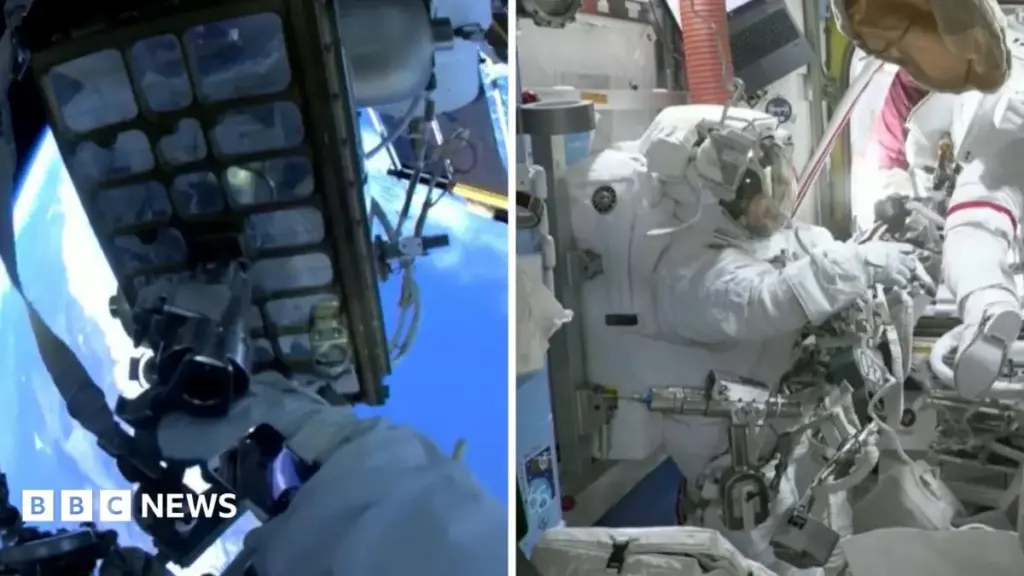
In a milestone moment for human spaceflight, NASA astronaut Jessica Meir and European Space Agency (ESA) astronaut Sophie Adenot successfully completed a grueling six-and-a-half-hour extravehicular activity (EVA) outside the International Space Station (ISS). This meticulously choreographed operation marked only the sixth time in the history of crewed space exploration that a spacewalk has been performed exclusively by a team of women.
The mission, which combined precision robotics with high-dexterity manual labor in the unforgiving vacuum of low Earth orbit, underscores the evolving demographics of elite space exploration. While groundbreaking in its representation, the excursion was far from symbolic; it was a mission-critical infrastructure overhaul designed to maintain the structural and power integrity of humanity’s orbiting laboratory. Meir, a veteran of historic spacewalks, utilized the station’s sophisticated Canadarm2 robotic arm to transport equipment and position worksites, while Adenot—marking a monumental stride in her burgeoning spaceflight career—navigated the exterior trusses tethered directly to the station’s metallic spine.
This operation represents the 284th spacewalk dedicated to the assembly, maintenance, and structural upgrades of the International Space Station since its inception, and stands as the seventh EVA executed within the calendar year. As space agencies globally pivot toward commercialized low Earth orbit economies and prepare for deep-space exploration to the Moon and Mars, missions of this caliber serve as both technical proofs of concept and powerful cultural catalysts. This report provides an exhaustive examination of the mission, detailing its operational timeline, the broader metrics of human spaceflight, official statements from international space agencies, and a forward-looking analysis of what this means for the future of orbital infrastructure.
Detailed Chronology of the EVA
The success of any extravehicular activity hinges on months of rigorous simulation, split-second timing, and absolute synergy between the astronauts inside the pressurized cabin and those venturing into the thermal extremes of space. The operation involving Meir and Adenot was executed with military precision, adhering to a strict, minute-by-minute timeline formulated by Mission Control Houston and coordinated with international partners in Munich and Tsukuba.
Phase I: Pre-Breathe and Suit Preparation (T-4 Hours to T-0)
The day of the spacewalk began long before the hatch opened. At approximately four hours prior to egress, Meir and Adenot commenced the intricate and physically demanding "campout" and pre-breathe protocol inside the Quest airlock. Because the internal pressure of the ISS (roughly equivalent to Earth’s sea level) differs significantly from the 4.3 pounds per square inch (psi) maintained inside Extravehicular Mobility Units (EMUs), astronauts must purge nitrogen from their bloodstreams to prevent decompression sickness, colloquially known as "the bends."
During this phase, the astronauts donned their liquid cooling and ventilation garments (LCVG)—undergarments laced with microscopic tubing designed to circulate cooling water and regulate body temperature during intense physical exertion. Following medical checks and telemetry verifications of their respective EMUs, the crew transitioned their suits to internal battery power, officially disconnecting from the station’s life support umbilical.
Phase II: Hatch Egress and Worksite Transit (Hours 0 to 2)
At precisely the designated hour, the outer hatch of the Quest airlock swung open, exposing the crew to the stark reality of the thermosphere: a silent, airless expanse where temperatures swing violently from 250 degrees Fahrenheit in direct sunlight to minus 250 degrees Fahrenheit in the shadow of the Earth.
Sophie Adenot was the first to egress, carefully maneuvering out of the airlock and establishing her primary safety tether to the station’s Integrated Truss Structure. Working in microgravity requires an entirely re-engineered cognitive and physical approach; every movement must be countered to prevent rotational drift, and tools must be meticulously secured to prevent loss or collision with sensitive station optics and solar arrays.
Simultaneously, Jessica Meir reported to the workstation governing the Space Station Remote Manipulator System (SSRMS), universally known as the Canadarm2. Acting as the primary operator of the 57.7-foot robotic arm, Meir smoothly un-berthed and positioned herself on the foot restraint platform at the end of the boom. Through coordinated audio channels with Mission Control, Meir orchestrated a delicate ballet of mechanical engineering, translating across space to the primary worksite while Adenot traversed the handrails along the P3/S3 truss segments.
Phase III: Core Maintenance and Upgrade Operations (Hours 2 to 5)
Upon convergence at the designated worksite—situated on the port-side truss structure—the duo initiated the primary objectives of the EVA. The mission called for the replacement of aging power-channel electronics, the installation of upgraded communication hardware, and the routing of cabling to prepare the station for the integration of forthcoming Roll-Out Solar Arrays (iROSA).
Adenot demonstrated exceptional mechanical dexterity, utilizing specialized pistol-grip tools (PGTs) designed to operate effectively in zero-gravity environments without transmitting destabilizing torque to the astronaut. Meanwhile, Meir operated as the mobile vantage point, adjusting the Canadarm2 to grant Adenot optimal lighting and physical access to recessed umbilical ports and mounting brackets.
Despite the complexities inherent in working inside bulky, pressurized gloves that limit tactile feedback, the timeline remained exceptionally smooth. Flight controllers in Houston noted that the crew’s efficiency was a direct result of their extensive underwater training sessions at NASA’s Neutral Buoyancy Laboratory (NBL) in Houston, Texas, where a life-size replica of the ISS is submerged in a 6.2-million-gallon pool.
Phase IV: Cleanup, Ingress, and Post-EVA Protocols (Hours 5 to 6.5)
As the ISS completed another orbital sunrise—orbiting the Earth at a blistering 17,500 miles per hour—the crew initiated the wrap-up phase. Tools were accounted for, tethered configurations were secured, and any potential contamination (such as lunar or orbital dust adhered to the suits) was brushed away using specialized EVA-rated remediation mitts.
Adenot made the reverse transit back to the Quest airlock, followed by Meir, who successfully stowed the Canadarm2 into its predetermined park position. Re-entering the airlock at the 6-hour and 30-minute mark, the crew initiated repressurization procedures. As the hatch was safely sealed and cabin pressure normalized, the weary but triumphant astronauts were greeted by their fellow crewmembers with traditional orbital congratulations, marking the official conclusion of EVA number 284.
Supporting Context & Metrics: The Evolution of Spacewalks
To fully comprehend the magnitude of this achievement, one must examine the broader historical tapestry of extravehicular activities, as well as the quantitative metrics that define operations aboard the International Space Station.
A Historical Retrospective on All-Female EVAs
For the first four decades of human spacewalking, the domain was overwhelmingly male, a reflection of early military test-pilot pipelines from which the first generations of astronauts were selected. The very first spacewalk in history was conducted by Soviet cosmonaut Alexei Leonov on March 18, 1965. It took nearly two decades—until July 25, 1984—for Soviet cosmonaut Svetlana Savitskaya to become the first woman to perform an EVA.
American women followed shortly thereafter, with NASA astronaut Kathryn Sullivan stepping into the vacuum later that same year during Space Shuttle Challenger mission STS-41-G. However, despite the growing presence of female astronauts in the corps, logistical hurdles—specifically the design of spacesuit components—frequently constrained scheduling. For many years, NASA maintained only one medium-sized upper torso assembly on the space station, rendering dual-female spacewalks practically impossible due to sizing constraints.
That barrier was decisively shattered on October 18, 2019, when Jessica Meir and Christina Koch floated out of the Quest airlock to replace a failed battery charge/discharge unit (BCDU). That historic event captured global attention and served as a cultural watershed. Since that pivotal day, all-female spacewalks, while still rare due to the complex, multidisciplinary nature of crew assignments, have steadily built a legacy of operational normalcy. This latest excursion by Meir and Adenot represents the sixth time this milestone has been achieved, cementing the reality that gender is entirely immaterial to elite technical performance in the cosmos.
Quantitative Breakdown of ISS Spacewalk Metrics
To contextualize the scale of maintenance required to keep the International Space Station operational, consider the following statistical framework:
- Total Spacewalks in ISS History: 284 (spanning structural assembly from Node 1 in 1998 through modern-day commercial and scientific upgrades).
- Total Spacewalks for the Calendar Year: 7, reflecting an aggressive maintenance schedule designed to mitigate micrometeoroid damage and integrate next-generation solar power generation.
- Duration of Current EVA: 6 hours and 35 minutes (inclusive of prep, execution, and airlock repressurization).
- Orbital Velocity of the ISS: 17,500 mph (28,000 km/h), meaning the station circles the Earth every 90 minutes, forcing astronauts to navigate alternating 45-minute cycles of blinding sunlight and absolute darkness.
- Altitude of Operations: Approximately 250 miles (400 kilometers) above the surface of the Earth.
Official Statements and International Reactions
The significance of the mission resonated across international space agencies, drawing praise from leadership figures who emphasized both the operational triumph and the symbolic resonance of the partnership between NASA and the European Space Agency.
NASA Administrator issued an official statement following the successful hatch closure, highlighting the seamless collaboration between the American and European space programs:
"Today’s successful spacewalk is a testament to the rigorous training, unmatched skill, and unwavering dedication of Jessica Meir and Sophie Adenot. Beyond the critical infrastructure work completed on the truss systems, this mission serves as a shining example of international cooperation and the limitless potential of a diverse astronaut corps. As we look toward the Artemis generation and sustainable habitation on the lunar surface, the technological and human foundations we lay today on the ISS are more vital than ever."
European Space Agency Director General echoed these sentiments, expressing immense pride in astronaut Sophie Adenot’s stellar performance during her orbital tenure:
"Sophie Adenot has once again demonstrated why European astronauts are selected to represent the pinnacle of scientific and operational excellence. To execute a complex, high-risk extravehicular activity alongside a seasoned veteran like Jessica Meir requires immense psychological and physical fortitude. ESA is immensely proud of Sophie’s contribution to the upkeep of the ISS, and we view this mission as a profound milestone for European participation in human spaceflight."
Veteran astronaut Jessica Meir, speaking via audio downlink during the post-EVA debrief, reflected on the historical continuity of the moment:
"When we stepped out there today, we weren’t thinking about history books; we were thinking about the checklists, the hardware, and the health of the space station. But standing shoulder-to-shoulder—or rather, tether-to-tether—with Sophie, I was deeply reminded of how far our program has come. We stand on the shoulders of the incredible women who pushed for access, design equity, and representation in the early days of the space program. It is an extraordinary privilege to pass that torch forward."
Future Outlook: The Next Generation of Orbital Infrastructure
As the International Space Station approaches its third decade of continuous human habitation, missions of this nature are not merely routine maintenance—they are the critical bridge to the future of commercial low Earth orbit and deep-space exploration.
Transitioning to Commercial Destinations
The lessons learned from thousands of hours of cumulative EVA time on the ISS are currently being directly funneled into the design of next-generation, commercially owned and operated space stations. As NASA prepares to de-orbit the ISS at the end of this decade, commercial entities such as Axiom Space, Blue Origin, and Voyager Space are designing modular habitats that will replace the aging station. The architectural insights gained by astronauts navigating complex truss structures, routing power cables, and handling advanced robotics will inform the safety standards and ergonomic designs of these future commercial outposts.
Powering the Future: The iROSA Rollout
A major impetus for recent and upcoming spacewalks is the installation of the International Space Station Roll-Out Solar Arrays (iROSA). The original silicon solar panels, launched in the early 2000s, are degrading naturally due to thermal fatigue and space weathering. By augmenting the station’s power channels with advanced, flexible composite arrays that roll out like carpets in microgravity, engineers are ensuring that the laboratory remains powered to support cutting-edge biological, material, and physical sciences research through the remainder of its operational lifecycle.
The Road to the Moon and Mars
Ultimately, every hour spent working outside the protective hull of the ISS acts as a high-fidelity analog for future planetary exploration. The challenges faced by Meir and Adenot—managing thermal constraints in spacesuits, maintaining fine motor control while tethered in microgravity, and troubleshooting unexpected hardware resistance—are the exact challenges future astronauts will face on the surface of the Moon during Artemis basecamp construction, and eventually, during the first human sorties to the Martian surface.
The success of the sixth all-female spacewalk is more than a milestone for diversity in STEM; it is a clear, undeniable demonstration that humanity’s expansion into the cosmos is powered by the best and brightest minds available, regardless of background. As Jessica Meir, Sophie Adenot, and their colleagues continue their work aboard the orbiting laboratory, they carry with them the technical expertise and visionary spirit required to guide human spaceflight into its next golden era.