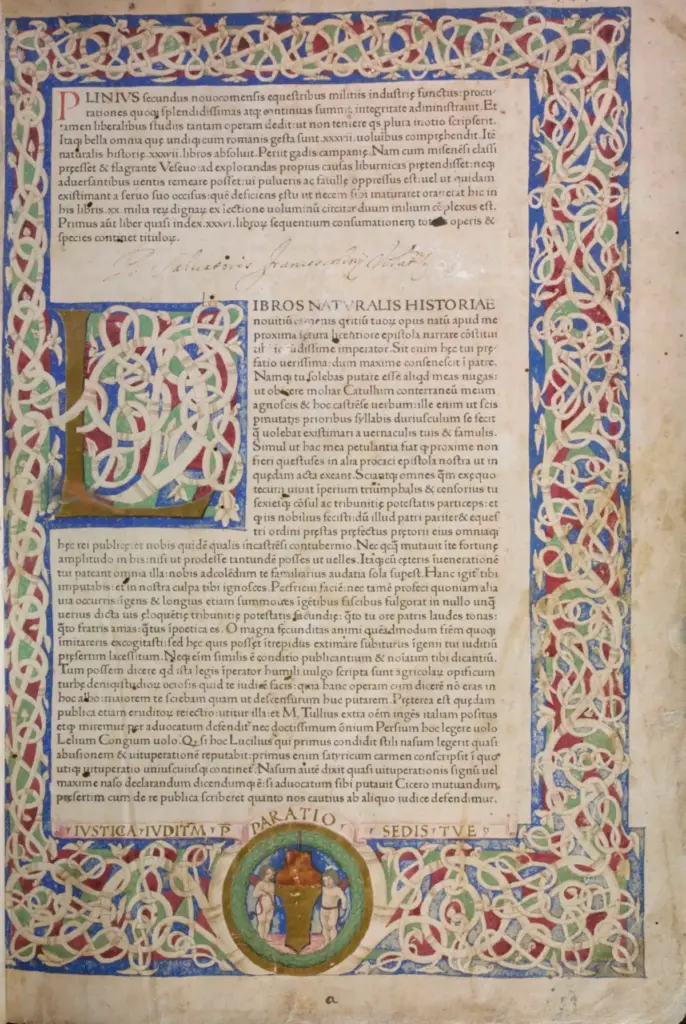
For two decades, the Biodiversity Heritage Library (BHL) has served as the digital cornerstone for historical natural science, liberating centuries-old texts from climate-controlled vaults and placing them into the hands of researchers, historians, and the global public. As the organization marks its 20th anniversary through its commemorative series, BHL at 20: Treasures from the Biodiversity Heritage Library, it highlights cornerstone artifacts that bridge antiquity and the digital age. Among these crown jewels stands a breathtaking survivor of human intellectual history: the 1469 Venetian edition of Pliny the Elder’s Natural History (Historia Naturalis), printed by Johann de Speyer.
Held in the collection of the Natural History Museum (NHM) in London and recently showcased to international delegates at the annual BHL meeting, this rare incunabulum represents a pivotal intersection in media history. It merges the ancient Roman drive to map, categorize, and control the natural world with the nascent power of Gutenberg’s movable-type printing press. While modern scholarship continues to debate whether Pliny’s masterwork constitutes the world’s first encyclopedia or an ambitious Imperial assertion of Roman dominance, its survival—and its seamless integration into the modern digital ecosystem—demonstrates the enduring value of collaborative, open-access preservation. This report explores the dramatic origins of the text, its journey through the fifteenth-century printing revolution, its physical life marked by centuries of human annotations, and its ongoing legacy within the digital archives of the twenty-first century.
Detailed Chronology
AD 79: The Shadow of Vesuvius and the Birth of a Legacy
On a fateful afternoon in August AD 79, a family gathered at a sunlit villa overlooking the breathtaking expanse of the Bay of Naples. Outside, seventeen-year-old Pliny the Younger and his mother, Plinia, noticed a meteorological anomaly on the horizon: an unusual, towering cloud ascending from a distant peak. As the teenager later recounted in surviving letters to the historian Tacitus, the cloud assumed the distinct silhouette of a Mediterranean pine tree—an image that modern observers instantly recognize as the classic mushroom cloud of a catastrophic pyroclastic eruption.
Plinia alerted her brother, Gaius Plinius Secundus—better known to history as Pliny the Elder. Serving as the Admiral of the Roman Fleet stationed at Misenum, the elder Pliny was a man of relentless curiosity, intellectual vigor, and sweeping administrative duties. Rather than fleeing, his immediate instinct was to investigate the phenomenon up close. What began as a scientific expedition rapidly morphed into a desperate rescue mission as the full scale of the disaster became apparent.
Crossing the bay to Stabiae, the elder Pliny found himself trapped amid toxic volcanic fumes raining down from Mount Vesuvius. Already suffering from respiratory weakness, the legendary scholar collapsed and died, leaving behind a nephew whose written accounts would immortalize both his uncle’s final hours and the destruction of Pompeii and Herculaneum. Though Pliny the Elder perished in the ashes of Vesuvius, his intellectual ambitions outlived him, preserved across dozens of lost military and historical tracts and one monumental, surviving masterwork.
Antiquity to the Middle Ages: The Survival of the Natural History
Pliny the Elder’s literary output was staggering. His lost works included detailed accounts of the Roman military campaigns in Germania (where he served with distinction in the cavalry), a specialized treatise on throwing a lance from horseback, and exhaustive studies on Latin grammar. Yet, his ultimate monument to human learning was the Natural History.
Composed of 37 comprehensive books, likely published posthumously, the text attempted to compile all known information regarding the natural and physical world. It spanned subjects as diverse as astronomy, geography, zoology, botany, and horticulture. Without a formal, pre-existing tradition of encyclopedic compilation to draw upon, Pliny forged a new genre. He pulled together an estimated 20,000 distinct factual entries, merging empirical observation, contemporary Roman science, folklore, and myth into a sweeping literary panorama.
Following Pliny’s death, his Natural History embarked on a remarkable manuscript journey. Through the turbulent collapse of the Western Roman Empire and across the intellectual workshops of the Middle Ages, the text remained a prized, heavily copied asset. Long before the invention of the printing press, scribes had laboriously hand-copied at least 200 distinct manuscript versions of the text, ensuring its survival across monastic libraries and scholarly centers throughout Europe.
1469: The Incunabula Revolution in Venice
The dawn of the printing press changed the trajectory of human knowledge forever. Roughly a decade and a half after Johannes Gutenberg utilized movable metal type to print his famous Bible in Mainz, Venice emerged as the vibrant capital of European publishing. In 1469, the Venetian Senate granted a commercial printing monopoly to Johann de Speyer, authorizing him to bring major classical texts into the mechanical age.
De Speyer recognized the immense commercial and cultural value of Pliny’s work. Selecting the Natural History as one of his inaugural printing projects, he produced an edition tailored explicitly to wealthy, elite clientele. This 1469 Venice edition was not merely a utilitarian reading text; it was designed as a luxury commodity. It featured expansive, wide margins, elegant typography, and hand-decorated initials that consciously mirrored the aesthetic of high-end manuscript production.
Today, the Natural History Museum in London preserves one of these exceedingly rare 1469 volumes. Historians estimate that de Speyer produced a run of only about 100 copies. The survival of the NHM copy—verified through historical flyleaf notes as "perfect" despite later restorative facsimile folios—represents a miraculous bridge between the scriptorium and the modern library.
The Digital Era: Joining the Biodiversity Heritage Library
As centuries passed, Pliny’s work continued to evolve through translations, such as Philemon Holland’s celebrated 1st English translation in 1601, and countless scholarly editions. However, the twenty-first century introduced a profound shift: digital democratization.
Through the collaborative efforts of international institutions—including the Natural History Museum (London), the Boston Public Library, and McGill University Library—multiple historical editions of Pliny’s Natural History (spanning incunabula from 1469, 1472, 1473, 1481, and 1497) have been digitized and ingested into the Biodiversity Heritage Library. Celebrating its 20th anniversary, BHL has successfully transformed these delicate, physical artifacts into globally accessible digital assets. While the baton for the "oldest item on BHL" has recently passed to the Circa Instans manuscript at the New York Botanical Garden’s LuEsther T. Mertz Library, Pliny’s 1469 incunabulum remains a foundational pillar of the BHL collection, embodying the organization’s core mission to keep historical scientific heritage open to all.
Supporting Context & Metrics
To fully appreciate the scope of Pliny’s Natural History and its home within the Biodiversity Heritage Library, it is valuable to examine the quantitative and historical data defining the project:
100 Copies: Estimated total print run of Johann de Speyer’s landmark 1469 Venetian edition of the Natural History.
37 Books: The structural division of Pliny’s masterwork, covering subjects from cosmology and geography to medicine, agriculture, and art history.
20,000 Facts: The approximate tally of distinct pieces of information, observations, and historical notes compiled by Pliny from hundreds of antecedent authors.
200+ Manuscripts: The number of hand-copied manuscript versions known to have survived the Middle Ages prior to the advent of mechanical printing.
1501 Cutoff: The formal definition of incunabula—books printed using movable metal type prior to the year 1501. BHL holds multiple incunabula editions of Pliny, including printings from Venice (1469, 1472, 1497), Rome (1473), and Parma (1481).
20 Years of BHL: Two decades of continuous digital preservation, uniting major natural history libraries worldwide to provide free, unrestricted access to millions of pages of biodiversity literature.
Official Statements
Reflecting on the milestone anniversary of the Biodiversity Heritage Library and the ongoing significance of foundational texts like Pliny’s Natural History, institutional leaders and cultural heritage experts have emphasized the vital role of open-access digital repositories.
"For 20 years, BHL has made treasures like this freely accessible to the world. With your support, we can ensure these treasures—and the knowledge they hold—remain open for generations to come."
— The Biodiversity Heritage Library Outreach & Development Initiative
Scholars examining the reception of Pliny’s work in early modern print culture note that the physical survival of annotated incunabula provides a unique window into past intellectual habits. As highlighted during the recent BHL Annual Meeting in London, the marginalia found across the 1469 de Speyer edition—written in at least two distinct historical hands—illustrate how Renaissance scholars interacted with the text.
"Annotations to the margins… demonstrate active use of the volume. Johann de Speyer knowingly produced a product that would appeal to a wealthy clientele, utilizing wide margins that allowed the reader to make annotations, often as a means of navigating the text."
— BHL Archival and Curatorial Notes
Future Outlook
As the Biodiversity Heritage Library looks beyond its twentieth anniversary, the imperative to preserve, digitize, and contextualize historical biodiversity literature becomes increasingly urgent. The digital curation of incunabula such as the 1469 Pliny Natural History moves far beyond simple archival record-keeping; it forms an active, dynamic foundation for modern scientific and historical research.
Future initiatives within the BHL consortium focus on enhancing interoperability, leveraging advanced optical character recognition (OCR) for early Latin typography, and deepening collaborative networks with global institutions. By expanding access to rare, pre-modern texts and integrating them with contemporary biodiversity databases, BHL ensures that historical insights into botany, zoology, and ecology remain fully accessible to researchers addressing modern environmental challenges.
Pliny the Elder sought to capture the sum total of human knowledge regarding the natural world to honor and project the reach of Rome. Today, the Biodiversity Heritage Library expands upon that vision on a planetary scale—transforming elite, fragile relics of the past into a shared, digital commons for all of humanity.