

Executive Overview
In a milestone achievement for collaborative environmental science, a groundbreaking study published in the journal Ocean & Coastal Management has formally rewritten our understanding of tropical marine ecosystems. The research—co-authored by a team of independent scientists alongside the Bardi Jawi and Oorany Rangers and the Bardi Jawi Traditional Owners—delves deep into the ecological relationship between the rugged mangrove forests and vibrant coral reefs of northwestern Australia’s Kimberley region.
For over a decade, the Bardi Jawi people, known traditionally as "Saltwater People," have locked arms with institutions like the Australian Institute of Marine Science (AIMS) to monitor, study, and safeguard their ancestral waters. This unique partnership transcends conventional academic fieldwork, operating instead as a reciprocal exchange where Western methodologies and Indigenous ecological knowledge (IEK) validate and elevate one another.
The study’s core finding reveals an intricate, highly dynamic connection between mangrove and reef habitats that directly sustains crucial fisheries. While conventional marine science has long categorized mangroves primarily as early-life nurseries for juvenile fish, this latest research demonstrates that numerous culturally and economically vital fish species continuously migrate between mangroves and reefs long after the nursery stage. Furthermore, these interconnected habitats act as critical ecological refuges against the worsening impacts of climate change, such as marine heatwaves and widespread coral bleaching.
Beyond its scientific breakthroughs, the collaborative framework underpinning the research has served as the bedrock for vital conservation frameworks, directly informing the design and establishment of the 95,000-hectare Bardi Jawi Indigenous Protected Area (IPA) and the 204,000-hectare Bardi Jawi Gaarra Marine Park. This article explores the depths of this scientific alliance, the methodologies bridging thousands of years of oral history with contemporary marine biology, and the blueprint it provides for global conservation efforts in an era of rapid climate disruption.

Detailed Chronology: A Decade of Trust, Research, and Conservation
The journey toward this landmark publication did not happen overnight; it is the product of nearly ten years of patient relationship-building, mutual respect, and shared labor under the tropical sun of the Dampier Peninsula.
The Foundation Years (Mid-2010s)
The collaborative framework began humbly. Initially, Western scientists approached the region with traditional research questions driven largely from an academic perspective. However, as relationships deepened, the nature of the inquiry shifted. The declaration of the Bardi Jawi Indigenous Protected Area (IPA) in 2013 marked a pivotal turning point. Administered entirely by the Bardi Jawi, the IPA required robust ecological metrics to baseline and monitor the health of diverse coastal ecosystems.
Instead of imposing external metrics, researchers from institutions like AIMS aligned their objectives with the management needs of the Traditional Owners. This transition turned academic study into community-led conservation research, ensuring that every survey question served both scientific curiosity and local stewardship priorities.
Scaling Up and Surveying (Late 2010s to Early 2020s)
Armed with generational insights regarding seasonal cycles, tidal movements, and species habits, the Bardi Jawi rangers guided AIMS scientists to precise locations across the red-earth, blue-ocean, and green-mangrove landscapes of Sunday Islands and One Arm Point.

Using traditional environmental cues combined with contemporary scientific gear—such as underwater cameras and spatial mapping tools—the team tracked fish distributions across shifting tides. The Kimberley region boasts some of the most extreme tidal ranges in the world, creating a dynamic biological pump that flushes nutrients between the dense mangrove forests and the offshore coral reefs.
Legislative Milestones and Publication (2022–2026)
The synergy between local knowledge and scientific metrics began producing tangible legislative results. The accumulated data played a critical role in the 2022 establishment of the 204,000-hectare Bardi Jawi Gaarra Marine Park, whose zoning scheme formally entered into force in July 2026.
Parallel to these regulatory achievements, the accumulation of field data culminated in the 2026 Ocean & Coastal Management study. Uniquely, the publication proudly lists the Bardi Jawi and Oorany Rangers and Traditional Owners alongside academic researchers as co-authors—a powerful testament to equitable knowledge production. This milestone coincided with broader global recognitions of mangrove resilience, highlighting how Indigenous-managed lands shield critical coastal zones from mounting environmental pressures.
Supporting Context & Metrics: Unraveling the Reef-Mangrove Nexus
To understand the weight of the 2026 study, one must examine the specific ecological metrics uncovered by the research team led by AIMS fish biologist Katherine Cure.

Beyond the Nursery Paradigm
For decades, marine ecologists worldwide have understood that mangrove forests serve vital functions as nurseries for juvenile fish. Young fish find shelter from larger predators within the tangled web of prop roots, feeding on rich organic detritus before eventually moving out to open reefs as adults.
However, the 2026 study revealed that this relationship extends far beyond early-life stages. Researchers analyzed fish assemblages across both habitats and found a striking anomaly:
- The Ten Key Species: Ten fish species of immense cultural and dietary importance to the Bardi Jawi—such as the barrambarr or bluebone (Choerodon schoenleinii)—exhibited high abundance within mangrove systems long after completing their nursery phase.
- Tidal Highways: Aided by the unique, massive tidal movements characteristic of northwestern Australia, these species routinely migrate back and forth between reefs and mangroves throughout their adult lives.
- Exceptions to the Rule: Certain species, such as the gambarl or surgeonfish (Acanthurus grammoptilus), still showed higher overall abundance and biomass on reefs. Yet, even among the gambarl, researchers noted that individuals found within mangroves tended to be larger on average, pointing to complex behavioral motivations for utilizing these intertidal zones.
Landscape Resilience and Climate Shocks
This continuous movement between habitats is not merely accidental; it is an evolutionary survival strategy that underpins landscape-level resilience. Recent global studies—such as landmark research published in Science tracking global mangrove dynamics—have revealed that while many mangrove ecosystems have expanded or shown remarkable recovery over the past four decades of rising temperatures, coral reefs remain profoundly vulnerable.
In 2025, a severe marine heatwave swept through northwestern Australia, triggering devastating coral bleaching events within the newly designated marine park. In this climate-stressed reality, mangroves act as a physiological lifeline.

- Thermal and Nutritional Refuges: When reefs experience thermal stress, fluctuating chemistry, or high vulnerability, certain fish species utilize the shaded, nutrient-dense mangrove networks as alternative sanctuaries.
- Ecosystem Health: As Bardi Jawi Ranger Coordinator Phillip “Bibido” McCarthy notes, the survival of these species depends entirely on the health of both ecosystems. The nutrient feedback loop running from mangroves to reefs helps bolster the biological shock-absorption capacity of the entire marine zone.
Official Statements and Perspectives
The success of the Bardi Jawi-AIMS collaboration lies in its deep philosophical alignment regarding how science is conducted, interpreted, and applied.
The Voice of the Traditional Owners
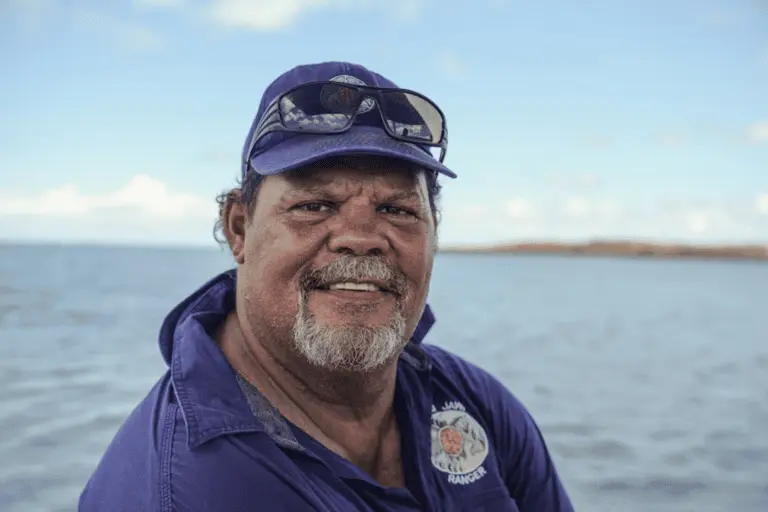
For Phillip “Bibido” McCarthy, a 59-year-old Saltwater People leader and men’s ranger coordinator for the Kimberley Land Council, the scientific findings contained no real surprises, but carried immense validation.
"We knew most of it," Bibido tells Mongabay, reflecting on the study’s conclusions about fish migration and ecosystem connectivity. "But the science confirmed it. They told us, ‘You were right.’"
Bibido emphasizes that Indigenous science cannot be divorced from the broader cultural framework of the landscape.

"Everything is connected—the songlines, cultural protocols, language, kinship," he explains. "You have to look at the whole ecosystem. Scientists will come and say they want to research this. We can do that, but we also bring the traditional knowledge, history, the stories, the cultural information to any research we do. Then you work out what’s the next step."
Furthermore, Bibido highlights how merging traditional observation with modern technological tools—such as aerial drones and underwater cameras—empowers the Bardi Jawi to monitor rapid environmental shifts over vast geographies, enabling them to communicate effectively with government policymakers.
"Working with the scientists connects us to the outside world," Bibido notes. "The research we did played a big part in setting up the marine park."
The Scientific Perspective
Dr. Katherine Cure, lead author of the study and a fish biologist with AIMS, reflects deeply on the evolution of her partnership with the Bardi Jawi over the past decade.

"First Nations peoples are the first scientists of the world," Cure asserts. "Science is about observation and asking questions. I guess we make more experiments sometimes. But Indigenous people would have also made experiments… and they’ve done this for thousands of years. It’s definitely a type of science and should be recognized as such."
Cure points out that while Western science often struggles with compartmentalization, looking at isolated variables in artificial silos, Indigenous ecological knowledge offers a holistic, systemic view of the environment.
"Ecology is very complex, and there are a lot of cycles within cycles that have to be looked at together, and that’s the beauty of the Indigenous knowledge," Cure says. "As scientists we tend to compartmentalize things, but Traditional Owners have everything together in their heads. Often, we’ll go and ask about the mangroves and they’ll say that we can’t just talk about the mangrove because the mangrove is connected to this and that. They see it as an overall system."
Future Outlook: A Blueprint for Global Conservation
As the international conservation community grapples with the cascading crises of climate change, habitat loss, and declining marine fisheries, the collaborative model forged on the Dampier Peninsula offers a vital blueprint for the future.

The integration of Western quantitative metrics with Indigenous qualitative depth creates a dual-lens approach that is far more powerful than either methodology operating in isolation. By granting Traditional Owners co-authorship on peer-reviewed papers, securing formal legal protections like the Bardi Jawi Gaarra Marine Park, and utilizing modern tools to monitor climate impacts like coral bleaching, this partnership redefines what modern environmental stewardship can achieve.
Moving forward, the primary challenge will be scaling these collaborative frameworks globally. As funding agencies and academic institutions increasingly recognize Indigenous Protected Areas and Indigenous-led monitoring programs as gold standards for biodiversity conservation, the lessons learned from the Saltwater People of the Kimberley will resonate across oceans.
Ultimately, the story of the Bardi Jawi, the Oorany Rangers, and AIMS is a powerful reminder that saving our planet’s oceans requires more than sophisticated laboratory equipment or distant satellite mapping; it requires listening to those who have walked, watched, and cared for the red earth, blue ocean, and green mangroves for over 30,000 years.



