

Executive Overview
The global transition to electric mobility has officially crossed a historic Rubicon. According to a landmark analysis published by energy think tank Ember, more than 25 percent of all new passenger vehicles sold globally in 2025 are now electric. This milestone represents a monumental acceleration in adoption, far outpacing the conservative forecasts of traditional automotive analysts from just half a decade ago.
More importantly, the underlying mechanics of this boom have fundamentally shifted. While the early chapters of the electric vehicle (EV) revolution were written primarily by wealthy nations in Western Europe, China, and affluent pockets of North America, the 2025 surge is being propelled by an unlikely catalyst: emerging markets. Nations across Southeast Asia, Latin America, and the Middle East—many of which displayed negligible EV adoption rates as recently as 2019—are leapfrogging traditional internal combustion engine (ICE) infrastructure entirely.
Driven by competitive pricing from Chinese manufacturers, strategic government incentives, and an urgent desire to curb urban air pollution and volatile fossil fuel import bills, emerging economies are no longer playing catch-up. They are setting the pace for the global automotive market, rendering legacy forecasts obsolete and reshaping geopolitical energy dependencies in real-time.
Detailed Chronology: The Evolution of the Global EV Market
To understand the magnitude of the 2025 tipping point, it is necessary to examine the rapid trajectory of the global EV ecosystem over the past six years.
2019–2021: The Niche Phase and Western Dominance
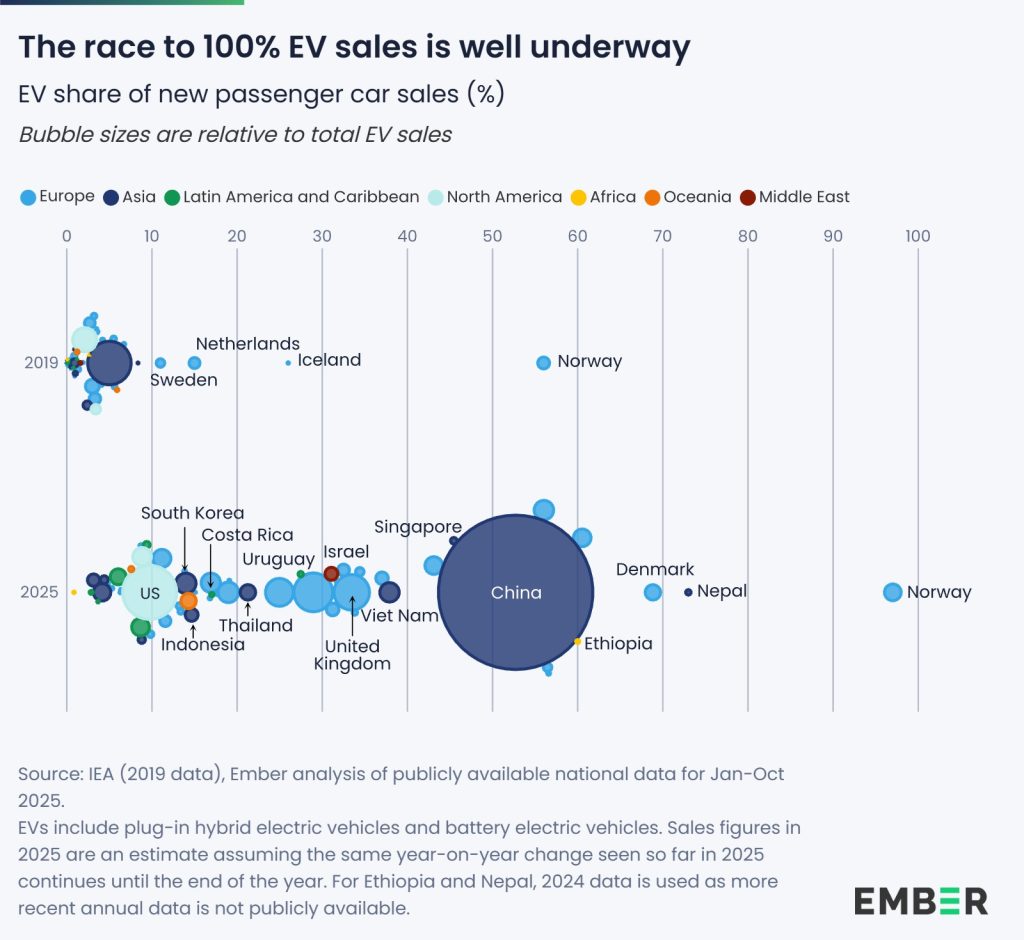
At the close of the last decade, the global EV market was remarkably concentrated. In 2019, only four countries worldwide boasted an electric vehicle market share exceeding 10 percent of total new car sales. These markets were almost exclusively restricted to early-adopter bastions like Norway and select Western European nations with heavy state subsidies. For the vast majority of the world, EVs remained an expensive, niche technology plagued by high upfront purchase costs and virtually nonexistent public charging infrastructure. Emerging markets were widely written off by legacy automakers as decades away from viable electrification.
2022–2023: Supply Chain Pressures and the Export Pivot
Following pandemic-era supply chain disruptions, battery raw material costs spiked globally. However, this period also marked a profound structural shift in China’s domestic automotive sector. Fueled by years of state-backed R&D, fierce internal price wars, and massive economies of scale, Chinese automakers achieved dominance in affordable lithium iron phosphate (LFP) battery technology.
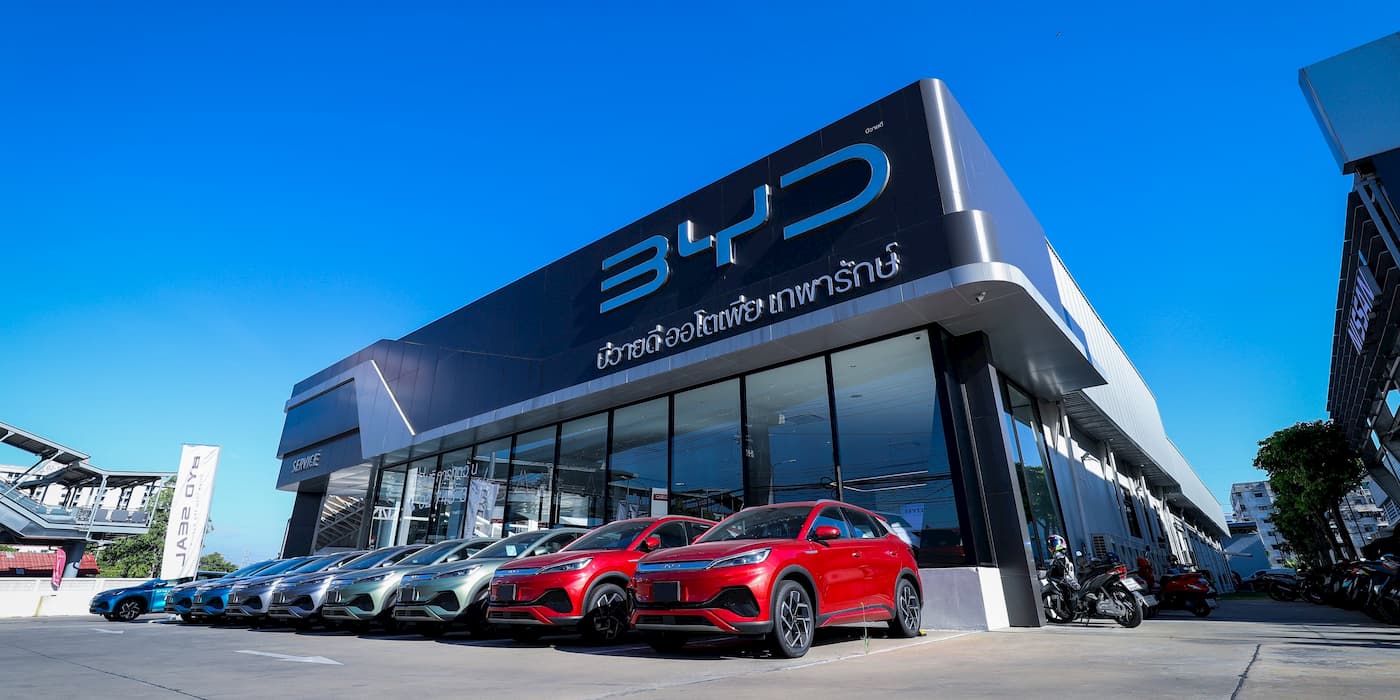
By mid-2023, facing a fiercely competitive domestic market and rising trade barriers in the United States and the European Union, Chinese EV manufacturers began aggressively pivoting their export strategies toward non-OECD (Organization for Economic Co-operation and Development) markets. Nations in Southeast Asia, Latin America, and the Middle East suddenly found themselves courted by affordable, technologically sophisticated EVs priced competitively with—or even lower than—comparable gasoline-powered vehicles.
2024–2025: The Emerging Market Leapfrog
The years 2024 and 2025 witnessed what Ember researchers term the "EV leapfrog." Rather than following the slow, linear transition curve experienced by Europe and North America, emerging economies compressed decades of automotive evolution into a matter of months.
By 2025, the number of countries where EVs capture more than 10 percent of new car sales skyrocketed from just four in 2019 to an astounding 39 nations worldwide. The epicenter of the global automotive industry had decisively shifted southward and eastward, fueled by policy frameworks explicitly designed to welcome foreign green tech investment, lower import tariffs, and establish local manufacturing hubs.
Supporting Context & Metrics: By the Numbers
The quantitative data underpinning Ember’s 2025 analysis illustrates a profound geographic redistribution of green technology adoption.
Southeast Asia’s Meteoric Rise
The Association of Southeast Asian Nations (ASEAN) emerged as an unexpected powerhouse in global EV adoption throughout 2025.
- Singapore and Vietnam: Both nations surged ahead to claim remarkable EV sales shares of approximately 40 percent. In doing so, they officially surpassed adoption levels recorded in the United Kingdom and several key European Union member states.
- Thailand: Reaching a 20 percent EV adoption share, Thailand achieved a staggering volume milestone. In the first three quarters of 2025 alone, Thailand sold more electric vehicles than Denmark, a traditional European leader in per-capita EV adoption.
- Indonesia: Achieving a 15 percent EV share in 2025, Indonesia successfully surpassed the United States in terms of relative market penetration for the first time. This leap is deeply tied to Indonesia’s vast domestic nickel reserves and aggressive government policies designed to position the archipelago as Southeast Asia’s premier EV manufacturing and supply chain hub.
Latin America, the Middle East, and Eurasia
The phenomenon is by no means restricted to Asia.
- Uruguay: Pacing Latin America, Uruguay recorded a 27 percent EV market share, putting it on roughly equal footing with the average of the European Union.
- Brazil and Mexico: Both industrial giants continued steady, exponential growth curves in 2025, solidifying their status among the top global destinations for Chinese EV exports. Crucially, their adoption rates have now surpassed that of Japan, where EV market share has stagnated at roughly 3 percent since 2022 due to deep-rooted domestic loyalty to hybrid technologies.
- Türkiye: Surging to a 17 percent EV share, Türkiye officially overtook Belgium to claim the crown as Europe’s fourth-largest battery electric vehicle (BEV) market by sheer volume.
The Chinese Export Engine
The engine driving much of this growth is China’s dominant manufacturing apparatus. Since mid-2023, nearly all growth in Chinese EV export volumes has bypassed protectionist Western barriers to flood non-OECD markets. Nations such as Brazil, Mexico, the United Arab Emirates, and Indonesia now populate the top ten destinations for Chinese automotive exports, capitalizing on bilateral trade agreements, lower regulatory friction, and robust local consumer demand for feature-rich, economical electric cars.
The Macro Impact on Global Fossil Fuel Demand
Beyond vehicle sales metrics, the 2025 data reveals a profound structural impact on global energy demand. Because electric motors are roughly three times more energy-efficient than internal combustion engines, the mass deployment of EVs is translating into immediate, measurable reductions in oil consumption—even in countries where the national electrical grid relies partially on fossil fuels.
The efficiency dividends vary by grid composition, but the macro savings are undeniable:
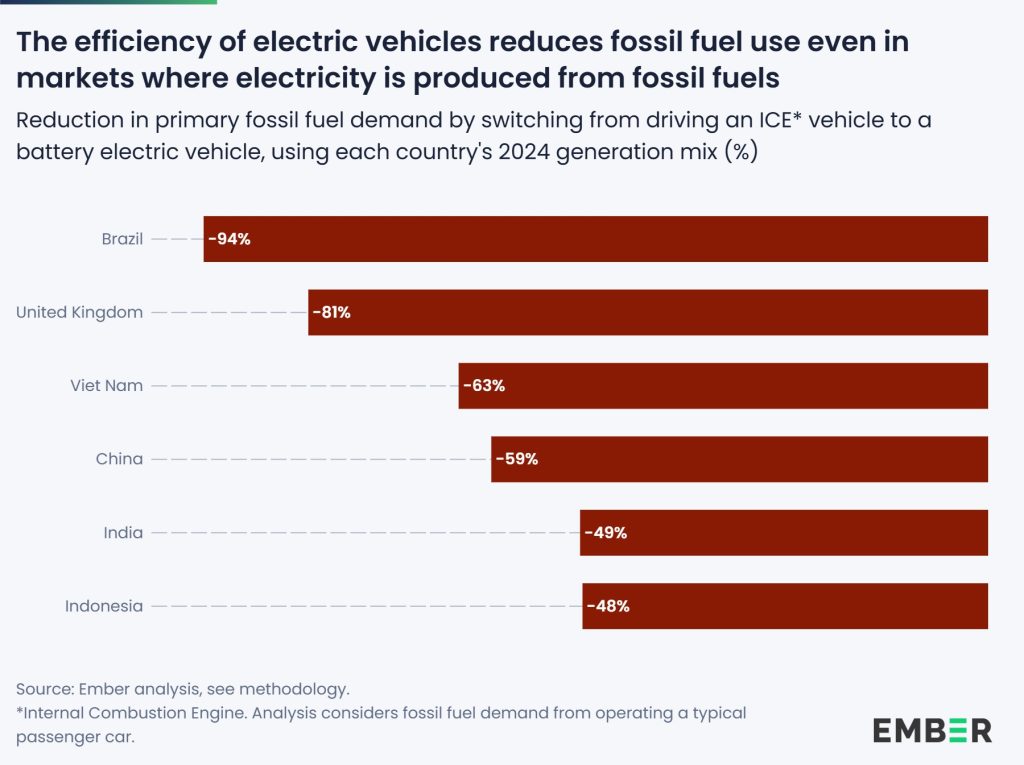
- Brazil: Benefiting from a grid powered overwhelmingly by renewable hydroelectricity, battery electric vehicles in Brazil successfully cut overall fossil fuel demand associated with light-duty transport by approximately 90 percent.
- Indonesia: Despite a coal-heavy power generation mix, the sheer mechanical efficiency of EVs compared to legacy ICE vehicles resulted in a nearly 50 percent reduction in fossil fuel energy requirements for those drivers.
Official Statements and Industry Perspective
The speed and scale of this transformation have prompted a reassessment of global energy projections by analysts and environmental economists alike.
Euan Graham, a leading electricity and data analyst at Ember, emphasized the historic nature of the shift in a statement accompanying the report:
"This is a major turning point. In 2025, the center of gravity has moved. Emerging markets are no longer catching up; they are leading the shift to electric mobility. These countries see the strategic advantages of EVs, from cleaner air to reduced fossil fuel imports."
Graham noted that developing economies are evaluating the automotive transition through a lens of national security and economic sovereignty. By cutting reliance on imported crude oil, developing nations are able to stabilize their trade balances while simultaneously addressing severe urban air pollution crises that plague fast-growing megacities from Bangkok to São Paulo.
Furthermore, Graham highlighted that early policy interventions will dictate long-term market dominance:

"Emerging markets will shape the future of the global car market. The choices made now on charging infrastructure and early support will determine how fast this momentum continues."
As governments across Latin America, Southeast Asia, and the Middle East refine their tax structures, local content requirements, and grid investments, the foundational infrastructure established today will lock in consumer driving habits for the next several decades.
Future Outlook: The Next Frontier for Global Mobility
As the world looks beyond 2025, the trajectory of the electric vehicle market points toward irreversible global saturation, though significant challenges and structural questions remain.
Infrastructure as the Ultimate Bottleneck
While vehicle affordability has largely been solved by the influx of low-cost Chinese manufacturing, the next phase of the emerging market EV boom will depend entirely on infrastructure deployment. Scaling reliable public charging networks across rapidly urbanizing nations in Southeast Asia and Latin America requires massive capital expenditure and smart-grid integration. Without proactive investments in fast-charging corridors and residential charging solutions, grid congestion and range anxiety threaten to throttle growth just as consumer demand hits an all-time high.
Geopolitical Friction and Local Manufacturing Mandates
The success of Chinese automakers in emerging markets has not gone unnoticed by traditional Western and Japanese legacy manufacturers, who risk complete displacement in the Global South. In response, several emerging economies are leveraging their market attractiveness to demand domestic technology transfer and local factory assembly. Countries like Indonesia, Thailand, and Brazil are increasingly implementing stringent local content rules, requiring automakers to build regional supply chains rather than merely dumping finished vehicles into ports. This strategy ensures that the EV boom translates into domestic industrial jobs, battery recycling ecosystems, and long-term economic development.

The Lingering Laggards
The stark contrast highlighted by Ember’s 2025 report—where emerging markets like Vietnam, Thailand, and Uruguay are achieving adoption rates of 20 to 40 percent while advanced industrial economies like Japan stall in the single digits—serves as a cautionary tale for protectionist policymakers. Markets that fail to foster competitive, affordable EV ecosystems risk losing their industrial relevance in the face of a rapidly modernizing Global South.
Ultimately, 2025 will be remembered as the year the electric vehicle transition ceased to be an exclusive club for wealthy industrialized nations. Driven by pragmatic economic incentives, technological democratization, and visionary public policy in the developing world, the electric vehicle leapfrog has become an unstoppable global reality.



