Executive Overview
Corporate sustainability is currently navigating a profound identity crisis, caught in a delicate tension between compliance-driven obligations and visionary, long-term value creation. According to recent comprehensive research released by global insights consultancy GlobeScan in partnership with Business for Social Responsibility (BSR), a significant internal alignment challenge is destabilizing sustainability departments within major global enterprises. The data points to a widening gulf of perception between the professionals tasked with executing sustainability strategies on the ground and the C-suite executives steering the corporate ship.
While sustainability practitioners overwhelmingly view their initiatives as foundational engines for long-term business strategy, innovation, and market growth, they perceive senior leadership as viewing these same programs primarily through the narrow lens of risk management, regulatory compliance, and damage control. This executive disconnect is more than a mere philosophical disagreement; it represents a structural vulnerability. As regulatory pressures intensify globally—becoming the undisputed dominant driver of corporate sustainability—traditional commercial drivers such as operational efficiency, top-line growth, and creative disruption have been pushed to the periphery compared to where they stood a decade ago.
For modern organizations, closing this internal perception gap is no longer just an internal human resources or change management issue. It is a fundamental strategic imperative. If corporate sustainability is permanently relegated to a defensive compliance function by executive leadership, enterprises risk losing the vital innovation momentum required to navigate an increasingly volatile global marketplace. This in-depth report explores the root causes of the GlobeScan-BSR findings, analyzes the quantitative metrics behind the executive disconnect, examines the broader market shifts driving these attitudes, and outlines actionable pathways for bridging the chasm between sustainability teams and the C-suite.
Detailed Chronology: The Evolution of the Sustainability Divide
To understand how modern enterprises arrived at this current juncture of internal misalignment, it is necessary to examine the historical trajectory of corporate sustainability over the past ten to fifteen years.
Phase I: The Rise of Strategic Sustainability (The Early 2010s)
A decade ago, corporate sustainability was undergoing a renaissance. Buoyed by growing consumer demand for ethical products, cheaper renewable energy technologies, and an emerging consensus around resource efficiency, sustainability was frequently championed as a core driver of commercial innovation. C-suites were eager to market their companies as forward-thinking, and sustainability teams enjoyed a tailwind of executive enthusiasm. During this period, environmental, social, and governance (ESG) metrics were increasingly tied to brand equity, market differentiation, and new product development. Sustainability professionals were often given a broad mandate to explore how ecological and social challenges could inspire entirely new business models.
Phase II: The Regulatory Tsunami (The Early 2020s)
As the decade progressed, the landscape shifted dramatically. Fueled by escalating climate realities, shifting geopolitical landscapes, and a demand for standardization from global financial markets, governments and international bodies stepped in with an unprecedented wave of mandatory disclosure laws and regulatory frameworks. From the European Union’s Corporate Sustainability Reporting Directive (CSRD) and the Corporate Sustainability Due Diligence Directive (CSDDD) to evolving SEC climate disclosure rules in the United States, compliance ceased to be optional.
While these regulatory frameworks brought much-needed accountability and rigor to corporate reporting, they also fundamentally altered the day-to-day work of sustainability departments. Teams that had previously spent their hours brainstorming circular economy product designs or breakthrough supply chain innovations were suddenly forced to pivot toward heavy data collection, auditing, legal compliance, and meticulous risk mitigation.
Phase III: The Contemporary Perception Chasm (2026)
By the spring of 2026, this operational pivot created a profound psychological and strategic divide within large corporations. As captured in the GlobeScan and BSR survey data collected in April and May 2026 among 124 corporate sustainability professionals at enterprises with annual revenues of $1 billion or more, a stark dual reality emerged. Practitioners found themselves operating in a framework where compliance rules the day, yet their core professional identities remain tethered to the belief that sustainability is an engine for growth. Senior leadership, inundated with complex legal mandates and fearful of greenwashing liabilities, increasingly views sustainability primarily as a defensive shield rather than an offensive spear.
Supporting Context & Metrics: Unpacking the GlobeScan-BSR Data
The empirical findings from the GlobeScan and BSR research provide a striking statistical portrait of internal corporate dissonance. The data reveals that while there is widespread agreement on the defensive utility of sustainability, there is a profound fracture regarding its offensive capabilities.

The Strategic Vision Disconnect
Perhaps the most alarming statistic to emerge from the research concerns how sustainability is viewed in the context of overarching corporate strategy:
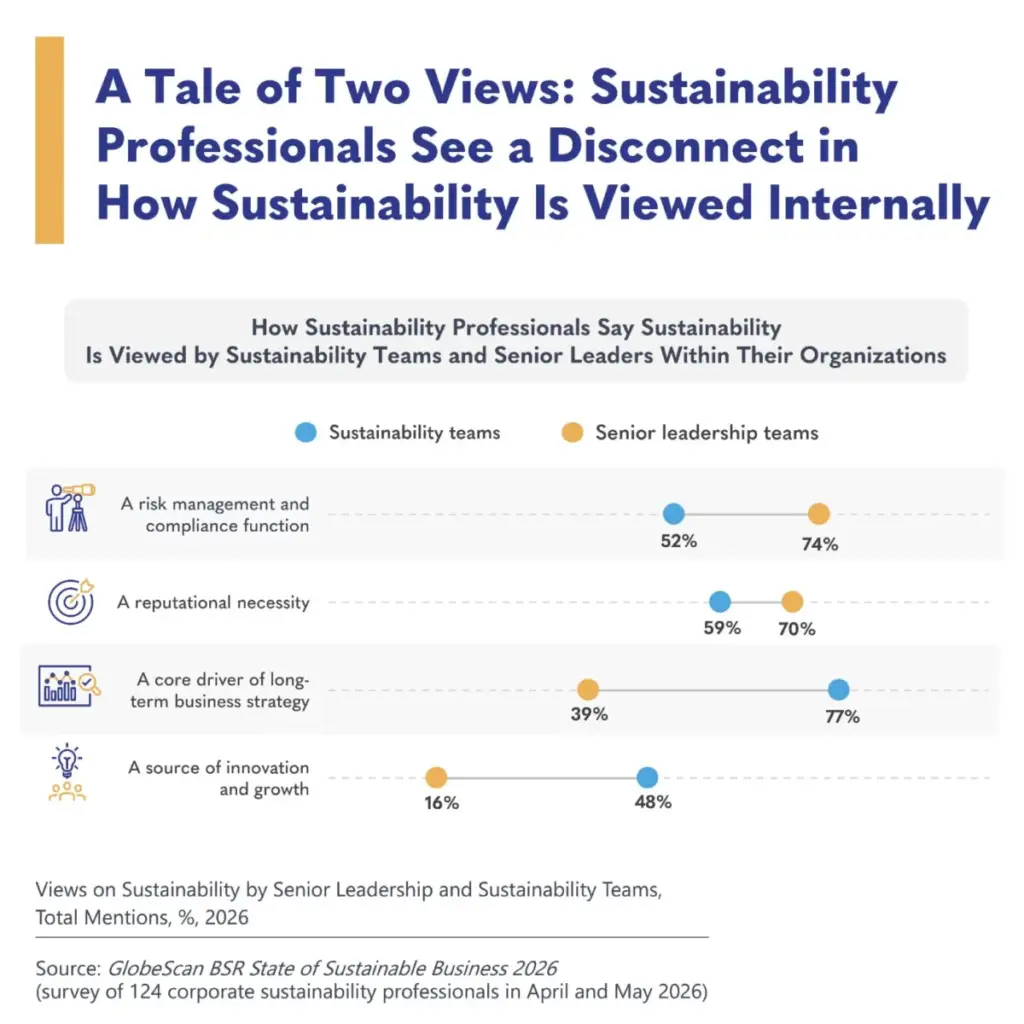
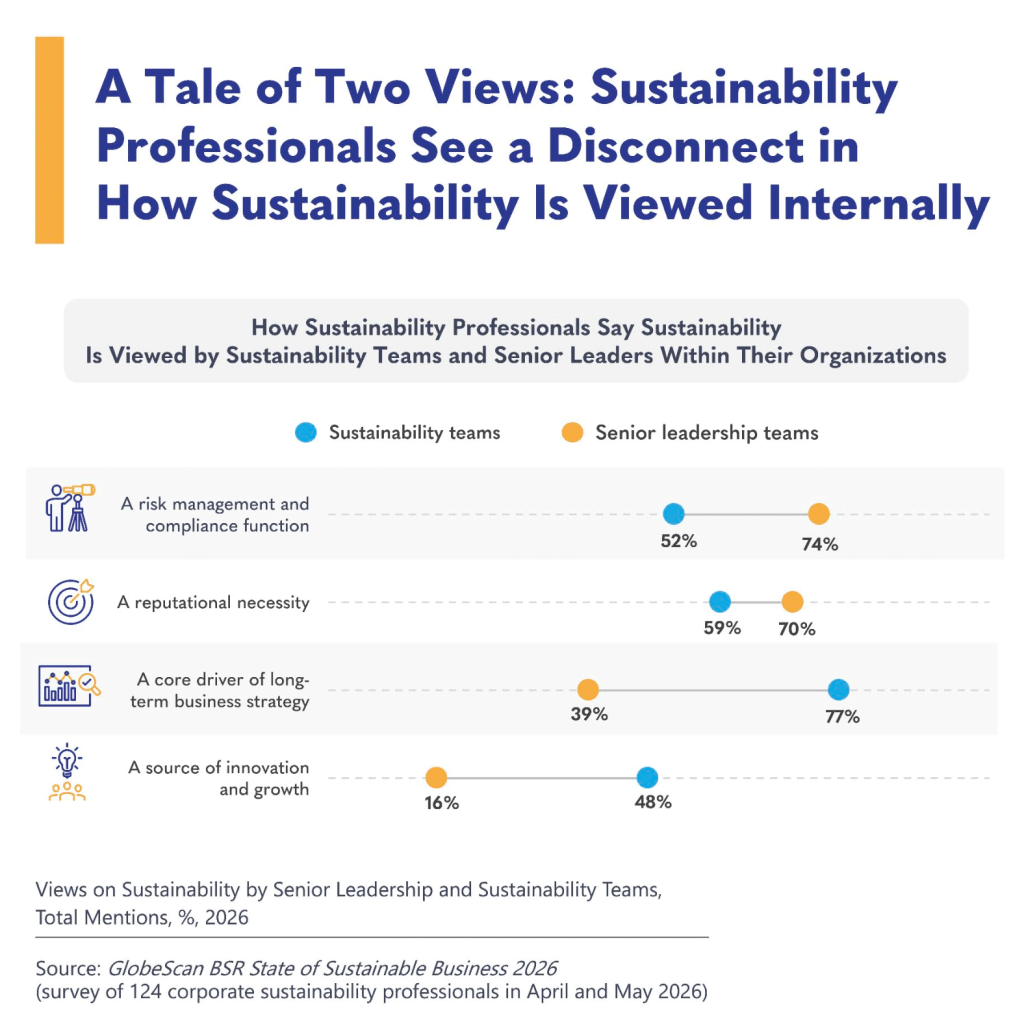
- 77% of corporate sustainability professionals view their function as a core driver of long-term business strategy.
- Only 39% of those same professionals believe that senior leaders share this perspective.
This represents a nearly two-fold divergence in how strategic value is interpreted. Sustainability practitioners see their work as inextricably linked to the future viability, adaptability, and long-term positioning of the company. Conversely, they perceive senior leadership as treating sustainability as an auxiliary or siloed function—important, perhaps, for public relations or regulatory checkboxes, but detached from core commercial decision-making.
Innovation and Growth versus Risk and Compliance
The divergence deepens when examining specific business outcomes associated with sustainability initiatives:
- Innovation and Growth: 48% of sustainability professionals actively associate their work with innovation and growth. However, they believe that only 16% of senior leaders make that same association. This means practitioners are three times more likely to view sustainability as a growth engine than they believe their executive counterparts do.
- Risk Management and Compliance: The script flips entirely when examining defensive measures. A commanding 74% of respondents report that senior leaders characterize sustainability as primarily a risk management and compliance function. Meanwhile, 52% of sustainability professionals agree that their work serves this purpose.
While risk management is an undeniable and necessary pillar of corporate governance, the dominance of this perception at the executive level threatens to stifle creative problem-solving. When the C-suite views sustainability purely through the lens of compliance, budgets are allocated defensively, mandates become restrictive, and teams are incentivized to avoid failure rather than pursue transformative breakthroughs.
The Shared Foundation: Corporate Reputation
Despite these stark differences in strategic and innovative outlook, the research highlights one critical area of internal alignment: corporate reputation. Both sustainability teams and senior leadership overwhelmingly recognize that sustainability programs play an indispensable role in safeguarding brand equity, maintaining consumer trust, and protecting the company from reputational crises.
This shared understanding provides a crucial bridgehead. Reputation management protects the license to operate, but relying on reputation alone leaves massive amounts of potential business value on the table. Without unlocking the innovation and growth dimensions of sustainability, corporations risk treating the discipline as an insurance policy rather than a catalyst for future-proofing their business models.
Official Perspectives & Expert Analysis
To contextualize these findings, industry leaders and researchers have weighed in on the structural implications of the GlobeScan-BSR data. James Morris, who leads GlobeScan’s San Francisco office and partners with leading organizations on stakeholder engagement and long-term value creation, emphasizes the urgency of closing this perception gap.
"Organizations face a critical imperative not to choose between managing risk and creating value, but to demonstrate how sustainability can successfully accomplish both," Morris notes.
According to Morris and fellow sustainability analysts, the danger of the current alignment challenge is that sustainability teams become disillusioned or marginalized. When practitioners feel that their executive leadership views them merely as compliance officers rather than strategic partners, morale can dip, talent retention can suffer, and cross-departmental collaboration with product, R&D, and finance teams can stall.
Furthermore, BSR’s ongoing work with global enterprises underscores that modern sustainability challenges—ranging from climate-induced supply chain disruptions to shifting consumer demographics—cannot be solved with a purely defensive compliance mindset. True resilience requires proactive innovation. Regulatory frameworks like CSRD and SEC rules are designed to establish a baseline of transparency, but transparency alone does not generate new revenue streams or invent low-carbon technologies. That requires the exact kind of visionary, long-term strategic alignment that the GlobeScan-BSR research indicates is currently lacking in the upper echelons of corporate management.
Future Outlook: Bridging the Gap and Reigniting Momentum
As corporations look toward the remainder of the decade and beyond, resolving the internal alignment challenge identified by GlobeScan and BSR will be a defining factor in commercial success. Enterprises that successfully bridge the gap between sustainability teams and senior leadership will unlock competitive advantages that elude their peers.
To transform sustainability from a compliance burden into a recognized engine for growth and long-term strategy, organizations must pursue several strategic imperatives:
1. Elevating the Business Case through Financial Literacy
Sustainability professionals must become fluent in the language of the C-suite and the finance department. To convince senior leaders that sustainability is an engine for innovation and growth rather than just a compliance cost center, practitioners must translate environmental and social outcomes into rigorous financial metrics. This includes demonstrating how sustainability initiatives reduce operational costs, open new market segments, attract ESG-conscious capital, and future-proof supply chains against physical and regulatory shocks.
2. Reframing the Regulatory Burden as a Launchpad
While regulatory requirements have undeniably crowded out some discretionary sustainability efforts over the past decade, forward-thinking organizations are learning to use compliance as a baseline rather than a ceiling. By automating and streamlining compliance through advanced data systems, companies can free up human capital and financial resources to reinvest in transformative, high-value innovation projects.
3. Fostering Cross-Functional Executive Integration
Bridging the perception gap requires dismantling organizational silos. Sustainability cannot reside in an isolated department reporting solely to legal or public relations. It must be woven into the fabric of core business units—collaborating directly with research and development, product design, procurement, and investor relations. When senior executives see cross-functional teams using sustainability frameworks to design breakthrough products or optimize supply chain resilience, the outdated perception of sustainability as a mere "compliance box-checking exercise" naturally dissolves.
4. Demonstrating Dual-Value Creation
Ultimately, the future of corporate sustainability lies in embracing both sides of the coin. The GlobeScan-BSR research demonstrates that while risk management and compliance currently dominate executive thinking, corporate reputation remains a universally acknowledged value driver. Winning organizations will prove that risk mitigation and value creation are not mutually exclusive. By embedding sustainability into core strategy, enterprises can simultaneously protect themselves against regulatory penalties and pioneer the innovative solutions demanded by a rapidly changing world.
In conclusion, the alignment challenge revealed by GlobeScan and BSR serves as both a warning and an invitation. By confronting the executive disconnect head-on, corporate leaders and sustainability professionals can realign their visions, harness the full power of innovation, and secure enduring business resilience for the decades ahead.