


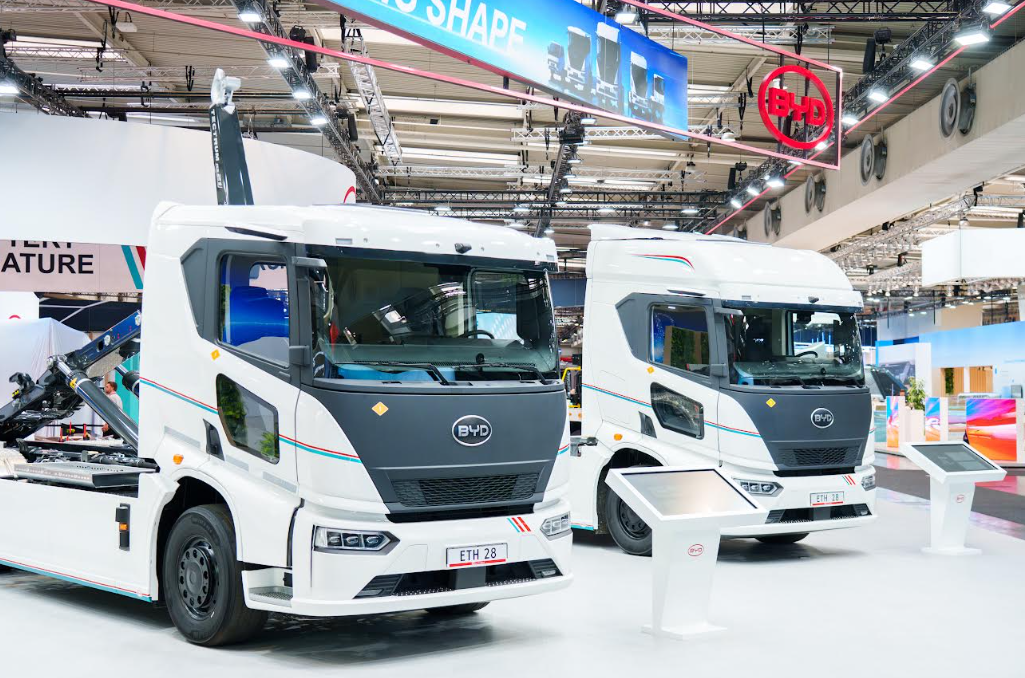
HANNOVER, Germany — In a move that has sent ripples of anxiety through the boardrooms of Europe’s legacy commercial vehicle makers, Chinese electric vehicle powerhouse BYD launched an aggressive, multi-pronged assault on the continent’s heavy-duty freight market. Unveiled at the biennial IAA Transportation show in northern Germany, the company’s showcase featured a flagship 44-metric-ton electric tractor paired with ultra-fast commercial megawatt charging systems—a direct challenge to established European truck manufacturing titans on their own home turf.
While BYD has spent the past decade methodically building an unassailable global footprint in passenger electric vehicles and urban transit buses, the Hannover exhibition marked a definitive psychological and strategic turning point. The message to the European logistics sector was unmistakable: BYD’s ambitions across the continent extend far beyond last-mile delivery vans and municipal transit fleets. The company has its sights set squarely on the backbone of European heavy transport.
Executive Overview
The stakes for the European road freight sector could hardly be higher. The continent’s heavy-duty transport operators are grappling with some of the world’s most stringent carbon dioxide reduction mandates, enacted under European Union climate targets. Manufacturers must cut fleet-wide emissions from heavy commercial vehicles by 45% by 2030, with reductions scaling steeply to 90% by 2040.
These regulatory milestones have forced legacy European brands—including Daimler Truck, Volvo Group, Scania, and Traton’s MAN—to pour billions of euros into the difficult transition toward battery-electric and hydrogen-fuel-cell architectures. Yet, mass adoption among fleet operators has been notoriously sluggish. Haulers have pointed to prohibitive purchase premiums, lingering anxieties over battery longevity, and, most pressingly, an underdeveloped public charging network along vital trans-European transport corridors.
BYD’s debut at IAA Transportation directly addresses these pain points. By combining massive vertical integration, unprecedented battery warranties, and a proprietary 1.5-megawatt charging architecture, the Chinese juggernaut is attempting to bypass the traditional bottlenecks that have kept European fleets tethered to diesel.
The Tech Specs: Inside the BYD ETT 44 and Megawatt Ecosystem
At the absolute center of BYD’s Hannover showcase was the BYD ETT 44, a formidable 4×2 heavy-duty electric semi-truck engineered specifically for regional and long-distance freight operations.
+-----------------------------------------------------------------+
|                    BYD ETT 44 KEY SPECIFICATIONS                 |
+--------------------------+--------------------------------------+
| Vehicle Class            | 4x2 Heavy-Duty Electric Semi-Truck   |
| Gross Combination Weight | 44 Metric Tons                       |
| Powertrain Output        | Up to 1,000 Metric Horsepower        |
| Battery Technology       | Lithium Iron Phosphate (LFP) Blade   |
| Battery Capacity         | 651 Kilowatt-Hours                   |
| Maximum Operating Range  | Up to 372 Miles (600 km)             |
| Peak Charging Power      | 1.5 Megawatts (DC Flash Charging)    |
| Recharge Time (20%-80%)  | Approximately 20 Minutes             |
| Range Restored per 20 Min| ~248 Miles (400 km)                  |
| Standard Battery Warranty| 10 Years or 1.2 Million Kilometers   |
+--------------------------+--------------------------------------+
The ETT 44 packs up to 1,000 metric horsepower, delivering the instantaneous torque and pulling power required to haul a 44-metric-ton load across demanding European topography. Energy is stored in a massive 651-kilowatt-hour lithium iron phosphate (LFP) Blade Battery pack, yielding an operating range of up to 372 miles (600 kilometers) on a single charge.
More impressive than the battery capacity alone is how quickly it can be replenished. BYD paired the truck with a commercial flash-charging architecture capable of drawing a staggering 1.5 megawatts of direct-current power. According to company specifications, this high-power infrastructure can recharge the ETT 44’s massive LFP pack from 20% to 80% capacity in approximately 20 minutes—pumping roughly 248 miles of highway range back into the vehicle during a standard driver rest break.
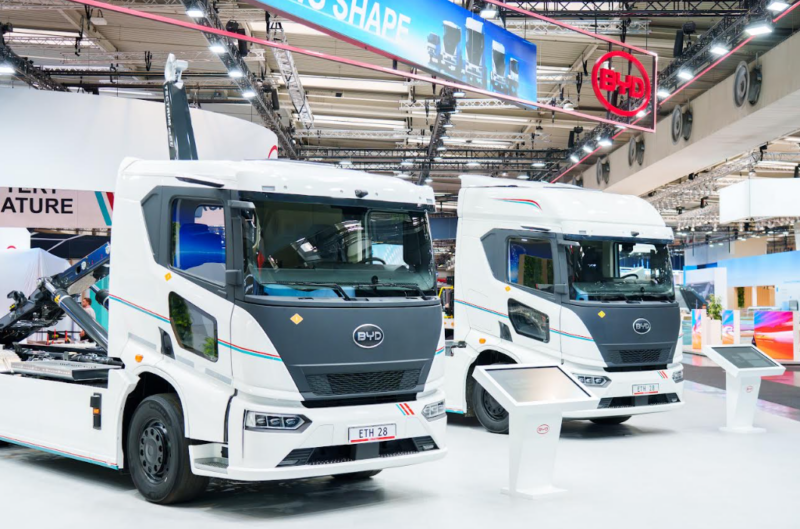
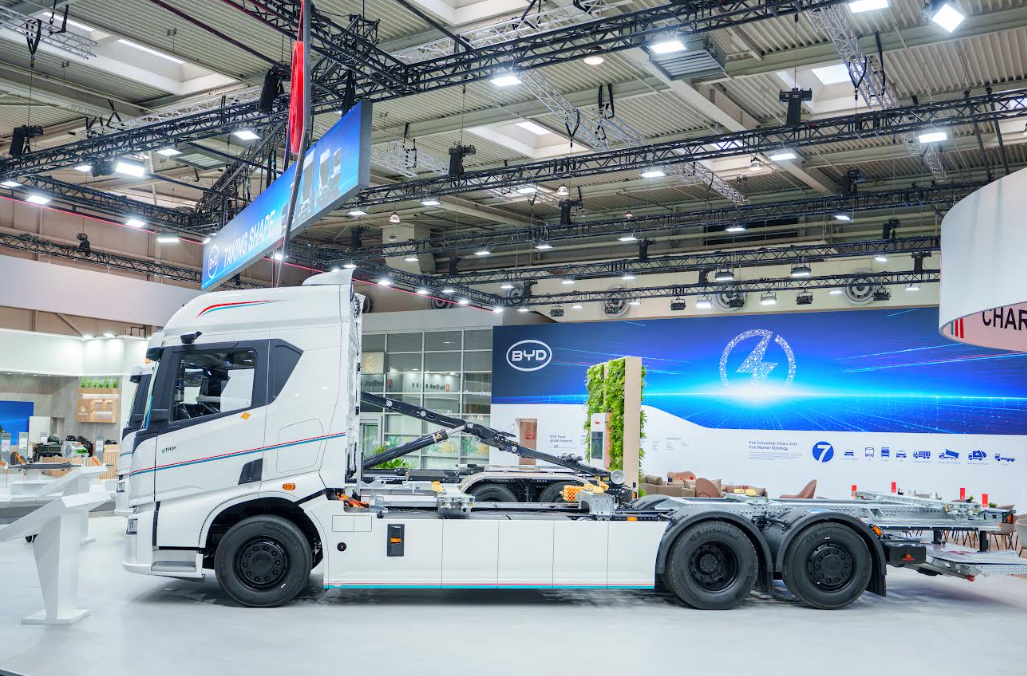
Beyond the flagship long-haul tractor, BYD expanded its European medium- and heavy-duty portfolio with two new rigid models configured in 4×2 and 6×2 layouts. These included a versatile 26-metric-ton swap-body carrier and a vocational hooklift unit. With these introductions, BYD now markets a comprehensive spectrum of commercial zero-emission haulers, ranging from nimble 3.5-metric-ton urban delivery vehicles all the way up to 44-metric-ton long-haul titans.
Breaking Down Operator Hesitation: The 1.2-Million-Kilometer Warranty
Despite the growing maturity of electric commercial vehicles, fleet operators remain risk-averse. Diesel trucks are reliable, predictable, and supported by a century-old network of mechanics, fuel stations, and parts suppliers. Transitioning to electric semi-trucks requires a massive capital outlay, and fleet managers have historically worried about premature battery degradation and unpredictable residual values.
BYD is directly defusing this anxiety through aggressive warranty backing. The company is offering the ETT 44’s battery pack with a standard 10-year or 1.2-million-kilometer warranty.
To put this in perspective, base warranties across the traditional European heavy truck segment typically span just two to three years. Battery coverage from legacy European manufacturers usually caps out at six to eight years or significantly lower mileage thresholds unless haulers purchase expensive, premium service and maintenance plans. By guaranteeing its LFP Blade Battery for over a million kilometers, BYD is signaling supreme confidence in its chemistry and manufacturing rigor—effectively matching or exceeding the projected working life of a diesel engine over a similar timeframe.
Official Statements and Strategic Vision
During the company’s press presentation in Hannover, Stella Li, Executive Vice President of BYD, framed the commercial vehicle push as a natural evolution of the company’s sprawling internal manufacturing ecosystem, which spans proprietary battery cells, semiconductors, and electronic control units.
"We have already put FLASH Charging into practice in passenger vehicles. Today, we are bringing this technology to commercial vehicles, starting with our trucks," Li told industry attendees and media representatives.
"With 1.5 megawatts of charging power, it can charge from 20 percent to 80 percent in about 20 minutes, delivering up to 248 miles of range. Less time charging. More time on the road."
Crucially, Li emphasized that BYD is not merely trying to sell individual freight haulers as standalone pieces of hardware. Instead, the company is pitching itself as an energy solutions provider, offering freight operators participation in a broader, proprietary logistics energy network. This ecosystem encompasses everything from on-site commercial solar generation and stationary battery storage units to intelligent energy pricing management software and customized fleet financing packages.

"From batteries and solar power to energy storage, FLASH Charging and commercial vehicles, we provide a one-stop solution for sustainable commercial transport," Li added.
Supporting Context: The Competitive Landscape & Geopolitical Realities
BYD’s presentation sent a shockwave across the Hannover fairgrounds, where European manufacturers have historically dominated trade discussions and set the industry agenda.
While legacy commercial vehicle makers have introduced competitive long-haul battery models—such as the Mercedes-Benz eActros 600 and the Volvo FH Electric—BYD’s absolute vertical integration and dominance over internal battery cell production give it a structural pricing and supply chain scale advantage that has deeply unsettled European executives. Because BYD manufactures its own LFP cells, chips, and powertrains at scale, it can absorb cost pressures in ways that traditional assemblers relying on tier-one European suppliers simply cannot match.
At the same time, this expansion unfolds against a tense geopolitical backdrop. Trade relations between Brussels and Beijing regarding electric vehicle subsidies remain fraught with friction. While the European Commission has focused its import tariffs primarily on passenger cars, Chinese commercial vehicle manufacturers are well aware of regulatory vulnerabilities. To insulate their operations against future protectionist measures, companies like BYD are rapidly accelerating plans to anchor local assembly operations, distribution agreements, and technical partnerships directly within European borders.

Future Outlook: What Lies Ahead for European Freight
The arrival of BYD’s heavy-duty electric semi-trucks and megawatt charging systems in Europe marks the beginning of a high-stakes competitive era.
- Pressure on Legacy Margins: European truck makers—Daimler, Volvo, Scania, and MAN—will face immediate pricing pressure. They must either accelerate the deployment of their own high-power megawatt charging solutions or risk losing market share to a heavily capitalized competitor offering superior battery warranties.
- Infrastructure Evolution: The success of the ETT 44 will ultimately depend on the rollout of the 1.5-megawatt charging infrastructure. BYD’s strategy of selling integrated energy ecosystems—pairing trucks with stationary storage and on-site generation—offers a pragmatic workaround to the notoriously slow rollout of public truck-charging corridors across Europe.
- The Localization Imperative: Expect BYD and other Chinese commercial giants to announce European manufacturing and assembly footprints sooner rather than later. Establishing local production will be essential to circumventing potential trade tariffs and convincing conservative European fleet buyers that long-term parts availability and maintenance support are guaranteed.
As the heavy transport sector steers toward the 2030 EU carbon reduction deadlines, the race to electrify Europe’s highways has shifted into overdrive. BYD has firmly planted its flag in the heart of the continent’s trucking industry, and the legacy giants can no longer afford to look in their rearview mirrors—the competition has pulled right alongside them.



