

Executive Overview
The transformation of the global automotive landscape has entered a hyper-accelerated phase. In August, China’s passenger vehicle market reached a momentous watershed: 65% electric vehicle (EV) market share, shattering previous monthly records. However, the architectural anatomy of this historic milestone reveals a profound structural shift. While prior record-breaking months were predominantly driven by surging, aggressive demand for electric platforms, August’s triumph was equally defined by a dramatic, compounding collapse of internal combustion engine (ICE) vehicle sales.
As traditional fossil-fuel vehicles experience a severe cyclical and secular downturn—with the overall Chinese auto market contracting by 24% year-over-year (YoY) to approximately 1.5 million units—battery electric vehicles (BEVs) and plug-in hybrids (PHEVs) remain the solitary pillars of resilience. BEVs specifically posted positive growth despite the broader market bloodbath, rising 1% YoY, while extended-range electric vehicles (EREVs) and PHEVs experienced steeper contractions amid regulatory shifts.
With year-to-date (YTD) EV adoption climbing to 57%—comfortably outstripping the 2025 full-year close—industry analysts are forced to revise previous timelines. If current momentum holds, the world’s largest automotive market is on track to achieve complete domestic vehicle electrification well before 2030, with pure battery-electric vehicles poised to dominate entirely by 2035. This structural decoupling spells existential peril for legacy automakers still pouring capital into internal combustion engine research and development (R&D).
Detailed Chronology and Market Dynamics
The month of August laid bare the widening chasm between legacy fossil-fuel manufacturing and next-generation new energy vehicles (NEVs). Total industry volume shrank to roughly 1.5 million registrations, a 24% drop compared to the same period in 2025. Within this contraction, the powertrain breakdown painted a stark picture of distress: plug-in hybrids tumbled 30% YoY, and extended-range vehicles dropped 22%. Yet, pure BEVs defied the broader market gravitational pull, posting a 1% YoY increase and capturing 45% of the total monthly market share. Combined with PHEVs holding a 20% share, total electrified vehicle penetration touched an unprecedented 65%.
This shift is recalibrating the internal dynamics between pure electrics and hybrids. Earlier in the year, PHEVs capitalized on minor incentive adjustments that temporarily penalized BEVs. By August, however, pure electrics returned with a vengeance, capturing a 69% to 31% dominance over plug-in hybrids for the month, pulling the 2026 average to a robust 67% BEV versus 33% PHEV split.
The Export Tsunami and Global Repercussions
Simultaneously, a seismic transformation is occurring at China’s ports. Domestic original equipment manufacturers (OEMs) exported 888,000 units in August alone—a staggering 78% surge YoY. Electrified models accounted for 58% of these foreign shipments.
As Chinese automakers aggressively expand their global footprint, matching domestic competitive pricing and superior technological integrations, they are colliding with legacy brands not only inside China but across emerging and developed markets. Up-and-coming global players—such as Vietnam’s VinFast, Türkiye’s Togg, and India’s Tata and Mahindra—are racing to catch up, leaving legacy Western and Japanese OEMs squeezed on all fronts. The persistent belief that traditional automakers can survive the global EV transition by leaning on legacy ICE models in overseas markets is increasingly exposed as a dangerous delusion.
Supporting Context & Metrics: Best-Sellers and Segment Shifts
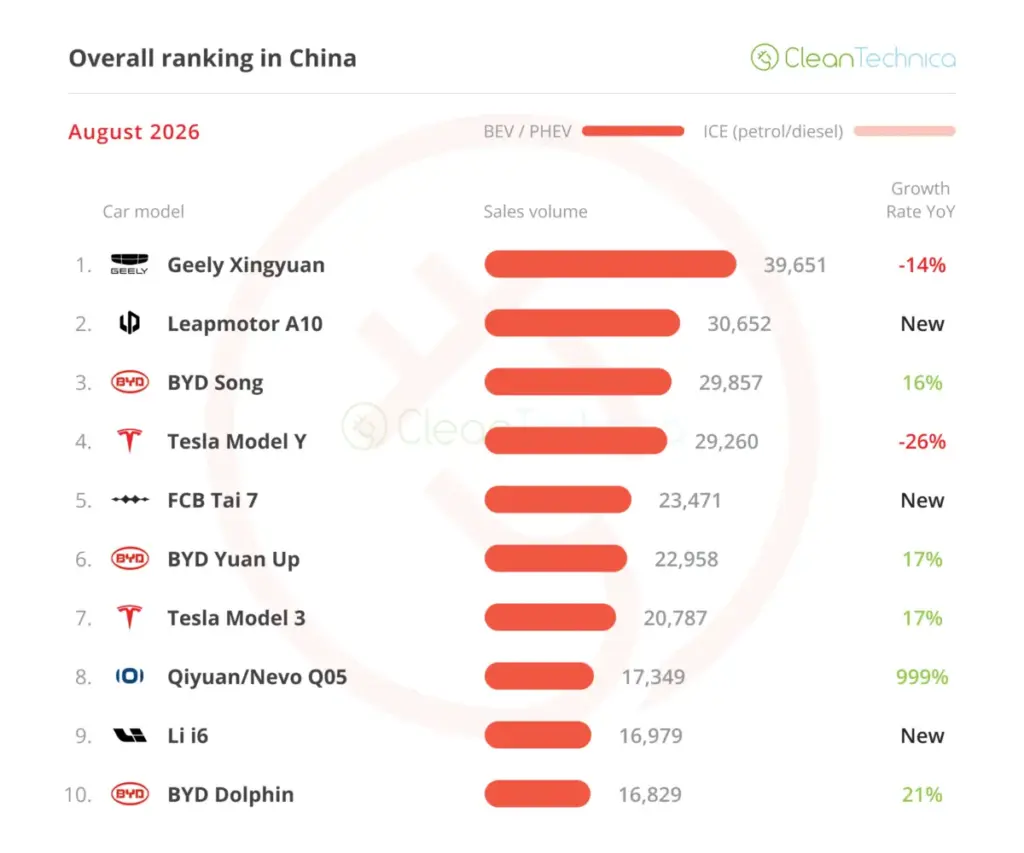
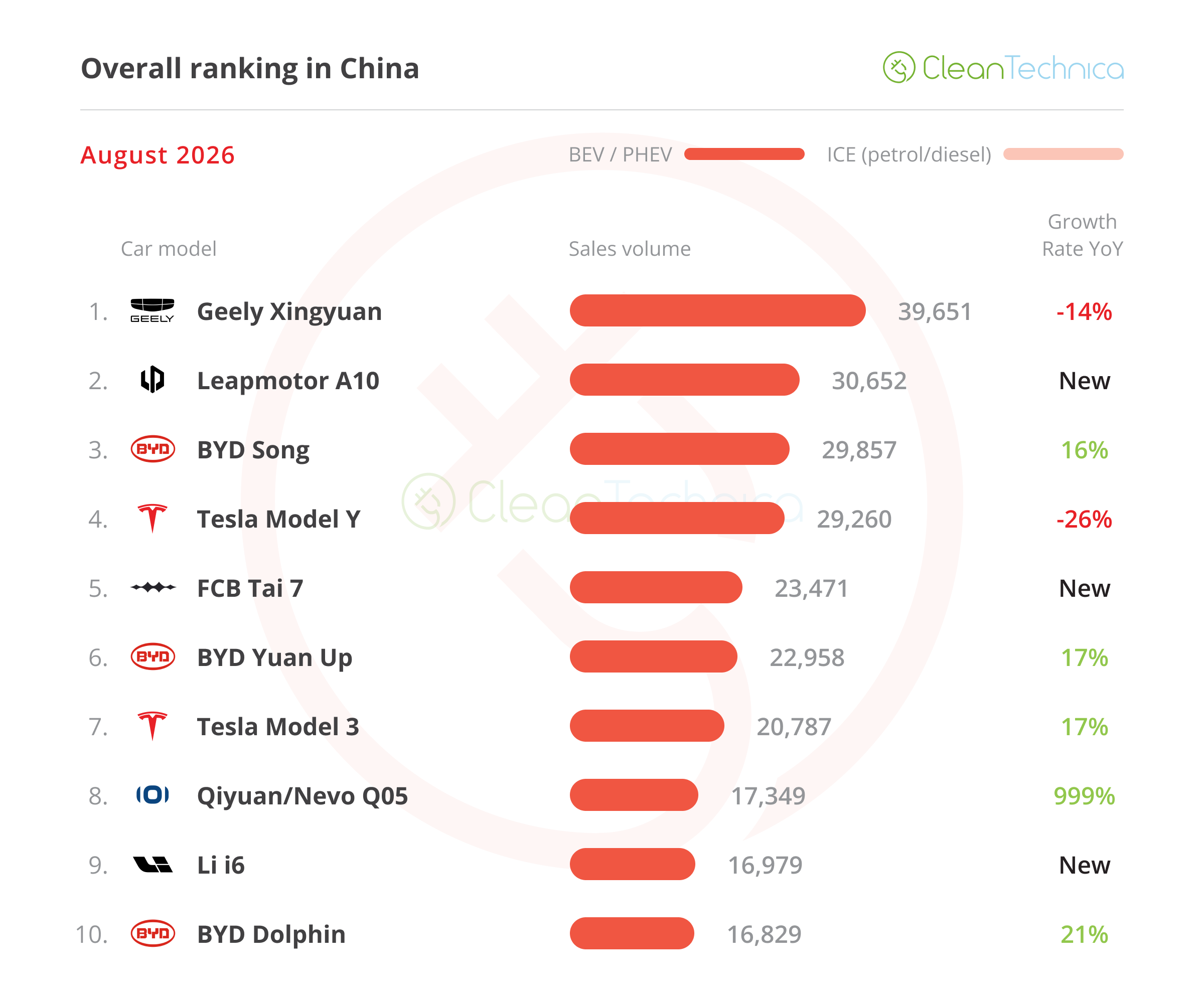
The extinction-level event facing internal combustion engines is vividly reflected in China’s model-specific sales charts. For August, the top ten best-selling vehicles across the entire Chinese automotive market were exclusively electrified, with eight of those spots claimed by pure battery-electric models. Consequently, tracking overall mixed-powertrain top lists has become redundant, prompting analysts to phase out legacy-inclusive rankings.
Size Category Breakdown
All major vehicle size segments showcased 100% electrified podiums in August:

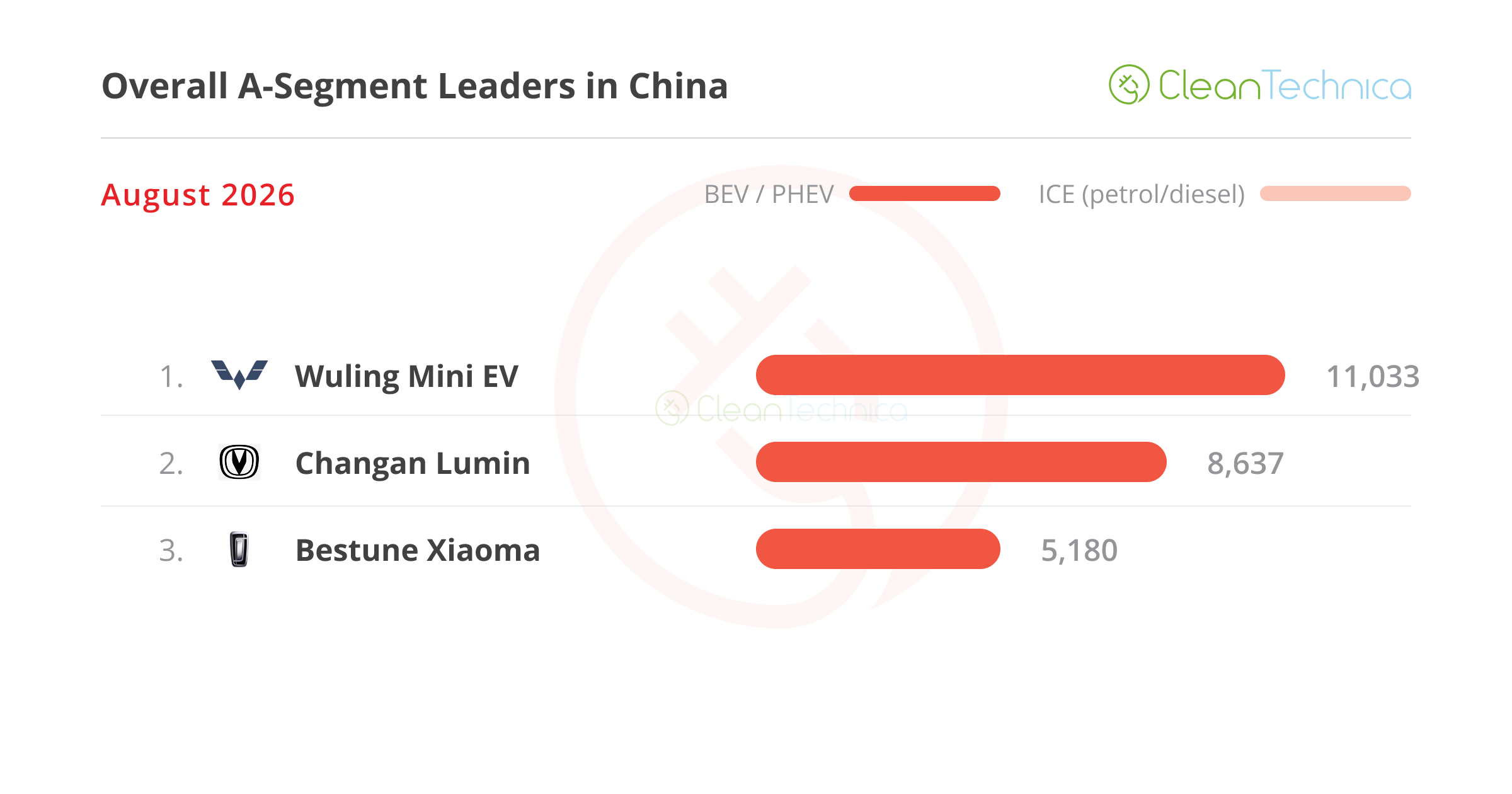
- A-Segment (City Cars & Subcompacts): Pressured by early-year subsidy adjustments, the smallest vehicle category is staging a methodical recovery. The Wuling Mini EV continues to anchor the segment, while the Changan Lumin secured a yearly best of 8,637 registrations to capture silver, fending off competition from Bestune’s Xiaoma and Geely’s Panda. The subcompact landscape, however, is bracing for the upcoming arrival of next-generation contenders like the BYD Racco.
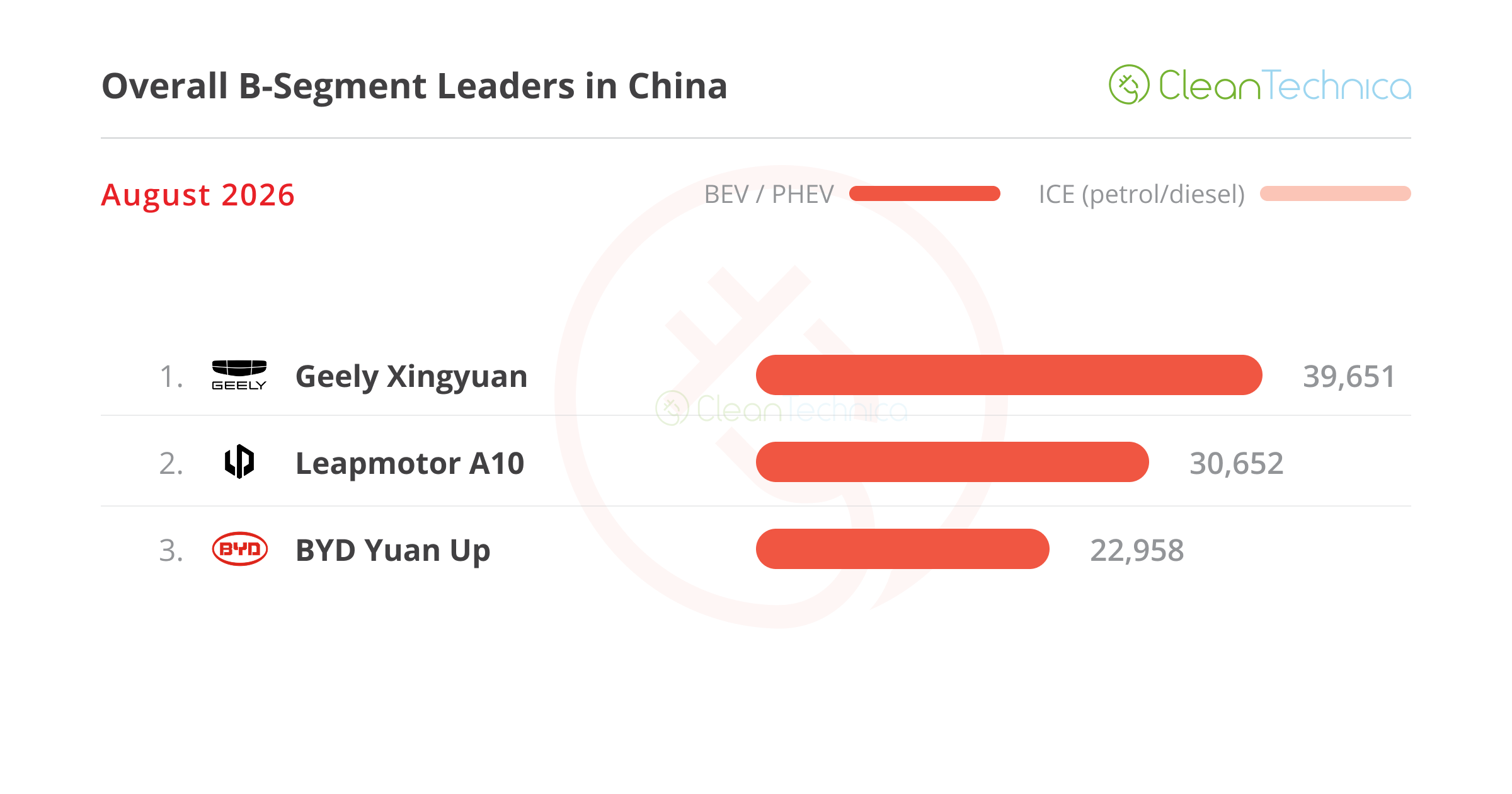
- B-Segment (Subcompact Hatchbacks & Crossovers): This remains the most fiercely contested battleground in the Chinese market, heavily defined by the formula pioneered by the Geely Xingyuan. Competitors are swarming the space; Leapmotor’s A10 crossover and A05 hatchback are ramping up production rapidly, with the latter clearing 8,000 units in its early months.
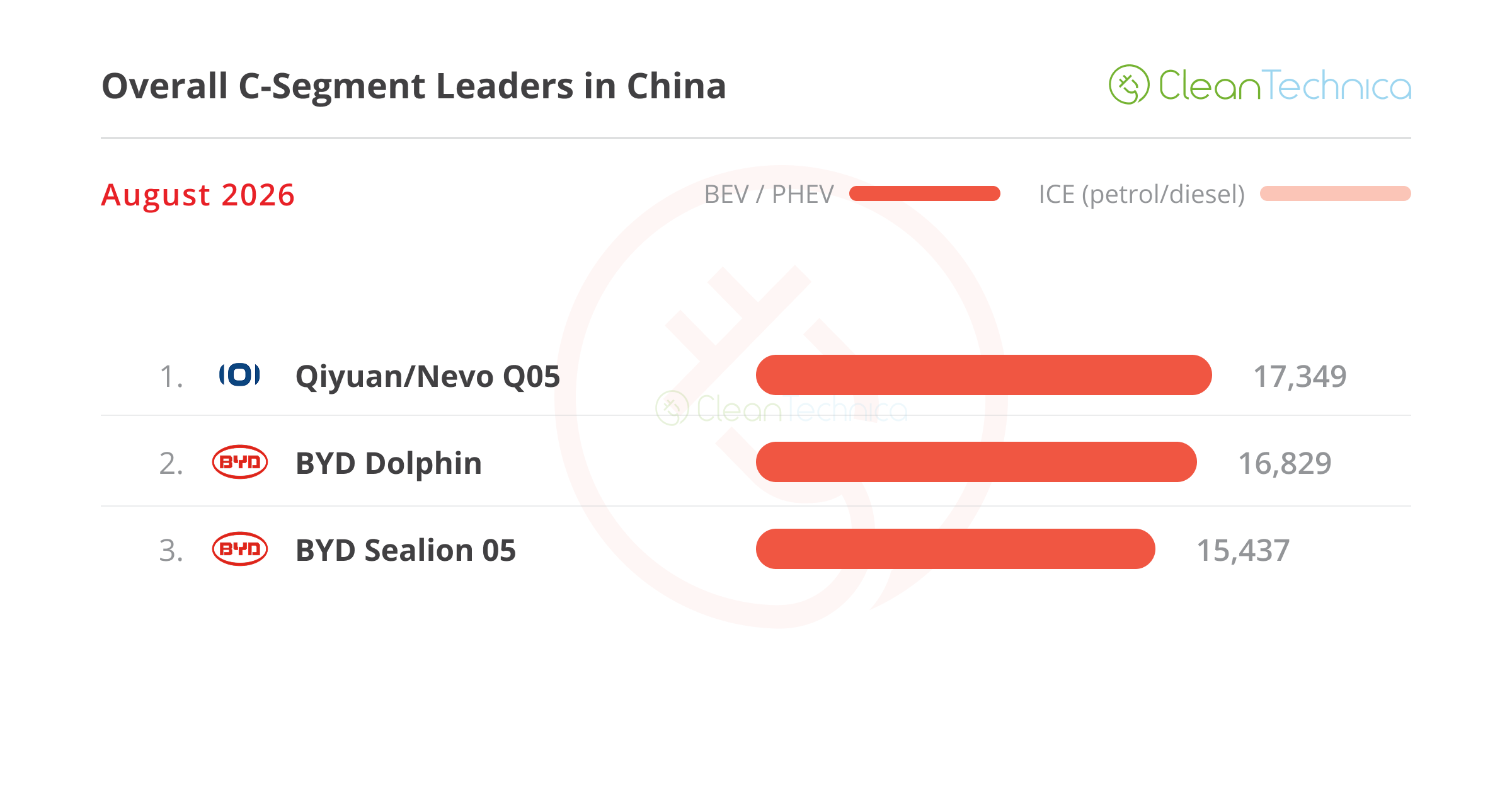
- C, D, and E Segments: Across midsize, large, and executive classes, legacy ICE models have been entirely displaced by advanced BEVs and range-extended architectures featuring 800V charging networks and deep AI-driven cockpit integrations.
Spotlight on Top-Selling Models
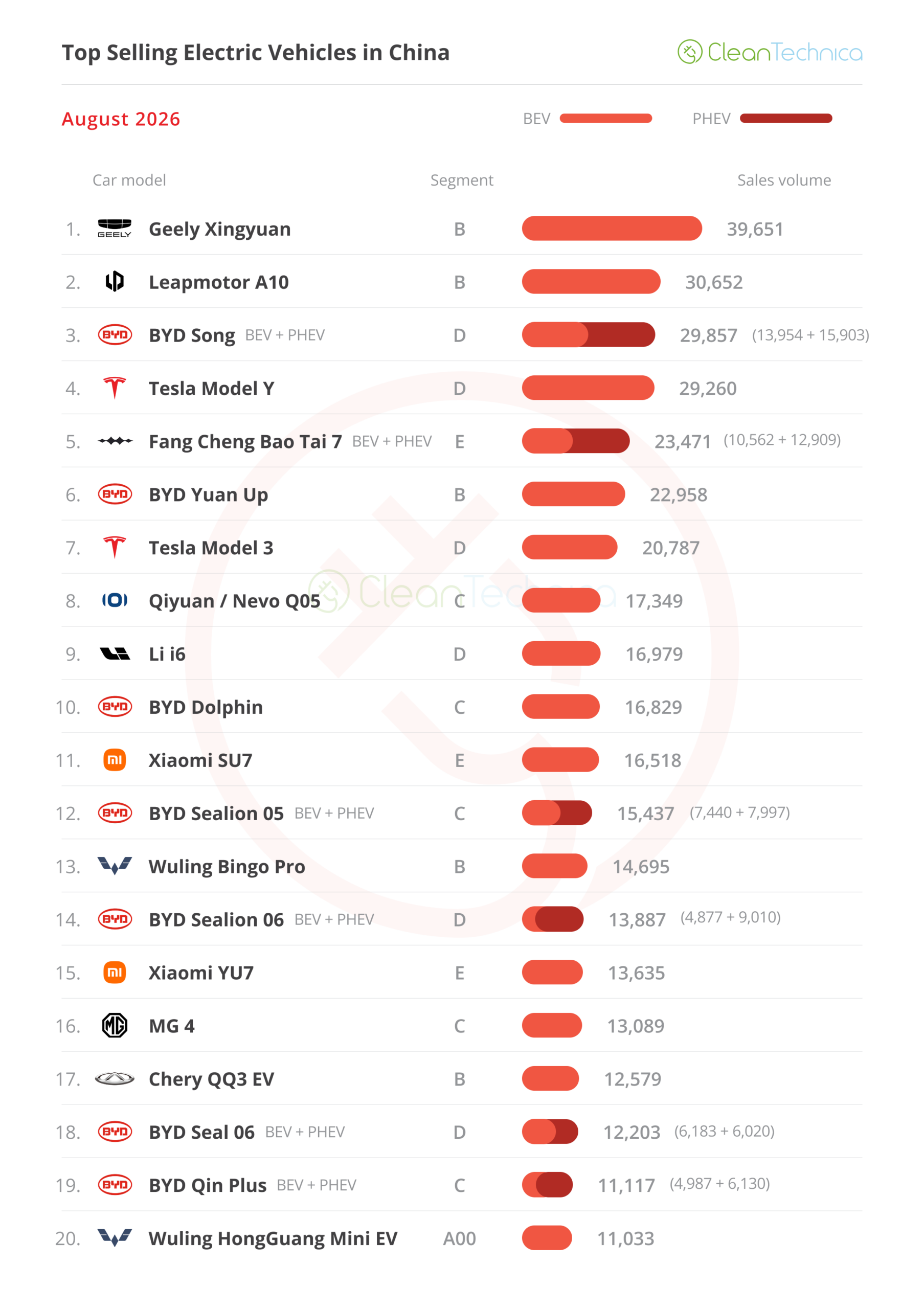
- Geely Xingyuan (#1): Conceived internally under the directive to build " a BYD Dolphin for BYD Seagull money ($10,000 USD)," Geely’s wishing-upon-a-star hatchback claimed the top spot with 39,651 registrations. Despite winning the monthly trophy, the figure represents a 14% drop YoY, underscoring the relentless pressure applied by rivals like Leapmotor’s A10 and A05, Chery’s QQ3, and the next-generation BYD Seagull.
- Leapmotor A10 (#2): The startup brand’s compact crossover continues its meteoric rise, securing 30,652 registrations and its first silver medal. Combining a value-focused 66,000 yuan ($10,000) entry point with a distinctive floating-roof design and striking lighting signatures, the A10 is rapidly emerging as a foundational volume driver for Leapmotor.
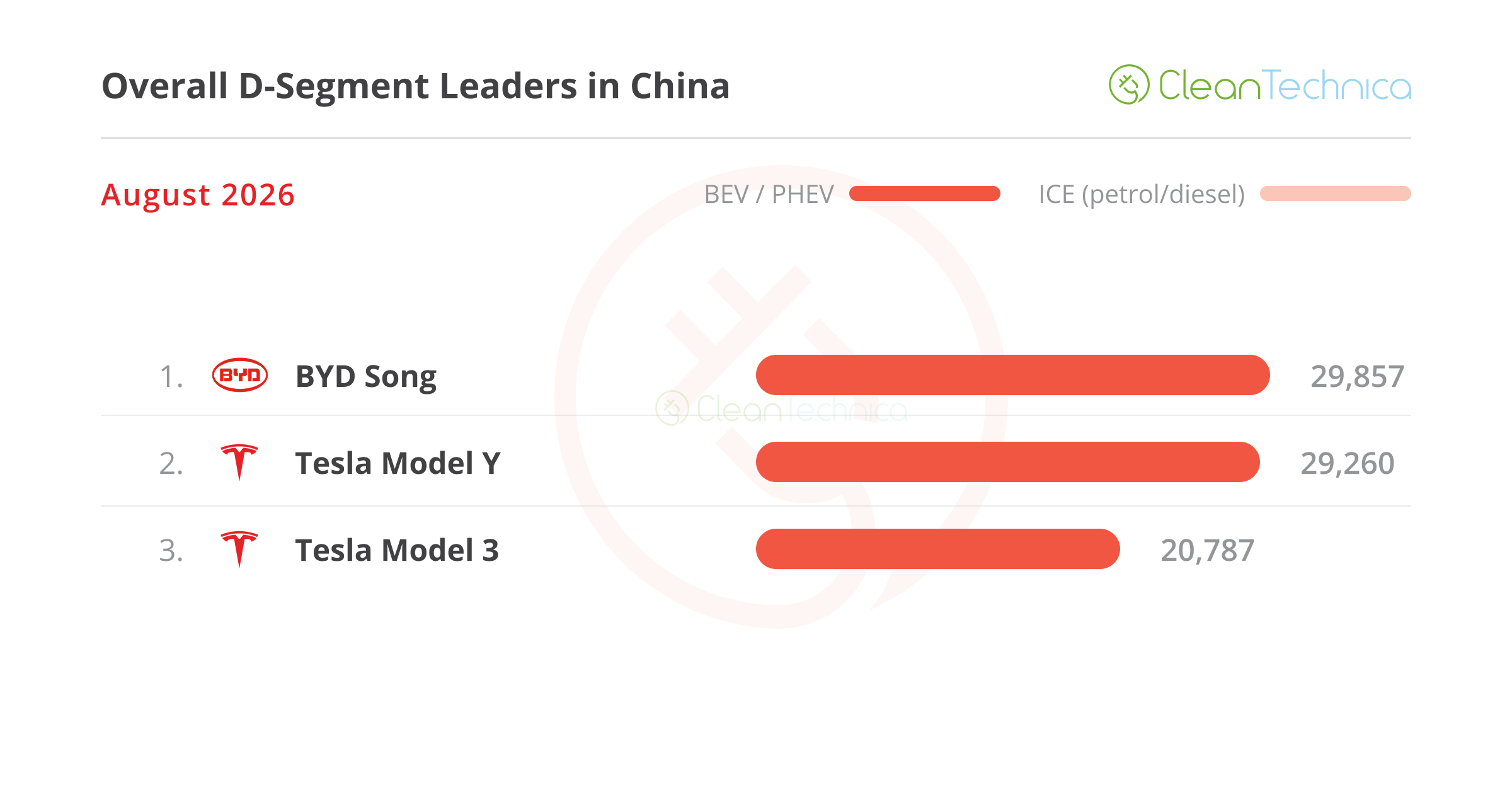
- BYD Song / Ultra (#3): Transitioning smoothly into its next-generation "Ultra" body style, BYD’s midsize SUV logged 29,857 registrations (up 16% YoY). Featuring advanced lidar integration and ultra-fast 1,500 kW DC charging at a price point starting between 152,000 and 180,000 yuan ($22,000–$26,000), it undercuts competitors like the Tesla Model Y while offering immense value.
- Tesla Model Y (#4): Delivering 29,260 units (a 26% drop YoY), Tesla’s mainstay crossover is leaning heavily on its newly introduced long-wheelbase "L" variant to sustain local demand. However, as domestic rivals roll out 800V platforms and advanced computing architectures, the aging Model Y architecture is encountering fierce structural headwinds.
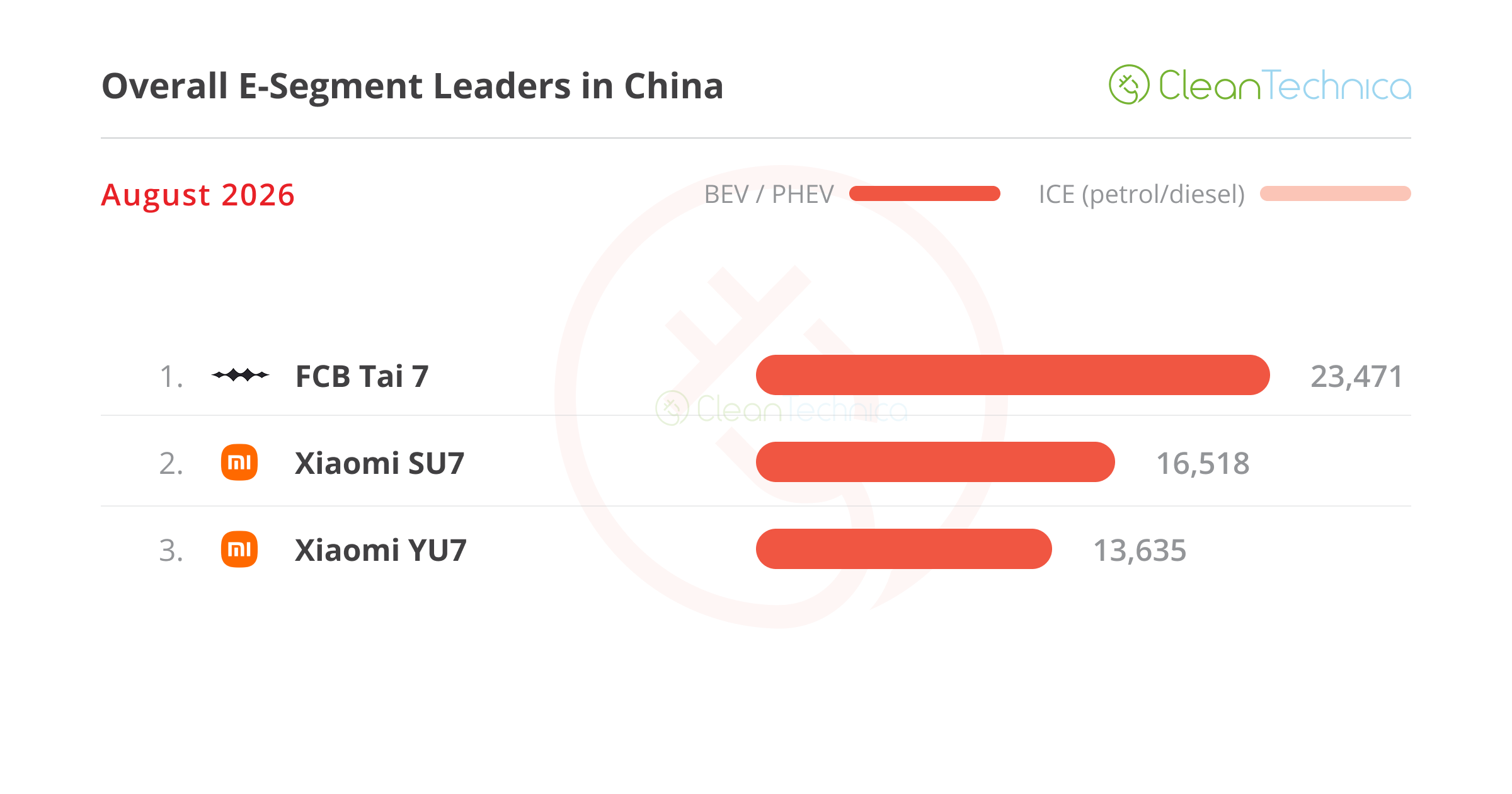
- Fang Cheng Bao Tai 7 (#5): BYD’s premium off-road brand recorded a stellar month with 23,471 registrations. Capitalizing on the market’s pivot toward pure electrics, the boxy, Land Rover–esque SUV saw its BEV variants (12,909 units) outsell its PHEV counterparts (10,562 units), positioning it as a formidable challenger to traditional gas-guzzling heavyweights like the Toyota Land Cruiser.
Official Statements and Industry Insights
Market observers and industry executives point to an unmistakable dichotomy within the Chinese auto sector. The traditional ICE segment is experiencing accelerated margin erosion, forcing legacy joint ventures into emergency restructuring.
As noted in recent market intelligence, the traditional foreign mainstays are registering severe volume crises:
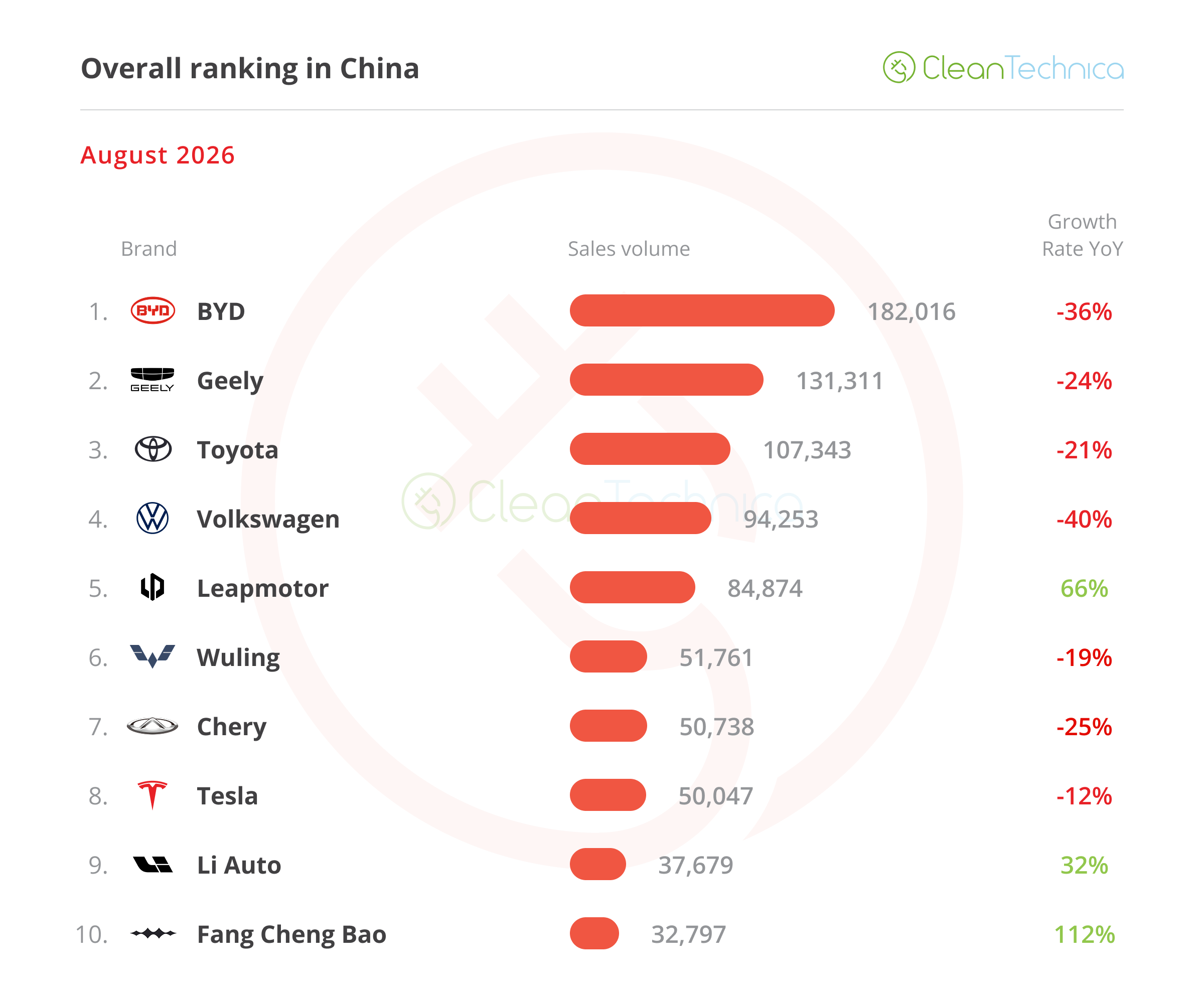
- Volkswagen: Suffered a steep 40% YoY sales crash, slipping to 4th place in the manufacturer rankings.
- Honda and Nissan: Experienced catastrophic contractions in August, with Honda cratering 50% YoY (to 27,000 units) and Nissan plunging 55% YoY (to 24,000 units).
Conversely, domestic startups are rewriting operational scaling playbooks. Leapmotor posted an astonishing 66% YoY surge to 84,874 registrations, closing to within striking distance of legacy titan Volkswagen. Leapmotor’s disciplined strategy—covering everything from city cars to large formats without the portfolio fragmentation seen at competitors like BYD—has positioned the Hangzhou-based startup for sustained market-share capture. Rumors of a forthcoming secondary premium brand targeted for late launch further underscore the aggressive ambitions of China’s emerging EV leaders.
Future Outlook: The Road to 2030
The trajectory established through August 2030 points toward an inevitable market endpoint. With the full-year 2026 EV adoption rate projected to comfortably exceed 60%—and pure BEVs tracking north of 40%—the economic viability of internal combustion engine technology has effectively expired. Financial analysts note that pouring capital into new ICE research and development at this stage represents sunk capital, as shrinking volume pools leave insufficient runway to amortize development costs.

Key indicators to watch heading into the final quarters of 2026 and into 2027 include:
- The Expiration of PHEV Incentives: Scheduled tax adjustments slated for late 2026 threaten to strip hybrid and extended-range vehicles of certain subsidies, potentially triggering a definitive return to pure BEV market dominance reminiscent of early adoption cycles.
- Global Export Expansion: As domestic consolidation forces Chinese OEMs to look outward, European, Latin American, and Southeast Asian regulatory bodies will face intense pressure to protect domestic manufacturing bases against the incoming wave of cost-optimized, highly-digitized EVs.
- Startup Consolidation: The rise of agile players like Leapmotor—and their potential evolution into global multi-brand conglomerates via strategic partnerships—suggests that tomorrow’s dominant global automotive giants may bear little resemblance to the century-old legacy institutions that built the twentieth-century car culture.



