

1. Executive Overview
The United Kingdom’s strategy to achieve decarbonized flight while expanding airport capacity has suffered a major setback. Quietly published Department for Transport (DfT) modeling reveals that the government has sharply scaled back its expectations for next-generation aviation technologies—including Sustainable Aviation Fuels (SAFs), battery-electric aircraft, and fleet fuel-efficiency improvements.
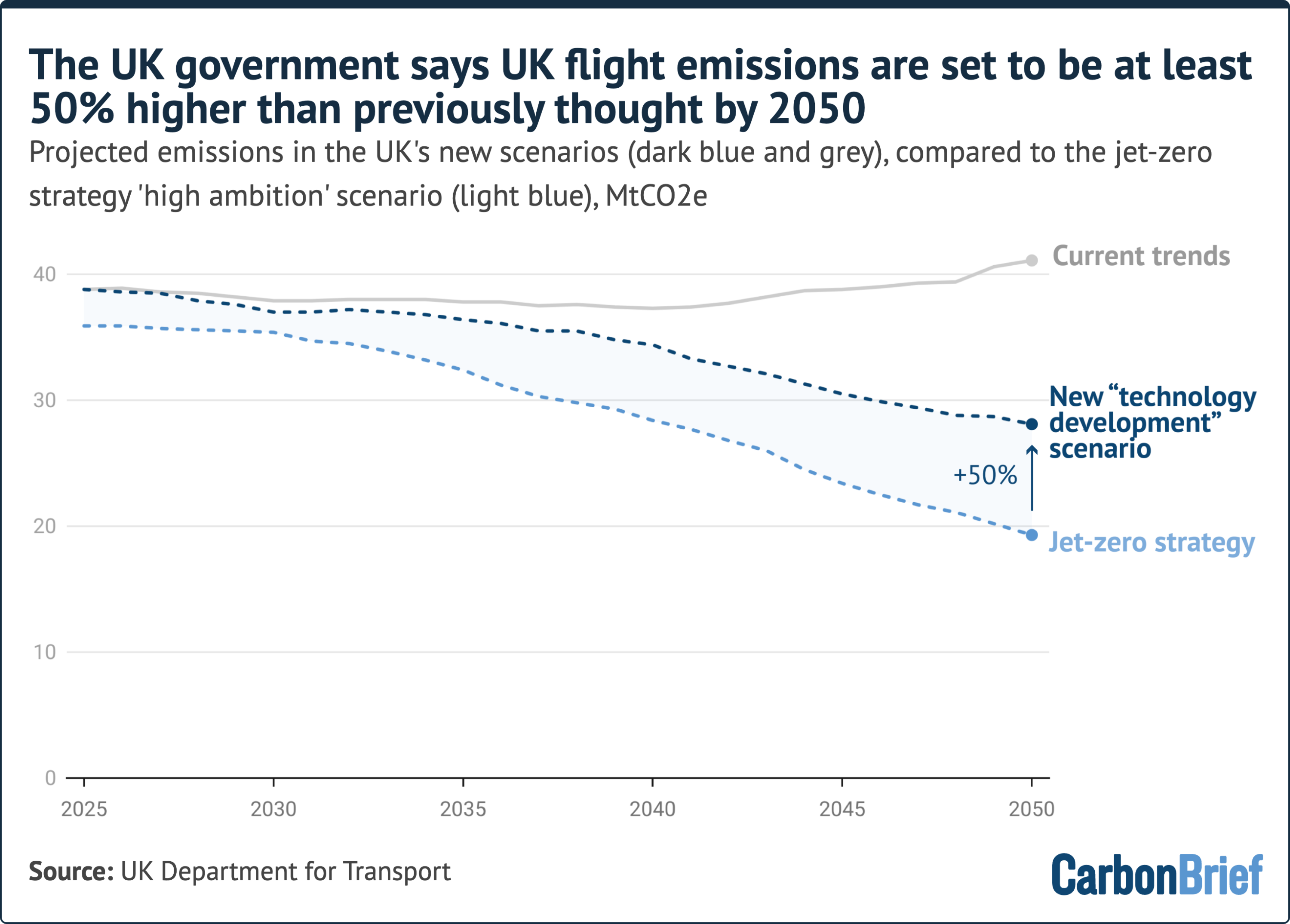
This recalibration exposes a expanding gap between political rhetoric and scientific reality. Ahead of a final planning decision on London Heathrow Airport’s contentious third runway, updated government projections indicate that flight emissions in 2050 will exceed earlier targets under the previous Conservative administration’s "Jet Zero" strategy by nearly 50%. Rather than dropping to a previously promised target of 19.3 million tonnes of carbon dioxide equivalent ($textMtCO_2texte$), updated modeling suggests that even with "ambitious" technology adoption, aviation emissions will remain at roughly 28.1 $textMtCO_2texte$ by mid-century.
If passenger demand rises by the projected 50% or more without aggressive policy intervention, unmitigated emissions could surge to 41.1 $textMtCO_2texte$—more than double the baseline scenario compatible with statutory climate obligations. Ministers have long justified major infrastructure expansions by promising that technological breakthroughs would decouple passenger growth from greenhouse gas pollution. However, independent analysts and climate scientists caution that the government’s updated forecasts remove this technological safety net, placing the UK’s legally binding 2050 Net Zero target at severe risk unless passenger growth is constrained or billions are poured into unproven engineered carbon removals.
2. Detailed Chronology: From ‘Jet Zero’ Promises to Modern Reality
========================================================================================
2019            2022                  2024–2025              Mid-2026         2029 (Target)
 |               |                      |                      |                |
 Peak Aviation   Launch of "Jet Zero"   Labour Government      DfT Quietly      Final Heathrow
 Emissions       Strategy               Reaffirms Support      Publishes Downgraded Planning
 (38.2 MtCO2e)   (19.3 MtCO2e target    for Heathrow Expansion  Tech Forecasts   Decision
                 by 2050)               via Green Tech         (28.1 MtCO2e)    Expected
========================================================================================
The 2019 Baseline and Jet Zero Strategy (2022)
UK aviation emissions reached a historic peak of 38.2 $textMtCO_2texte$ in 2019 before the global pandemic temporarily halted air travel. In July 2022, the Conservative government published its landmark "Jet Zero" strategy. The document outlined a "high ambition" pathway asserting that UK aviation could maintain unrestricted passenger growth while slashing emissions to 19.3 $textMtCO_2texte$ by 2050. The framework leaned heavily on the rapid deployment of drop-in SAFs, aggressive efficiency upgrades from commercial airframe manufacturers, and the swift entry into service of zero-emission (electric and hydrogen) regional aircraft.
Labour’s Endorsement of Infrastructure Growth
Following political transitions, the incoming Labour government maintained support for airport expansion, specifically endorsing plans for Heathrow’s long-delayed third runway. Cabinet ministers repeatedly cited the promises of the Jet Zero framework, arguing that green aviation technologies would mitigate the climate impact of adding hundreds of thousands of additional annual flights to West London’s airspace.
The Forecast Revision
Ahead of formal planning assessments for Heathrow, the Department for Transport quietly issued its revised aviation emissions forecasts. Built on updated technical assessments and lower international carbon price projections, the document officially abandoned key technical assumptions of the 2022 Jet Zero pathway, admitting that clean flight technologies would deliver significantly lower carbon reductions than originally claimed.
3. Supporting Context & Metrics: Deconstructing the Emission Gap
The technical updates published by the DfT mark a departure from speculative modeling toward empirical realities. By comparing the 2022 Jet Zero framework against the updated baseline scenarios, the magnitude of the decarbonization deficit becomes clear.
| Metric / Scenario | Jet Zero Strategy (2022 Target) | Updated Tech Scenario | Current Trends Scenario |
|---|---|---|---|
| 2050 Flight Emissions Target | 19.3 $textMtCO_2texte$ | 28.1 $textMtCO_2texte$ (+45.6% increase) | 41.1 $textMtCO_2texte$ (+112.9% increase) |
| 2050 SAF Market Share | 50% | 30% | Minimal baseline integration |
| Annual Fuel Efficiency Gain | 2.0% per annum | 1.3% per annum | Historical rate (~0.8–1.0%) |
| Zero-Emission Aircraft (2035) | Narrowbody regional integration | Smallest sub-regional only | Negligible commercial deployment |
| Projected Passenger Growth | ~70% increase | >50% increase | >50% increase |
UK Aviation Emission Projections to 2050 (in MtCO2e)
 50 |---------------------------------------------------------------------
    |                                            [Current Trends: 41.1]
 40 |--- [2019 Peak: 38.2] -----------------------------------------------
    |                                            [New Tech Forecast: 28.1]
 30 |---------------------------------------------------------------------
    |
 20 |-------------------------------------------- [Jet Zero Target: 19.3]
    |_____________________________________________________________________
   2019                                                                 2050
The Sustainable Aviation Fuel (SAF) Bottleneck
The cornerstone of the UK’s clean aviation policy was a rapid transition to SAFs—liquid hydrocarbon substitutes derived from waste fats, municipal trash, or synthetic power-to-liquid processes. The original Jet Zero pathway assumed a 50% SAF blend across all UK departing flights by 2050.
The revised DfT forecast cuts this projection to 30%. Furthermore, officials conceded that the lifecycle carbon reduction of SAFs had been over-estimated. Meeting even a 22% blend target by 2040 would require vast, potentially unachievable volumes of waste biomass feedstocks (such as used cooking oil and tallow), which are already facing severe global supply shortages and severe competition from other industrial sectors.
Fleet Efficiency and Electric Flight Delays
To re-evaluate fleet efficiency trajectories, the government commissioned an independent study from the Aviation Impact Accelerator (AIA). The AIA’s findings led ministers to lower expected fleet efficiency gains from 2.0% per year down to 1.3% per year.
Concurrently, early promises regarding battery-electric and hydrogen-powered flight were substantially walked back. Due to energy density limitations of battery technology, the DfT now expects only the smallest sub-regional aircraft (under 19 seats) to be operating commercially on zero-emission powertrains by 2035, leaving short-haul and long-haul commercial air travel almost entirely reliant on jet fuel.
Key Factors Driving Emission Revisions:
  1. SAF Scalability Limits      ==> Blend target cut from 50% to 30% by 2050
  2. Lower Fleet Efficiency Gains ==> Revised down from 2.0% to 1.3% annually
  3. Commercial Electric Delays  ==> Limited to sub-19 seat aircraft by 2035
  4. Rising Passenger Demand     ==> Forecasted passenger growth exceeding +50%
4. Official Statements & Critical Analysis
The widening gap between aviation expansion plans and environmental limits has sparked widespread concern among climate scientists, policy experts, and environmental advocacy organizations.

The Heathrow Expansion Dilemma
The revision poses a direct challenge to the legal justification for Heathrow’s third runway. Analysis provided by the Aviation Environment Federation (AEF) indicates that the runway addition alone would contribute an extra 3.5 $textMtCO_2texte$ annually by 2050, with operational emissions continuing to climb well past the mid-century mark.
Tim Johnson, Director of the Aviation Environment Federation (AEF), noted:
"The government’s updated forecasts offer a more honest and realistic vision of what is achievable over the next quarter-century. However, stepping back from an over-reliance on unproven technology and alternative fuels reopens the fundamental debate regarding greenhouse gas removals and how to address the projected 50% growth in passenger demand."
Carbon Budget Breaches
Academic analysis raises further questions about whether airport expansion aligns with statutory commitments under the UK Climate Change Act.

Dr. Lois Pennington, Research Associate at the Tyndall Centre for Climate Change Research at the University of Manchester, stated:
"The updated forecast reveals that we are projected to be well over aviation’s sustainable allocation of the national carbon budget even before a third runway at Heathrow is considered. Expansion can no longer be waved through on the unfulfilled promise of future technology. Any formal approval will be made in the full knowledge that it will bust our legally binding carbon budgets."
Advisory bodies, including the Climate Change Committee (CCC), have repeatedly urged the government to implement demand-management measures—such as a frequent flyer levy or airport capacity caps—warning that unmitigated aviation growth could consume up to 80% of the UK’s entire remaining national carbon budget by 2050.
5. Future Outlook: The Dangerous Gamble on Negative Emissions
The government’s revised forecasts leave ministers with a stark policy choice as the final planning decision for Heathrow approaches:

                  ┌─────────────────────────────────────────┐
                  │ UK Aviation Emissions Deficit in 2050   │
                  │   (9 to 22 MtCO2e above Jet Zero Target)│
                  └────────────────────┬────────────────────┘
                                       │
            ┌──────────────────────────┴──────────────────────────┐
            ▼                                                     ▼
┌───────────────────────────────────────┐   ┌───────────────────────────────────────┐
│ Option A: Demand Management           │   │ Option B: Mass Carbon Removal         │
├───────────────────────────────────────┤   ├───────────────────────────────────────┤
│ • Frequent Flyer Levies               │   │ • Direct Air Capture (DAC)            │
│ • Airport Capacity Caps               │   │ • Massive Afforestation               │
│ • Air Passenger Duty Adjustments      │   │ • Extreme Financial & Land Costs      │
└───────────────────────────────────────┘ └───────────────────────────────────────┘- Implement Demand Management: Introduce structural policies to curb passenger growth, such as frequent flyer levies, reforming Air Passenger Duty, or halting further regional airport capacity expansions.
- Rely on Mass Carbon Removal: Compensate for excess flight emissions by relying heavily on engineered Greenhouse Gas Removals (GGRs), such as Direct Air Capture (DAC) and Bioenergy with Carbon Capture and Storage (BECCS), or through afforestation.
The Scale of the Removal Task
To neutralize the projected 2050 aviation emissions overshoot (between 9 $textMtCO_2texte$ and 22 $textMtCO_2texte$ above Jet Zero allocations), the UK would need to construct expensive engineered carbon removal facilities or dedicated forestry schemes covering vast land areas.
Offsetting the expansion of a single major airport like Heathrow would require establishing new dedicated forests twice the geographical size of Greater London—a strategy experts deem ecologically and financially unfeasible given competing land demands for housing and agriculture.
As the 2029 deadline for the final Heathrow decision approaches, the UK government faces an inescapable trade-off. Without a dramatic breakthrough in alternative fuels or a sharp pivot toward constraining passenger growth, approving major airport expansions will force the UK to either breach its legal net-zero obligations or divert significant public and private funds toward speculative carbon removal technologies.



