


Executive Overview
As the international community prepares for the upcoming United Nations Climate Change Conference (COP31) in Antalya, Turkey, high-stakes preliminary negotiations in Nadi, Fiji, have exposed profound ideological fractures among global leaders. At the center of the debate is a stark warning from the incoming COP31 presidency: wealthy nations must fundamentally reallocate their financial priorities, spending vastly more on mitigating and adapting to the climate crisis than the 5% of Gross Domestic Product (GDP) recently pledged by NATO members toward conventional military defense.
Murat Kurum, Turkey’s climate change minister and the COP31 president-designate, argued unequivocally that “the climate issue is the security issue.” However, Kurum’s refusal to firmly commit to replicating previous landmark pledges to “transition away from fossil fuels”—the primary driver of global heating—has drawn fierce criticism from vulnerable island nations, climate advocates, and progressive coalitions.
Against a backdrop of geopolitical volatility, economic strain, and a retrenchment of climate policies by major international players, the pre-COP31 summit underscored an uncomfortable truth: while frontline nations like Tuvalu face existential threats from rising seas, global heavyweights remain deeply divided over whether to target the supply-side production of coal, oil, and gas or rely exclusively on demand-side renewable scaling.

Detailed Chronology: The Road to Antalya via Nadi
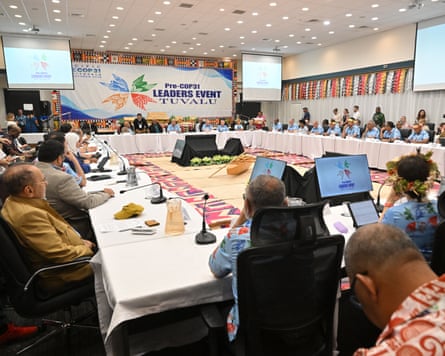
The journey toward COP31—scheduled for November in the Turkish coastal city of Antalya—began thousands of miles away in the Pacific island nation of Fiji. At the urging of Australia, which has assumed the novel role of “president of negotiations” for COP31, the pre-COP ministerial summit was deliberately hosted in the Pacific to focus international attention directly on the existential threats facing low-lying island states.
The Pacific Pre-COP Gathering (October 2026)
- Low Turnout of Global Leaders: Geopolitical turmoil, ongoing armed conflicts, an unprecedented energy crisis, and the presence of a climate-skeptic administration in the United States contributed to a muted turnout of national leaders. Aside from Australian Prime Minister Anthony Albanese, only 12 other national leaders—predominantly from Pacific nations—attended the summit in Nadi.
- Broad Ministerial Representation: Despite the sparse presence of heads of state, the gathering attracted roughly 30 national ministers from countries including India and various European states, as well as official representatives from major greenhouse gas emitters such as China and Saudi Arabia. In total, approximately 4,000 delegates participated in the events.
- The Tuvalu Delegation Visit: On Tuesday of the summit week, a high-level delegation flew north to Tuvalu, a vulnerable atoll nation of 10,000 residents whose land sits mostly just two meters above sea level. Delegates inspected a 20-hectare (49-acre) land reclamation project and heard harrowing accounts of survival against rising tides and intensifying storm surges. Thirteen-year-old local resident Melelusi Sokotia delivered a poignant address, noting that her peers’ aspirations of becoming teachers, doctors, and builders were being eclipsed by the fundamental question of whether they could safely grow up in their homeland.
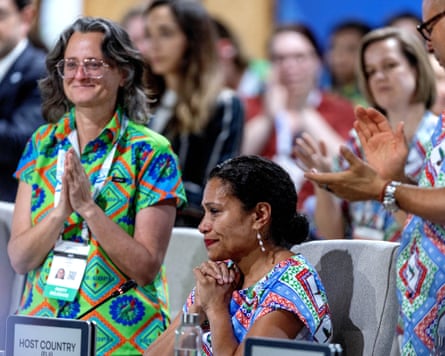
- Emotional Conclusion in Nadi: Upon the delegation’s return to Fiji, the summit concluded with a deeply emotional address by Fiji’s climate minister, Lynda Tabuya. Receiving a standing ovation and brought to tears, Tabuya urged delegates to honor the human toll of the climate crisis: "This pre-COP draws to a close tonight. Our responsibility does not."
Supporting Context & Metrics: The Widening Gap Between Rhetoric and Reality
The urgency of the Nadi talks is underscored by alarming metrics released by international bodies. With approximately 190 national governments set to converge on Antalya, mounting evidence demonstrates that current global efforts fall drastically short of averting catastrophic planetary warming.
The Emissions and Temperature Gap
According to a landmark report by the United Nations Environment Programme (UNEP), even under the most optimistic future policy scenarios, global heating is projected to reach at least 1.8°C, comfortably overshooting the 1.5°C ceiling established by the landmark Paris Agreement. Scientists and UN officials have repeatedly emphasized that every fraction of a degree of avoided warming saves thousands of lives and prevents trillions of dollars in economic devastation.

The Climate Finance Deficit
A core grievance voiced throughout the pre-COP31 summit was the gross inadequacy of financial flows to the regions most vulnerable to climate impacts. Australian Climate Change Minister Chris Bowen highlighted a glaring disparity: only 0.2% of global climate finance is currently allocated to helping small island developing states adapt to environmental shifts.
- "The countries that need it the most get it the least," Bowen stated plainly. "That has got to change. It’s a key priority of COP31."
The Defense vs. Climate Spending Paradox
Murat Kurum drew a sharp comparison between military expenditures and environmental investments. Pointing out that NATO members have committed to increasing their defense budgets to 5% of GDP by 2035 driven by conventional security anxieties, Kurum argued that climate change represents an infinitely greater security threat that warrants vastly superior financial mobilization.
- Pre-Disaster vs. Post-Disaster Economics: Kurum noted through an interpreter that failing to invest adequately in pre-disaster climate resilience results in exponential costs down the line. "If you don’t spend one unit of money prior to the disasters, then you are left in a position where you have to spend 10 units of money after the disaster. It’s cheaper pre-disaster."
Official Statements and Policy Divisions
While the rhetoric surrounding security and adaptation found broad resonance, sharp disagreements emerged regarding the mechanics of decarbonization, specifically concerning the explicit phasing out of fossil fuels.
The Electrification Target
Both Kurum and Bowen announced that a central objective for COP31 in Antalya will be securing global backing for a new energy target: 35% of all energy required to power homes, businesses, factories, and vehicles must come from electricity by 2035. Currently, that figure stands at approximately 21%.
The Fossil Fuel Stalemate
Despite broad agreement on electrification, the question of whether nations should explicitly commit to transitioning away from oil, gas, and coal remains a political minefield.
- The Host Nations’ Stance: Both Turkey and Australia endorsed a multi-country statement in Fiji supporting a “transition away from fossil fuels,” echoing the historic language agreed upon at COP28 in Dubai. However, both nations faced sharp accusations of hypocrisy from civil society groups and climate activists for continuing to approve and finance new coal and gas development projects domestically.
- Bowen’s Supply-Side Theory: Defending Australia’s approach, Bowen argued that the most effective way to eliminate fossil fuel use is not to artificially restrict supply, but to scale up renewable energy generation so rapidly that fossil fuel power plants become economically obsolete.
- Kurum’s Pragmatic Hesitation: In comments bound to spark intense debate at the summit, Kurum hedged on whether COP31 should attempt to replicate the explicit fossil fuel transition language of past pacts. Asserting that the world is “already in a transition,” Kurum suggested that fixating on specific terminology may yield diminishing returns, noting that petro-states like Saudi Arabia and Russia fiercely resisted naming fossil fuels directly at COP30 in Brazil.
Resistance from Frontline States and Coalitions
Frustrated by what they perceive as institutional stagnation within the UN framework, a coalition of nations dissatisfied with the pace of reform convened earlier this year in Colombia to map out an independent path away from fossil fuels. These nations plan to meet again next July in Tuvalu, maintaining intense pressure for explicit phaseout language to be codified in any Antalya agreement.
Tzeporah Berman, chair of the Fossil Fuel Non-Proliferation Treaty Initiative, encapsulated the frustration of civil society delegates in Nadi:
"Pacific leaders have been crystal clear: this means no new projects. You can’t phase something out by building more of it."
Future Outlook: Looking Ahead to Antalya
As the diplomatic caravan packs up and departs Fiji, the trajectory for COP31 in November is coming into sharp focus. The conference will serve as an ultimate litmus test for international cooperation under severe geopolitical strain.
- The Financing Battleground: Developing nations and small island states will push relentlessly for binding commitments on loss-and-damage funding and enhanced adaptation grants, demanding that wealthy nations fulfill—and expand upon—their historical financial liabilities.
- The Security Paradigm Shift: Kurum’s framing of climate change as an existential security crisis may alter how Western nations calculate their budgetary priorities, potentially unlocking new defense-adjacent funding pools for environmental resilience.
- The Fossil Fuel Battle Lines: The central drama in Antalya will undoubtedly revolve around whether the summit can transcend the diplomatic compromises of past COPs. With major producers digging in their heels and vulnerable island nations staring down the barrel of inundation, the push for binding supply-side phaseout mechanisms will determine whether COP31 is remembered as a turning point or a missed opportunity for humanity.



