

Executive Overview
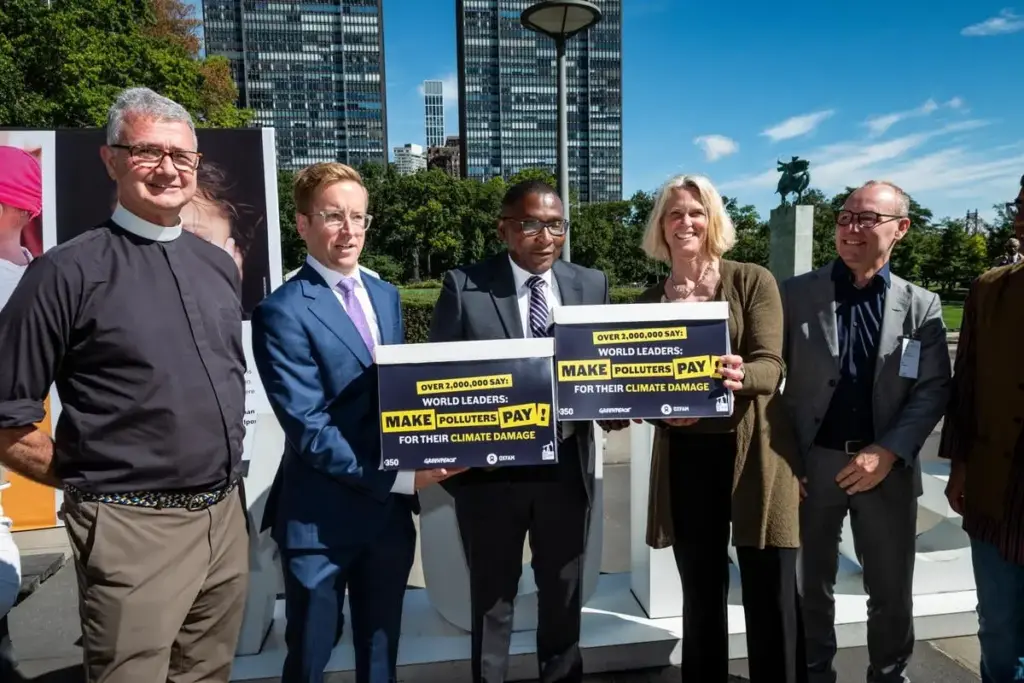
Against the backdrop of a warming planet battered by historic heatwaves, relentless floods, and catastrophic wildfires, a global coalition of grassroots campaigners and international advocacy groups has escalated the climate fight directly to the doorstep of the United Nations. In New York City, coinciding with the high-level gatherings of the UN General Assembly, delegations representing the Make Polluters Pay International Coalition delivered petitions carrying a staggering combined total of more than two million signatures.
The primary target of this historic mobilization is unambiguous: global governments must enact binding legislative frameworks to ensure that fossil-fuel corporations and their ultra-wealthy beneficiaries pay their fair share for the planetary damage they have knowingly caused. Received directly by Selwin Hart, the United Nations Assistant Secretary-General for Climate Action, the petitions reflect an unprecedented convergence of global public outrage. Ordinary citizens, frontline communities, faith leaders, and international environmental organizations are uniting around a singular moral and economic imperative—shifting the staggering financial burden of the climate crisis away from overburdened taxpayers and placing it squarely onto the balance sheets of the oil, gas, and coal conglomerates that profited from destruction.
This high-stakes intervention arrives at a critical juncture in international climate diplomacy. With scientists confirming that the global climate system is teetering perilously close to the critical 1.5-degree Celsius threshold established by the Paris Agreement, developing nations are being systematically starved of the capital required to protect their populations. Meanwhile, the fossil-fuel industry continues to rake in incomprehensible fortunes. Leaders from organizations such as Greenpeace, Oxfam, 350.org, and GreenFaith have joined forces to demand that governments abandon their defense of corporate wealth and choose whether they stand with humanity or with the polluters driving the planet toward collapse.
Detailed Chronology of the New York Action
The delivery of the two million-plus signatures in New York was the culmination of months of coordinated international organizing, timed deliberately to exploit the political gravity of the UN General Assembly.
The morning of the presentation began outside UN headquarters, where a diverse coalition of frontline activists, indigenous leaders, trade unionists, and environmental defenders gathered under banners bearing the campaign’s defining slogan: Make Polluters Pay. The visual contrast was stark: while world leaders convened inside the glass halls to discuss global security, resilience, and macroeconomic stability, the voices of everyday people who are living on the frontlines of climate breakdown echoed loudly outside.
The mobilization gained momentum following a severe summer that shattered historical meteorological records. August was officially recorded as the hottest month in human history, punctuated by deadly flash floods in parts of the Global South, out-of-control mega-fires scorching North America and Europe, and an ongoing energy insecurity crisis directly tied to structural reliance on volatile fossil fuels.
Delegates representing the coalition marched to the UN Secretariat, where they formally handed over the massive dossier of signatures to Assistant Secretary-General Selwin Hart. The symbolic transfer underscored a growing alignment between civil society demands and top-tier UN leadership. Unlike historical climate protests that focused solely on emission reductions, this action targeted the financial architecture of the crisis, demanding specific punitive and corrective fiscal mechanisms: climate-damages taxes, heavy surtaxes on windfall fossil-fuel profits, and mandatory compliance fines to capitalize international recovery and adaptation funds.
Following the formal handover, coalition leaders convened a press briefing to dissect the systemic failures of current global governance and outline the concrete legislative demands of the two million signatories. The event served as a clarion call, signaling that civil society will no longer accept empty diplomatic promises while communities absorb the human and economic toll of unchecked corporate emissions.
Supporting Context & Metrics: The Anatomy of Climate Injustice
To understand the urgency behind the Make Polluters Pay petition, one must examine the staggering asymmetry between corporate enrichment and global destitution. The statistics underpinning the campaign reveal an economic model built on externalizing catastrophic costs onto the public while privatizing extraordinary windfalls.
The Profit-Disaster Paradox
Since the onset of geopolitical disruptions, including Russia’s invasion of Ukraine, the five largest publicly traded oil and gas majors (often referred to as the "Big Five": ExxonMobil, Chevron, Shell, TotalEnergies, and BP) have accumulated approximately half a trillion dollars in profits. These staggering sums have largely been funneled into stock buybacks, dividend payouts to institutional investors, and continued exploration for new fossil reserves—despite clear warnings from the International Energy Agency (IEA) that no new oil and gas fields can be developed if the world is to reach net-zero emissions by 2050.
Attribution Science and Historical Damage
Recent breakthroughs in climate attribution science have made it possible to link specific corporate emissions directly to extreme weather events. According to data highlighted by Oxfam International:
- The greenhouse gas emissions traceable to just five oil androgens were singularly responsible for roughly one in every four heatwaves experienced globally since the year 2000.
- The six largest fossil-fuel corporations are collectively on track to generate an estimated $147 billion in profits during the current fiscal year alone.
- Meanwhile, the human toll is overwhelmingly concentrated in the Global South, where smallholder farmers, marginalized women, and low-income families are losing their homes, livelihoods, and lives to climate emergencies they did literally nothing to cause.
The Moral and Economic Theft
As GreenFaith Executive Director Fletcher Harper noted, the fossil-fuel industry has enjoyed an estimated $3 billion in daily profits over the past half-century, even as internal documents revealed that these companies were fully aware of the lethal consequences of their products. Studies indicate that pollution stemming from fossil-fuel combustion is responsible for roughly one in five deaths globally. Yet, the multi-trillion-dollar bill for sea-wall construction, disaster relief, crop failure compensation, and emergency relocation has been systematically shifted onto taxpayers, local municipalities, and devastated families. In economic and ethical terms, campaigners argue, this is nothing short of institutionalized theft.
Official Statements and Perspectives
The coalition’s action drew powerful endorsements from global leaders, spiritual figures, and organizational directors who unified their voices behind the demand for systemic tax reform and corporate accountability.
United Nations
Selwin Hart, UN Assistant Secretary-General for Climate Action:
"The fossil fuel industry right now is earning extraordinary profits… As the climate crisis accelerates, developing countries are being starved of the resources they need to protect their communities and to safeguard livelihoods from a crisis they did literally nothing to cause. This is unjust. This is the heart of climate injustice. Polluters must pay, and the UN supports this effort, we are with you. We urge you to use every single legal and lawful tool at your disposal. Regulate, legislate and litigate. Civil society must use every tool at your disposal to hold the polluters accountable. You are on the right side of history."
Greenpeace International
Mads Christensen, Executive Director:
"2026 is a year the whole world could feel. August was the hottest month ever recorded, and scientists confirmed we are close to breaking the 1.5°C limit governments swore to hold… The biggest oil companies keep chasing profit to the last barrel, fueling the very disasters wrecking lives, ready to burn everything behind them rather than change course. The wealthiest polluters should be permanently taxed more to pay for the damage they cause, not the families and communities left to pick up the bill. Governments now face a clear choice, and too many are still on the wrong side of it: keep shielding the wealthiest polluters, or stand with the rest of us paying the price. This is how we take the profit out of destruction and protect the generations to come. It is us, or them."
350.org
Anne Jellema, Executive Director:
"For years, campaigners and communities on the frontlines have been saying the same thing: the companies that have profited from fossil fuels must pay their fair share of the costs of the crisis they helped create. Today, that demand is moving into the mainstream. We have watched homes burn, communities flood and families struggle with the rising costs of climate and energy crises, while fossil-fuel companies continue to make extraordinary profits. We pay. They profit. It’s time to change that. Now the voices of more than two million people are being brought to the United Nations. Governments have the power to make polluters pay, and they must use it."
Oxfam International
Amitabh Behar, Executive Director:
"Super-rich polluters are causing the most climate damage while the rest of us are left to pay the price… There is no fixing the climate crisis without taking on the billionaires and corporations cashing in on it. Frontline communities and millions of people have made their demand clear: make the richest polluters pay. Now world leaders must find the courage to protect billions of lives instead of polluters’ billions of dollars."
GreenFaith
Fletcher Harper, Executive Director:
"Every religion teaches the same moral principle: you do not get to harm your neighbor and walk away… For 50 years, the fossil fuel industry has enjoyed $3 billion in daily profits while knowingly creating pollution responsible for one in five deaths globally. Communities worldwide are absorbing the mounting costs of climate damage. Those expenses have not been paid by the polluters. They have been pushed onto families, communities, and taxpayers. In moral terms, that is theft."
Future Outlook: The Road Ahead for Global Climate Taxation
The presentation of the two million signatures marks not an end, but a strategic escalation in the global campaign for climate justice. As international bodies prepare for upcoming negotiations on climate finance, loss-and-damage architecture, and global tax rules, the pressure on national governments has reached a boiling point.
The mandate delivered to the United Nations is structurally clear and politically unavoidable:
- Accelerate the Phase-Out: Governments must enact binding legal frameworks to phase out fossil-fuel extraction and consumption, replacing an obsolete energy economy with robust investments in clean, democratized, and affordable renewable energy.
- Implement Binding Polluter Taxes: Lawmakers must draft and pass permanent tax regimes that target excess fossil-fuel revenues, corporate windfalls, and the accumulated wealth of major shareholders and institutional investors who back carbon-intensive industries.
- Fund the Just Transition: Revenues generated from these taxation measures must be directly channeled into domestic adaptation funds, international climate finance mechanisms (such as the Santiago Network and the Fund for Responding to Loss and Damage), and economic diversification programs for workers in legacy energy sectors.
The political window for incremental reform has closed. As extreme weather events escalate in frequency and severity, the global public has demonstrated through sheer numbers that it will no longer subsidize the destruction of the biosphere. The choice facing world leaders is stark, existential, and immediate: continue subsidizing the fossil-fuel elite, or heed the mandate of millions and finally make the polluters pay.



