

By Claudia De Meulemeester
London-based Financial Journalist
Originally published by Green Central Banking, adapted for Corporate Knights
Executive Overview
Resilience has decisively overtaken the narrative of global climate action. For years, the primary lexicon of environmental diplomacy was dominated by terms like "mitigation," "decarbonization," and "net-zero targets." Today, however, as extreme weather events exact a staggering human and economic toll, the conversation has shifted toward survival, adaptation, and collective endurance.
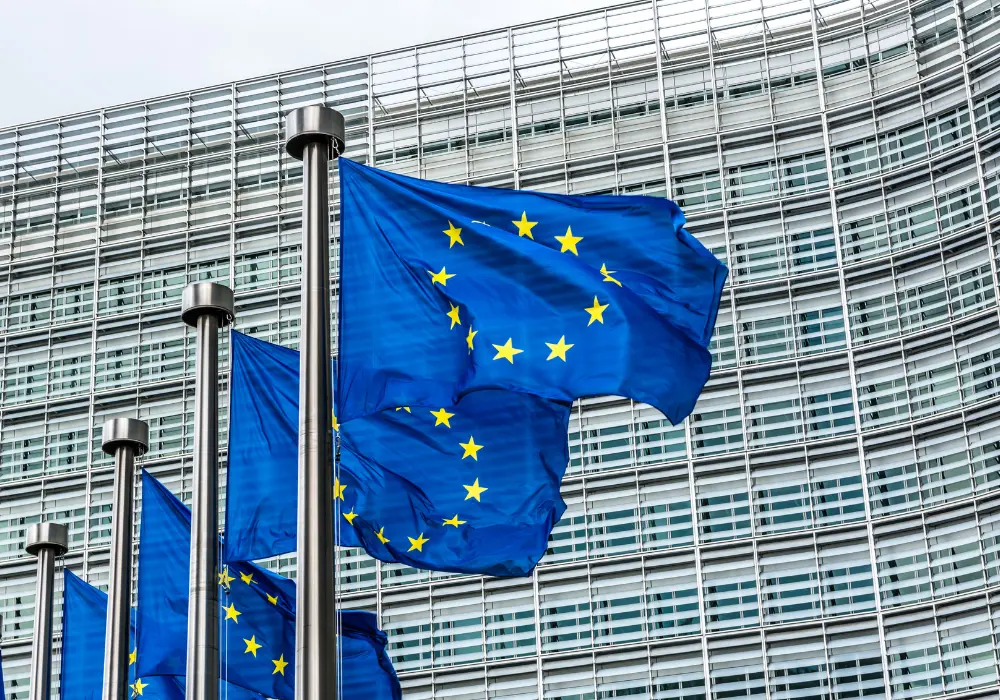
This thematic pivot was starkly evident at New York Climate Week, where panels, corporate strategies, and policy roundtables repeatedly returned to the concept of structural resilience. It is a sentiment mirrored in Brussels, where the European Union is poised to release its eagerly anticipated climate resilience framework. This policy rollout arrives against a grim statistical backdrop: Europe’s record-breaking summer heatwaves triggered an estimated 35,000 excess deaths, serving as a brutal reminder that the climate crisis is no longer a distant threat on the horizon, but an immediate, ongoing emergency.
Amid this shifting paradigm, a striking geopolitical realignment is taking shape. During a recent address to the European Parliament, Canadian Prime Minister Mark Carney championed the ethos of "collective resilience." His remarks welcomed a surprise overture by European Commission President Ursula von der Leyen, who proposed offering Canada unprecedented associate membership within the European Union.
While legal scholars and policy analysts debate the exact mechanics of what "associate membership" entails—given that no nation has previously held this status and the EU’s legal architecture for such a tier is remarkably patchy—the strategic intent is clear. A tighter alliance between Brussels and Ottawa has the potential to supercharge cooperation on energy security, critical raw materials, and the broader green transition. Despite recent revisions and pushback against parts of the European Green Deal, von der Leyen has steadfastly reiterated that "Europe can, must and will stay the course on its climate targets."
Yet, this burgeoning partnership unfolds against a backdrop of domestic policy contradictions, shifting geopolitical fault lines, and economic headwinds. As the world’s leading superpowers, the United States and China, pull in opposite directions on climate policy, middle powers like Canada and the EU are forging their own path. In doing so, they are transforming the green transition from an idealistic crusade into a pragmatic quest for industrial survival and strategic autonomy.
Detailed Chronology: The Evolution of Carney’s Climate Record and Transatlantic Diplomacy
To understand the weight of Mark Carney’s current diplomatic overtures to Europe, one must examine his extensive, and at times contradictory, trajectory through global financial architecture and climate governance.
The Central Banking Pioneer
Carney is no stranger to the levers of international climate finance. During his tenure as Governor of the Bank of England through the tumultuous years following the 2016 Brexit vote, Carney earned a reputation as a visionary green central banker. He pioneered climate stress-testing for the UK financial sector, forcing institutions to reckon with the systemic risks posed by global warming.
Furthermore, he was instrumental in establishing the Task Force on Climate-related Financial Disclosures (TCFD), a framework that revolutionized corporate reporting by requiring financial services firms to incorporate climate risk directly into their governance and decision-making architecture. Later, as the United Nations Special Envoy on Climate Action and Finance, Carney became the public face of the Glasgow Financial Alliance for Net Zero (GFANZ), mobilizing trillions of dollars in private capital toward decarbonization goals. His acclaimed speeches at global forums, including his landmark address at the World Economic Forum in Davos, cemented his status as a premier global voice on sustainable finance.
The Domestic Policy Reversals
However, since transitioning from central banking and advisory roles into active partisan politics and assuming office as Canada’s Prime Minister, Carney’s domestic climate track record has undergone intense scrutiny. The idealistic architecture of his financial frameworks has collided with the gritty reality of resource politics and regional economic pressures in Canada.
His administration has faced criticism for notable policy reversals, including adjustments to federal carbon taxation frameworks and electric vehicle (EV) mandates. These concessions were widely interpreted as political compromises designed to appease energy-producing provinces and voters squeezed by a cost-of-living crisis.
Further friction emerged with a controversial government proposal to include fossil-fuel abatement technologies within Canada’s long-awaited sustainable finance taxonomy. Climate skeptics and environmental groups raised immediate alarms, warning that greenlighting abatement—such as carbon capture, utilization, and storage (CCUS)—opens the door to systemic greenwashing. For a leader who once demanded absolute financial purity from global markets, Carney’s pragmatic domestic compromises have complicated his narrative as an uncompromised climate champion.
The Geopolitical Pivot to Europe
Recognizing the political limits of domestic carbon pricing, Carney has pivoted outward. Leveraging his international stature, he has positioned Canada as a dependable, alternative partner to its unpredictable neighbor to the south.
Following his Davos address, Carney has systematically courted European capitals, offering Canada as a cornerstone of energy diplomacy and resource security. This diplomatic charm offensive culminated in his address to European Parliamentarians, where he declared that "Canada brings energy at huge scale and in every form that the transition requires."
This outreach was met with unexpected enthusiasm from European Commission President Ursula von der Leyen. Facing mounting trade pressures from Washington and supply chain vulnerabilities tied to Beijing, von der Leyen extended the historic invitation for Canadian associate membership in the EU—a move that sets the stage for a transformative bilateral summit just days ahead of the United States midterm elections.
Supporting Context & Metrics: The Anatomy of the Transition
The convergence of European regulatory ambition and Canadian resource abundance is driven by cold economic and strategic calculus. As the global energy landscape fractures under the weight of trade protectionism and geopolitical conflict, both economies face acute vulnerabilities.
The Human and Economic Cost of Inaction
The urgency underpinning the EU’s upcoming climate resilience framework is anchored in quantifiable suffering. The European summer of recent years has rewritten climate extremes:
- 35,000+ Excess Deaths: According to epidemiological data from public health agencies, record-breaking heatwaves across Southern and Central Europe pushed mortality rates to catastrophic levels.
- Agricultural Shocks: Consecutive years of severe droughts have crippled agricultural output in the Po Valley, the Iberian Peninsula, and parts of France, driving up food inflation.
- Infrastructure Strain: Urban centers across the continent are finding their municipal cooling infrastructure, transit systems, and power grids utterly unprepared for sustained wet-bulb temperatures.
These crises have fundamentally altered how European policymakers view climate policy. Decarbonization is no longer viewed merely as an environmental imperative to lower global temperatures, but as an urgent matter of public health, social stability, and economic preservation.
The Critical Minerals Imperative
For the EU, the green transition requires an astronomical volume of critical raw materials—minerals essential for manufacturing wind turbines, solar panels, and battery storage systems. Historically, Europe has suffered from a dangerous dependency on China for the processing and supply of these elements, coupled with a volatile economic relationship with the United States.
Canada enters this equation as an indispensable superpower of resource supply. As Carney noted during his European Parliament address, Canada ranks among the global top producers of the ten most essential critical raw materials required for the energy transition, including:
- Nickel and Cobalt: Vital for next-generation EV batteries.
- Lithium: The foundational element for energy storage grids.
- Copper: The indispensable conductor for electrified transmission networks.
- Graphite and Rare Earth Elements: Critical for high-efficiency motors and electronics.
By forging closer institutional ties through associate membership, the EU can secure long-term, stable access to Canadian resources. This directly advances Brussels’ long-term quest for "strategic autonomy," reducing its economic exposure to foreign coercion from Beijing and navigating around US trade protectionism.
Official Statements and Diplomatic Posturing
The shifting dynamics of transatlantic climate politics are best understood through the public pronouncements of key leaders, whose rhetoric reflects both ambition and deep-seated anxiety over the global order.
Ursula von der Leyen: Staying the Course
Despite fierce pushback from agricultural lobbies, industrial heavyweights, and rising populist factions across the continent, European Commission President Ursula von der Leyen has remained steadfast regarding the European Green Deal. Even as parts of the bloc’s environmental legislation have been diluted or delayed to appease protesting farmers and industries, von der Leyen’s messaging is unequivocal:
"Europe can, must and will stay the course on its climate targets."
Her surprise offer of Canadian associate membership is a tactical masterstroke. By expanding the perimeter of the European economic and regulatory sphere to include a resource-rich democracy, von der Leyen is fortifying the EU against external shocks. It sends a clear signal to Washington and Beijing that Europe is actively building a multilateral coalition of willing middle powers.
Mark Carney: Canada as the Ultimate Energy Partner
Prime Minister Mark Carney’s rhetoric has similarly aimed to reassure European allies of Canada’s reliability. Addressing European lawmakers, Carney framed his nation not just as a supplier of commodities, but as an existential partner in the global structural transformation:
"Canada brings energy at huge scale and in every form that the transition requires."
By emphasizing "every form," Carney deftly bridges the gap between Canada’s traditional oil and gas sectors and its burgeoning clean technology industries. This dual-track approach allows him to appeal to European nations desperate for non-Russian fossil fuels during the ongoing global energy crisis—intensified by Middle Eastern instability and US-Iran flashpoints—while simultaneously pitching Canadian wind, hydro, and critical mineral capacities for the long-term net-zero transition.
Future Outlook: Middle Powers in a Fragmented World
As the international community looks toward upcoming climate summits and geopolitical elections, the overarching question remains: How much leverage can middle powers like Canada and the European Union wield in a world dominated by polarized superpowers?
The Superpower Divergence
The world’s two largest economies—the United States and China—are currently pulling in fundamentally opposite directions regarding the green transition.
- The United States: Under alternating political administrations, US climate policy swings wildly. The current Washington agenda relies heavily on domestic trade protectionism, punitive tariffs, and at times, overt climate skepticism. Furthermore, unresolved energy shocks tied to prolonged conflicts in the Middle East have forced American economic policy inward, prioritizing fossil-fuel security over international climate cooperation.
- China: Conversely, Beijing dominates global supply chains for clean energy technology, controlling the vast majority of refining capacity for solar panels, wind turbines, and EV batteries. While China continues to build domestic renewable capacity at a record-breaking pace, its state-directed industrial policy utilizes green technology as an instrument of geopolitical dominance, leaving Western democracies uncomfortable with their high degree of supply chain dependency.
The Pragmatic Redefinition of Decarbonization
Caught between an inward-looking, protectionist United States and an assertive, monopolistic China, the EU and Canada are charting a third way. However, this path is fraught with internal economic friction.
Across Europe, rising interest rates, stubbornly high inflation, and escalating defense spending—spurred by continental security threats—are placing severe fiscal stress on national governments. Simultaneously, the mainstreaming of far-right political rhetoric has transformed the decarbonization debate. Climate action is no longer framed merely through the lens of ecological preservation, but as a crusade for re-industrialization, economic competitiveness, and national security.
This political reality has not halted the green transition, but it has profoundly rephrased it. The idealistic, borderless environmentalism of the early 2020s has given way to a transactional, highly strategic pragmatism.
Conclusion: The Age of Resilience
Ultimately, "resilience" has emerged as the defining watchword of our era. It is not a retreat from climate ambition, but a realistic acknowledgment that the window for preventing global warming has narrowed, forcing societies to simultaneously adapt to warming impacts while securing their industrial supply chains.
Whether through historic institutional experiments like Canadian associate membership in the EU, or through the painstaking redirection of central banking frameworks, middle powers are proving that climate action can survive in an increasingly fragmented geopolitical landscape. As the upcoming EU-Canada summit approaches, the world will be watching to see if these shared ambitions can be translated into concrete governance—proving that cooperation remains possible even when the global climate narrative darkens.
The Weekly Roundup
Get all our essential climate finance, policy, and investigative stories delivered straight to your inbox in one comprehensive package, every Wednesday at noon EST. Subscribe to the Corporate Knights newsletter to stay ahead of the structural shifts shaping our sustainable future.



