

Executive Overview
Oxfordshire’s ecological heritage is facing an acute crisis following a series of infrastructure failures that threaten not only a delicate, centuries-old ecosystem but also the continued institutional backing of a premier conservation charity. The Long Mead Local Wildlife Site, situated near Swinford along the banks of the River Thames, has fallen victim to a catastrophic burst water main for the fourth time. This latest inundation has submerged vital flora during the most biologically sensitive period of the agricultural and ecological calendar, bringing the site to the brink of irreversible environmental degradation.
The implications of these recurring floods extend far beyond localized water damage. Catriona Bass, director of the Long Mead Foundation, has voiced grave concerns that the crippled state of the meadow could jeopardize a crucial funding grant. This grant underpins ongoing restoration efforts and scientific monitoring designed to halt the alarming decline of floodplain meadows across the United Kingdom.
Floodplain meadows are among the rarest and most carbon-dense agricultural ecosystems in Europe. Unlike conventional wetlands, these systems rely on a precise hydrological balance characterized by winter inundation followed by spring drying and summer growth. When pressurized treated water from failing commercial mains bursts onto the land during the height of the growing season, it alters soil chemistry, suffocates specialized root systems, and introduces artificial stagnation.
As Thames Water scrambles to defend its environmental record, local conservationists, ecologists, and regional stakeholders are demanding accountability. This report examines the chronology of the infrastructure failures, the ecological mechanics of floodplain devastation, the national context of meadow conservation, and the high-stakes battle to preserve one of Oxfordshire’s most irreplaceable natural treasures.
Detailed Chronology of Infrastructure Failures
The systematic destabilization of the Long Mead Local Wildlife Site is not an isolated weather event, but rather the cumulative result of chronic infrastructure decay. To understand the gravity of the current emergency, one must trace the timeline of pipeline ruptures that have plagued the Swinford area over recent years.
The Anatomy of Repeat Failures
The vulnerability of the Long Mead site stems from aging commercial water mains traversing or running adjacent to the Thames-side meadows. While water utility providers routinely map pipeline networks to mitigate supply risks, the intersection between high-pressure potable water distribution and sensitive conservation zones has proven disastrously volatile.
- Incident One and Two (Initial Vulnerabilities): The early warnings began several years ago when minor leaks near the perimeter of the reserve raised initial concerns among local naturalists. While these early breaches were contained before causing widespread ecological damage, they underscored the fragility of the subsurface infrastructure managed by Thames Water.
- Incident Three (The Escalation): Last year, a more substantial pipe failure unleashed millions of gallons of treated water across the lower terraces of the meadow. Although occurring closer to the shoulder of the winter dormancy period, the volume of water overwhelmed existing drainage ditches, leaving residual pooling that stunted early spring growth.
- Incident Four (The Current Catastrophe): The most recent and destructive failure occurred during the height of the summer growing season. A major mains rupture sent torrents of water across the protected acreage. Because the break involved treated mains water rather than river water, it carried chemical additives—such as chlorine and fluoride residuals—directly into an unfertilized, organic soil matrix unaccustomed to municipal water chemistry.
Immediate Aftermath and Emergency Response
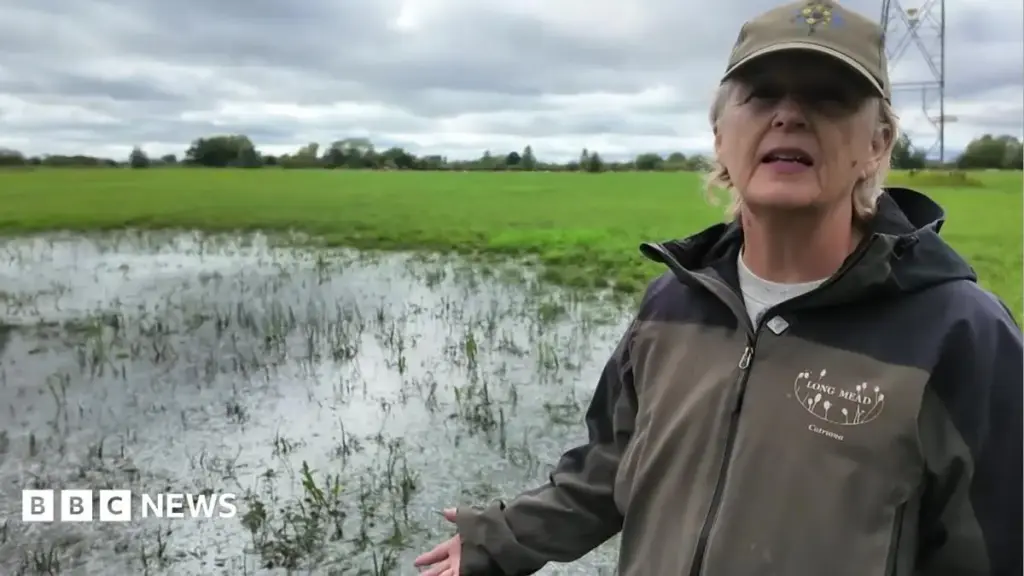
When the latest pipe burst, local residents and foundation volunteers immediately alerted the utility provider. However, the lag time between the initial rupture, the shut-off of the main, and the eventual cessation of flooding was sufficient to inundate over 80 percent of the prime conservation area.
By the time repair crews mobilized to clamp the broken pipe, standing water had already formed vast, shallow lakes across the meadow. In the blazing summer heat, these pools rapidly transformed into anaerobic dead zones. The water temperature spiked, dissolved oxygen levels plummeted, and the foundation was left powerless to pump out the water without causing heavy machinery damage to the fragile, waterlogged turf.
Supporting Context & Metrics: The Fragile Ecology of Floodplain Meadows
To fully appreciate why a summer flood constitutes an existential threat to Long Mead, one must examine the unique ecological architecture of floodplain meadows. These landscapes are living museums of agricultural history, shaped by centuries of traditional management that harmonized with the natural rhythms of Britain’s major river systems.
The Ecological Clock: Winter versus Summer Inundation
The core misunderstanding often cited by utility operators and the general public is the assumption that because a meadow floods in winter, summer water should have a similar, benign effect. Ecologically, this could not be further from the truth.
[Winter Flooding (Dormant Phase)]
       │
       ├── Plants are dormant (above-ground biomass is dead/decaying)
       ├── Soil microbes are inactive
       ├── Silt deposition enriches soil naturally
       └── RESULT: Natural, healthy seasonal cycle

[Summer Flooding (Active Growth Phase)]
       │
       ├── Plants are actively growing and photosynthesizing
       ├── Root systems require high oxygen levels
       ├── Artificial standing water causes stagnation and rot
       └── RESULT: Catastrophic die-off of rare species
During the winter months, floodplain meadows are naturally designed to flood. The River Thames swells with seasonal rains, spilling over its banks and depositing nutrient-rich silt across the flat topography. At this time of year, the plants inhabiting the meadow—perennial grasses and deep-rooting wildflowers—are entirely dormant. Their above-ground biomass has withered, and their metabolic processes have slowed to a near standstill. The winter floodwaters act as a protective blanket, insulating the soil from severe frosts and replenishing mineral stores without harming the flora.
Conversely, the summer growing season is a period of intense biological activity. Plants are racing to flower, set seed, and store energy in their root networks before the autumn hay cut. When a water main bursts in June, July, or August, the consequences are catastrophic:
- Oxygen Deprivation: Water displaces air in the pore spaces of the soil. Plant roots, which require continuous oxygen respiration, suffocate within days.
- Thermal Stagnation: Shallow water exposed to high summer ambient temperatures quickly heats up, breeding harmful bacteria and fungi that attack weakened root crowns.
- Chemical Shock: Treated municipal water contains residual chlorine and other water-treatment chemicals that burn delicate root hairs and disrupt the symbiotic mycorrhizal fungi essential for nutrient uptake in wild meadow plants.
Rarity and National Significance
The ecological value of Long Mead cannot be overstated. According to national conservation metrics, authentic, unimproved floodplain meadows are among the rarest habitats in the British Isles.
- Total National Acreage: There are only about four square miles (roughly 2,500 acres) of traditional floodplain meadow left in the entire United Kingdom.
- Spatial Comparison: To put this into perspective, the total remaining acreage of this once-widespread habitat type is roughly equivalent in size to Heathrow Airport.
- Biodiversity Hotspots: These sites support an extraordinary diversity of specialized flora that cannot survive anywhere else. Iconic species found at Long Mead include:
- Great Burnet (Sanguisorba officinalis): A striking plant with dark crimson, button-like flower heads, serving as a key food source for specialized invertebrate species.
- Devil’s-bit Scabious (Succisa pratensis): A vital late-summer nectar source for declining pollinators, most notably the marsh fritillary butterfly.
- Snake’s Head Fritillary (Fritillaria meleagris): Renowned for its distinctive checkered purple and white bell-shaped flowers, representing the crown jewel of Thames valley flora.
Furthermore, these meadows function as critical carbon sinks. Their deep, tangled root systems—often extending downward by a meter or more—lock away carbon for centuries, outperforming many modern forestry plantations in terms of long-term carbon sequestration and soil stability.
Official Statements and Institutional Conflict
The confrontation between grassroots conservationists and corporate utility management has brought issues of corporate accountability, infrastructure resilience, and environmental stewardship sharply into focus.
The Voice of the Foundation: Catriona Bass
Catriona Bass, director of the Long Mead Foundation, has pulled no punches in her assessment of the crisis. Speaking from the edge of the waterlogged reserve, her frustration was palpable as she surveyed the decaying biomass.
"It’s already starting to stagnate, so that’s serious," Bass stated, pointing toward a vast expanse of discolored, foaming water resting over stunted patches of great burnet.
"Floodplain meadows are used to flooding in winter when the plants are dormant. These meadows don’t flood typically in summer and when they do it’s a disaster because the plants are growing—so it kills off the plants."
Bass emphasized that the timing could not have been worse. The foundation is currently mid-way through a rigorous, multi-year restoration project designed to harvest green hay from Long Mead and spread it across degraded agricultural land in Oxfordshire to jump-start the recovery of the county’s broader ecological network. If the donor site is ruined by repeated artificial flooding, the entire regional restoration strategy is thrown into jeopardy.
Compounding the biological loss is the looming threat of administrative penalties. The restoration programme is heavily dependent on external funding grants, which are tied to strict ecological condition assessments and biodiversity metrics. If botanical surveys reveal that rare species have been eradicated or severely depleted across large swathes of the site due to negligence, funding bodies may withhold future disbursements or demand the return of previous allocations.
The Corporate Response: Thames Water
In the wake of the fourth flooding incident, Thames Water issued a formal response defending its operational record and seeking to reassure stakeholders of its commitment to environmental protection.
A spokesperson for the utility company stated: "Our engineers successfully isolated and repaired the latest leak at Swinford as quickly as possible. We recognize the unique ecological importance of the Long Mead Local Wildlife Site and deeply regret any distress or disruption caused to the local community and conservation groups."
The statement went on to highlight ongoing investments in pipeline monitoring technology: "Thames Water remains fully committed to protecting local wildlife sites across our region. We are currently reviewing network resilience in the Upper Thames catchment area to identify vulnerable legacy mains and schedule proactive replacements before further failures can occur."
However, for local naturalists, corporate promises ring hollow after four identical failures. Critics point out that reactive repairs—fixing a pipe only after it bursts and floods a protected reserve—are wholly inadequate when dealing with irreplaceable ancient habitats. Calls are mounting for Thames Water to reroute or completely reconstruct the aging water main away from the ecological zone altogether.
Future Outlook: Mitigation, Restoration, and Policy Implications
As the floodwaters slowly recede under the heat of late summer, the long-term recovery of Long Mead hangs in the balance. The path forward requires a coordinated effort between the Long Mead Foundation, regional regulatory bodies, and the utility provider to ensure that this disaster is not repeated a fifth time.
Immediate Remediation Steps
Ecologists working with the foundation have outlined an emergency stabilization protocol:
- Soil Aeration and Monitoring: Once the ground dries sufficiently to bear lightweight equipment without causing further structural damage, soil scientists will test for oxygen depletion, compaction, and chemical contamination.
- Reseeding and Plug Planting: Where rare perennials have succumbed to root rot, the foundation plans to introduce hand-collected seed stock and greenhouse-grown plugs propagated from surviving local genotypes.
- Legal and Financial Safeguards: Discussions are underway between legal representatives for the conservation charity and Thames Water’s liability insurers to secure compensation for lost grant opportunities and to underwrite the cost of restorative interventions.
Structural Policy Changes Required
Beyond the immediate site management, the incident at Long Mead serves as a stark warning for conservation policy across the United Kingdom. Infrastructure developers, water companies, and local planning authorities must re-evaluate how utility corridors intersect with nationally significant wildlife sites.
- Mapping High-Risk Infrastructure: Water companies must prioritize the auditing and replacement of pressurized mains that run through Sites of Special Scientific Interest (SSSIs), Local Wildlife Sites (LWS), and ancient semi-natural habitats.
- Enhanced Compensation Frameworks: Current regulatory frameworks governing water utilities often under-penalize environmental damage to non-statutory wildlife sites, focusing primarily on chalk streams or major rivers. Expanding regulatory oversight to protect rare terrestrial and wetland habitats like floodplain meadows is an urgent legislative necessity.
- Strengthening Community-Led Conservation: Grassroots charities like the Long Mead Foundation act as the frontline guardians of Britain’s natural heritage. Ensuring that these organizations are shielded financially from corporate negligence is vital to maintaining the credibility of national biodiversity strategies.
Conclusion
The plight of the Long Mead Local Wildlife Site is a microcosm of the wider tension between modern industrial infrastructure and fragile natural ecosystems. While Thames Water has repaired the physical pipe, the breach in trust—and the biological damage inflicted upon one of Britain’s rarest habitats—will take years to heal.
Whether the Long Mead Foundation can secure its vital funding grants and restore the meadow to its former glory will depend not only on the resilience of the wild flowers and deep-rooting grasses that define the landscape, but also on whether corporate accountability can match the irreplaceable value of the natural world it threatens.



