

Executive Overview
As global temperatures continue to rise due to anthropogenic climate change, cities around the world are transforming into stifling heat traps. The urban heat island (UHI) effect—driven by an abundance of dark asphalt, concrete, and towering edifices that block cooling breezes—makes metropolitan areas significantly hotter than their rural counterparts. During intense summer heatwaves, these urban cores can experience mid-afternoon temperatures that are a staggering 15°F to 20°F (8°C to 11°C) higher than surrounding natural landscapes.
This extreme heat is not merely an uncomfortable seasonal inconvenience; it is a lethal public health crisis. Recent summers have witnessed tens of thousands of excess heat-related deaths across Europe and Asia, disproportionately impacting vulnerable populations such as the elderly, individuals with preexisting health conditions, and low-income urban residents who lack access to reliable air conditioning.
Amid this escalating crisis, a team of researchers has proposed an innovative, cost-effective, and sustainable countermeasure. Led by Zhonghua Zheng, an associate professor of urban climate and environmental data science at the University of Manchester in the U.K., a multidisciplinary research team has developed a novel machine-learning and artificial intelligence model. This model integrates widely distributed rainwater collection tanks with smart rooftop sprinkler systems. By automatically wetting building roofs when ambient temperatures cross specific thresholds, the system harnesses the ancient, powerful physics of evaporation to cool both the interiors of buildings and the surrounding outdoor air.
Published in the journal Earth’s Future, the study models this technology using Tokyo as a case study, demonstrating profound potential not only for temperature reduction but also for mitigating urban stormwater runoff and flooding. While experts emphasize that localized pilot programs and varying regional climates must be carefully evaluated, this integrated approach offers a vital blueprint for safeguarding urban populations against the inevitable heatwaves of the coming decades.
Detailed Chronology: Developing the AI-Powered Cooling Model
The genesis of this research lies in the intersection of data science, hydrology, and urban climatology. For years, scientists and municipal planners have recognized that standard urban cooling interventions—such as planting trees, installing green roofs, or deploying "cool roof" reflective coatings—come with distinct limitations. Green roofs require substantial, continuous irrigation that can strain municipal water supplies, while reflective roofs primarily reflect solar radiation but do little to actively dissipate trapped ambient heat or cool surrounding air masses.

Recognizing these gaps, Zhonghua Zheng and co-author Junjie Yu, alongside colleagues from institutions including the National Center for Atmospheric Research (NCAR), set out to optimize a hybrid approach. Many cities already practice rainwater harvesting, and municipal authorities in various parts of the world occasionally resort to manually sprinkling water on streets or public squares during peak heat waves. However, these practices have historically been siloed, ad-hoc, and disconnected from smart-city infrastructure.
The research team set out to answer a fundamental question: What if rainwater collection tanks and rooftop sprinklers were merged into an automated, synchronized, AI-driven system?
To test this hypothesis, the researchers developed a sophisticated computer-modeling framework powered by machine learning algorithms. They selected Tokyo, Japan, as their primary case study. Tokyo offered an ideal testing ground due to its temperate climate, distinct seasonal weather patterns, and the city’s advanced, preexisting infrastructure for rainwater management.
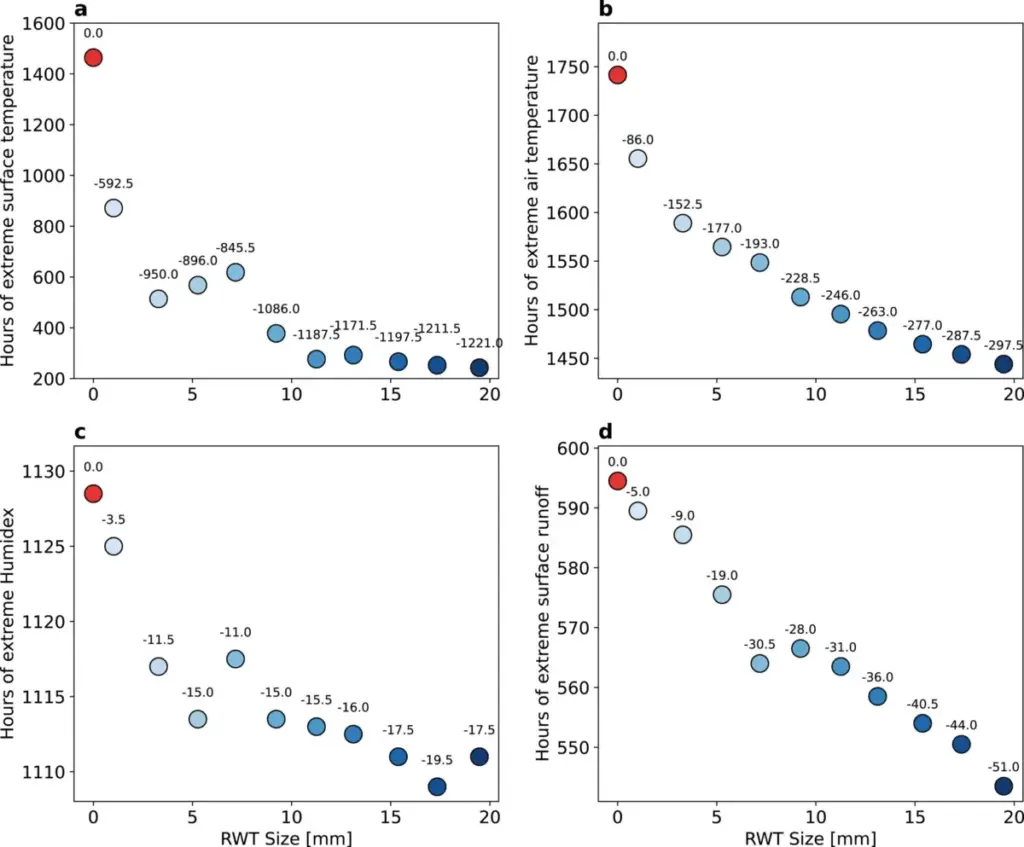
Using historical meteorological data and advanced thermodynamic simulations, the AI model evaluated how varying sizes of rainwater collection tanks, different sprinkler intensities, and specific temperature activation thresholds would impact urban microclimates. The results, finalized and published in Earth’s Future under the title "Optimizing the rainwater harvesting and roof sprinkling system to adapt to urban extreme heat," revealed that a widespread rollout of this technology could systematically drive down both surface temperatures and ambient air temperatures across dense urban environments.
Supporting Context & Metrics: The Mechanics of Urban Heat and Evaporative Cooling
To understand why rooftop sprinklers are so effective, one must first examine the mechanics of the urban heat island effect. Dr. Xuhui Lee, a climate scientist at Yale University who was not involved in the study, points out that the fundamental driver of urban heating is the disruption of natural energy balances.

"Cities have a higher temperature than the natural land," Lee explains. "That extreme heat is due to a lack of evaporation. If you’re in a place with buildings, wind’s cut off. That’s an important part of warming. Another is human heat sources," including industrial operations, vehicular traffic, and the massive discharge of waste heat from air-conditioning units.
In rural or natural settings, solar energy is largely consumed by evapotranspiration—plants and soil evaporating moisture into the air, which naturally cools the surrounding atmosphere. In a concrete jungle, rainwater is quickly shunted away into storm drains, and impervious surfaces absorb and re-radiate massive amounts of solar energy.
The University of Manchester study demonstrates that artificial rooftop evaporation can successfully mimic natural cooling cycles. When smart sensors detect that ambient outdoor temperatures have crossed a critical safety threshold, rooftop sprinkler systems activate, coating the roof surface with harvested rainwater. As the water evaporates, it absorbs latent heat, directly cooling the building’s thermal mass and lowering indoor temperatures while simultaneously chilling the microclimate of the surrounding air layer.
Key variables identified by the study include:
- Tank Capacity: Larger rainwater harvesting tanks directly correlate with greater cooling efficacy. More stored water allows the system to operate for longer durations during prolonged, multi-day heatwaves without depleting reserves.
- Activation Threshold: The ambient temperature at which the AI triggers the sprinklers is critical. Timing the activation precisely prevents wasted water while maximizing relief during the hottest hours of the day.
- Sprinkler Intensity: Interestingly, the study found that high-intensity sprinkling yields diminishing returns past a relatively low operational threshold, indicating that optimal cooling can be achieved efficiently without excessive water usage.
Beyond temperature reduction, the model highlighted a powerful secondary benefit: a significant decrease in surface runoff. By capturing rainfall in decentralized rooftop tanks, the system holds back millions of gallons of water during severe downpours. This acts as a vital buffer against flash flooding and prevents climate-intensified precipitation events from overwhelming outdated combined sewer outflows (CSOs). In major metropolitan hubs like New York, London, and Paris, overwhelmed CSOs frequently bypass treatment plants, dumping raw sewage and toxic pollutants directly into local rivers, bays, and estuaries. An integrated tank-and-sprinkler network addresses urban heat and water pollution simultaneously.

Official Statements and Expert Perspectives
The intersection of public health, climate resilience, and urban engineering has drawn praise from independent researchers, though experts also counsel careful, pragmatic implementation.
Lead researcher Zhonghua Zheng emphasized the holistic nature and dual benefits of the innovation during an interview with Mongabay. "Evaporation cools roof temperatures," Zheng said. "It has a dual benefit to cool both the indoor temperature and outdoor temperature."
Zheng noted that the philosophy behind the system relies on familiar, accessible mechanisms rather than speculative geoengineering. "People are already doing rainwater harvesting. Some cities are doing water sprinkling, although I don’t know where the water comes from. So then we’re thinking, ‘Can we combine this as an integrated system?’"
Discussing the broader health implications, co-author Junjie Yu pointed out that millions of urban residents lack access to air conditioning, leaving them deeply vulnerable to heat stress. "Many people lack air-conditioning," Yu stated. Older adults, individuals with preexisting health conditions, and low-income urban communities bear the heaviest burden. Recent statistics underscore this peril, with European nations recording at least 35,000 excess deaths during consecutive summer heatwaves, alongside widespread hospitalizations across Asia.
"There is kind of a chain," Zheng added, outlining the public health trajectory. "By using the device, we will reduce heat exposure. By reducing heat exposure, there’s a positive health impact." Furthermore, by dropping indoor temperatures naturally, the system reduces society’s heavy reliance on energy-intensive air conditioning, which in turn cuts carbon emissions from power plants.

Offering an external perspective, Yale climate scientist Xuhui Lee lauded the concept while urging empirical testing. "It’s going to be a local solution," Lee noted. "You need to bring it into the real world first. Set up a few houses and test it out. The idea is cool though."
Lee contextualized the innovation within the broader portfolio of global climate action: "You need both big solutions to reduce greenhouse gases, and then you have little solutions to help with the warming that is going to happen in the next few decades."
Future Outlook: Global Implementation and Remaining Challenges
While the AI-driven computer model developed by the Manchester team is adaptable to virtually any city across the globe, scaling the technology from simulations to reality presents distinct challenges.
Co-author Junjie Yu issued a cautionary note regarding regional climatic limitations. While the system performs exceptionally well in temperate and semi-arid urban environments like Tokyo, its effectiveness diminishes in humid tropical zones. In environments where the air is already saturated with moisture, the rate of evaporation drops significantly, rendering water-sprinkling techniques far less efficient. Consequently, urban planners must evaluate their local microclimates before deploying capital-intensive infrastructure upgrades.
Additional hurdles include financial and logistical questions regarding retrofitting existing buildings versus incorporating the systems into new constructions. Questions remain regarding capital installation costs, maintenance requirements, and whether decentralized, individual home installations can match the efficiency of a unified, community-wide municipal network.

Nevertheless, the potential rewards far outweigh the developmental hurdles. As global warming pushes urban heat exposure to unprecedented heights—with studies showing that extreme heat exposure in cities has tripled over the past three decades—traditional cooling methods are proving insufficient. By turning the vast, underutilized expanse of urban rooftops into decentralized, AI-managed evaporative cooling stations, cities can forge a viable path forward.
As research transitions from academic journals to real-world pilot projects, innovations like Zheng and Yu’s integrated rainwater-sprinkler model offer a beacon of hope. They remind us that effective climate adaptation does not always require high-tech, energy-hungry machinery; sometimes, the most powerful solutions involve working smarter with the natural water cycles we already have.
Citation Reference
- Study Citation: Yu, J., Oleson, K. W., Qin, Y., Zhao, L., Topping, D. O., & Zheng, Z. (2026). Optimizing the rainwater harvesting and roof sprinkling system to adapt to urban extreme heat. Earth’s Future, 14(8). DOI: 10.1029/2026EF008876
- Article Citation: Nick Ruggia (2026). Rooftop rainwater sprinkler systems could help cool warming cities, study says. Mongabay Conservation News. DOI: 10.66709/news-330065



