By Global Marine Conservation Desk Published in coordination with World Octopus Day observations
Executive Overview
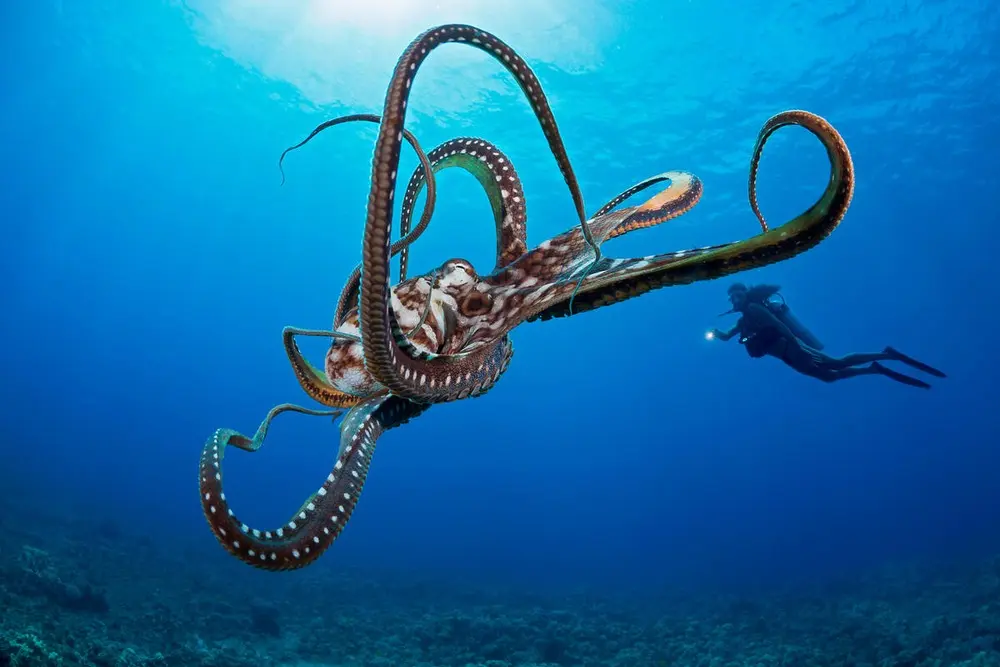
Every October 8th, the global scientific and conservation communities pause to celebrate one of the planet’s most mesmerizing, intelligent, and alien-like inhabitants: the octopus. With their characteristic eight arms, decentralized nervous systems, remarkable capacity for tool use, and instantaneous shape-shifting abilities, octopuses have long captivated marine biologists and casual beachgoers alike. Yet, beyond their well-documented behavioral eccentricities and mastery of deception, these cephalopods occupy a pivotal, dynamic role in the evolutionary tapestry of Earth’s oceans.
Over the course of 2026, scientific literature has continually reshaped our understanding of the Octopoda order. Far from being mere footnotes in marine ecology, recent discoveries span deep time and the deep sea. From prehistoric, bus-sized apex predators that ruled the Cretaceous seas to microscopic embryonic marvels developing off the coast of Patagonia, and a newly minted, golf ball-sized species hiding in the volcanic shadows of the Galapagos Islands, the past year has delivered a series of landmark revelations.
This report synthesizes these monumental findings, offering an authoritative, deep-dive examination of how ancient giants, fragile nurseries, and cryptic deep-sea dwellers are radically updating marine taxonomy and evolutionary history.
Detailed Chronology: A Landmark Year for Cephalopod Science
The breakthroughs of 2026 did not happen in isolation; rather, they emerged from a confluence of advanced paleontological excavations, deep-sea remote-vehicle technology, and microscopic embryology.
April 2026: Reclaiming the Crown — The Ancient Megafaunal Predators
For decades, popular marine imagination has cast modern colossal squids (Mesonychoteuthis hamiltonii) as the undisputed heavyweight champions of invertebrate history. However, paleontological work published in April 2026 by a team of Japanese researchers shattered this baseline, rewriting the upper limits of invertebrate size.
Working in geological formations dating back to the late Cretaceous period—between 100 million and 72 million years ago—scientists unearthed and described a fossilized jawbone belonging to a now-extinct genus and species: Nanaimoteuthis haggarti.
By analyzing the scale and morphology of this fossilized beak, the research team calculated that Nanaimoteuthis haggarti could have reached staggering lengths of 6.6 to 18.6 meters (approximately 22 to 61 feet). At its maximum estimated length, this ancient cephalopod reached roughly two-thirds the size of an adult blue whale (Balaenoptera musculus), the largest animal ever known to inhabit Earth.
This discovery fundamentally shifts our paleo-ecological frameworks. It demonstrates that giant cephalopods were not merely secondary scavengers or prey items for marine reptiles like mosasaurs; they were apex predators actively shaping the marine food webs of ancient oceans.
June 2026: The Enigma of the Galapagos — Microeledone galapagensis
Shifting from the immense scale of deep time to the micro-scale of contemporary deep-sea exploration, marine biologists reported a contrasting marvel in June 2026. During a 2015 deep-sea expedition utilizing advanced Remotely Operated Vehicles (ROVs) operated by the Schmidt Ocean Institute, scientists encountered an unusual, short-armed blue octopus dwelling in the abyssal depths surrounding the Galapagos Islands.
Following a decade of taxonomic and morphological analysis, researchers officially described this diminutive creature in a landmark study published in Zootaxa, naming it Microeledone galapagensis. Measuring roughly the size of a standard golf ball, this newly identified species poses distinct evolutionary questions.
Unlike most benthic octopuses that rely on long, highly flexible arms equipped with extensive rows of suckers to forage through sediment for buried prey, Microeledone galapagensis possesses notably stubby limbs. This morphological anomaly has left leading researchers scratching their heads regarding its behavioral ecology and hunting strategies.
August to October 2026: Vulnerable Beginnings in Patagonian Waters
In late-season marine reporting, attention turned from the abyssal depths to the sunlit, protected shallows of Argentina. Documented via striking, rare photographic evidence captured within the Puerto Lobos Protected Natural Area, researchers shed light on the reproductive cycle of the small Patagonian octopus (Octopus tehuelchus).
The imagery captured clusters of translucent eggs affixed securely within abandoned shells, revealing distinct black dots—the developing ocular structures of embryonic octopuses nearing the hatching phase. While Octopus tehuelchus is historically common along the Patagonian shelf, its long-term viability remains obscured by a distinct lack of global conservation data, compounded by worrying local catch declines over the past half-century.
Supporting Context & Metrics: Anatomy, Behavior, and Ecology
To fully appreciate these discoveries, one must contextualize the extraordinary biological blueprint of the octopus. As soft-bodied mollusks, octopuses lack internal or external skeletal protection—a vulnerability that forced them to evolve some of the most sophisticated neurological and physiological defense mechanisms in the animal kingdom.
Cognitive Sophistication and Tool Use
The decentralized nervous system of an octopus is legendary. Roughly two-thirds of an octopus’s neurons reside in its arms rather than its central brain, allowing each limb to taste, touch, and move autonomously while processing complex spatial data. This architecture supports advanced cognitive behaviors, including:
Tool Use: Documented instances of octopuses collecting discarded coconut shells or bivalve valves to construct portable, defensive armor.
Problem Solving: Navigating intricate mazes, unscrewing jar lids from the inside or outside, and bypassing experimental barriers to secure prey.
Advanced Escape Artistry: Squeezing through minuscule apertures—limited only by the size of their hard, chitinous beaks.
The Mechanics of Dynamic Camouflage
Octopuses are the undisputed masters of biophotonics and structural color change. Their skin contains millions of specialized cells working in concert:
Chromatophores: Tiny, elastic sacs filled with pigments (yellow, red, brown, black) expanded or contracted by radial muscles to alter skin hue instantly.
Iridophores and Leucophores: Reflective cellular layers that manipulate ambient light, mimicking the metallic sheens of open water or the matte textures of coral reefs.
Papillae: Specialized muscular hydrostats that raise and lower the skin’s surface texture, transforming a smooth mantle into a jagged, algal-encrusted rock in milliseconds.
Ecological Metrics: Size and Conservation Status
Species / Group
Approximate Size / Scale
Temporal / Geographic Context
Conservation & Ecological Status
Nanaimoteuthis haggarti
22 to 61 feet (6.6 – 18.6 m)
Late Cretaceous (100–72 million years ago)
Extinct; classified as an apex marine predator.
Microeledone galapagensis
Golf ball-sized (~inches)
Deep-sea Galapagos hydrothermal/volcanic zones
Newly described; data deficient regarding exact population baselines.
Octopus tehuelchus
Small benthic species
Coastal Patagonia, South America
Lacks comprehensive IUCN global assessment; regional catches down over 50 years.
Official Statements and Expert Insights
The gravity of these recent scientific shifts has prompted leading paleontologists and marine biologists to re-evaluate traditional taxonomic assumptions.
Reflecting on the discovery of the colossal Cretaceous predator Nanaimoteuthis haggarti, study co-author and Hokkaido University paleontologist Yasuhiro Iba emphasized the sheer scale of the findings in an interview with science journalists:
"It suggests that it may have been among the largest invertebrates ever known," noted Dr. Iba, pointing out that the fossil evidence bridges a crucial evolutionary gap regarding the ecological dominance of ancient cephalopods before the mass extinction event that wiped out non-avian dinosaurs.
Conversely, contemporary marine exploration continues to humble researchers regarding the mechanical realities of deep-sea speciation. Janet Voight, lead author of the Microeledone galapagensis description, highlighted the paradox of the newly identified species’ morphology:
"If you gather prey by moving your arms through the sediment (as we think they do), wouldn’t it be better to have longer arms with more suckers than short little arms?" Dr. Voight queried, framing the evolutionary mystery of why natural selection favored stubby limbs in the abyssal plains of the Galapagos.
Adding conservation urgency to reproductive biology, Argentine marine researcher Martin Brogger, whose photographic documentation of Octopus tehuelchus eggs brought international attention to Patagonian nurseries, underscored the maternal sacrifice inherent to the species:
Female Patagonian octopuses exhibit terminal maternal care. Upon cementing their eggs within protective substrate structures—often hollowed-out mollusk shells—the mother maintains an unyielding vigil. She cleans, aerates, and fiercely defends the clutch against predatory interlopers, entirely forgoing feeding throughout the multi-week incubation period, ultimately expiring as her offspring emerge into the sub-Antarctic waters.
Future Outlook: The Horizon of Cephalopod Research
As World Octopus Day reminds us of the sheer wonder inspired by these creatures, the trajectory of marine science heading into the late 2020s points toward critical conservation and technological frontiers.
1. Re-evaluating Deep-Sea Vulnerabilities
While discovery rates for new octopus species are accelerating due to robotic submersibles and environmental DNA (eDNA) sampling, anthropogenic pressures are closing in. Deep-sea mining, bottom trawling, and ocean acidification threaten fragile benthic habitats. Conservation biologists are pushing for comprehensive International Union for Conservation of Nature (IUCN) red-list assessments for data-deficient species like Octopus tehuelchus and newly cataloged abyssal dwellers before commercial exploitation outpaces scientific understanding.
2. Paleontological Re-assessments
The revelation of Nanaimoteuthis haggarti has ignited a renewed search for soft-tissue and fossilized beak remains in Cretaceous strata worldwide. Paleontologists suspect that the fossil record has historically underrepresented soft-bodied cephalopods due to the decomposition-prone nature of muscular tissue. Advanced non-destructive scanning technologies are now being deployed in museum archives to re-examine previously misidentified fossil fragments.
3. Biomimetic and Technological Applications
Beyond pure biology, the engineering and artificial intelligence sectors are increasingly looking to the octopus for inspiration. The decentralized nervous system and flexible arm mechanics of octopuses are guiding the development of soft robotics—machines capable of navigating hazardous, confined spaces during search-and-rescue operations or industrial maintenance. Furthermore, materials scientists are studying cephalopod skin proteins (reflectins) to engineer adaptive, camouflaging materials for defense and commercial textiles.
Conclusion
From the twilight seas of the Cretaceous period where titan octopuses hunted as apex predators, to the delicate, sacrificial brooding cycles occurring along the Patagonian coast, and the cryptic, miniature realms of the Galapagos abyss, octopuses remain an endless source of scientific revelation.
As we celebrate World Octopus Day, the message from the marine scientific community is clear: safeguarding the future of these intelligent, shape-shifting marvels requires an equal commitment to protecting the fragile marine ecosystems they call home—ensuring that the oceans continue to harbor their profound and evolving mysteries for generations to come.