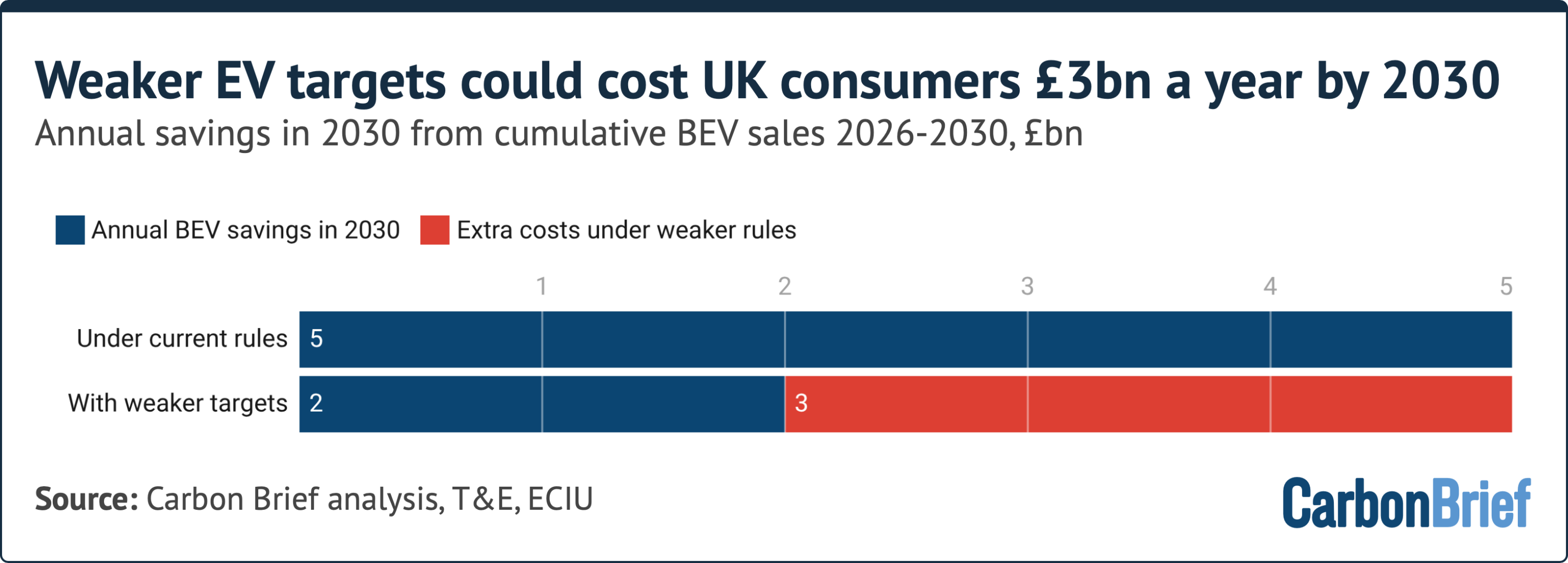
A proposed retreat by the UK government on its flagship net-zero transport policy threatens to burden British households with up to £3 billion a year in added vehicle running costs by 2030, while severely compromising national energy security and climate commitments.
According to extensive modeling conducted by Carbon Brief, proposals currently under review inside Downing Street to water down the Zero-Emission Vehicle (ZEV) mandate would dramatically slow the adoption of battery electric vehicles (BEVs). The rollback could result in up to 3 million fewer electric cars taking to British roads by the end of the decade.
The consequences extend beyond household finances. Slowing the transition away from internal combustion engines would require the UK to import an additional 17 million barrels of oil in 2030 alone—driving up expected net oil imports by 8%—while adding 7.4 million tonnes of carbon dioxide equivalent ($textMtCO_2$) to the atmosphere. This surge would expand the UK’s net national emissions burden by 2.5% against its binding international climate targets for 2030.
The policy pivot follows intense lobbying from sections of the automotive manufacturing sector, which argue that market demand is lagging behind statutory quotas. However, clean energy advocates, consumer groups, and energy sector analysts warn that weakening the mandate will expose motorists to prolonged reliance on volatile fossil fuels, derail billions of pounds in private supply-chain investments, and undo the single most effective policy mechanism for reducing UK transport emissions.
Detailed Chronology and Policy Evolution
The Genesis of the ZEV Mandate
The Zero-Emission Vehicle (ZEV) mandate was introduced under the previous Conservative administration as the primary regulatory engine to phase out petrol and diesel vehicles. Designed to provide long-term regulatory certainty to automotive manufacturers, chargepoint operators, and power grid infrastructure developers, the policy established legally binding annual sales quotas for carmakers operating in the UK market.
Under the original statutory roadmap, zero-emission models—specifically pure Battery Electric Vehicles (BEVs)—were required to constitute:
33% of new passenger car sales by 2026,
Rising systematically to 80% of new sales by 2030,
Reaching 100% zero-emission sales by 2035.
To cushion the industrial transition, the initial framework incorporated a series of "flexibilities." These regulatory mechanisms allowed manufacturers to trade emissions credits, offset shortfalls against over-performance in earlier years, or utilize fleet-wide efficiency allowances. In practice, these mechanisms lowered the effective baseline target for 2026 from 33% to an estimated 25% of actual sales.
Despite these built-in allowances, lobbying by traditional vehicle manufacturers intensified as the first compliance milestones approached. Automakers cited high borrowing costs, global supply chain bottlenecks, and sluggish consumer uptake as justification for regulatory relief.
Reports indicate that the government, led by Labour Prime Minister Andy Burnham, is considering a significant weakening of the 2030 quota. A draft consultation document, currently being vetted by the Prime Minister’s office at No. 10 Downing Street prior to public dissemination, presents options to slash the 2030 BEV sales target from 80% down to 50%, with secondary options set at 60% or 70%.
Should the core target drop to 50%—and should carmakers fully leverage available compliance flexibilities—modeling by transport NGO Transport & Environment (T&E) indicates that the volume of BEVs on UK roads would fall by up to 3 million vehicles by 2030 compared to baseline projections.
Supporting Context and Economic & Environmental Metrics
              ECONOMIC & ENVIRONMENTAL IMPACT OF WEAKENING ZEV TARGETS (2030)
+------------------------------------+---------------------------------------------------+
| Metric                             | Impact of Weakened Mandate (to 50% Target)         |
+------------------------------------+---------------------------------------------------+
| Added Consumer Ownership Costs     | +£3.0 Billion annually by 2030                     |
| Net Oil Import Volume Increase     | +17 Million barrels in 2030                        |
| Net Oil Import Percentage Shift    | +8% increase in overall UK net oil imports        |
| Carbon Emissions Increase          | +7.4 Million tonnes of CO2 (MtCO2)                |
| National Carbon Budget Impact      | +2.5% increase in total 2030 net national emissions|
| Vehicle Fleet Reduction            | Up to 3.0 Million fewer BEVs on UK roads          |
+------------------------------------+---------------------------------------------------+
1. Financial Impact on UK Households
The financial argument for preserving the ZEV mandate centers on the lower operational costs of electric vehicles compared to fossil-fuel-powered alternatives.
Analysis by Carbon Brief confirms that pure electric vehicles remain significantly cheaper to fuel than their internal combustion engine (ICE) counterparts. On average, a UK driver saves approximately £1,100 per year in fuel expenses by operating a BEV instead of a standard petrol car, benefiting from the vastly superior thermodynamic efficiency of electric powertrains over internal combustion systems.
Expanding upon pure fuel metrics, an analysis of the Total Cost of Ownership (TCO) conducted by the Energy and Climate Intelligence Unit (ECIU) demonstrates that BEVs maintain a distinct economic advantage over both conventional petrol vehicles and Plug-in Hybrid Electric Vehicles (PHEVs). The TCO framework incorporates key long-term expenditure drivers:
Upfront capital purchase price and depreciation trends
Volatile retail fuel prices vs. domestic/public charging tariffs
Annual insurance premiums and maintenance overheads
Anticipated pay-per-mile road usage charges
Even when accounting for future pay-per-mile motoring taxes, the ECIU analysis reveals that BEVs remain more than £1,000 per year cheaper to own and run than either petrol vehicles or PHEVs. Consequently, watering down the ZEV mandate to a 50% target directly penalizes British drivers, accumulating an aggregate financial loss of £3 billion annually by 2030 in avoided savings.
Comparative Annual Operating Costs per Vehicle Type
------------------------------------------------------------------------
BEV (Battery Electric Vehicle):    [£] Baseline Cost (Lowest Overall TCO)
Petrol ICE Vehicle:                [£] +£1,100/yr (Fuel) | >+£1,000/yr (TCO)
PHEV (Plug-in Hybrid):             [£] >+£1,000/yr (TCO)
------------------------------------------------------------------------
Combined Consumer Loss by 2030 under Weaker Mandate: £3.0 Billion / Year
2. Energy Security and Oil Import Vulnerability
Slowing the EV transition increases the UK’s exposure to volatile global oil markets.
The Carbon Brief assessment indicates that lowering the 2030 target to 50% would require the UK to import an additional 17 million barrels of crude oil and refined petroleum products in 2030 alone. Based on production and demand projections from the North Sea Transition Authority, this requirement represents an 8% increase in total net UK oil imports for that year.
This added import burden worsens trade deficits and leaves UK consumers vulnerable to international energy price shocks, geopolitical instability, and supply chain disruptions.
3. National Emissions and Climate Budgets
From an environmental perspective, transport remains the UK’s largest emitting sector. The ZEV mandate was designed as the central pillar of the statutory Carbon Budget Delivery Plan to meet the nation’s legally binding Nationally Determined Contribution (NDC) under the Paris Agreement.
Carbon Brief’s modeling reveals that diluting the mandate would release an additional 7.4 million tonnes of $textCO_2$ ($textMtCO_2$) in 2030. This addition represents a 2.5% increase in total net national emissions allowed under the UK’s 2030 climate budget.
Absorbing an extra 7.4 $textMtCO_2$ in transport would force the government to implement deeper, costlier decarbonization measures across other sectors—such as heavy industry, domestic heating, or agriculture—to avoid breaching statutory carbon budgets.
Official Statements and Stakeholder Perspectives
The debate surrounding the proposed revision of the ZEV mandate has drawn sharp reactions from across the industrial, environmental, and public policy sectors.
The Automotive Industry Position
The Society of Motor Manufacturers and Traders (SMMT) has lobbied hard for regulatory concessions. The trade body argues that current statutory targets outstrip organic consumer demand, forcing vehicle manufacturers to absorb severe financial losses to meet compliance thresholds.
"Automakers operating in the UK are spending billions of pounds on heavy discounting, finance incentives, and aggressive marketing support to push electric vehicles into a market where natural consumer demand remains below statutory target levels," an SMMT representative stated.
The industry group maintains that without substantial consumer subsidies, direct tax cuts, and accelerated public infrastructure rollout, rigid annual quotas penalize carmakers that are already committing substantial capital toward long-term electrification efforts.
The Clean Energy and Policy Response
Conversely, energy industry bodies, climate policy think tanks, and environmental NGOs reject the SMMT’s assertions, arguing that the car industry’s narrative misrepresents market dynamics and risks self-sabotage.
Clean energy advocate Energy UK emphasized that the ZEV mandate is operating as intended, serving as the single most impactful instrument for meeting national decarbonization targets:
"The ZEV mandate is working precisely as it was designed to work. It is the single biggest driver of emissions reductions within current government climate plans," Energy UK noted in a policy briefing.
"Crucially, shifting the national vehicle fleet to electric power will help lower household energy bills for everyone—not just EV drivers. By expanding the electricity user base, the capital costs of upgrading and modernizing national power grid infrastructure are distributed across a far wider pool of consumers, reducing per-unit network charges across all household energy bills."
Meanwhile, industry news outlet BusinessGreen reported warnings from infrastructure investors that changing policy course midway through the transition risks destroying investor confidence:
"Weakening the ZEV mandate mid-course would put billions of pounds of committed private sector investments at risk, particularly across EV charging network development, battery manufacturing capacity, and localized supply chains."
Environmental organization Transport & Environment (T&E) described any retreat as a failure of industrial strategy:
"A government flip-flop on the ZEV mandate would be bad for drivers, bad for the environment, and bad for British manufacturing. The automotive industry’s argument for weakening the mandate does not stand up to scrutiny, and backing down now forfeits the UK’s leadership position in green technology."
Future Outlook and Strategic Implications
The deliberations within Downing Street mark a critical junction for the UK’s industrial strategy and climate policies. The decision to either uphold or dilute the ZEV mandate carries consequences that extend far beyond immediate vehicle sales figures.
               STRATEGIC TRADE-OFFS AT A GLANCE
    Maintain 80% ZEV Target (2030)   vs.   Weaken Target to 50% (2030)
    ------------------------------         ---------------------------
    - £3bn/yr consumer cost saving         - £3bn/yr added cost to drivers
    - 17m fewer barrels oil imported       - 8% increase in net oil imports
    - Keeps 2030 Carbon Budget on track    - +7.4 MtCO2 (+2.5% total emissions)
    - Secures infrastructure capital       - Risks billions in private investment
Industrial and Investment Risk
If the government adopts lower targets (50% to 70%), the immediate effect will likely be a deceleration of private capital deployment in charging networks, battery gigafactories, and secondary EV services. Investors require clear regulatory signals to deploy high-capital projects. Abrupt policy changes risk diverting green investment away from the UK toward jurisdictions with stable mandates, such as the European Union.
Net-Zero Credibility
The UK’s reputation as a climate leader hinges on delivering structural emissions reductions. Because transport accounts for such a large share of domestic emissions, any deficit created by weakening the ZEV mandate must be balanced elsewhere. If the transport target is weakened by 7.4 $textMtCO_2$, the government will face pressure to mandate stricter emissions reductions in domestic heating, heavy industry, or agriculture—sectors where decarbonization is often far more costly and technically complex than replacing petrol cars with mature BEV technology.
Consumer Equity
Retreating on ZEV targets also risks creating a two-tier motoring market. While early EV adopters benefit from lower running costs and vehicle efficiency, slowing the secondary (used) EV market will prolong low- and middle-income households’ reliance on expensive fossil fuels.
The choice before No. 10 Downing Street is a strategic trade-off: grant temporary regulatory relief to traditional carmakers, or protect long-term consumer savings, national energy independence, and the UK’s legal carbon targets. As the consultation release date approaches, the government’s decision will signal whether the UK intends to stay the course on its industrial net-zero transition or accept the high costs of regulatory delay.