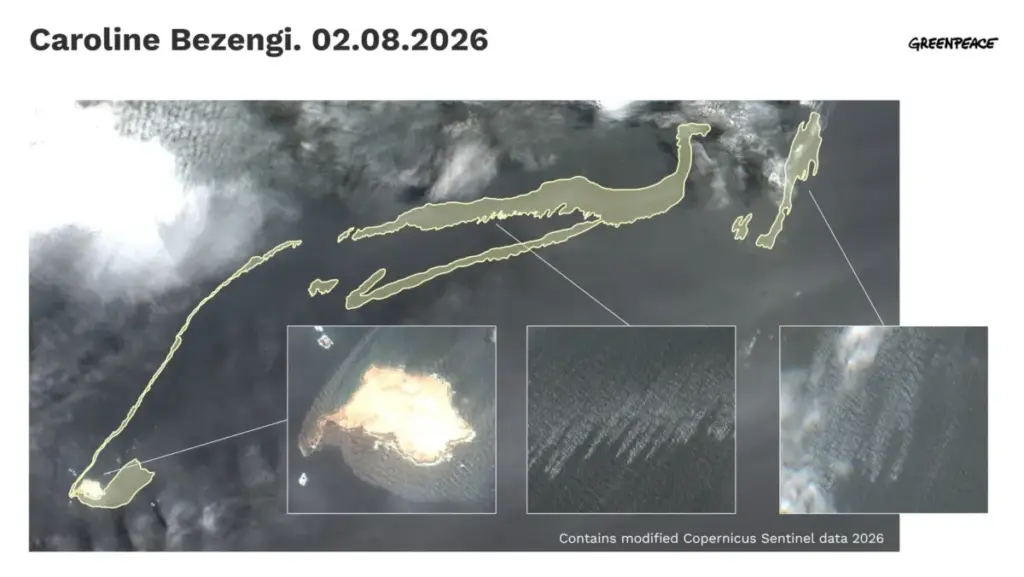
Oman — Fresh satellite data analyzed by Greenpeace Germany reveals a dramatic and alarming acceleration in oil leakage from the grounded Russian "shadow fleet" tanker Caroline Bezengi. Trapped within Oman’s ecologically vital Al Hallaniyat archipelago, the deteriorating vessel has now fouled an estimated 600 square kilometers of pristine waters—representing a terrifying fourfold expansion of the oil slick in a matter of days.
The unfolding environmental crisis has reignited intense global scrutiny regarding the maritime safety risks posed by aging, under-regulated vessels used to bypass international sanctions. As toxic sludge spreads closer to protected coastlines, environmental watchdogs, marine biologists, and regional authorities are racing against the clock to avert an unprecedented ecological catastrophe.
Executive Overview
The Caroline Bezengi, loaded with an estimated 800,000 barrels of crude oil, has been leaking persistently since it ran aground in June within a designated marine protected area near Al Qibliyah, an uninhabited island in the Al Hallaniyat chain. The grounding followed a suspected limpet mine attack that flooded the vessel’s engine room, crippling its propulsion and steering capabilities.
Recent satellite imagery paints a grim picture of structural degradation. Analysis shows that the surface area covered by the oil slick has ballooned from 45 square kilometers in late July to 150 square kilometers by August 2, before surging to approximately 600 square kilometers by August 4.
This rapidly worsening disaster highlights the existential threats posed by the clandestine network of tankers hauling Russian crude. By operating outside standard regulatory frameworks—lacking valid flag registrations, reputable P&I (Protection and Indemnity) insurance, or accountable corporate owners—these vessels transfer the full environmental and financial liabilities of maritime accidents onto host nations and vulnerable local communities.
Detailed Chronology of the Disaster
Understanding the trajectory of the Caroline Bezengi crisis requires mapping its timeline from its operational history in European waters to its tragic demise in the Arabian Sea.
1. Operational History and Evasion of Scrutiny
For years, the Caroline Bezengi operated as a cog in Russia’s sprawling shadow fleet, navigating through high-risk choke points such as the Baltic Sea. According to maritime documentation reviewed by Greenpeace Nordic via Freedom of Information requests to the Danish Maritime Authority (DMA), the vessel moved in and out of the Baltic during 2024 and 2025.
To evade Western sanctions and safety checks, the vessel engaged in a revolving door of substandard flag registrations. Most recently, it lost its flag registration in Cameroon on May 29, subsequently plunging into administrative limbo as a "flag unknown" vessel categorized by the International Maritime Organisation (IMO). Furthermore, the ship abandoned standard, reputable marine insurance networks, relying instead on an opaque entity known as Arsenal Kyrgystan—a purported insurance provider based in the Kyrgyz Republic whose solvency and willingness to cover multi-million-dollar spill cleanup costs remain entirely unverified.
2. The Attack and Grounding (June)
In June, while transiting regional waters, the Caroline Bezengi was reportedly targeted in a suspected limpet mine attack. The blast breached the hull and flooded the engine room, rendering the nearly fully loaded tanker immobile. Unresponsive to emergency directives, the crippled ship drifted into the shallow, ecologically sensitive waters of the Al Hallaniyat archipelago, eventually running hard aground close to Al Qibliyah Island.
3. The Accelerating Leak (Late July – August)
Initial containment failures led to a slow, persistent leak that went largely unmitigated due to a lack of immediate local intervention resources and an absent, non-responsive owner (reportedly based in Shanghai).
By late July, satellite monitoring captured the nascent stages of an unfolding disaster:
- July 26: Satellite imagery confirmed an oil slick footprint covering approximately 45 square kilometers.
- August 2: The slick expanded significantly, blanketing roughly 150 square kilometers of open water and coastal zones.
- August 4: Analysis revealed a catastrophic leap, with the slick stretching across 600 square kilometers—a staggering fourfold increase in just 48 hours, signaling an acute structural collapse of the tanker’s hull integrity.
Supporting Context & Metrics: The Anatomy of a Shadow Fleet Threat
The crisis surrounding the Caroline Bezengi is not an isolated incident; it is the predictable byproduct of a systemic global loophole. Greenpeace’s ongoing investigations into Russia’s shadow fleet have consistently warned that utilizing aging, sub-standard tankers to maintain wartime revenue streams invites ecological disaster.
The Scale of the Shadow Fleet Risk
- 192 High-Risk Vessels: A landmark report published by Greenpeace Germany cataloged 192 high-risk shadow fleet tankers plying European and international waters, serving as floating environmental hazards.
- Regulatory Blind Spots: By shedding reputable flags of convenience and substituting recognized Western P&I club insurance with shadowy, undercapitalized firms from Central Asia or elsewhere, these operators insulate themselves from liability. When a spill occurs, coastal states are left holding the financial bag.
- Interactive Threat Modeling: Greenpeace has deployed advanced oil spill simulations (
maps.greenpeace.org) to demonstrate how leaks from decaying shadow fleet vessels interact with prevailing currents, projecting devastating outcomes for marine biodiversity.
Ecological Stakes in the Al Hallaniyat Archipelago
The location of the grounding compounds the severity of the crisis. The Al Hallaniyat Islands constitute a uniquely fragile and biologically rich marine ecosystem:
- Endangered Fauna: The surrounding waters are a critical habitat for the rare and endangered Arabian Sea humpback whale, a genetically distinct and highly vulnerable cetacean population.
- Nesting and Breeding Grounds: The beaches of Al Qibliyah and neighboring islands serve as vital nesting sites for threatened sea turtles, while numerous migratory seabird species depend on the archipelago’s cliffs and shores for breeding.
- Submerged Ecosystems: Extensive coral reef systems and expansive seagrass meadows fringe the islands. These habitats act as nurseries for regional fisheries and form the ecological foundation of the protected marine area. Chemical residues from persistent oil spills can settle into marine sediments, poisoning the food web and compromising ecosystem resilience for years to come.
Official Statements and Expert Analysis
Environmental authorities and campaigners have issued urgent pleas for immediate international intervention, emphasizing that local actors alone cannot manage a disaster of this magnitude.
Nina Noelle: Documenting the Collapse
Nina Noelle, international environmental disaster expert at Greenpeace Germany, underscored the gravity of the rapid expansion observed via satellite analytics:
"This is a drastic increase, indicating a deterioration of the vessel’s condition. Satellite imagery analysis suggests that the oil spill covered 45 square kilometres up until 26 July. By 2 August it had expanded to around 150 square kilometres, and imagery from 4 August indicates that it now extends across roughly 600 square kilometres."
Noelle emphasized that the exponential growth rate points away from a manageable surface sheen and toward ongoing, uncontained structural failure of the tanker’s cargo tanks.
Hanen Keskes: Long-Term Ecological Devastation
Hanen Keskes, campaigner at Greenpeace MENA, detailed the profound biological fallout facing the region:
"Even relatively small oil spills can have long-lasting consequences for marine ecosystems with chemical residues that persist in marine sediments for years, compromising their ecological resilience. With the oil leak from the stranded Caroline Bezengi now accelerating, the environmental consequences will be severe, threatening coral reefs, seagrass meadows and coastal habitats that support endangered sea turtles, migratory seabirds and marine mammals in the Hallaniyat Islands."
Keskes stressed the interconnected nature of the habitats at risk:
"Sea turtles rely on the islands’ beaches for nesting and egg-laying, while many seabird species depend on the islands as critical breeding sites. The surrounding waters are also home to the rare Arabian Sea humpback whale."
Future Outlook and Urgent Recommendations
With the Caroline Bezengi locked in a precarious grounding position and bleeding crude at an alarming rate, the window to prevent a permanent environmental scar is closing rapidly. Without an accountable owner, functional insurance, or a responsive flag state, the burden of containment falls squarely on Omani authorities and the international community.
Greenpeace has outlined a clear, urgent roadmap for mitigating the crisis:
- Immediate Multi-Agency Assessment: Omani authorities, alongside regional maritime bodies, must immediately deploy specialized salvage teams to assess the remaining structural integrity of the Caroline Bezengi and evaluate all technical options for halting the leak.
- Cargo Security and Lightering: Plans must be expedited to secure the remaining crude oil onboard—estimated at a vast portion of the initial 800,000-barrel load—and transfer it safely away from the wreck before further hull fractures occur.
- Request for International Assistance: Given the high-stakes environment and the technical complexities of open-ocean salvage in protected zones, Oman should immediately issue an international call for specialized expertise, heavy equipment, and financial resources.
- Comprehensive Ecological Auditing: Independent scientific bodies must be granted access to conduct baseline and ongoing environmental damage assessments, ensuring that long-term monitoring of coral health, sea turtle nesting grounds, and humpback whale populations is prioritized.
- Accountability and Legal Recourse: Diplomatic channels must be pursued to trace the ultimate beneficiaries of the shadow fleet operation, holding accountable those who finance aggressive geopolitical conflicts at the direct expense of global marine safety.
As satellite data continues to tick upward and toxic slicks push deeper into the Arabian Sea, the Caroline Bezengi stands as a stark, floating monument to the unchecked dangers of maritime sanctions evasion—and a critical test of the international community’s capacity to protect our shared oceans.