

Executive Overview
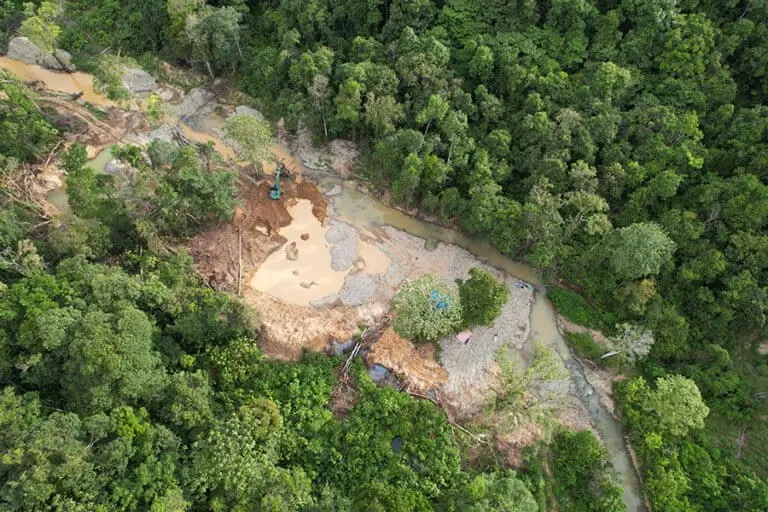
Weeks after regional government and law enforcement leaders in Indonesia’s semiautonomous province of Aceh issued a high-profile ultimatum to eradicate illegal gold mining, reality on the ground tells a troubling story of defiance. Despite a strict government-mandated deadline of August 17—coinciding with Indonesia’s Independence Day—to halt all unauthorized extraction, excavators continue to tear through riverbanks and mountainsides deep within the tropical interior.
Aceh, situated on the northern tip of Sumatra, represents one of Southeast Asia’s most ecologically critical landscapes. Home to the legendary Leuser Ecosystem—a sprawling expanse of high-conservation-value tropical rainforests and carbon-rich peatlands—the region stands as a vital refuge for critically endangered species, including the Sumatran orangutan, Sumatran elephant, Sumatran rhinoceros, and the Sumatran tiger. Yet, these biodiversity strongholds are increasingly compromised by a surging, lucrative black-market gold trade.
Environmental watchdogs, local communities, and investigative reports confirm that heavy machinery remains operational, supply chains funneling diesel and equipment to remote sites are uninterrupted, and toxic chemicals like mercury and cyanide continue to poison pristine river systems. The persistence of these illicit operations highlights a profound enforcement gap between political posturing in provincial capitals and the hard realities of resource extraction in remote, heavily guarded forest zones.
Detailed Chronology and Ground Realities
The confrontation between provincial authorities and illegal mining syndicates has escalated over the summer months, marked by unheeded deadlines and persistent environmental degradation.
The July Ultimatum and the August 17 Deadline
In late July, a high-level regional coordination meeting convened in Aceh, bringing together top government officials, security forces, and law enforcement agencies. Faced with mounting evidence of widespread ecological destruction, the leadership issued a sweeping directive: all illegal gold mining operations across the province must completely cease, and all heavy machinery and mining tools must be removed by August 17, 2026.
The decree explicitly outlawed the use of toxic chemicals, notably mercury and cyanide, and reminded operators that they faced severe prosecution under national environmental frameworks, including the 1999 Forestry Law and the 2020 Mining Law.
Defiance in the Field
However, as August bled into September, reports from local residents and community leaders across multiple Acehnese districts indicated that the ultimatum had virtually no impact on daily operations.
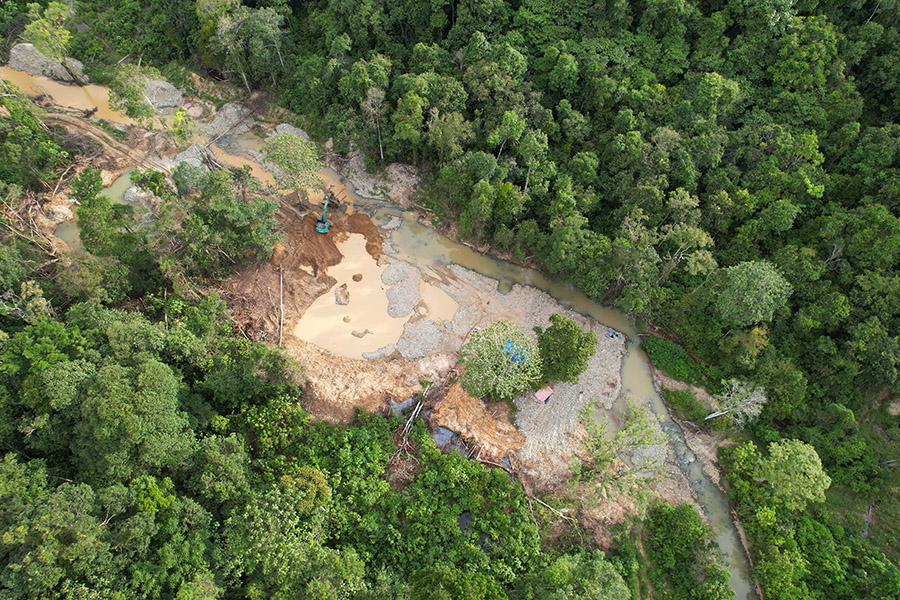
In the Seunagan area of Nagan Raya district, community leader Amran reported that heavy excavators were still actively carving up river verges. Supply lines remain robustly active, with fuel and provisions continuously delivered to clandestine camps hidden deep within forest interiors.
Similar accounts emerged from South Aceh. Razali, a resident of Fajar, noted that local gas stations frequently face severe shortages of diesel fuel, driven primarily by the massive, unyielding demand from heavy excavators chewing through riverbanks and mountainsides. In Pidie district, residents living near Tangse observed that miners continue to inhabit established encampments shielded by blue tarpaulins.
"If it’s just an announcement, it won’t have any effect," said Hamdani, a local resident of Tangse, pointing out that organized mining syndicates possess the manpower, resources, and local security arrangements necessary to heavily guard their operational perimeters against sporadic patrols.
Supporting Context & Metrics: The Scale of Destruction
The environmental cost of unregulated gold mining in Aceh is staggering, documented extensively by regional environmental organizations and civil society groups.
Walhi’s Comprehensive Assessment
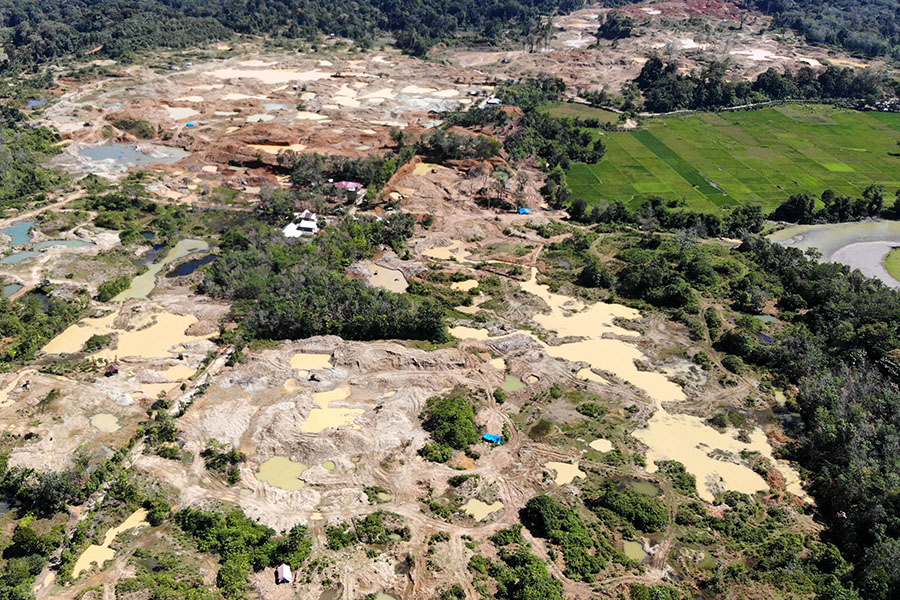
According to spatial research conducted by the Indonesian Forum for the Environment (Walhi)—the country’s largest environmental pressure group—illegal gold mining inflicted catastrophic damage on Aceh’s forests between 2023 and 2025. During this two-year window, an estimated 23,433 hectares (57,904 acres) of forest cover were destroyed.

To contextualize the scale of this devastation, Ahmad Shalihin, director of Walhi’s Aceh chapter, noted that the damaged area is equivalent to four times the total landmass of Banda Aceh, the provincial capital.
Key statistical findings from the Walhi analysis include:
- Protected Forests Hit Hard: Approximately 10,552 hectares (26,075 acres)—representing 45% of the total destruction—occurred within officially designated protected forest zones.
- River System Concentration: More than 80% of all mining-induced ecological damage was concentrated within three principal river basins: the Meureubo, Seunagan, and Woyla rivers. Among these, the Woyla River alone accounted for nearly a third of the total destruction.
- Heavy Machinery Footprint: Field surveys identified more than 1,000 units of heavy equipment operating within sensitive forest zones, linked to over 450 distinct illegal mining operations scattered across various districts of Aceh.
Encroachment on Critical Wildlife Refuges
The physical footprint of these operations extends far beyond simple soil excavation. Miners construct unauthorized water-storage dams, build artificial sluices to separate gold ore from sediment, carve out access roads for heavy machinery, and clear large tracts of old-growth forest for worker encampments.
This relentless expansion has brought miners into direct conflict with conservation initiatives. In August, Mongabay reported that illegal gold mining operations had actively encroached into a vital reintroduction forest in Aceh specifically set aside for critically endangered Sumatran orangutans rescued from the illegal wildlife trade.
Official Statements and Institutional Challenges
The inability of the state to curb the crisis has triggered intense debate among regional administrators, law enforcement agencies, and environmental advocates regarding accountability and systemic corruption.
Government and Police Perspectives
Before transitioning out of his post in August under President Prabowo Subianto, then-Aceh provincial secretary M. Nasir openly acknowledged the widespread scope of the crisis. He confirmed that illegal gold operations were actively undermining at least nine districts, including Aceh Besar, Aceh Jaya, Central Aceh, Gayo Lues, Nagan Raya, Pidie, South Aceh, Southwest Aceh, and West Aceh.
"These activities cause environmental pollution, increased risk of social conflict, increased risk of workplace accidents, and lost potential revenue for the state and regions," Nasir stated on August 22.
Law enforcement officials have similarly conceded that fragmented efforts are failing. Ruddi Setiawan, the Aceh police chief, emphasized that conventional policing methods are inadequate against entrenched syndicates.
"It’s going to take robust cooperation," said Ruddi, a former police chief on the island of Bali. "We need to collaborate." However, critics argue that institutional collaboration has been painfully slow, hampered by local complicity and the sheer profitability of the black-market trade.
The Call to Target Financiers
Walhi’s Ahmad Shalihin argues that law enforcement agencies consistently make the mistake of targeting low-level laborers while ignoring the wealthy backers who bankroll the operations.
"The state must pursue the financiers, freeze their assets, and bring them to justice," Ahmad asserted. "This gets to the real source of the problem."
Furthermore, the environmental health hazards associated with these sites remain a severe public crisis. Miners rely heavily on mercury—which binds to gold dust in crushed ore—and cyanide to extract remaining particles. Both chemicals pose catastrophic risks, including fatal poisoning and irreversible, long-term cognitive decline for workers and local communities downstream. The unchecked circulation of these toxins directly violates Indonesia’s commitments under the international Minamata Convention and its own national action plans to phase out mercury in the artisanal and small-scale gold mining sector.

Future Outlook and Strategic Recommendations
As the dust settles following the unenforced August 17 deadline, the future of Aceh’s remaining high-conservation forests hangs in the balance. Without a fundamental shift in strategy from both Jakarta and provincial authorities, the Leuser Ecosystem and its surrounding watersheds face an existential threat.
Environmental coalitions and local community leaders have laid out a clear roadmap for dismantling the illegal gold economy. According to Walhi, superficial sweeps and temporary warnings are useless so long as the underlying logistical lifelines remain open.
To successfully incapacitate the illegal gold mining networks in Aceh, experts emphasize that authorities must execute a four-point strategic intervention:
- Sever Fuel Supply Chains: Implement rigorous checkpoints and supply audits to cut off the continuous flow of diesel fuel required to run heavy excavators in remote interior camps.
- Intercept Toxic Imports: Crack down on the illicit distribution networks trafficking mercury and cyanide into mining districts.
- Seize and Confiscate Heavy Machinery: Launch coordinated, militarized raids aimed at confiscating multi-thousand-dollar excavators and heavy equipment, rendering operations physically impossible.
- Target the Capitalists: Freeze the assets of and prosecute the high-level financial backers and corrupt officials shielding these operations from legal consequences.
Until the Indonesian government transitions from empty deadlines to aggressive, systematic enforcement targeting the financial and logistical pillars of the illegal trade, the rivers of Aceh will continue to run murky, and the forests of the Leuser Ecosystem will remain under siege.



