SEATTLE, WA — In the rapidly evolving landscape of global tourism, a silent crisis has long paralyzed conscientious tour operators: the sheer administrative nightmare of carbon accounting. While travelers increasingly demand data-backed proof of climate-friendly itineraries, and international regulatory bodies tighten the screws on misleading environmental claims, the tools available to measure tour emissions have remained mired in archaic spreadsheets, complex methodologies, and costly consulting fees.
Entering the fray to disrupt this status quo is Sustainable Travel International (STI), a non-profit organization with over two decades of experience in environmental advocacy and tourism transformation. On June 10, 2026, STI officially launched Humí, an artificial intelligence-powered carbon footprinting tool designed to convert standard tour itineraries into granular, reliable emissions reports in a matter of seconds rather than weeks.
By bridging the gap between cutting-edge AI and specialized tourism science, Humí seeks to solve a foundational bottleneck in climate action: the arduous task of baseline measurement. As incoming anti-greenwashing directives sweep across Europe and global markets, Humí arrives not merely as a convenience, but as a potential compliance lifeline for an industry struggling to substantiate its green credentials.
Executive Overview: The Dawn of Instantaneous Tour Footprinting
For decades, calculating the carbon footprint of a complex, multi-day tour package has been a formidable barrier to entry for small- and medium-sized operators. Unlike corporate travel or hotel stays—which rely on relatively straightforward metrics like square footage, utility bills, and standardized flight databases—tours are dynamic, multi-faceted experiences. A single itinerary might encompass international flights, charter bush planes, multi-operator ground transportation, diverse accommodation types, boat excursions, and localized cultural activities.
Traditionally, capturing this data required painstaking manual research, exhaustive email chains with local suppliers, and custom spreadsheet architectures. Consequently, many tour operators simply avoided carbon measurement altogether, leaving them vulnerable to accusations of greenwashing or falling short of evolving regulatory expectations.
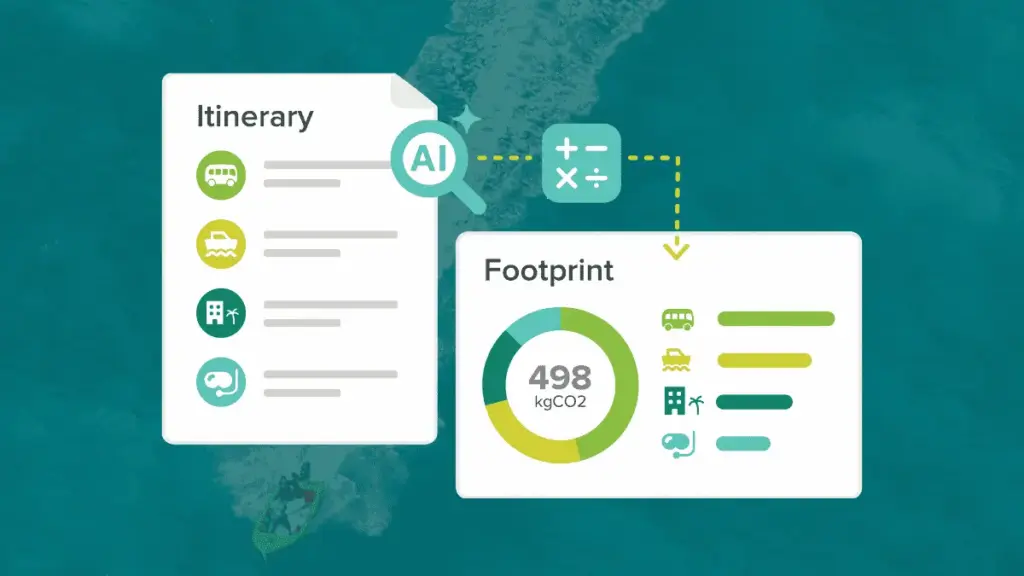
Humí changes this paradigm entirely. By leveraging advanced generative AI alongside STI’s proprietary, tourism-specific calculation methodology, the platform allows users to simply paste a webpage link to a tour itinerary or upload a PDF document. Within seconds, the software parses the text, extracts critical logistical variables, computes total emissions, and generates a structured report.
Currently available for a limited time as a free trial at sustainabletravel.org/humi, the platform promises to democratize climate data. It equips operators of all sizes with the institutional-grade metrics needed to navigate a carbon-conscious marketplace.
Detailed Chronology & Mechanics: How Humí Translates Itineraries into Emissions
To understand the technological leap represented by Humí, one must examine the friction points inherent in legacy carbon accounting. The development of the tool stems from a multi-year effort by Sustainable Travel International to streamline data collection without sacrificing scientific rigor.
1. Automated Ingestion and NLP Parsing
The user workflow is intentionally frictionless. An operator inputs a tour itinerary—either by pasting a live URL or uploading a PDF document. Humí’s underlying Natural Language Processing (NLP) engines scan the text, identifying key infrastructural markers such as destinations, modes of transit, lengths of stay, and specific activities.
2. Intelligent Data Translation and Gap-Filling
One of the most persistent hurdles in tourism sustainability is incomplete data. Tour descriptions rarely state the exact fuel efficiency of a specific tour bus or the precise energy matrix of a boutique ecolodge.
Humí directly addresses this through an intelligent estimation framework. When itinerary details are ambiguous or missing, the system applies smart assumptions based on regional averages and sector-specific archetypes. Crucially, the tool provides confidence scores for every data point, transparently indicating where the AI intervened to fill in the blanks. This empowers tour operators to execute an immediate baseline assessment using whatever data they currently possess, while offering a clear pathway to upgrade data accuracy as they gather more precise information from local suppliers.
3. Specialized Tourism Science vs. Generic AI
Generic carbon calculators and out-of-the-box large language models (LLMs) frequently fail when applied to complex travel itineraries. They tend to miscalculate or completely omit niche tourism activities such as game drive safaris, charter flights, expedition cruises, and backcountry excursions.
Humí is built upon Sustainable Travel International’s proprietary calculation methodology, refined over 20 years of real-world environmental auditing. This ensures that emissions tied to irregular transport nodes, remote lodging off-grid, and wildlife-centric excursions are accurately accounted for, providing a level of domain-specific accuracy that generic AI tools simply cannot replicate.
4. Enterprise Scaling and Centralized Dashboards
Beyond single-itinerary analysis, STI offers enterprise-tier plans tailored for large tour operators, DMCs (Destination Management Companies), and major travel conglomerates. These enterprise suites enable users to:
- Scale analysis across hundreds of tours simultaneously.
- Receive expert human review of algorithmic results to ensure ironclad accuracy.
- Access centralized dashboards to compare footprints across diverse product portfolios.
- Track year-over-year emissions reductions to meet corporate net-zero targets.
- Utilize embedded guidance for translating measurement data into transparent marketing communications and regulatory disclosures.
Supporting Context & Metrics: The Regulatory and Consumer Imperative
The launch of Humí does not occur in a vacuum; it is strategically timed to address converging pressures from both lawmakers and modern consumers.
The Regulatory Hammer: Europe’s Anti-Greenwashing Crackdown
Across Europe, regulatory bodies are actively dismantling vague environmental claims. The European Union’s Directive on Green Claims and related consumer protection directives are introducing stringent verification standards for companies marketing themselves as "sustainable," "eco-friendly," or "carbon-neutral."
Under these incoming laws, businesses that make environmental assertions without robust, verifiable, scientific data face severe financial penalties, public censures, and legal liabilities. For tour operators selling into European markets—or operating globally—relying on guesswork or unsubstantiated marketing slogans is no longer a viable business strategy. Tools like Humí provide the audit trails and standardized metrics required to stand up to regulatory scrutiny.
The Consumer Shift: Demand for Radical Transparency
Concurrently, consumer behavior has shifted dramatically. Post-pandemic travelers increasingly prioritize sustainable tourism, yet they have also grown deeply skeptical of corporate greenwashing. According to various travel industry studies, a significant majority of consumers want to understand the tangible environmental impact of their journeys.
However, bridging the gap between intent and action remains difficult when operators cannot provide clear numbers. By rapidly quantifying footprints, Humí allows travel companies to offer radical transparency, turning climate data from an administrative burden into a competitive differentiator that attracts eco-conscious travelers.
Official Perspectives: Leadership Insights
In announcing the tool, leadership at Sustainable Travel International emphasized both the urgency of the climate crisis and the practical necessity of lowering barriers to entry for small businesses.
"Carbon measurement is the first step to taking climate action, but tour operators have been stuck with a system that makes emissions measurement far harder than it should be," stated Paloma Zapata, CEO of Sustainable Travel International.
"We built Humí to significantly reduce the time and technical effort required to measure tour emissions without compromising accuracy, making it easier for businesses to understand their impacts and start taking action."
Zapata’s remarks underscore a core philosophy of STI: that environmental stewardship within tourism must move beyond elite corporate sustainability departments and become accessible to independent operators who form the bedrock of the global tourism economy. By cutting the time required for an audit from weeks to seconds, Humí democratizes access to professional-grade climate intelligence.
Future Outlook: What Humí Means for the Next Decade of Travel
As the global tourism industry charts its course toward decarbonization, tools that harness artificial intelligence for ecological good will play a decisive role. Humí represents an important blueprint for how niche domain expertise can be successfully married with modern software architecture.
Looking forward, the broader integration of automated carbon accounting is expected to reshape the travel supply chain in several profound ways:
- Supplier Accountability: As tour operators utilize tools like Humí to identify high-emission hotspots in their supply chains, they will increasingly demand cleaner energy practices, fuel-efficient transport, and transparent data from their local partners, hotels, and excursion providers.
- Dynamic Eco-Routing: Future iterations of AI-driven travel tools may enable real-time itinerary optimization, allowing planners to design routes that minimize carbon output before a single ticket is booked.
- Standardized Benchmarking: Widespread adoption of consistent methodologies will allow destination management organizations (DMOs) and national tourism boards to establish regional carbon baselines, paving the way for targeted destination management and regenerative tourism policies.
For now, the immediate challenge lies in adoption. By offering Humí free for a limited time, Sustainable Travel International has removed the financial barrier to experimentation. Whether tour operators will seize this opportunity to overhaul their sustainability practices remains to be seen, but the technological infrastructure to do so is finally within reach.
About Sustainable Travel International
Sustainable Travel International is a trailblazing non-profit organization dedicated to protecting vulnerable destinations and transforming the impact of tourism on nature and people. For over two decades, the organization has pioneered practical technology tools, data-driven impact measurement systems, and expert guidance to help travel businesses and destinations combat climate change, overtourism, and environmental degradation.
To explore Humí or start a free trial, visit sustainabletravel.org/humi. For media inquiries and partnership opportunities, contact STI via their official communication channels.