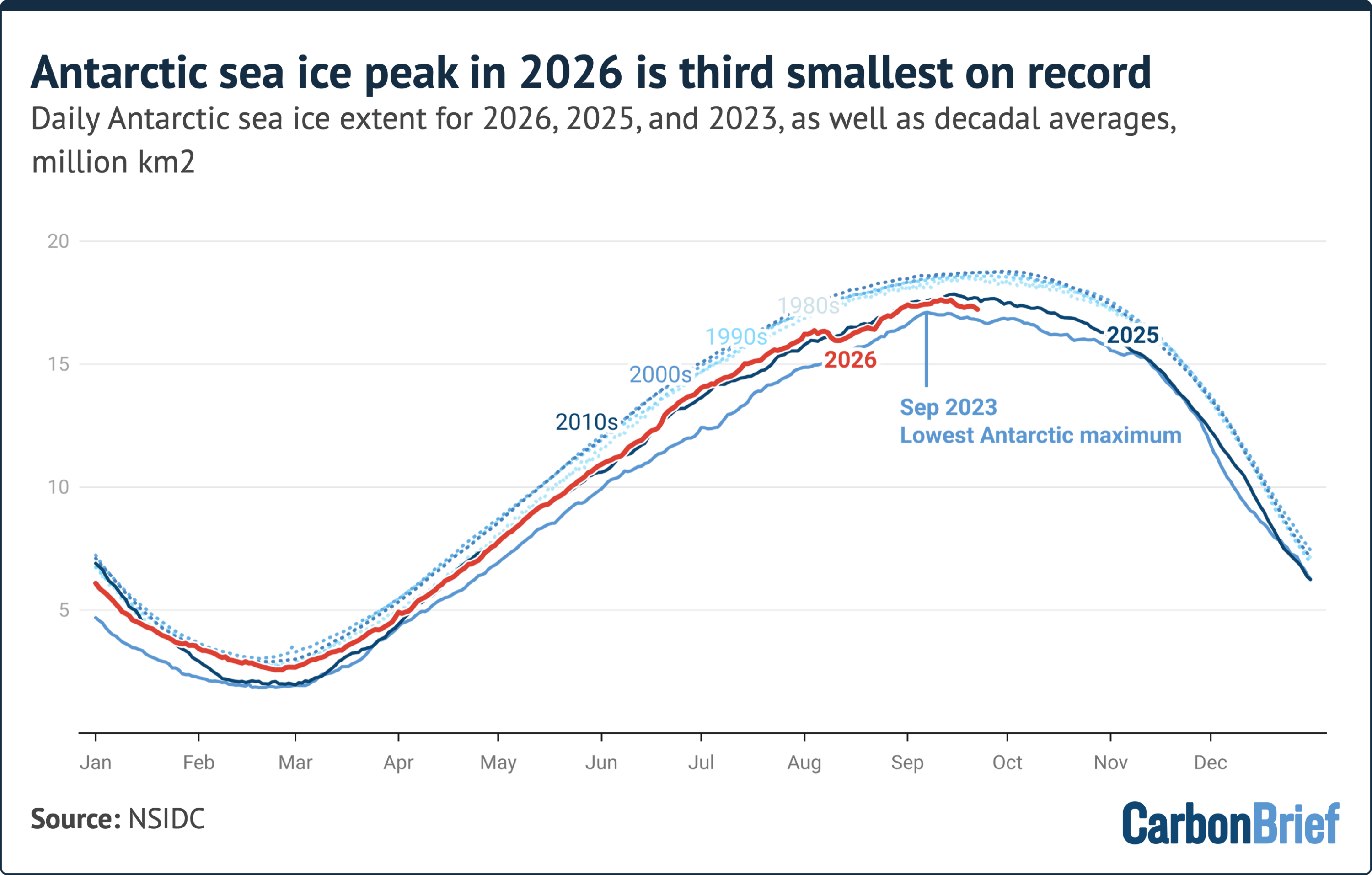
Preliminary satellite data released by the U.S. National Snow and Ice Data Center (NSIDC) reveals a sobering milestone in Earth’s polar regions: Antarctic sea ice reached its annual winter peak on September 14, 2026, at an extent of 17.59 million square kilometers. This measurement marks the third-smallest winter maximum recorded in the 48-year satellite record, coming behind only the unprecedented collapse observed in 2023 and subsequent low levels in recent years. The continued suppression of Antarctic winter ice cover signals that the Southern Ocean may be undergoing a structural regime shift, departing from decades of relative stability toward persistent, climate-driven decline.
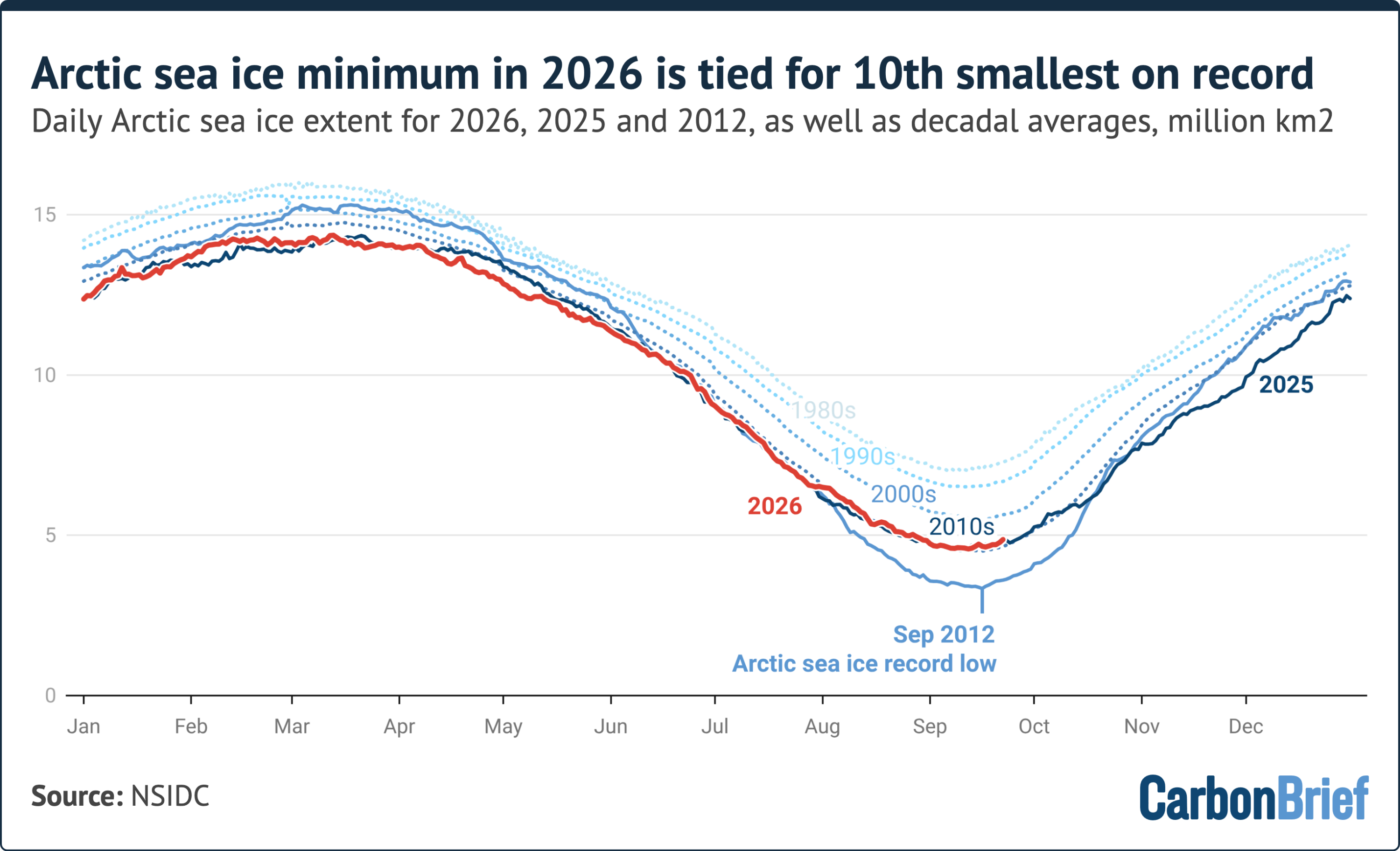
Concurrently, at the planet’s northern pole, Arctic sea ice reached its annual summer minimum on September 12, 2026, dropping to 4.60 million square kilometers. Tied with 2025, 2010, and 2008 for the 10th-lowest extent in the satellite era, the Arctic minimum underscores an unrelenting long-term loss. The last 20 years now comprise the 20 lowest summer minimums ever recorded, illustrating that conditions considered extreme two decades ago have become the baseline reality today.
Beyond the physical loss of ice, polar science faces a parallel observational crisis. In March 2026, the National Oceanic and Atmospheric Administration (NOAA) terminated a key global atmospheric pressure dataset. This operational cut abruptly halted updates to the Pan-Arctic Ice Ocean Modeling and Assimilation System (PIOMAS)—the primary reanalysis tool used by global researchers to track Arctic sea ice volume and thickness. As both poles experience heightened environmental volatility, international researchers warn that critical data blind spots are emerging precisely when precise climate monitoring is needed most.
Detailed Chronology
The 2026 polar calendar was characterized by erratic growth cycles, severe regional temperature anomalies, and disruptive shifts in atmospheric circulation patterns across both hemispheres.
+-----------------------------------------------------------------------------------+
|                                2026 POLAR TIMELINE                                |
+------------------+----------------------------------------------------------------+
| March 2026       | Arctic winter sea ice reaches joint-smallest maximum extent.   |
|                  | NOAA cuts global air pressure dataset, freezing PIOMAS updates.|
+------------------+----------------------------------------------------------------+
| April 2026       | Antarctic growth season begins; Bellingshausen Sea remains     |
|                  | almost ice-free, while Amundsen Sea shows temporary excess.    |
+------------------+----------------------------------------------------------------+
| July-August 2026 | Antarctic ice growth falters; July reaches 5th-lowest extent;  |
|                  | August reaches 4th-lowest on record.                           |
|                  | Barents Sea experiences earliest summer melt-out on record.    |
+------------------+----------------------------------------------------------------+
| Sept 12, 2026    | Arctic summer sea ice reaches minimum extent at 4.60m km²      |
|                  | (tied for 10th lowest on record).                              |
+------------------+----------------------------------------------------------------+
| Sept 14, 2026    | Antarctic winter sea ice reaches peak extent at 17.59m km²     |
|                  | (3rd lowest on record).                                        |
+------------------+----------------------------------------------------------------+
Late Winter to Early Spring (March – April 2026)
March: Arctic sea ice reached its peak winter extent, tying for the smallest winter maximum in the 48-year satellite record—a stark continuation of the previous year’s record low. Concurrently, NOAA terminated its gridded reanalysis dataset for atmospheric air pressure, stripping researchers of a primary data input required to model sea ice thickness.
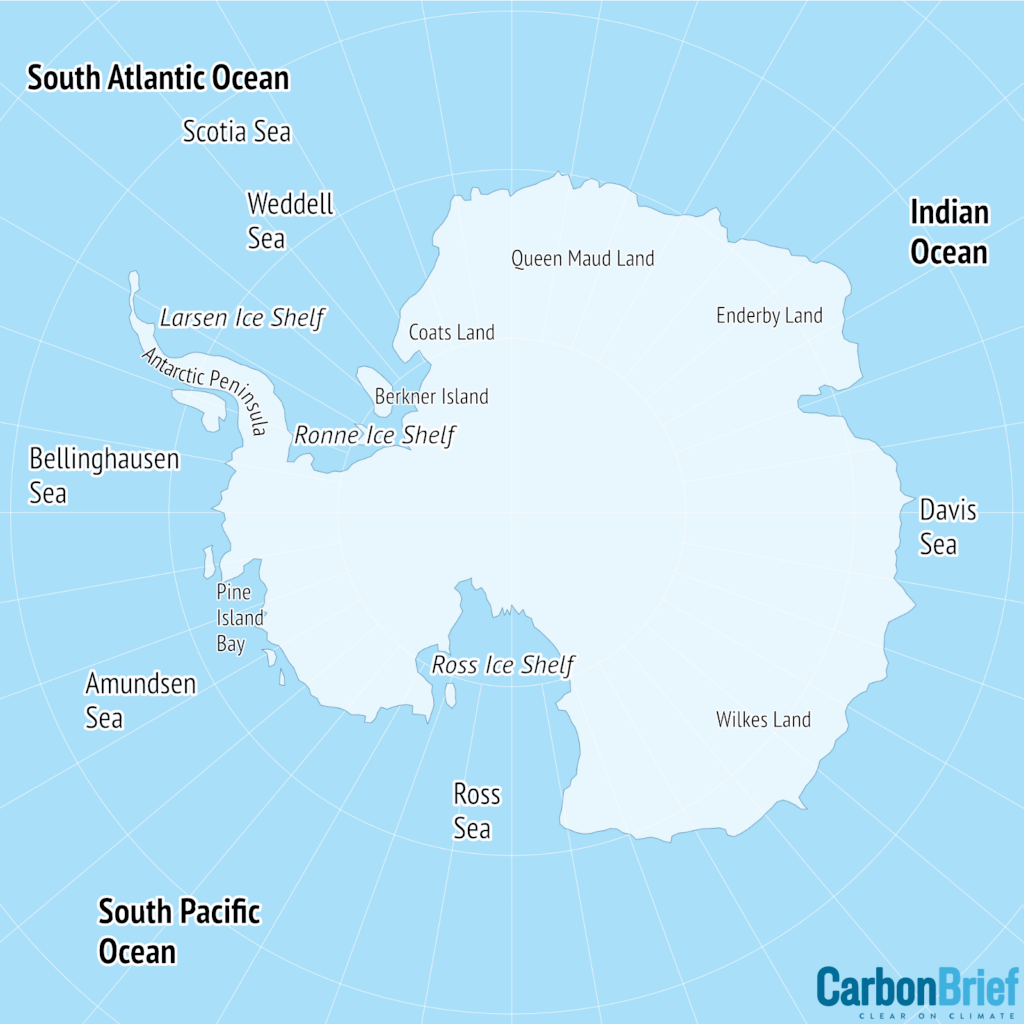
April: Antarctic sea ice transitioned into its autumn freeze period following a near-average February minimum. Regional disparities immediately emerged: the Bellingshausen Sea remained virtually free of sea ice, whereas the adjacent Amundsen Sea exhibited temporarily above-average coverage.
Mid-to-Late Summer Melt and Winter Freeze (July – August 2026)
July: Antarctic winter growth slowed considerably. The monthly average extent registered as the fifth-lowest July on record. In the Arctic, heatwaves spread across Western Siberia, pushing surface temperatures more than 5°C above the 1981–2010 baseline.
August: Antarctic sea ice recorded its fourth-lowest August extent on record. All four of the lowest August extents have now occurred since 2023. In the Northern Hemisphere, heat extended into Arctic coastal regions, triggering the earliest recorded melt-out of sea ice in the Barents Sea.
September Peak and Minimum Events
September 12: The Arctic reached its annual minimum sea ice extent at 4.60 million square kilometers, tying with 2025, 2010, and 2008 for the 10th-lowest minimum.
September 14: Antarctic sea ice reached its annual winter peak at 17.59 million square kilometers, officially registering as the third-smallest maximum on record.
Supporting Context & Metrics
Antarctic Dynamics: A Persistent Low-Ice Regime
For decades, Antarctic sea ice extent exhibited a slight, paradoxically increasing trend despite global ocean warming, confusing early climate projections. However, since a sharp transition in 2016, Southern Ocean sea ice has suffered repeated collapse events. The 2026 maximum of 17.59 million square kilometers reinforces concerns that the region has crossed a tipping point into a low-ice regime.
Statistical trends reveal an unprecedented clustering of extreme low coverage:
July Trends: The five lowest July extents in recorded history have all occurred in the last five years (2022–2026).
August Trends: The four lowest August extents have occurred consecutively between 2023 and 2026.
Regional shifting was particularly pronounced throughout 2026. Atmospheric pressure systems shifted late in the freezing season, reconfiguring wind patterns across the Southern Ocean. While early season deficits in the Bellingshausen Sea partially recovered by late August, severe deficits opened across the Amundsen Sea and large sectors of East Antarctica, keeping overall coverage well below historical decadal averages.
       ANTARCTIC REGIONAL DYNAMICS (WINTER 2026)

       [ Bellingshausen Sea ] ---> Ice-free in April ---> Partial Late-Season Recovery
       [ Amundsen Sea ]       ---> High Ice in April ---> Unusually Scarce by August
       [ East Antarctica ]    ---> Persistent Winter Deficit Driven by Atmospheric Shifts
Arctic Asymmetry and the Loss of Observational Tools
In the Arctic, summer weather conditions created a marked divergence between sectors:
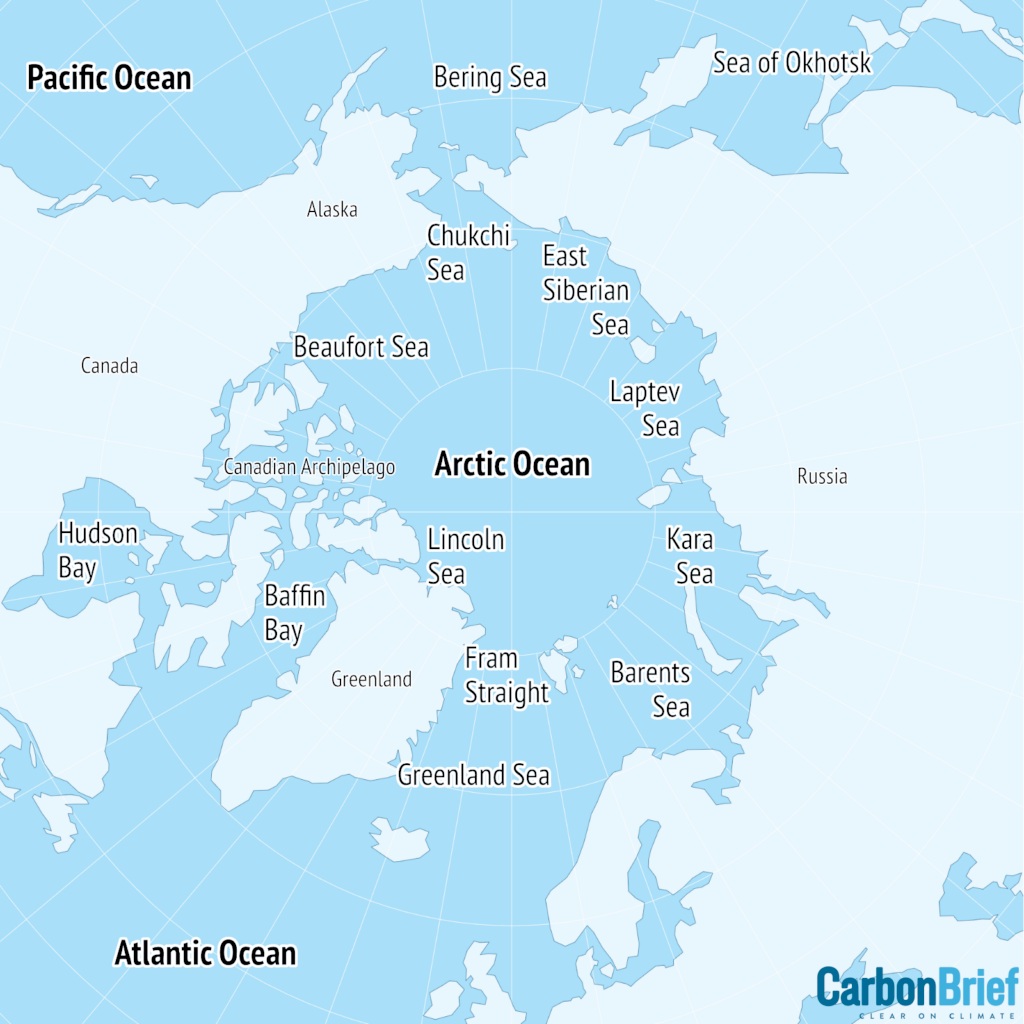
The Pacific Sector (Beaufort and Chukchi Seas): A persistent low-pressure system centered over the North Pole brought cloud-covered, cooler conditions. This weather pattern shielded the ice pack from intense solar radiation and delayed the onset of surface melt by more than two weeks, with significant melting only beginning after early July.
The Atlantic Sector (Barents and Kara Seas): In contrast, persistent high-pressure ridges delivered extreme warm air anomalies out of Western Siberia. Combined with elevated ocean temperatures, this caused rapid ice breakdown, leading to the earliest melt-out ever recorded in the Barents Sea.
                       ARCTIC REGIONAL CONTRASTS (SUMMER 2026)

       PACIFIC SECTOR                                ATLANTIC SECTOR
 (Beaufort & Chukchi Seas)                        (Barents & Kara Seas)
 -------------------------                        ---------------------
 • Low-pressure anomalies                         • High-pressure anomalies
 • Cloud cover & lower temps                      • Persistent warmth (>5°C anomaly)
 • Melt delayed by >2 weeks                       • Earliest melt-out on record
While surface area extent measurements remain available through microwave satellite sensors, researchers have lost a key tool for measuring ice volume. The Pan-Arctic Ice Ocean Modeling and Assimilation System (PIOMAS), operated by the University of Washington, relies on high-resolution reanalysis data to compute ice thickness—a critical metric for determining whether ice can survive summer melt cycles. Following NOAA’s decision to terminate its global air pressure reanalysis dataset in March 2026 due to administrative and funding constraints, PIOMAS updates were suspended. Researchers caution that relying solely on two-dimensional surface area can obscure thinning ice packs, creating a dangerous blind spot in global climate assessment.
Official Statements
Polar climatologists and oceanographers emphasize that current satellite data highlights structural changes in global climate systems.
Dr. Lettie Roach, polar climate scientist at the Alfred Wegener Institute (AWI) in Germany:
"This year’s Antarctic sea ice maximum was well below average for the season. After several decades of stable or increasing winter Antarctic sea ice conditions, it is concerning to see these low values persisting.
"Compared with the Arctic, it’s less clear how recent changes in Antarctic sea ice are attributable to human-caused warming versus natural variability. We need more years of observations to better understand whether this is truly a structural shift.
"Human-caused climate change has reduced Arctic sea ice cover and thickness, so the region is fundamentally different compared to a few decades ago. Even during years without record minimums, coastal heat waves continue to drive significant localized ice loss."
Dr. Clare Eayrs, postdoctoral researcher at the Korea Polar Research Institute (KOPRI):
"Antarctic sea ice has returned to unusually low winter coverage after recording a near-average February minimum. Regional patterns changed substantially during the growth season. In April, the Bellingshausen Sea remained almost entirely ice-free, while the neighbouring Amundsen Sea had more ice than usual.
"However, by late August, changes in atmospheric pressure and wind meant that the Bellingshausen deficit had largely recovered, while ice was unusually scarce in the Amundsen Sea and across much of East Antarctica."
Dr. Zack Labe, climate scientist at Climate Central:
"Local weather patterns across the Arctic play a really important role in year-to-year sea-ice extent, even as the long-term trend is clearly downward. The absence of a new record low this year does not mean the Arctic ice pack is becoming more resilient.
"Going forward, scientists need more data and observations of other sea-ice metrics, like ice thickness, which may give us better insight into the overall condition of the ice pack, especially during years like 2026 when it is very fragmented."
Future Outlook
The persistent lack of sea ice growth at both poles carries profound consequences for the global climate system. Sea ice acts as Earth’s primary solar reflector; as white ice is replaced by dark ocean water, the ocean absorbs significantly more thermal energy, accelerating global ocean warming through the ice-albedo feedback loop.
In the Antarctic, reduced sea ice coverage exposes coastal ice shelves to strong ocean waves and warm Circumpolar Deep Water. Recent modeling indicates that continued loss of sea ice buffering contributes directly to the instability of major land-based ice sheets, such as the Pine Island Glacier, where climate change has already driven one-fifth of its historical retreat. Scientists stress that keeping global warming below 2°C remains crucial to preserving fragile ecosystems along the Antarctic Peninsula and avoiding irreversible melting.
       GLOBAL FEEDBACK LOOP OF POLAR SEA ICE LOSS

       +-------------------------------------------------+
       | Atmospheric & Oceanic Warming (GHG Accumulation) |
       +------------------------+------------------------+
                                |
                                v
       +-------------------------------------------------+
       | Loss of Polar Sea Ice Cover (Antarctic/Arctic)   |
       +------------------------+------------------------+
                                |
                                v
       +-------------------------------------------------+
       | Lower Albedo: Ocean Absorbs More Thermal Heat   |
       +------------------------+------------------------+
                                |
                                v
       +-------------------------------------------------+
       | Ocean Warming & Accelerated Glacier Retreat      |
       | (e.g., Pine Island Glacier / Antarctic Shelves)  |
       +-------------------------------------------------+
Simultaneously, the disruption of critical research infrastructure—highlighted by the suspension of PIOMAS—exposes vulnerabilities in international polar research. As political and fiscal pressures threaten polar science programs, leading science organizations are calling for immediate funding guarantees to restore basic observational datasets. Without accurate, real-time measurements of sea ice thickness and ocean salinity, global climate models will face growing uncertainties, impairing the ability to forecast sea-level rise and extreme weather events worldwide.