

Executive Overview
The global new energy vehicle (NEV) landscape is undergoing a profound structural evolution, and industry giant BYD is once again at the epicentre of this transformation. Following a comparatively sluggish start to the year, the Chinese automotive titan is rapidly picking up both steam and electricity, posting commanding delivery figures for September 2026 that underscore a decisive market shift.
In September 2026, BYD achieved a remarkable 456,713 passenger vehicle deliveries. This performance represents a robust 5.4% increase over August 2026 and a significant 16.2% surge compared to September 2025. However, headline figures alone fail to capture the underlying market dynamics. Beneath this broad-based growth lies a stark divergence in consumer demand: while battery-electric vehicles (BEVs) are experiencing explosive, record-breaking adoption, plug-in hybrid electric vehicles (PHEVs) are facing a year-over-year contraction.
This comprehensive report examines BYD’s September 2026 sales performance, analyzes the shifting economics of BEVs versus PHEVs, evaluates the year-to-date trajectory, and outlines the long-term implications for the company’s global market dominance.
Detailed Chronology: September 2026 Sales Breakdown
To understand the trajectory of BYD’s recent success, one must examine the specific mechanics of the September delivery data. The month-over-month (MoM) and year-over-year (YoY) trajectories reveal a company successfully overcoming early-year headwinds through aggressive product positioning and scaling efficiency.

Total Passenger Vehicle Deliveries
For the month of September 2026, BYD delivered a total of 456,713 passenger vehicles.
- Month-over-Month Growth: Up 5.4% compared to August 2026.
- Year-over-Year Growth: Up 16.2% compared to September 2025 (which stood at 393,060 units).
- Absolute Volume Increase: More than 63,000 additional vehicles delivered compared to the same month in the previous year.
Battery-Electric Vehicle (BEV) Surge
The primary driver behind BYD’s September acceleration is its fully electric portfolio. BEV sales outpaced the company’s aggregate growth rates by a wide margin, proving that consumer preference is aggressively tilting toward zero-emission, pure-electric architectures.
- September 2026 BEV Sales: 273,143 units.
- September 2025 BEV Sales: 205,050 units.
- Year-over-Year Growth: A massive 33.2% increase.
- Month-over-Month Growth: A solid 6.6% increase over August 2026.
Plug-In Hybrid Electric Vehicle (PHEV) Contraction
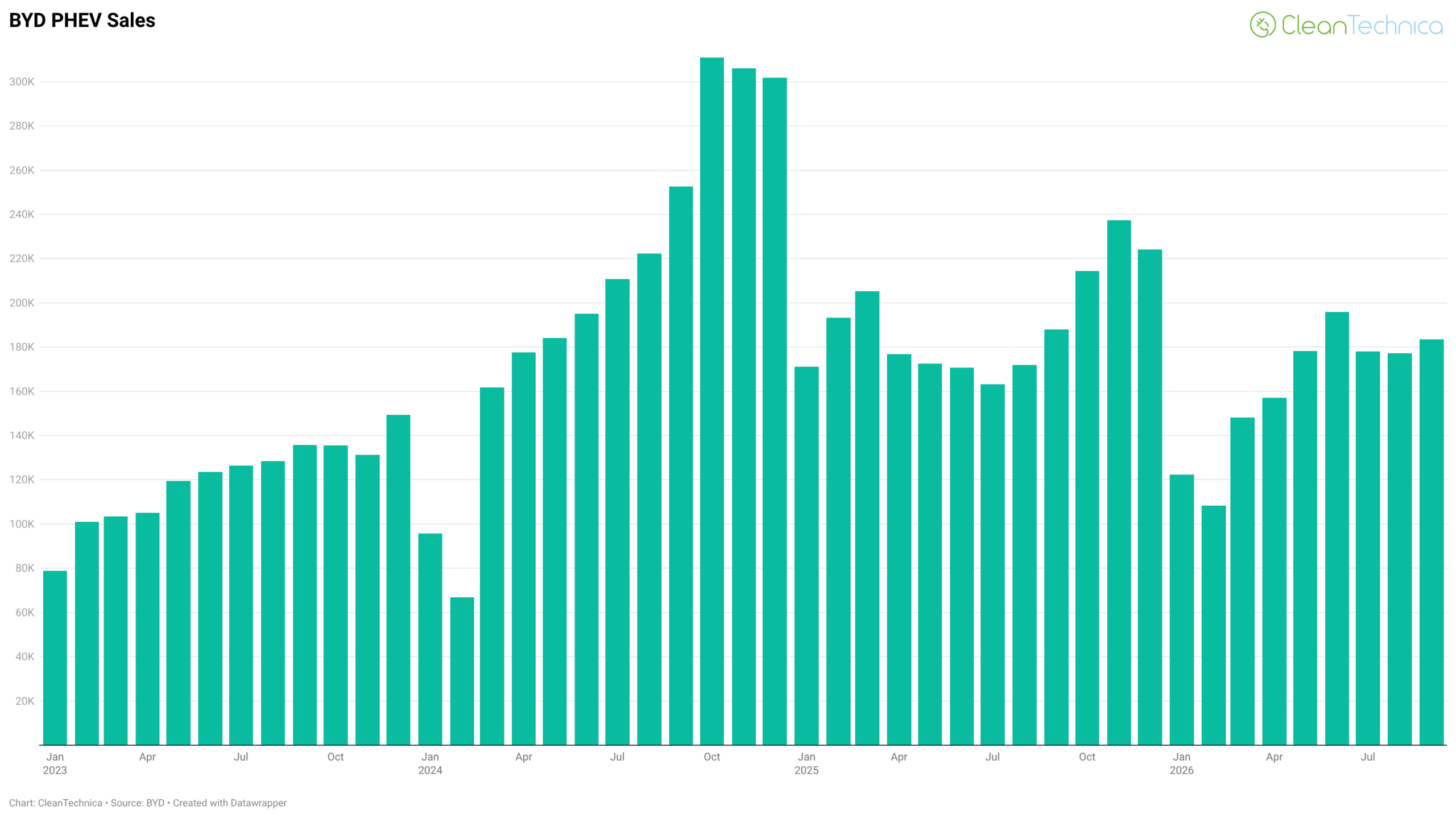
Because BYD’s passenger vehicle lineup is strictly partitioned between BEVs and PHEVs, the exceptional performance of pure electrics stands in stark contrast to the performance of plug-in hybrids. While PHEV sales managed a modest sequential recovery, they suffered on an annual basis.
- September 2026 PHEV Sales: 183,570 units.
- September 2025 PHEV Sales: 188,010 units.
- Year-over-Year Growth: A decline of 2.4%.
- Month-over-Month Growth: A modest recovery of 3.6% compared to August 2026.
The contraction in PHEVs indicates that as charging infrastructure matures, range anxiety diminishes, and BEV price parity approaches, consumers are increasingly bypassing hybrid compromises in favor of dedicated electric platforms.

Supporting Context & Metrics: Year-to-Date Performance Analysis
While monthly snapshots provide immediate tactical insights, examining the broader year-to-date (YTD) performance across the first three quarters of 2026 reveals how BYD is recovering from its slow start earlier in the year.
Nine-Month Aggregate Performance (Q1–Q3)
When aggregating data from January through September, the narrative of recovery becomes strikingly clear.
| Metric | Jan–Sep 2025 | Jan–Sep 2026 | YoY Growth / Decline |
|---|---|---|---|
| Total Passenger Vehicles | 3,218,862 | 3,078,544 | -4.4% |
| Total BEV Deliveries | 1,605,903 | 1,629,957 | +1.5% |
| Total PHEV Deliveries | 1,612,959 | 1,448,587 | -10.2% |
Analyzing the YTD Trajectory
- The Closing Gap: Although total passenger vehicle sales for the first three quarters of 2026 remain down 4.4% compared to the record-setting pace of 2025, the robust performance of late summer—culminating in September’s 456,713 units—is rapidly eroding this deficit.
- BEVs Reach Full-Year Growth: Fully electric vehicles have already crossed into positive territory on an annualized basis. With a 1.5% increase across the first three quarters (moving from 1.605 million to 1.629 million units), BEVs are carrying the growth torch for the brand.
- The PHEV Headwind: Conversely, the 10.2% year-to-date decline in PHEV sales (dropping from 1.612 million to 1.448 million units) highlights a structural market correction. For several years, PHEVs served as a crucial bridge technology for mainstream buyers transitioning away from internal combustion engines (ICE). However, as battery costs decline, energy density improves, and fast-charging networks expand globally, the market is demonstrating a decisive preference for the simplicity and lower total cost of ownership offered by pure BEVs.
Official Statements and Industry Insights
Industry analysts tracking BYD’s Q3 performance point to several strategic pivots that have enabled the company to regain momentum after a sluggish first quarter.
Market observers note that BYD’s aggressive pricing strategies, continuous integration of advanced driver-assistance systems (ADAS), and the rapid rollout of next-generation blade battery technology have revitalized consumer interest. Furthermore, the company’s export strategy—expanding aggressively across Europe, Southeast Asia, Latin America, and the Middle East—has helped offset domestic pricing pressures in the fiercely competitive Chinese domestic market.
While company executives have not yet published a formal quarterly press conference transcript alongside the September figures, internal communications emphasize a steadfast commitment to cost optimization and technological leadership. By streamlining manufacturing lines to prioritize high-margin BEV platforms, BYD is successfully protecting its profitability even as the broader automotive sector navigates macroeconomic headwinds, inflation, and localized trade barriers.
Future Outlook: The Road Ahead for BYD
As BYD enters the final quarter of 2026, the strategic imperative for the company is clear: sustain the explosive momentum generated in September and solidify full-year positive growth across its entire passenger vehicle portfolio.
1. The Death of the Hybrid Bridge?
The persistent decline in PHEV sales—both monthly (-2.4% YoY in September) and year-to-date (-10.2%)—forces a critical question regarding product roadmaps. While PHEVs will likely retain niche appeal in commercial fleets or regions with underdeveloped charging grids, BYD’s long-term valuation and market dominance will increasingly hinge on its BEV architecture. Expect the company to channel a larger share of its R&D budget into pure-electric platforms, solid-state battery research, and ultra-fast charging ecosystems.
2. Global Expansion and Trade Dynamics
BYD’s ability to maintain high-volume delivery growth will depend heavily on navigating international trade policies. With protectionist tariffs and regulatory scrutiny intensifying in key Western markets like the European Union and North America, BYD is accelerating its localization strategy. Establishing overseas manufacturing hubs—such as upcoming production facilities in Europe and South America—will be vital to circumventing import tariffs and sustaining its global delivery trajectory.

3. Closing the 2025 Gap
With a cumulative year-to-date deficit of just 4.4% in overall passenger vehicle sales, a strong fourth quarter characterized by traditional end-of-year car-buying surges could allow BYD to completely erase the gap left by its slow start in early 2026. If September’s pace of over 450,000 monthly deliveries can be sustained or exceeded through October, November, and December, BYD is poised to close out the year with yet another historic annual milestone.
For ongoing, in-depth analyses of the global clean energy and electric vehicle transition, subscribe to CleanTechnica’s weekly and daily newsletters, and follow our continuous coverage of industry-shaping data.



