Robot lawn mowers have firmly transitioned from a futuristic novelty into an indispensable utility for UK gardeners. Offering a welcome, hands-free alternative to traditional petrol and electric lawn mowers, these automated machines are particularly beneficial for gardeners with mobility concerns, homeowners who travel frequently, or anyone simply looking to eliminate routine lawn maintenance chores.
Powered by rechargeable Lithium-ion batteries, modern robotic mowers have evolved past the limitations of traditional boundary cables. While traditional units still rely on perimeter wires to map boundaries and avoid obstacles like flower beds and trees, a new generation of smart mowers utilizes advanced camera arrays, RTK GPS positioning, and LiDAR 3D-mapping technology.
Following weeks of intensive, real-world testing across diverse UK gardens—spanning complex layouts, steep slopes, and variable weather conditions—our expert testing panel has evaluated the market’s leading models. Every mower has been rigorously assessed across key performance metrics, including setup and ease of use, cutting efficiency, battery endurance, obstacle avoidance, and overall value for money.
Detailed Chronology & Market Evolution
The trajectory of automated garden maintenance over recent years has been marked by a rapid shift from manual intervention to complete autonomy.
The Wire-Bound Era (Pre-2023): Early automated lawn care required laborious installation processes, demanding hours of back-breaking work to bury boundary and guide wires around every perimeter, tree, and flower bed.
The Rise of "Drop-and-Mow" (2023–2024): Manufacturers introduced basic camera-and-sensor hybrids (such as the LawnMaster OcuMow series) designed for smaller spaces, completely bypassing the need for perimeter wire installations or complex mobile apps.
Satellite & RTK Integration (2024–2025): Real-Time Kinematic (RTK) positioning systems entered the consumer market, allowing mowers to map a property within centimetres using satellite communication, eliminating wire layouts while maintaining high precision.
The LiDAR & AI Era (2026 and Beyond): The latest wave of autonomous mowers incorporates solid-state LiDAR and AI-enhanced vision software. Devices like the Segway Navimow i208 LiDAR and Mammotion Luba mini 2 AWD represent the pinnacle of this evolution, offering instantaneous mapping, advanced obstacle recognition, and multi-zone customization without external base station antennas.
Supporting Context & Comparative Metrics
To assist buyers in navigating the crowded marketplace, our testing panel categorized top-rated machines by price point, property size, and navigation system. Below is a detailed breakdown of the market’s standout performers based on rigorous hands-on evaluations.
Comparative Specification Matrix
Product
RRP (£)
Rating
Navigation System
Max Lawn Area
Max Slope
Warranty
LawnMaster OcuMow 16
£299.99
4.5/5
Camera & sensors
150m²
19°
2 years
Lawnmaster OcuMow AMB 16-400
£399.99
4.5/5
Camera & sensors
400m²
19°
2 years
Ecovacs GOAT O600
£449
4.5/5
RTK Navigation
600m²
24°
3 years
WORX Landroid Vision Cloud WR303E
£699.99
4.5/5
GPS & cameras
300m²
17°
2 years
Segway Navimow i208 LiDAR
£1,099
4.5/5
GPS, LiDAR & camera
800m²
24°
3 years
Mammotion Luba mini 2 AWD 1000
£1,399
5/5
GPS & camera (AWD)
1,000m²
38°
3 years
Stihl iMOW 5
£1,729
4.8/5
Boundary & guide wires
500m²
22° / 31°
5 years
Top-Rated Category Breakdown
1. Best Under £400: LawnMaster OcuMow AMB 16-400 (£399.99)
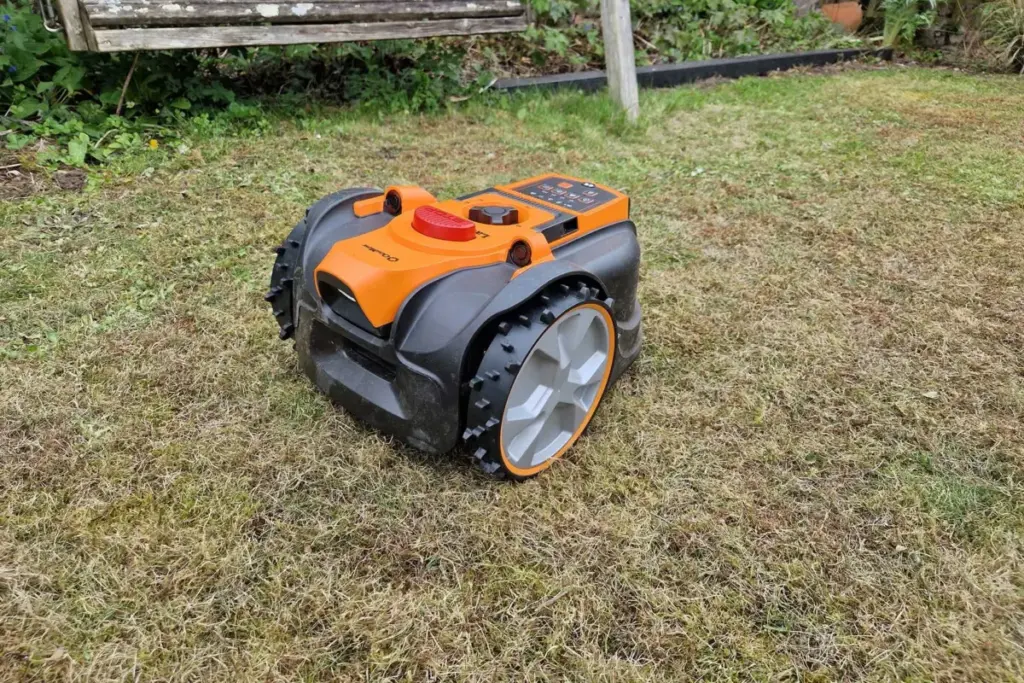
For homeowners seeking an affordable, self-charging entry point into robotics, the LawnMaster OcuMow AMB 16-400 represents exceptional value. Building on the ultra-simple "drop-and-go" philosophy of its predecessor, this model adds an automated charging dock while discarding the need for complex companion apps. Utilizing a central camera and dual ultrasonic sensors, it navigates cleanly within well-defined boundaries and includes magnetic strip options for no-go zones. It handles slopes up to 19° and charges fully in 60 minutes.
2. Best Value for Medium Lawns: Ecovacs GOAT O600 (£449)
Packing professional-grade RTK positioning technology into an accessible price bracket, the Ecovacs GOAT O600 communicates with up to 45 positioning satellites for precise parallel-line navigation. Measuring just 40cm across, it easily threads down 70cm pathways and covers up to 600m². Featuring a floating cutting deck, IPX6 dust and water protection, and integrated live-feed camera patrols via a unified smart home app, it punches well above its weight class.
3. Best for Hilly & Bumpy Ground: Mammotion Luba mini 2 AWD 1000 (£1,399)
For gardens characterized by steep gradients, rough terrain, and complex obstacles, the Mammotion Luba mini 2 AWD is peerless. Equipped with true all-wheel drive, it powers up slopes of up to 38° without slipping. Its standout design features include a dedicated second side cutting disc that guarantees immaculate edge-trimming performance, alongside a tri-camera AI system capable of recognizing hundreds of common lawn hazards like stray toys and garden hoses.
4. Best Traditional Option: Stihl iMOW 5 (£1,729)
Gardeners who prefer the fail-safe reliability of physical perimeter wires will find the Stihl iMOW 5 to be a masterclass in performance. Rated 4.8 out of 5, it covers complex layouts up to 500m² (expandable via upgrade kits) and tackles 22° slopes with ease. Supported by a comprehensive 5-year warranty, it features a weather-responsive rain sensor, a secure anti-theft alarm, and three free-swinging cutting blades that leave a pristine finish.
Official Industry Insights & Expert Testing Methodology
The evaluation process implemented by the reviews team relies on standardized, long-term testing protocols. Every unit is deployed in active residential gardens for a minimum of several weeks to assess authentic operational challenges, including variable British weather, high seasonal grass growth, and hidden lawn obstacles.
According to Oliver Parsons, Strategic Projects Editor:
"To help you find a robot lawn mower suitable for your garden, we tested a range of mowers for different size gardens, including gardens with slopes and complex shapes. Each mower is in use for weeks at a time to allow us to assess battery capacity, cutting proficiency, and ease of use. From 2026, you’ll only see newly awarded Best Buy badges on robotic mowers that score 4.5 out of 5 or higher."
Testing parameters are weighted equally across four core criteria:
Set-Up and Usability: Evaluating software intuitiveness, mapping speed, physical assembly, and auxiliary controls.
Extra Features: Factoring in obstacle avoidance reliability, security protocols (PIN codes, geofencing), wet-weather sensors, and smart-home integration.
Value for Money: Balancing retail purchase price against core capabilities, build quality, and warranty length.
Future Outlook & Consumer Guidance
As artificial intelligence and sensor technology continue to mature, the robot lawn mower market is projected to see several key trends over the coming years:
Total Elimination of Manual Infrastructure: The industry is moving rapidly toward fully vision-based and LiDAR-guided systems, effectively phasing out physical boundary wires and external RTK antennas.
Enhanced Energy Management: Future software integrations will increasingly coordinate charging cycles with off-peak, green-energy tariffs to minimize household electricity costs.
Biodiversity-Friendly Automation: Advanced software applications are introducing dynamic height zones, empowering users to seamlessly alternate between pristine formal lawns and designated uncut wildflower meadows to support local ecosystems.
Buyer’s Checklist Before Purchase
Before investing in an autonomous mower, consumers should carefully consider the following structural factors:
Lawn Layout & Access: Measure narrow gateways and pathways to ensure clearance compatibility (many mid-to-large mowers require at least 1m of lateral clearance).
Docking Station Placement: Ensure you have access to an outdoor power socket situated on flat, shaded ground with clear approach lines.
Terrain Severity: Calculate maximum slope angles and soil compaction levels to determine whether standard two-wheel-drive systems or heavy-duty all-wheel-drive units are required.