Executive Overview
Two thousand years ago, an inquisitive Roman commander witnessed a terrifying meteorological anomaly over the Bay of Naples that would forever alter our understanding of the natural world and cost him his life. Today, that fateful event—the catastrophic eruption of Mount Vesuvius in AD 79—serves as the dramatic backdrop for a modern milestone in digital preservation: the 20th anniversary of the Biodiversity Heritage Library (BHL).
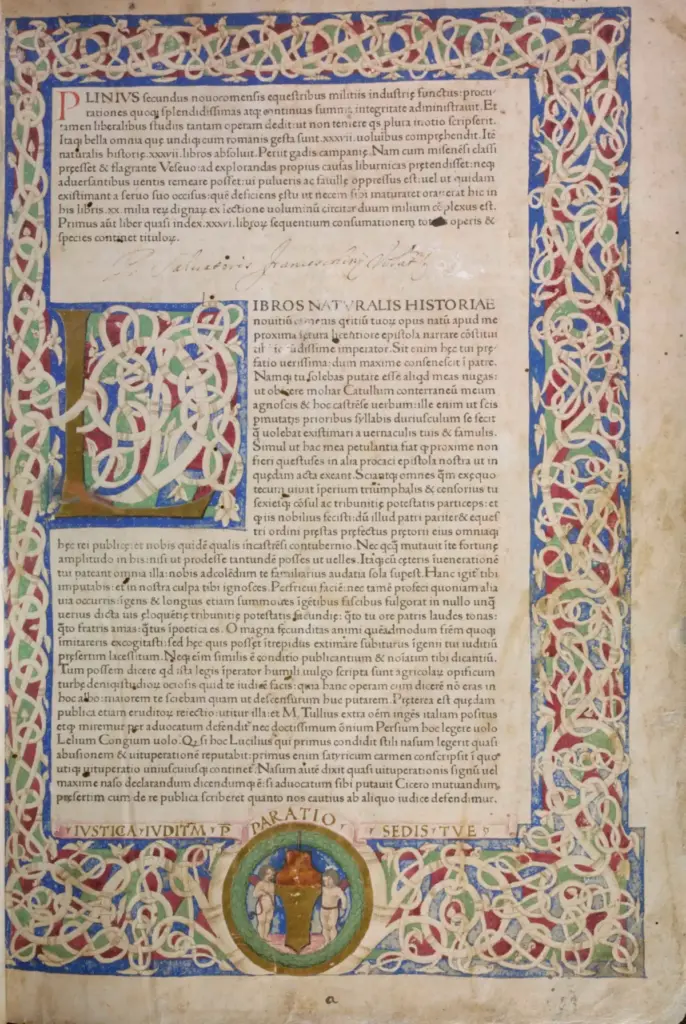
As part of the ongoing celebratory series BHL at 20: Treasures from the Biodiversity Heritage Library, institutions worldwide are spotlighting the crown jewels of their collective holdings. Among them, the Natural History Museum (NHM) in London stands out for housing one of the most historically significant artifacts in the digital repository: a remarkably preserved, first-edition copy of Pliny the Elder’s Natural History (Historia Naturalis), printed in Venice by Johann de Speyer in 1469.
This article examines the intersections of ancient Roman scholarship, the dawn of movable-type printing, and modern digital library infrastructure. By tracing the journey of Pliny’s masterwork from its classical conception to its current home within the BHL’s globally accessible database, we explore how humanity has continuously sought to catalog, preserve, and democratize knowledge of the natural world.
Detailed Chronology: From Vesuvius to the Printing Press
The Cataclysm of AD 79
On a hazy afternoon in the late summer of AD 79, a family estate overlooking the glistening waters of the Bay of Naples became ground zero for one of history’s most infamous natural disasters. Seventeen-year-old Pliny the Younger and his mother, Plinia, observed a peculiar and ominous cloud rising in the distance. Described by the teenager as resembling a Mediterranean pine tree—featuring a slender trunk branching out into a sprawling canopy—the phenomenon was, in modern terms, a classic pyroclastic surge and mushroom cloud generated by the eruption of Mount Vesuvius.

Rushing indoors, Pliny the Younger alerted his uncle and adoptive father, Gaius Plinius Secundus—better known to history as Pliny the Elder. Serving as the Admiral of the Roman Fleet stationed at Misenum, the elder Pliny was a polymath of legendary curiosity. Unfazed by the potential danger, and driven by an insatiable thirst for scientific observation, he immediately ordered his fleet into action. What began as a scholarly pursuit to witness a rare natural event firsthand quickly morphed into a desperate maritime rescue mission across the collapsing coastline.
Sailing toward the danger zone near Stabiae, Pliny the Elder succumbed to the toxic fumes, particulate matter, and intense heat of the eruption—or perhaps suffered a fatal cardiac event triggered by the exertion. While he perished on the ash-choked shores, his legacy was secured for posterity through the surviving eyewitness accounts penned by his nephew in letters addressed to the historian Tacitus.
The Monumental Natural History
While Pliny the Elder’s military histories, treatises on cavalry tactics, and linguistic guides are lost to time, his magnum opus endured. The Natural History (Historia Naturalis) is a colossal compendium divided into thirty-seven books. Published posthumously, likely around AD 77–79 with ongoing circulation, the work represents an unprecedented effort to capture the sum total of human knowledge regarding the physical world.
Spanning subjects as diverse as astronomy, geography, zoology, botany, mineralogy, and horticulture, the Natural History was treated by subsequent generations as the ultimate authority on the natural order. Modern scholars, however, argue against hastily categorizing it as merely the world’s first encyclopedia. Unlike later reference tools, Pliny was not drawing upon an established tradition of lexicography; rather, his project was an imperial undertaking. By synthesizing an estimated 20,000 distinct pieces of information collected from hundreds of sources, Pliny sought to claim the natural world for Rome, mapping the physical empire through the sheer breadth of its documented phenomena.

The Incunabula Era: Printing Pliny
Long before the advent of digital repositories, the survival of Pliny’s text depended on the painstaking labor of medieval scribes. By the middle of the fifteenth century, roughly two hundred manuscript copies of the Natural History remained in circulation across Europe.
The invention of the printing press by Johannes Gutenberg in the 1450s revolutionized the dissemination of these texts. Recognizing the commercial viability of classical literature among Europe’s intellectual elite, the Venetian Senate granted Johann de Speyer a commercial printing monopoly in 1469. De Speyer selected Pliny’s Natural History as one of his inaugural printing projects, producing a luxury edition designed to emulate the prestige of hand-copied manuscripts.
De Speyer’s 1469 edition—features that include wide margins, generous spacing, and illuminated capitals—was crafted for wealthy patrons who expected books to double as status symbols. Crucially, those expansive margins invited annotation. In the NHM copy, marginalia inscribed by at least two distinct historical readers reveal how scholars actively engaged with, corrected, and navigated the massive text centuries after its printing.
Supporting Context & Metrics: The BHL Ecosystem
The Biodiversity Heritage Library has transformed how researchers access historical literature. As the world’s largest open-access digital literature repository for biodiversity-related heritage, BHL operates through a global consortium of natural history libraries, botanical gardens, and research institutions.

Incunabula Holdings within the BHL Network
Books printed before January 1, 1501, are classified as incunabula (from the Latin for "cradle," signifying the infancy of printing). The BHL platform hosts several rare incunabula editions of Pliny’s Natural History, representing a transnational network of preservation:
- 1469 Edition (Venice): Printed by Johann de Speyer, contributed to the BHL by the Natural History Museum, London. This volume holds the distinction of being the oldest book digitized within the BHL’s core collection framework.
- 1472 Edition (Venice): Contributed jointly by the Boston Public Library and the Natural History Museum, London.
- 1473 Edition (Rome): Contributed by McGill University Library.
- 1481 Edition (Parma): Contributed by McGill University Library and held in parallel collections by the NHM.
- 1497 Edition (Venice): Contributed by McGill University Library.
- Later Vernacular Milestones: Including vernacular benchmarks such as Philemon Holland’s celebrated 1601 English translation, also preserved within the NHM holdings.
The 1469 NHM Copy: A Miracle of Survival
Bibliographic assessments of the NHM’s 1469 de Speyer edition indicate that only about one hundred copies of this specific print run were ever produced. Historical notes inscribed on the flyleaf describe the volume as having been thoroughly "collated" and verified as "perfect, which is almost a miracle" for a text of its vintage.
Although modern conservation analysis reveals that two facsimile folios were expertly integrated at a later date to replace missing pages, the artifact remains an astonishing monument to early printing technology and Renaissance scholarship.
Official Statements and Community Reflections
The significance of these rare materials was a central theme at the recent BHL Annual Meeting hosted in London. Delegates and international scholars gathered not only to assess two decades of digital archiving success but also to examine physical treasures like the NHM’s 1469 Pliny firsthand.

Reflecting on the shifting milestones of the digital library, curators noted the dynamic nature of archival tracking. While the NHM Pliny was long celebrated as the single oldest item hosted within the BHL ecosystem, recent digitization efforts have expanded the library’s temporal boundaries. As highlighted in preceding institutional announcements, the baton for the oldest item on BHL has recently passed to a copy of Circa Instans—a foundational 12th-century pharmacological text—housed at the LuEsther T. Mertz Library of the New York Botanical Garden and newly integrated into the digital catalog.
Scholars at the conference emphasized that these shifts illustrate the robust, ever-expanding health of the BHL network. Rather than static monuments, digital heritage libraries represent dynamic ecosystems where historical recovery is an ongoing, daily pursuit.
Future Outlook: Open Access and the Next Generation of Biodiversity Science
As the Biodiversity Heritage Library marks its 20th anniversary, its mission remains strikingly aligned with the foundational impulses of Pliny the Elder: to gather, synthesize, and disseminate all available knowledge regarding the natural world so that it may benefit society at large.
However, where Pliny’s Natural History was designed as an imperial project to claim knowledge for Rome, the BHL operates as a profoundly democratic enterprise. By leveraging modern digital imaging, optical character recognition (OCR), and global cloud infrastructure, the consortium has liberated millions of pages of legacy scientific literature from the physical confines of climate-controlled rare book rooms.

Looking forward, the challenge for the BHL and its partner institutions is twofold: ensuring the long-term digital preservation of aging file formats while actively expanding access to underrepresented regional archives across the Global South. As computational tools such as artificial intelligence and machine learning begin to parse centuries of historical natural history illustrations and descriptive text, digitized incunabula like de Speyer’s 1469 Pliny are finding new life as training datasets for modern ecological research.
Two millennia after Pliny the Elder gazed upward at the apocalyptic ash plume over Pompeii, his written observations—and the physical manifestations of his intellect printed by fifteenth-century artisans—continue to illuminate our understanding of Earth. Through the ongoing stewardship of the Biodiversity Heritage Library, these irreplaceable treasures remain open, searchable, and alive for generations of scientists, historians, and curious minds yet to come.