Executive Overview
On June 24, Ed Darmanin rolled out of Sydney with a single-minded vision: navigate 18,000 grueling kilometers around the perimeter of the Australian continent anti-clockwise on an electric motorcycle, entirely unassisted by a support vehicle. Eight weeks and more than 9,000 kilometers later, Darmanin has pushed past Broome, conquering the punishing topography of the tropical north, dodging rogue livestock on the Stuart Highway, managing extreme thermal throttling, and forging an accidental digital community numbering in the hundreds of thousands.
Darmanin’s journey—undertaken on an Energica Experia—is far more than a stunt. It serves as a rigorous, real-world stress test of electric vehicle (EV) touring capabilities in some of the most unforgiving environments on Earth. From structural chassis failures in rural Queensland to off-grid solar-canopy charging arrays in the Northern Territory, Darmanin’s odyssey provides a vital snapshot of how modern electric mobility interacts with remote-area infrastructure.
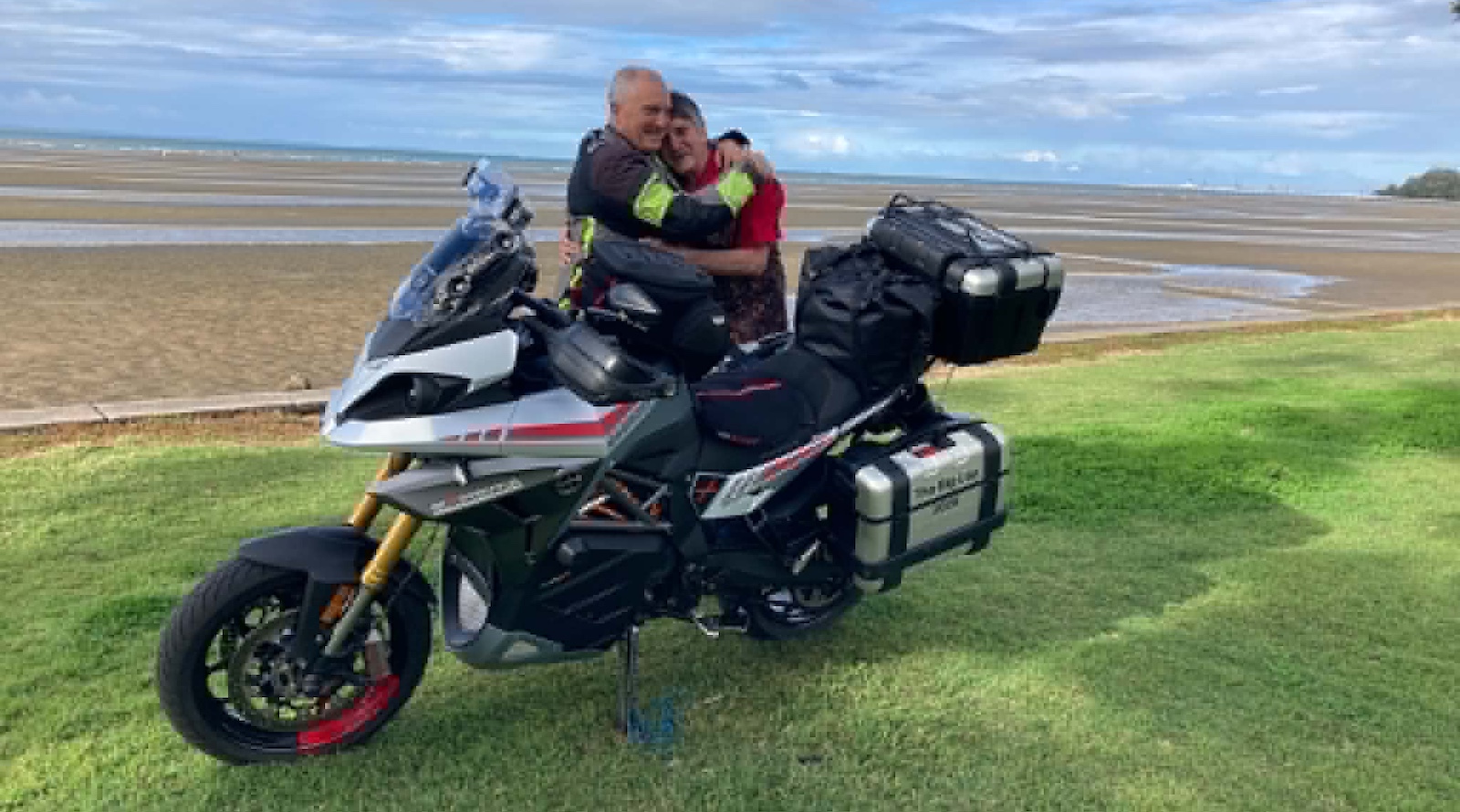
While critics frequently point to the tyranny of distance and sparse charging networks as insurmountable barriers for electric two-wheelers, Darmanin’s expedition illustrates a nuanced reality: the technology is fundamentally viable, though its success relies heavily on creative problem-solving, mechanical improvisation, and the burgeoning camaraderie of the global EV community.
Detailed Chronology: From Sydney to the Kimberley
Phase One: The East Coast and Early Mechanical Trials
Departing Sydney, Darmanin planned for the usual variables of long-distance motorcycle touring: weather, tire wear, and rider fatigue. What he did not factor in was a structural fatigue failure only 1,300 kilometers into the ride. Near Biloela in Queensland, a routine pre-trip inspection revealed a cracked top rail on the rear subframe.

A potential trip-ending disaster was averted through classic Aussie resourcefulness. Armed with a temporary, rough-hewn steel brace sourced from a local hardware store, Darmanin made it to Yeppoon for a scheduled public speaking engagement. The following morning, the local Coast Guard building was transformed into an impromptu workshop. Assisted by locals Arthur Hunt and Phil Nash, Darmanin stripped the rear end of the Experia, rushed the subframe to a local welder, and reinforced both rails with solid steel bars. By nightfall, the motorcycle’s chassis was structurally sounder than it had been when it rolled out of the factory in Sydney.
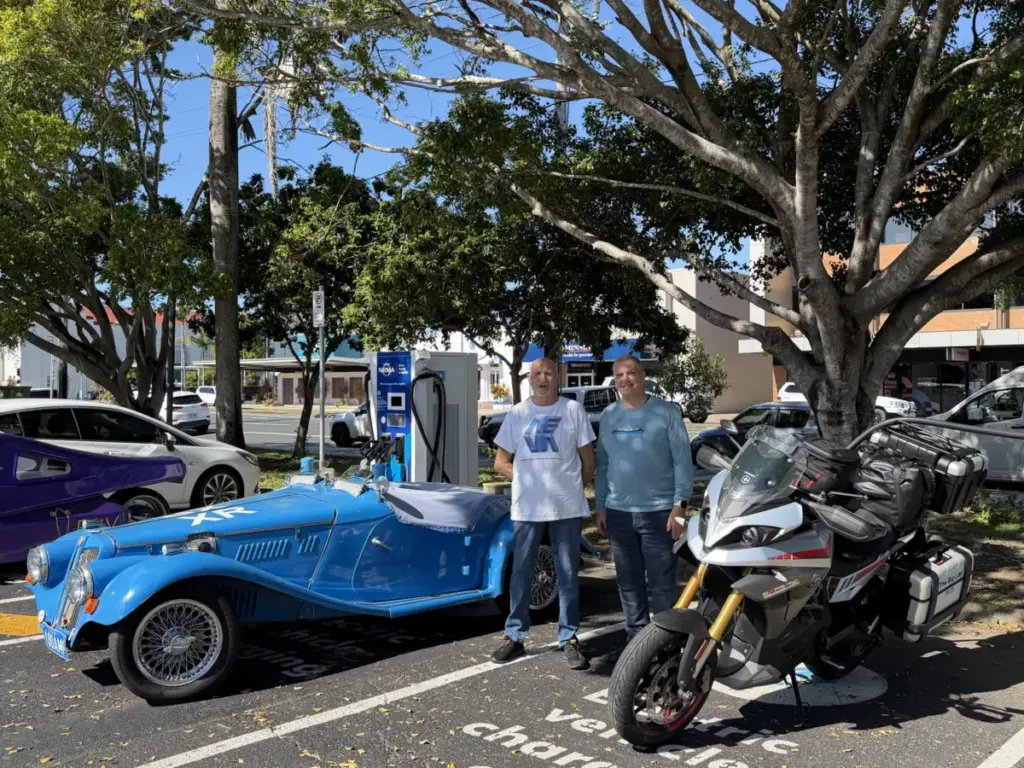
Shortly after the repair in Mackay, Darmanin experienced a profound passing of the torch. Through Arthur Hunt’s quiet coordination, Glenn George—the historic pioneer who became the first person to drive an EV around Australia in 2011 using a self-converted 1950s MG—was waiting at a public charging station. Eerily, George was 67 years old when he completed his landmark journey; Darmanin will be 67 when he finishes his. Joined by local EV enthusiast Trevor Richards, who arrived with a packed lunch, the three men stood beside the charger for an hour, bridging a 15-year generational gap in Australian electric vehicle history.

Phase Two: The Gulf Country and AC Improvisation
Moving past Cairns, Section 3 of the journey plunged Darmanin and his son Evan—who joined for a 1,200-kilometer pillion stretch—into Queensland’s Gulf Country toward Mount Isa. This leg featured zero DC fast chargers. Every kilowatt-hour had to be harvested via AC connections: caravan park power points, hotel wall sockets, and a 15-amp feed at a Georgetown caravan park while father and son played nine holes of golf to pass the time.
Compounding the challenge, Darmanin discovered mid-section that his trip computer had been under-reading distances due to a modified front drive sprocket. This calibration quirk meant their range calculations carried an uncounted 0.5 kWh/100km buffer—a razor-thin margin that proved critical while navigating the remote expanses of the Gulf.

Phase Three: The Northern Territory and Thermal Throttling
Entering the Northern Territory, Darmanin faced a combination of high-speed transit and punishing ambient temperatures. Cruising at 130 km/h toward Katherine, the Experia consumed battery capacity at an aggressive rate.
This high-speed depletion triggered a secondary bottleneck: thermal management. In 35-degree Celsius (95°F) heat, the battery pack retained excessive residual heat from fast-charging sessions. At Adelaide River, the battery management system (BMS) intentionally throttled incoming DC fast-charging speeds to protect the battery chemistry, stretching a routine charging stop to over an hour. It was a masterclass in how ambient climate directly impacts EV charging physics.

Phase Four: Solo Through the Kimberley
Transitioning to solo riding from Mount Isa, Darmanin encountered the isolated stretches of Western Australia’s Kimberley region. Infrastructure reliability proved spotty. At Warnum, a Chargefox charging unit cut out five consecutive times mid-session (stopping at 42%, 50%, 70%, 80%, and finally 95%), while automated phone support blamed Darmanin’s credit card rather than acknowledging local network faults—an issue corroborated by other users on PlugShare.
At Fitzroy Crossing, Darmanin—a licensed electrician—built a custom adapter to draw power directly from a 3-phase industrial socket parked alongside the local fuel bowser. At Timber Creek and Willare Bridge, hotel verandas and standard power points served as temporary life support.

Supporting Context & Infrastructure Metrics
Darmanin’s journey highlights a stark bifurcation in Australia’s EV charging ecosystem. Along the eastern seaboard from Sydney to Cairns, the network is robust, predictable, and rarely demands improvisation. However, deep regional corridors require careful calculation and an openness to alternative charging methodologies.
Two standout installations point the way toward the future of remote-area EV infrastructure:

- Victoria River (Northern Territory): A state-of-the-art NRMA off-grid solar canopy featuring two DC chargers and four CCS2 plugs. Completely independent of the local roadhouse power grid, the system combines solar generation, massive onsite battery storage, and a backup diesel generator that reportedly runs less than one percent of the time. Darmanin describes it as the most scalable model for remote EV deployment he has encountered.
- Ngumban Cliff (Kimberley, WA): Situated along a punishing stretch of highway with no other services for 100 to 200 kilometers in either direction, this ground-mounted solar array and fast charger operates autonomously via localized battery storage and a standby backup generator.
These installations decouple EV charging from traditional fossil-fuel or distant coal-fired grid constraints, proving that zero-emission transport is entirely feasible in the Australian outback.
Official Statements and Social Media Phenomenon
What began as a personal technical experiment quickly evolved into an unexpected viral phenomenon. Darmanin’s updates generated nearly 500,000 combined views across Facebook and Instagram, pulling in international coverage from Hungarian motorcycle magazines, UK electric vehicle publications, and European mobility outlets like The Pack News.

Paradoxically, the posts that drove the highest engagement were not cinematic drone shots of pristine landscapes, but raw, unfiltered accounts of adversity. A 30-second selfie video filmed in front of an offline fast charger on a 290-kilometer WA highway—detailing the exact problem and how Darmanin planned to fix it—racked up over 52,000 views and 112 comments within 14 hours.
When online trolls questioned the practicality of electric motorcycles in the outback, Darmanin found himself shielded by an organic, self-sustaining digital community. Engineers, touring veterans, and fellow EV owners routinely jumped into the comment sections at all hours to defend the data and debate technical merits, occasionally prompting Darmanin to deploy artificial intelligence (Claude AI) simply to manage and block persistent bad-faith actors.

Future Outlook: The Road Home
As Darmanin links up with his wife, Sally, in Broome for the fifth leg of the journey, the hardest geographical obstacles of the tropical north—the Kimberley, the Gulf Country, and the high-speed Top End tracks—are firmly in the rearview mirror.
Ahead lies the sweeping Western Australian coastline, the formidable crossing of the Nullarbor Plain, and the final 5,000 kilometers home to Sydney.

Ed Darmanin’s expedition has moved the electric vehicle conversation out of theoretical lecture halls and Reddit forums and onto 9,000 kilometers of punishing asphalt, corrugations, and red dirt. By proving that an electric motorcycle can survive the extremes of the Australian continent with nothing more than mechanical grit, community support, and a licensed electrician’s tool bag, Darmanin isn’t just completing a "Big Lap"—he is blazing a trail for the future of global adventure touring.