

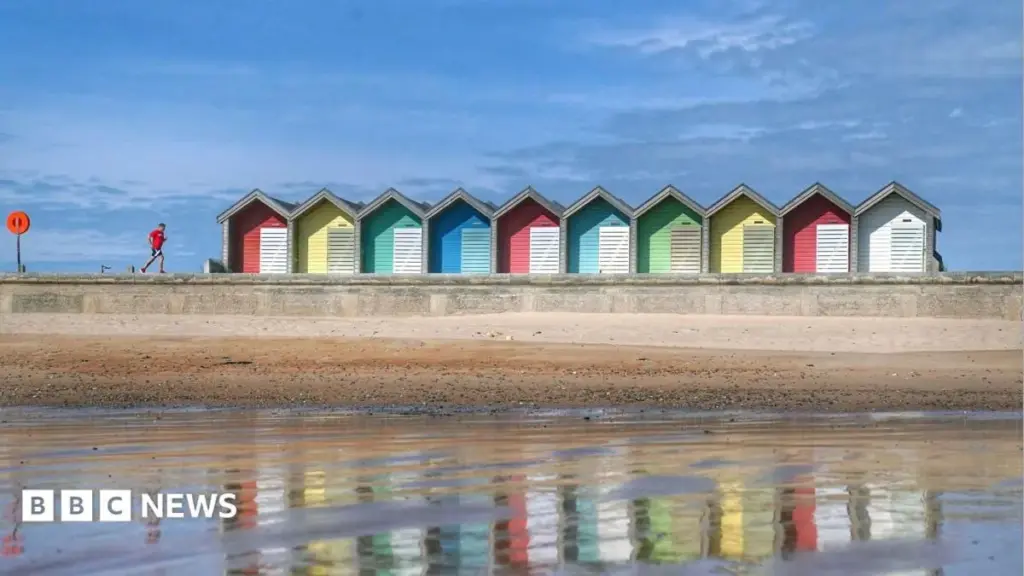
Executive Overview
Blyth South Beach in Northumberland remains the focus of an ongoing multi-agency environmental investigation after laboratory tests confirmed the presence of hazardous creosote seeping into the sand and coastal waters. Originally flagged in August following public reports of an overwhelming fuel-like odor and viscous, oil-like slicks washing ashore, the contamination has now been officially traced back to legacy industrial activity that ceased more than four decades ago.
Local authorities, alongside national environmental regulators and port officials, have maintained strict access restrictions along a designated stretch of the coastline situated between the Blyth West Pier and the Dave Stephens Centre. While public health officials maintain that the immediate risk to human health remains low, the discovery has triggered an extensive remediation effort. Officials have explicitly warned residents, beachgoers, and pet owners to avoid the affected zone entirely until further notice. The incident highlights the enduring environmental legacy of Britain’s industrial past, demonstrating how long-dormant chemical residues can re-emerge to threaten modern recreational spaces and coastal ecosystems.
Detailed Chronology of the Incident
Initial Reports and Public Alarms (August)
The sequence of events leading to the current environmental advisory began in late summer, when beachgoers and local residents in Northumberland reported unusual environmental conditions at Blyth South Beach. Observers noted a pungent, chemical odor resembling diesel or heavy fuel oil hanging heavily in the air, accompanied by dark, oily patches visible on the sand and within the shallow intertidal zone.
Prompted by mounting public concern and potential health hazards, local authorities acted swiftly in August, issuing preliminary warnings advising the public against swimming or bathing in the affected coastal waters. At that stage, the exact nature, source, and toxicity of the pollutant remained unknown, prompting immediate coordination between the Northumberland County Council, the Environment Agency (EA), and the Port of Blyth to launch a comprehensive pollution investigation.
Laboratory Analysis and Source Identification
In the weeks following the initial alert, environmental scientists collected numerous samples of the contaminated sand, water, and oily residue for forensic laboratory analysis. The results conclusively identified the substance as creosote—a complex mixture of derived chemicals typically used as a wood preservative.
Subsequent historical and geographical investigations conducted by Northumberland County Council revealed the likely origin of the pollutant: an ex-timber treatment works that had operated on industrial land directly adjacent to the affected beach. Although this facility ceased operations around 1980, residual chemicals appear to have remained trapped within the underlying soil and strata for over forty years, ultimately finding a pathway to the surface.
Containment and Ongoing Restrictions
Following the identification of the pollutant, Environment Agency investigators mapped the precise footprint of the contamination. Findings indicate that the pollution is largely contained within a specific, localized area of the beach near a local landmark known as the "Hole in the Wall."
In this zone, contaminated groundwater is actively seeping through the subsurface strata and emerging onto the beach sand. To mitigate exposure risks, regulatory bodies have maintained cordons and strict public access restrictions across the affected coastal stretch, prohibiting recreational bathing, paddling, and direct contact with the sand and water.
Supporting Context & Metrics: Understanding Creosote and Industrial Legacy
What is Creosote?
Creosote is a heavily carbonaceous chemical mixture created by the high-temperature distillation of tar, most commonly from coal. Historically valued for its exceptional preservative qualities, it has been widely used globally for more than a century to treat railway sleepers, utility poles, marine pilings, and structural timber to prevent rot, fungal decay, and insect infestation.
The substance is a complex cocktail comprising hundreds of distinct chemical compounds, predominantly polycyclic aromatic hydrocarbons (PAHs), phenols, and cresols. While highly effective at extending the lifespan of industrial wood products, creosote is recognized as a persistent environmental pollutant. Its chemical constituents can be toxic to aquatic life, fish, and macroinvertebrates, and prolonged dermal contact or ingestion can pose health risks to humans and animals.
The Challenge of Legacy Industrial Sites
The situation at Blyth South Beach underscores a broader, systemic challenge facing post-industrial nations: the management of contaminated land from the 19th and 20th centuries. Before modern environmental legislation—such as the Control of Pollution Act 1974 and the Environment Act 1995—industrial practices often lacked today’s stringent waste disposal and containment protocols.
Thousands of former gasworks, chemical plants, tanneries, and timber treatment yards across the United Kingdom occupy coastal or riverfront locations chosen historically for ease of transport and water access. Over decades, buried chemical residues can migrate through subsurface hydrological pathways. Changes in water tables, coastal erosion, or extreme weather events can destabilize these trapped pollutants, causing them to breach the surface unexpectedly, as observed at Blyth.
Impact on Local Wildlife and Domestic Pets
While public health assessments indicate that the general risk to human health is low—largely due to prompt access restrictions and the localized nature of the seepage—authorities have placed special emphasis on the protection of domestic animals.
Dogs are particularly vulnerable to chemical contamination on beaches because they are prone to licking their fur after contact with polluted sand or water, or ingesting toxic residues directly. Ingesting creosote can lead to severe gastrointestinal upset, chemical burns in the mouth and throat, and systemic toxicity. Environmental protection officers have therefore urged dog walkers to exercise extreme vigilance, keeping their pets on tight leashes or entirely away from the restricted zone between the Blyth West Pier and the Dave Stephens Centre.
Official Statements and Inter-Agency Response
Northumberland County Council
Local government leadership has emphasized transparency and inter-agency collaboration throughout the remediation process. A spokesperson for Northumberland County Council outlined the ongoing efforts to address the historical pollution source:
"Laboratory tests have now confirmed the substance as creosote, and our investigative work strongly points toward legacy operations from a former timber treatment works that ceased functioning around 1980. While the public health risk is currently assessed as low, we are not taking any chances. We are working hand-in-hand with the Environment Agency and the Port of Blyth to contain the spread, protect local wildlife and domestic pets, and map out a comprehensive clean-up strategy for the affected section of the beach near the Hole in the Wall."
The council has reiterated that while the majority of Blyth South Beach remains safe for public enjoyment, visitors must strictly respect the boundary markers and warning signs established in the hazard zone.
The Environment Agency (EA)
The Environment Agency, which leads on environmental protection and pollution regulation in England, detailed the geological and hydrological mechanisms driving the incident. An EA representative explained:
"Our technical teams have conducted extensive hydrological and soil testing at the site. We have established that the creosote is currently contained within a specific pocket of the beach near the Hole in the Wall. The contamination is migrating via subsurface groundwater pathways, slowly seeping upward through the sand layers. Our priority is to monitor this movement, prevent wider dispersion into the marine environment, and support the local authority in executing a safe, thorough remediation of the affected strata."
Port of Blyth Collaboration
Given the coastal and estuarine geography of the region, the Port of Blyth has played an integral role in coordinating the emergency response. Port authorities have assisted with maritime access, environmental monitoring, and logistical support for field teams operating along the shoreline. Maritime officials have confirmed that commercial shipping lanes and port operations remain unaffected by the localized beach pollution, though monitoring of local marine water quality continues unabated.
Future Outlook: The Road to Remediation
Assessing the Scope of the Clean-Up
As autumn transitions into winter, local authorities and environmental experts are turning their attention to the long-term remediation phase. While officials have not yet provided a definitive timeline for the completion of the clean-up operation, initial technical assessments describe the endeavor as a "significant" piece of engineering and environmental remediation work.
Unlike surface-level pollution—which can often be cleared rapidly using mechanical beach-cleaning equipment or manual litter collection—subsurface groundwater contamination involving viscous chemicals like creosote requires specialized intervention. Engineers must devise strategies to intercept the contaminated groundwater flow, excavate affected sand and soil strata safely without destabilizing the coastline, and properly dispose of hazardous waste at licensed facilities.
Monitoring and Long-Term Mitigation
Looking ahead, the Blyth South Beach incident serves as a stark reminder of the vigilance required to manage historical industrial footprints in coastal zones. Once the immediate clean-up is completed, the Environment Agency and Northumberland County Council are expected to implement long-term monitoring wells and soil testing protocols around the former timber treatment site to ensure that no further pockets of creosote remain hidden beneath the surface.
For the residents of Northumberland and regular visitors to Blyth South Beach, the return to complete normalcy will depend on the successful execution of these complex engineering works. Until authorities officially declare the area safe and lift the restrictions between the Blyth West Pier and the Dave Stephens Centre, the public is urged to heed all warning notices, protect their pets, and cooperate fully with the ongoing environmental recovery operation.



