Executive Overview
The global transition toward a decarbonized industrial economy has placed clean hydrogen at the vanguard of future energy systems. Among the various production pathways, methane thermolysis—frequently referred to as methane pyrolysis—has emerged as one of the most technologically elegant and environmentally promising alternatives. By utilizing heat rather than open flames to thermally split methane molecules ($textCH_4$), this process yields clean hydrogen gas alongside solid carbon instead of the concentrated carbon dioxide ($textCO_2$) streams associated with traditional fossil-based production or the complex capture-and-storage infrastructure required for "blue" hydrogen.
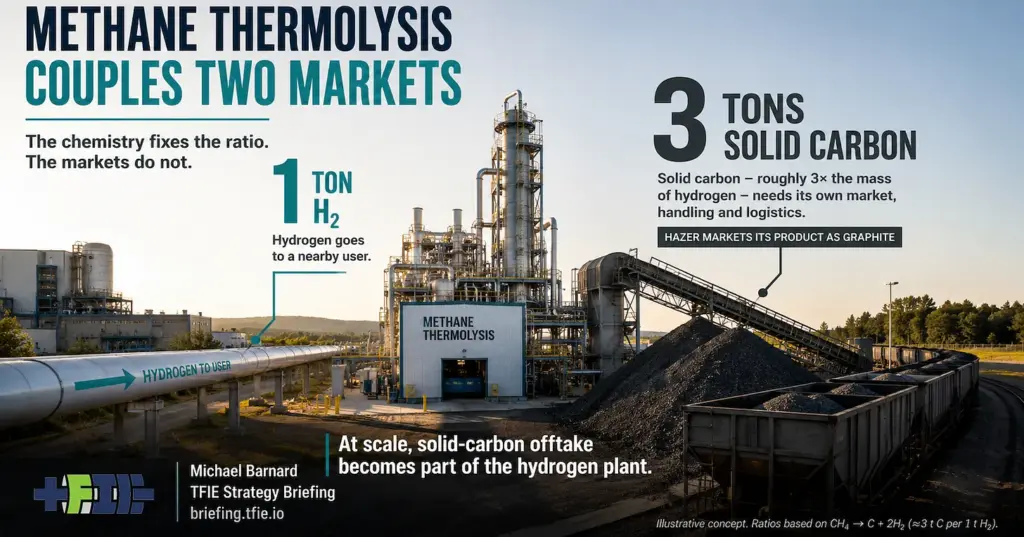
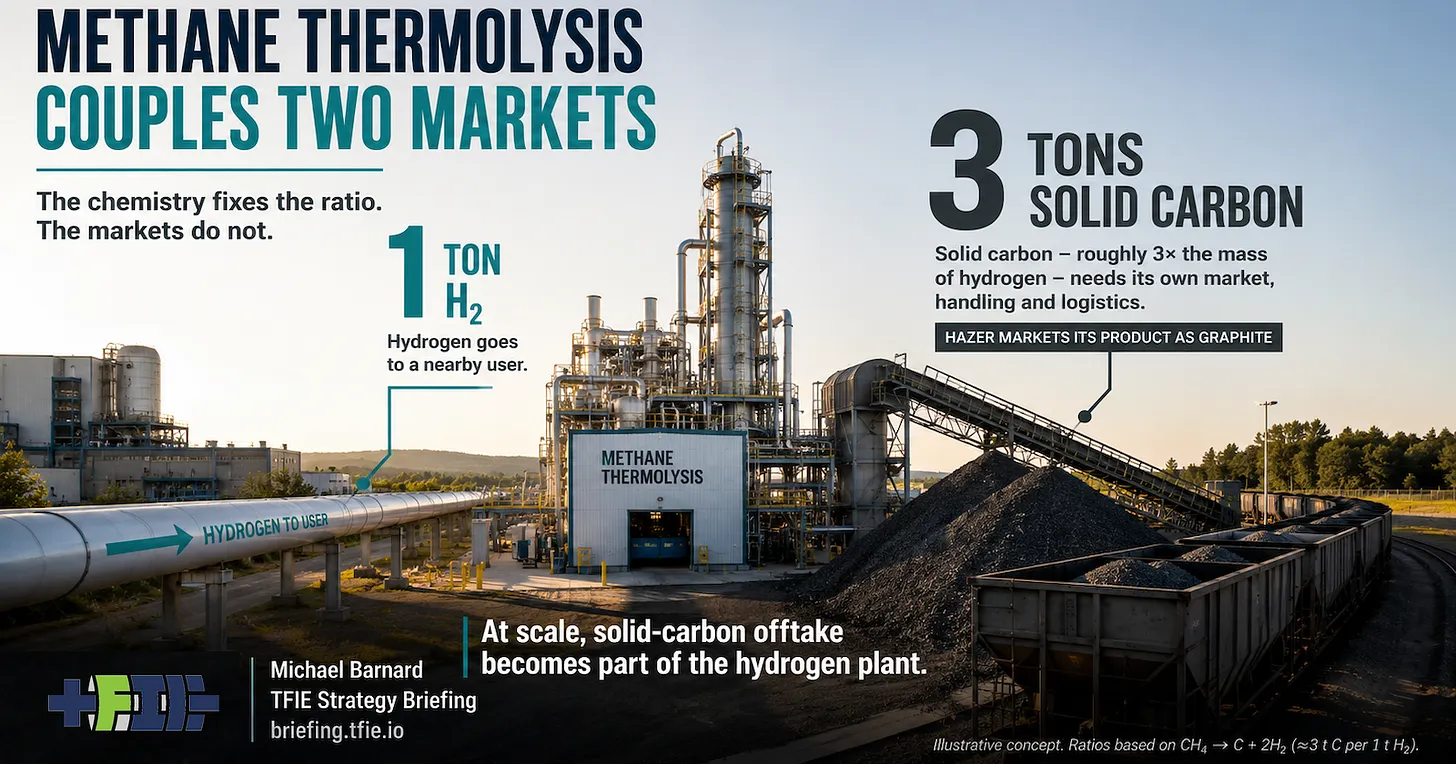
Yet, beneath the apparent simplicity of this chemical equation lies a stark, mathematically unavoidable reality: the mass balance. For every single tonne of hydrogen produced, the thermolysis process simultaneously generates approximately three tonnes of solid carbon byproduct. When scaled to meet heavy industrial demand, this ratio creates an overwhelming logistical and market paradox.
A rigorous analysis of industrial-scale operations reveals that even the most seemingly ideal end-use pairings—such as supplying hydrogen to a massive green steelworks operating via direct reduced iron (DRI)—fall radically short of absorbing the sheer volume of solid carbon generated. In a hypothetical facility mirroring the scale of modern green steel operations, roughly 80% to 90% of the resulting graphitic carbon would have no immediate internal sink and would be forced to find external buyers in crowded, highly competitive global markets.
This structural mismatch exposes a fundamental vulnerability in how the energy transition is modeled. Conventional carbon producers adjust output dynamically in response to market demand; methane thermolysis does the exact reverse. Hydrogen demand dictates carbon production, irrespective of whether the market actually needs millions of additional tonnes of graphite, carbon black, or soot. Consequently, investors, engineers, and policymakers can no longer treat the solid carbon stream as a secondary, trouble-free revenue co-product. Instead, industrial-scale methane thermolysis plants must be recognized for what they truly are: massive hydrogen producers operating concurrently as complex, large-scale carbon materials and logistics corporations.
Detailed Chronology: From Laboratory Curiosity to Industrial Commercialization
The Origins and Scientific Distinctions of Methane Thermolysis
For decades, the concept of cracking hydrocarbons into their elemental components remained a localized chemical curiosity rather than a mainstream energy solution. However, as global climate regulations tightened and the demand for low-carbon hydrogen surged, researchers and clean-tech pioneers revisited the thermal decomposition of methane.
To understand the trajectory of the technology, industry insiders emphasize a vital semantic and operational distinction: pyrolysis versus thermolysis. While both terms describe the breakdown of a compound using heat, the implementation of thermolysis relies strictly on indirect thermal energy rather than combustion flames. Methane gas is introduced into a high-temperature reactor containing specialized molten metal baths or catalytic beds. Heat transfers into the system, vibrating the methane molecules until the carbon-hydrogen bonds snap.
The resulting outputs are twofold: pure hydrogen gas, which can be immediately piped to industrial or energy applications, and solid carbon particles, which precipitate out of the reaction chamber. Crucially, because no oxygen or combustion takes place, there is no fugitive $textCO_2$ generated during the reaction. This bypasses the multi-billion-dollar infrastructure required for carbon capture, utilization, and storage (CCUS)—an expensive and politically fraught bottleneck that has slowed the adoption of blue hydrogen worldwide.
Scaling Up: From Benchtop Chemistry to Commercial Engineering
The transition from academic laboratories to commercial reality has accelerated significantly over recent years. Pioneering firms in the sector have moved past initial proof-of-concept setups into fully operational demonstration facilities.
A prominent example of this evolution is the Hazer Group, which has successfully advanced its proprietary catalytic methane thermolysis technology beyond bench-scale testing. By partnering with global engineering and industrial giants like KBR, Hazer transitioned from laboratory chemistry to operating commercial-scale engineering and demonstration units. These milestones proved that the core chemistry is sound and that continuous-flow methane splitting is physically and mechanically achievable.
As these engineering partnerships progressed, the conversation within the clean-tech sector fundamentally shifted. The central question is no longer whether methane can be cleanly split into hydrogen and solid carbon without direct $textCO_2$ emissions. Rather, the defining question of our era has become an economic and logistical one: What happens to the massive mountains of solid carbon when this chemistry is scaled to meet global industrial demands?
Supporting Context & Metrics: The Inforgiving Mathematics of Mass Balance
To grasp the magnitude of the carbon surplus generated by methane thermolysis, one must look closely at the atomic mass ratio. Carbon has an atomic weight of roughly 12, while four hydrogen atoms have a combined weight of approximately 4. This establishes a baseline stoichiometric ratio where every single unit of hydrogen mass is accompanied by three units of solid carbon mass.
The Numbers at Scale
Consider a commercial-scale clean energy facility designed to produce 300,000 tonnes of hydrogen annually—a volume easily swallowed by large regional industrial clusters. Applying the immutable laws of chemistry, this single facility would simultaneously generate approximately 900,000 tonnes of solid carbon every year. Broken down further, that equates to roughly 2,500 tonnes of solid carbon material pouring out of the plant every single day.
Proponents of methane thermolysis are quick to point out that this is not dirty, unmanaged soot. Companies like Hazer specialize in producing valuable graphitic carbon with structured morphologies that hold potential utility across multiple industries, including:
- Advanced lithium-ion battery anodes
- Structural enhancements for concrete and asphalt
- Additives for steel manufacturing and metallurgy
However, the existence of these potential end-uses does not solve the underlying market equation. The relevant economic denominator is not whether global markets for graphite and carbon exist—they clearly do. The critical dilemma is whether external customers want this specific carbon, at the required purity, particle-size morphology, price point, and geographic location, at the exact rate dictated by somebody else’s demand for hydrogen.
Conversely, it questions whether hydrogen consumers will adjust their consumption based on the market saturation of carbon. In industrial economics, matching these two entirely independent supply and demand curves is an extraordinary logistical hurdle.
Testing the Strongest Case: The Hydrogen-DRI Steelworks
To evaluate how this mass balance functions under optimal conditions, industry analysts frequently look to green steel production as the ultimate stress test. Modern steelmaking is moving rapidly toward direct reduced iron (DRI) processes powered by green hydrogen, replacing traditional coal-fired blast furnaces.
On paper, steel manufacturing appears to be the ultimate dual-product consumer. It demands massive volumes of hydrogen to reduce iron ore, and it simultaneously consumes large amounts of carbon for downstream electric arc furnace (EAF) operations—utilizing carbon for final alloy chemistry, iron oxide ($textFeO$) reduction, slag foaming, and process energy.
When researchers test this hypothesis against a facility mirroring the scale of cutting-edge green steel projects (such as Stegra-scale operations producing roughly 2.5 million tonnes of steel annually), the limitations of the dual-product model become glaringly apparent:
- Hydrogen Demand: Supplying the facility’s reduction needs via methane thermolysis requires massive hydrogen inputs.
- Carbon Generation: Producing that exact quantity of hydrogen would simultaneously yield roughly 340,000 to 365,000 tonnes of graphitic carbon annually.
- Internal Steelmaking Capacity: Even a massive 2.5-million-tonne steelworks can physically consume only about 45,000 to 63,000 tonnes of carbon across all its EAF processes per year.
The math reveals an inescapable conclusion: even within this unusually favorable, purpose-built industrial pairing, roughly 80% to 90% of the generated graphite is left stranded, with no internal consumer within the steel plant itself. It must be packaged, transported, and sold into entirely external markets.
Market Dynamics & Competitive Realities
Selling hundreds of thousands of tonnes of excess industrial graphite is far from straightforward. The potential external markets—batteries, construction materials, and metallurgy—are already mature, highly competitive, and strictly regulated.
Existing Supply Chains and Incumbent Materials
Potential industrial buyers do not operate in a vacuum. Long before methane thermolysis entered the commercial conversation, supply chains had established reliable sources for carbon inputs. Industries already rely heavily on:
- Petroleum coke (petcoke)
- Anthracite coal
- Natural flake graphite
- Synthetic graphite
- Rapidly expanding volumes of sustainable biochar
To displace these entrenched materials, thermolysis-derived carbon must match or exceed their price-performance metrics. For instance, battery producers require highly engineered, spherical purified graphite with exacting electrochemical specifications, tight particle-size distributions, and negligible impurity profiles. While catalytic thermolysis produces high-purity carbon, achieving battery-grade specifications typically requires extensive post-processing, refining, and purification steps that add substantial capital and operational costs.
Meanwhile, bulk markets like asphalt and concrete can technically incorporate carbon additives to improve structural properties or sequester carbon, but carbon is fundamentally an auxiliary additive rather than a core structural ingredient in these sectors. They cannot absorb millions of tonnes of industrial graphite without completely altering their standard manufacturing recipes and economic margins.
The Spatial Mismatch of Logistics
Compounding the market saturation issue is the geographic reality of hydrogen transport. Hydrogen is notoriously expensive and complex to move over long distances, requiring dedicated pipelines, high-pressure compression, or cryogenic liquefaction. Consequently, economic pressures dictate that methane thermolysis plants must be located relatively close to major hydrogen consumers—such as chemical refiners, ammonia plants, or steel mills.
This means that hydrogen demand not only dictates how much carbon is produced, but also where that carbon is produced. If a thermolysis facility is sited near a hydrogen consumer in an area with little local demand for industrial graphite, the operator faces an immense logistical challenge. The plant must manage massive solid-material handling, storage silos, classification processing, and long-distance freight shipping just to clear its production lines on a daily basis.
At industrial scale, a facility optimized for clean hydrogen production is simultaneously forced to function as a major mining, logistics, and materials-handling enterprise.
Future Outlook: Strategic Recommendations for Investors and Policymakers
Methane thermolysis is far from a failed concept; it possesses genuine, distinct advantages over traditional hydrogen production methods. In specific, localized industrial niches, the technology could prove transformative.
Identifying Viable Niches
- Biogas Integration: Utilizing biomethane (renewable natural gas) as a feedstock in a thermolysis process can create a carbon-negative hydrogen loop, as the solid carbon sequesters biogenic carbon indefinitely.
- Geographically Concentrated Clusters: Locations that possess steady, long-term industrial hydrogen demand situated immediately adjacent to specialized carbon-consuming industries (such as synthetic graphite manufacturers or advanced materials processors) can successfully clear both product streams.
- Fossil Displacement: Where thermolysis carbon can directly and cost-effectively displace emissions-intensive synthetic graphite or high-sulfur petroleum coke without requiring excessive secondary refining, additional environmental and economic value is unlocked.
A Call for Rigorous Modeling
For investors, venture capitalists, and energy policymakers, the primary takeaway is a necessary shift in analytical rigor. The solid carbon byproduct can no longer be treated as a convenient "free lunch" or booked automatically as guaranteed co-product revenue that offsets the cost of clean hydrogen production.
Instead, financial models must treat the solid carbon output as an independent, secondary business line. Analysts must rigorously evaluate:
- Grade and purity requirements
- Post-processing and refining costs
- Head-to-head competition with established incumbent materials
- Freight logistics, regional storage constraints, and supply chain bottlenecks
- Market saturation limits and price elasticity
When a chemical process generates a co-product that weighs three times as much as its primary headline product, the market dynamics of that co-product cease to be a peripheral detail. They become the central determinant of the project’s commercial viability. By acknowledging the heavy mathematics of the mass balance today, the clean energy sector can avoid costly miscalculations and build a truly resilient, economically sound industrial hydrogen economy for tomorrow.