

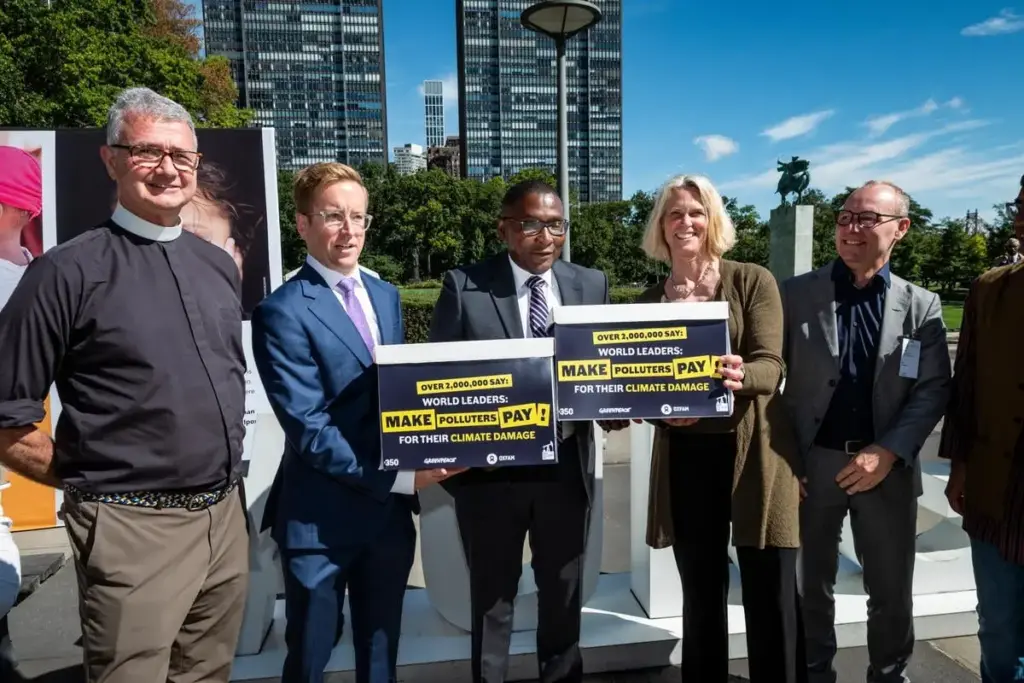
NEW YORK, U.S. — As world leaders descended upon Manhattan for the high-level sessions of the United Nations General Assembly, a coalition of international climate campaigners delivered an unmistakable message to the corridors of global power. Armed with petitions bearing a combined total of more than two million signatures, civil society leaders formally called on governments to enact binding legislation that forces fossil-fuel corporations to pay their fair share of the astronomical costs driven by the climate crisis.
The petitions were officially received by Selwin Hart, the United Nations Assistant Secretary-General for Climate Action, during a high-profile mobilization orchestrated by the Make Polluters Pay International Coalition. Coming on the heels of a brutal global weather season marked by catastrophic wildfires, historic flooding, and deep-seated energy market instability tied directly to fossil-fuel dependence, the delivery underscores a rapidly escalating confrontation between ordinary citizens and the energy giants driving global warming.
With international negotiations on climate finance, global minimum tax rules, and economic resilience looming, this mass mobilization aims to force governments to choose: continue shielding corporate polluters or take decisive legislative action to hold them financially accountable for global destruction.
Executive Overview: A Watershed Moment for Climate Accountability
The delivery of over two million signatures to the United Nations marks a critical escalation in the global demand to "Make Polluters Pay." For decades, the economic burden of climate-induced disasters has fallen disproportionately on frontline communities, vulnerable nations, and everyday taxpayers. Meanwhile, multinational oil and gas conglomerates have continued to rake in unprecedented, record-shattering profits.
The Make Polluters Pay International Coalition—uniting environmental heavyweights like Greenpeace, Oxfam, 350.org, and GreenFaith—is spearheading an initiative to close this chasm of climate injustice. The campaign calls for robust, enforceable regulatory mechanisms, including permanent climate-damages taxes, heavy surtaxes on fossil-fuel windfall profits, and punitive fines dedicated entirely to funding disaster recovery, climate adaptation, and a just energy transition.
The urgency of this demand is heightened by recent scientific warnings. Global temperatures continue to skirt the critical 1.5°C threshold established by the Paris Agreement, pushing Earth’s climate systems dangerously close to irreversible tipping points. By anchoring the voices of two million citizens directly inside the United Nations, campaigners have elevated the debate from local protest movements to the center stage of international diplomacy, demanding that world leaders dismantle the financial incentives driving ecological collapse.
Detailed Chronology: The Escalating Clash Over Climate Finance
The path toward this pivotal moment at the UN General Assembly has been paved by a relentless compounding of climate extremes and corporate windfall profiteering.
The Post-Pandemic Energy Shock and Super-Profits
The crisis entered a new phase following geopolitical disruptions, most notably Russia’s invasion of Ukraine, which sent energy markets into a tailspin. While households across the globe struggled with soaring utility bills and hyper-inflation, the world’s top five publicly traded oil and gas majors amassed a staggering half a trillion dollars in cumulative profits. This widening disparity catalyzed a global realization: ordinary people were financing their own destruction through high energy prices while fossil-fuel executives extracted record dividends.
The Record-Breaking Climate Catastrophes of 2026
The momentum for the petition delivery reached a boiling point over the summer. Climate scientists confirmed that August shattered all historical records to become the hottest month ever measured on Earth. The compounding devastation of unprecedented heatwaves, unmanageable wildfires across multiple continents, and catastrophic floods left governments scrambling to respond.
Frontline communities, particularly across the Global South, bore the brunt of these impacts, facing ruined harvests, destroyed infrastructure, and lost lives. Yet, despite mounting scientific consensus linking these disasters directly to carbon emissions, the largest oil companies continued their exploration and extraction efforts, prioritizing short-term shareholder returns over planetary survival.
The United Nations Handover
Against this volatile backdrop, representatives from the Make Polluters Pay International Coalition synchronized their efforts with the opening sessions of the UN General Assembly. On the steps and within the conference rooms of the UN headquarters in New York, campaigners converged to hand over the multi-million-signature petition. The symbolic act transformed grassroots digital organizing into a tangible policy mandate, directly challenging delegates to integrate corporate climate taxation into the official UN agenda.
Supporting Context & Metrics: The Human and Economic Toll of Inaction
To fully grasp the gravity of the Make Polluters Pay campaign, one must examine the staggering metrics quantifying corporate responsibility versus human suffering. The numbers illustrate an undeniable correlation between fossil-fuel extraction and global devastation.
The Carbon Footprint of the Elite
- The Heatwave Driver: According to recent attribution science highlighted by global humanitarian organizations, the carbon emissions generated by just five major oil companies alone are directly responsible for causing approximately one in every four heatwaves recorded globally since the year 2000.
- Staggering Profit Projections: Even as climate damages mount, the six largest fossil-fuel conglomerates remain on track to rake in an astounding $147 billion in profits within a single fiscal year.
- The Cost of Daily Operations: Faith-based and economic watchdogs note that over the past half-century, the fossil-fuel industry has operated on an average of roughly $3 billion in daily profits, while simultaneously generating pollution implicated in one out of every five deaths worldwide.
Shifting the Burden to the Taxpayer
For decades, the economic model of the fossil-fuel industry has relied on externalizing its immense costs onto society. When a hurricane decimates a coastal town, when prolonged droughts decimate agricultural sectors in the Global South, or when urban centers require billions in climate-resilient infrastructure, the bill is invariably paid by taxpayers, local municipalities, and disaster-relief funds.
The coalition argues that this dynamic is not merely an economic imbalance; it is a systemic injustice. By implementing dedicated climate taxes and profit surtaxes, governments can internalize these externalized costs, effectively defunding the machinery of climate destruction while securing the trillions of dollars needed for global adaptation and mitigation.
Official Statements: Leaders Rally Behind the Call to Regulate and Litigate
The urgency of the petition delivery drew powerful, unequivocal endorsements from top international officials and civil society leaders, highlighting a unified front against corporate impunity.
Selwin Hart, UN Assistant Secretary-General for Climate Action
Accepting the petitions on behalf of the United Nations, Assistant Secretary-General Selwin Hart delivered a fiery address condemning the exploitation of developing nations and backing the civil society mobilization:
"The fossil fuel industry right now is earning extraordinary profits. Since Russia’s invasion of Ukraine, the five largest oil companies have earned half a trillion in profits. As the climate crisis accelerates, developing countries are being starved of the resources they need to protect their communities and to safeguard livelihoods from a crisis they did literally nothing to cause. This is unjust. This is the heart of climate injustice. Polluters must pay, and the UN supports this effort, we are with you. We urge you to use every single legal and lawful tool at your disposal. Regulate, legislate and litigate. Civil society must use every tool at your disposal to hold the polluters accountable. You are on the right side of history."
Mads Christensen, Executive Director, Greenpeace International
Greenpeace International Executive Director Mads Christensen emphasized the stark binary choice facing world leaders in the wake of record-breaking global temperatures:
"2026 is a year the whole world could feel. August was the hottest month ever recorded, and scientists confirmed we are close to breaking the 1.5°C limit governments swore to hold. The climate crisis is here, and it falls hardest on the people who did the least to cause it. The biggest oil companies keep chasing profit to the last barrel, fueling the very disasters wrecking lives, ready to burn everything behind them rather than change course. The wealthiest polluters should be permanently taxed more to pay for the damage they cause, not the families and communities left to pick up the bill. Governments now face a clear choice, and too many are still on the wrong side of it: keep shielding the wealthiest polluters, or stand with the rest of us paying the price. This is how we take the profit out of destruction and protect the generations to come. It is us, or them."
Anne Jellema, Executive Director, 350.org
Highlighting the mainstreaming of climate accountability demands, 350.org Executive Director Anne Jellema pointed to the widening chasm between public suffering and corporate enrichment:
"For years, campaigners and communities on the frontlines have been saying the same thing: the companies that have profited from fossil fuels must pay their fair share of the costs of the crisis they helped create. Today, that demand is moving into the mainstream. We have watched homes burn, communities flood and families struggle with the rising costs of climate and energy crises, while fossil-fuel companies continue to make extraordinary profits. We pay. They profit. It’s time to change that. Now the voices of more than two million people are being brought to the United Nations. Governments have the power to make polluters pay, and they must use it."
Amitabh Behar, Executive Director, Oxfam International
Oxfam International Executive Director Amitabh Behar focused heavily on the stark inequalities embedded within the climate emergency, pointing to the disproportionate suffering of vulnerable populations in the Global South:
"Super-rich polluters are causing the most climate damage while the rest of us are left to pay the price. The emissions of just five oil giants were enough to cause around one in four heatwaves since 2000, and the six biggest are on track to rake in $147 billion this year. Meanwhile, farmers, women and families across the Global South are losing their lives, harvests and homes to a climate emergency they did not create. There is no fixing the climate crisis without taking on the billionaires and corporations cashing in on it. Frontline communities and millions of people have made their demand clear: make the richest polluters pay. Now world leaders must find the courage to protect billions of lives instead of polluters’ billions of dollars."
Fletcher Harper, Executive Director, GreenFaith
Infusing a moral and ethical dimension into the geopolitical discourse, GreenFaith Executive Director Fletcher Harper framed the fossil-fuel industry’s business model as an ethical violation:
"Every religion teaches the same moral principle: you do not get to harm your neighbor and walk away. That is why religious leaders around the globe are calling for climate polluters to pay for the damage they have caused. For 50 years, the fossil fuel industry has enjoyed $3 billion in daily profits while knowingly creating pollution responsible for one in five deaths globally. Communities worldwide are absorbing the mounting costs of climate damage. Those expenses have not been paid by the polluters. They have been pushed onto families, communities, and taxpayers. In moral terms, that is theft."
Future Outlook: The Road Ahead for Global Climate Taxation
As the dust settles on the UN General Assembly high-level week, the attention of the international community shifts toward upcoming multilateral negotiations, including the next round of UN climate talks (COP) and emerging international forums on global tax architecture.
The delivery of over two million signatures serves as both a political warning and a policy roadmap. Campaigners have established that public appetite for systemic reform is at an all-time high. However, translating this grassroots momentum into binding international law will require overcoming intense corporate lobbying and political resistance from fossil-fuel-reliant states.
Moving forward, the Make Polluters Pay International Coalition plans to ramp up domestic and international campaigns, urging national legislatures to independently introduce climate damage levies, excess profit taxes, and stringent polluter-liability statutes. By weaponizing legislation, regulation, and strategic litigation—as explicitly encouraged by UN leadership—civil society intends to close the chapter on corporate climate impunity.
Ultimately, the message delivered in New York resonates with unmistakable clarity: governments can no longer afford to subsidize and shield the architects of planetary breakdown. The mandate from over two million global citizens is set, leaving world leaders with the definitive task of choosing between the preservation of corporate wealth and the survival of future generations.



