

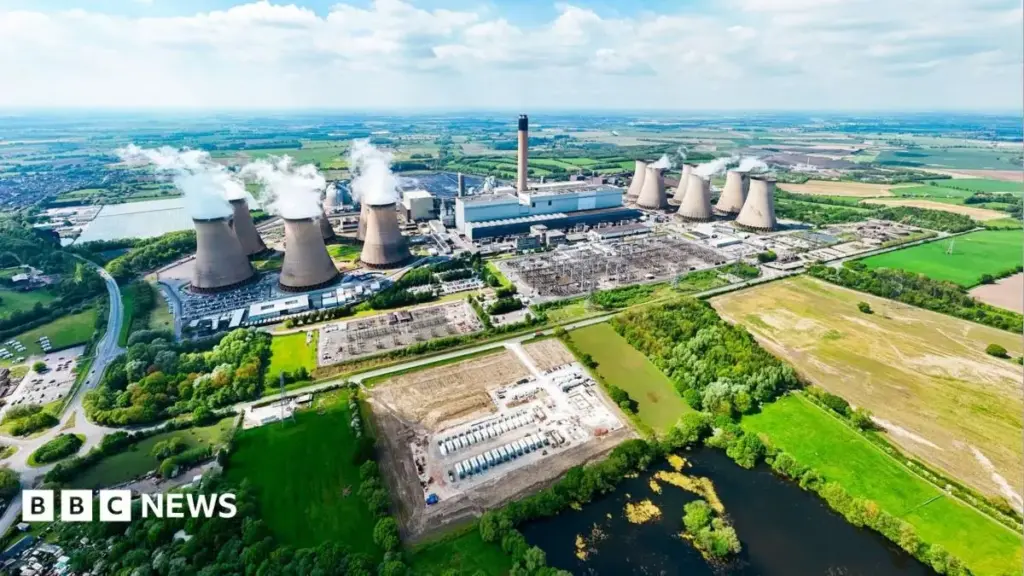
Executive Overview
North Yorkshire Council has officially granted planning permission for one of the most ambitious mineral recovery and land restoration schemes in the region’s recent industrial history. The approved venture will see energy generator Drax Power Ltd extract up to 23.5 million tonnes of pulverized fuel ash (PFA) from a colossal 161-hectare (398-acre) disposal site situated immediately northwest of the Drax Power Station, near Selby.
The colossal disposal mound, which rises to a height of 39 meters (128 feet) and has been used to deposit ash residues since the 1970s, will be systematically dismantled and processed over a multi-decade operational timeline. Under the approved schedule, extraction activities will continue until 2045, with final site restoration slated for completion by 2055.
While the project has been widely heralded by environmental strategists and industrial bodies as a triumph for the circular economy—repurposing industrial waste into vital construction materials like concrete and thereby significantly reducing the demand for virgin aggregates—it has not arrived without profound controversy. The approval process laid bare a deep tension between large-scale industrial decarbonization objectives and the day-to-day quality of life for residents in surrounding communities, most notably the village of Barlow.
Local opposition focused heavily on issues of noise, dust pollution, heavy goods vehicle (HGV) traffic, lighting glare, and the premature removal of natural landscape screening that shields local properties from the sprawling power station complex. In response to these concerns, North Yorkshire Council’s planning committee intervened directly. Rejecting the developer’s initial proposals for punishingly long operating hours, the council imposed stringent conditions, including restricted working windows and a mandate that the majority of the recovered ash be moved via rail freight rather than local roads.
This comprehensive report examines the genesis of the Drax ash extraction scheme, details the chronology and political friction of the planning committee’s deliberations, analyzes the rigorous mitigation framework put in place, and evaluates the broader future outlook for industrial mineral recovery in the United Kingdom.
Detailed Chronology & Planning Evolution
The journey toward the approval of the Drax ash recovery scheme represents a fascinating intersection of modern environmental policy, industrial legacy, and grassroots local government advocacy. To understand the gravity of the council’s recent decision, it is necessary to trace the operational history of the site and the bureaucratic steps that led to the development control committee meeting.
Industrial Legacy: The Rise of the Selby Ash Mound
The disposal mound adjacent to the Drax Power Station has been accumulating combustion byproducts since the facility opened in the 1970s. As one of Europe’s largest thermal power stations—historically reliant on coal combustion before transitioning to biomass—Drax produced millions of tonnes of pulverized fuel ash over decades of continuous operation. PFA is a fine, powdery residue resulting from the combustion of pulverized coal in thermal power plants. Traditionally treated as a waste product, vast quantities were piped or transported to dedicated land-raising disposal sites, transforming the topography of the Vale of York.
Over nearly half a century, the site northwest of the power station grew into a monumental 39-meter-high artificial landform spanning 161 hectares. While the mound eventually became colonized by local flora and integrated into the rural landscape to a degree, it remained an active industrial liability.
Submission and Initial Public Consultation
Drax Power Ltd’s formal planning application submitted to North Yorkshire Council proposed a fundamental paradigm shift: treating the historic disposal mound not as a permanent waste dump, but as a secondary aggregate quarry. The concept was straightforward: excavate the PFA, process it, and supply it to the construction sector as a high-grade replacement for ordinary Portland cement and virgin sand and gravel in concrete manufacturing.
However, when the plans entered the public consultation phase, they immediately triggered alarms among local residents and parish councils. Formal objections were lodged by local stakeholders citing a panoply of environmental and amenity concerns. Residents living in the shadow of the power station expressed acute anxiety regarding fugitive dust emissions, which could coat local properties during dry and windy conditions. Additional fears centered on continuous industrial noise, intrusive night-time lighting, degraded air quality, and the aesthetic degradation of the local landscape.
Crucially, objectors pointed out that the phased removal of the mound would strip away mature vegetation and earthworks that currently act as a visual and acoustic buffer between the industrial infrastructure of Drax and nearby rural settlements. The scale and duration of the scheme—spanning nearly a quarter of a century—fortified local resistance, transforming what might have been viewed as a standard industrial application into a contentious local battleground.
The Planning Committee Showdown
The friction between corporate ambition and community protection culminated during the North Yorkshire Council planning committee meeting, where local representatives voiced uncompromising opposition to the developer’s proposed operational tempo.
Councillor Tim Thrall of Barlow Parish Council set the tone during his oral submission to the committee. While he acknowledged that the parish council did not object to the principle of removing the ash mound—recognizing the environmental logic of recycling industrial byproducts—he issued a stark warning regarding the adequacy of proposed mitigations. "However, we do have a number of concerns about whether mitigation measures are enough to impact the quality of life of the residents of the village," Thrall stated.
The flashpoint of the meeting, however, centered on the proposed working hours. Councillor Mark Crane, whose electoral division encompasses Barlow, expressed absolute disbelief at the operational schedule put forward by the applicants. Drax Power Ltd had sought permission to operate the extraction and transport facilities for 18 hours a day, running from 06:00 until midnight, seven days a week, excluding only bank holidays.
"To expect them to accept that they can work from six in the morning till midnight every single day of the year is, I’m sorry, completely unreasonable," Crane declared, noting that the sheer breadth of the schedule would effectively rob residents of any periods of uninterrupted peace and quiet.
Recognizing the validity of these concerns, the planning committee exercised its regulatory authority to rewrite the operational parameters. Rejecting the developer’s preferred schedule, the committee instituted a much tighter working window: operations would only be permitted between 08:00 and 20:00, with all work prohibited on Sundays and bank holidays.
Furthermore, to alleviate highway safety and congestion concerns, the committee mandated a strict logistics rule: 65% of all extracted ash must be transported away from the site via rail, with only the remaining 35% permitted to travel by road.
Council planning officers ultimately supported the application, concluding that with these stringent conditions legally enforced, the development would not result in unacceptable impacts on local residents, the surrounding highway network, local ecology, air quality, or the delicate water environment of the Vale of York. The approval was formally clinched via a Section 106 legal agreement containing a £200,000 financial commitment dedicated entirely to mitigating landscape and environmental impacts in the surrounding area.
Supporting Context & Metrics
To fully appreciate the scope of the Drax ash extraction project, it is necessary to examine the hard data, economic drivers, and environmental metrics underpinning the initiative. The scheme is not merely a local planning decision; it is a microcosm of the structural changes sweeping the British construction and manufacturing sectors.
Quantifying the Resource: 23.5 Million Tonnes of PFA
The sheer scale of the operation is staggering. The 161-hectare site contains an estimated 23.5 million tonnes of recoverable pulverized fuel ash. To put this figure in perspective, 23.5 million tonnes is roughly equivalent in weight to more than 2,300 Eiffel Towers.
Pulverized fuel ash possesses pozzolanic properties—meaning that when mixed with lime and water, it forms compounds possessing cementitious properties. In modern construction, PFA is routinely used as a secondary cementitious material (SCM) in the production of ready-mixed concrete, precast concrete products, and grouting. By substituting cement with PFA, construction firms can significantly lower the carbon footprint of concrete production, as the manufacture of ordinary Portland cement is famously energy-intensive and carbon-emitting.
Environmental Metrics and Carbon Savings
The primary environmental justification for the Drax scheme lies in the conservation of virgin raw materials and the reduction of embodied carbon within the construction supply chain.
- Aggregate Conservation: Extracting 23.5 million tonnes of secondary aggregate directly offsets the need to quarry an equivalent amount of virgin sand, gravel, and rock from the UK countryside. Mineral extraction is notoriously disruptive to local ecosystems, biodiversity, and topography; utilizing an existing, man-made industrial deposit acts as a form of urban and industrial mining, preserving natural landscapes elsewhere.
- Embodied Carbon Reduction: Cement production accounts for roughly 8% of global carbon dioxide emissions. Utilizing PFA as a partial replacement for cement in concrete formulations reduces the chemical and thermal emissions associated with clinker production.
- Rail vs. Road Emissions: The council’s insistence that 65% of the ash be transported by rail is a critical environmental safeguard. Heavy goods vehicles (HGVs) are major emitters of nitrogen oxides ($textNOx$) and particulate matter ($textPM2.5$ and $textPM_10$), both of which pose severe public health risks. Rail freight produces significantly fewer greenhouse gas emissions per tonne-kilometer than road transport, drastically cutting the project’s carbon and air pollution footprint.
Financial and Legal Frameworks: The £200,000 Mitigation Fund
Regulatory approvals of this magnitude are invariably bound by legal contracts designed to ensure accountability. The Section 106 agreement tied to the Drax consent incorporates a ring-fenced £200,000 mitigation fund.
This financial allocation is specifically earmarked for landscape enhancement, habitat creation, and visual screening projects in the immediate vicinity of Barlow and the surrounding parishes. As the extraction process slowly strips away the existing mound over the next two decades, this funding will allow local authorities and environmental bodies to implement compensatory planting, establish new woodland belts, and enhance local green infrastructure to protect the visual amenity of residents.
Official Statements & Stakeholder Perspectives
The debate surrounding the Drax ash recovery project highlights the divergent priorities of industrial operators, local politicians, parish representatives, and planning authorities. A review of the official statements reveals a complex dialogue characterized by conditional acceptance and cautious oversight.
Drax Power Ltd: Advancing the Circular Economy
Representatives for Drax Power Ltd have consistently framed the project as a forward-thinking contribution to sustainable resource management. While corporate statements emphasize the alignment with national net-zero strategies, the underlying business case is equally clear: transforming a dormant, land-consuming industrial byproduct into a marketable commodity over a 20-year horizon unlocks significant economic value while fulfilling environmental remediation obligations.
Company spokespeople have highlighted that reclaiming the site allows for ultimate ecological restoration well before the end of the 21st century. Under the approved timeline, total site restoration—involving re-profiling, soil amelioration, and ecological replanting—will be completed by 2055, transforming a sterile industrial spoil heap into a stable, biodiverse landscape.
Local Government and Parish Advocacy
The local political response serves as a masterclass in effective municipal pushback. Rather than adopting an obstructionist "NIMBY" (Not In My Back Yard) stance, local representatives like Councillor Tim Thrall and Councillor Mark Crane engaged constructively with the planning process, acknowledging the industrial logic of the scheme while fiercely defending the day-to-day welfare of their constituents.
Councillor Thrall’s emphasis on the adequacy of mitigation measures underscores a recurring theme in modern planning disputes: industrial development is permissible only when the burden of externalities does not fall disproportionately on local communities.
Councillor Crane’s incredulity regarding the proposed 18-hour operating schedule proved pivotal. By translating corporate convenience into human terms—highlighting the absurdity of expecting rural residents to endure heavy industrial activity from dawn until midnight, seven days a week—he galvanized the planning committee to enforce humane operating boundaries. The resulting compromise—restricting hours to 08:00–20:00, excluding Sundays and bank holidays—demonstrates the vital watchdog role played by tier-one local authorities when empowered by articulate local councilors.
Planning Officers and Statutory Consultees
From the perspective of North Yorkshire Council’s professional planning staff, the application represented a balanced equation. Officers conducted exhaustive environmental impact assessments covering noise propagation, hydrogeology, ecological assets, and highways capacity.
Their ultimate recommendation for approval—subject to nearly two dozen meticulous planning conditions—was predicated on the confidence that modern engineering controls, dust suppression technologies, acoustic baffling, and strict logistical rules could reduce operational impacts to well within statutory thresholds. The council’s pragmatic stance reflects a broader regulatory consensus in the UK: that economic decarbonization and secondary resource recovery must be accommodated, provided environmental protections are uncompromisingly enforced.
Future Outlook: The Next Three Decades at Drax
With planning permission secured, the Drax ash extraction project now transitions from the bureaucratic drawing board to a multi-decade operational reality. Looking ahead, the timeline is defined by distinct phases of excavation, processing, transport, and eventual environmental restoration that will stretch across the working lives of an entire generation.
Phase 1: Mobilization and Infrastructure Setup (2025–2028)
The initial years following approval will be dedicated to site mobilization. Drax Power Ltd must establish processing plant infrastructure, construct internal haul roads designed to minimize dust and noise, and integrate the site’s rail loading facilities to ensure the mandated 65% rail-freight target can be met from day one. Environmental monitoring stations will be deployed around the perimeter of the 161-hectare site to establish baseline readings for air quality, noise, and particulate deposition before major earthmoving begins.
Phase 2: Systematic Extraction and Processing (2028–2045)
The core operational phase will span nearly two decades. Heavy earth-moving equipment will systematically peel back the 39-meter-high PFA mound in controlled phases. The extracted ash will be conditioned, blended, and loaded onto specialized rail wagons and HGVs for distribution to concrete batching plants across the North of England and beyond.
Throughout this lengthy period, strict regulatory oversight will be maintained. North Yorkshire Council’s planning enforcement officers, alongside the Environment Agency, will review regular monitoring reports concerning dust suppression efficacy, noise levels, water runoff management, and traffic compliance. The presence of the £200,000 mitigation fund will allow for adaptive landscape management, ensuring that newly exposed faces of the mound are rapidly screened by temporary or permanent planting.
Phase 3: Final Site Restoration and Aftercare (2045–2055)
Extraction is scheduled to cease by 2045, initiating the final decade of the project lifecycle. Restoration operations will focus on re-contouring the remaining landform to blend harmoniously with the surrounding agricultural and rural topography of the Vale of York.
Topsoiling, tree planting, wetland creation, and grassland establishment will be undertaken to convert the industrial footprint into a high-value wildlife habitat and amenity space. By 2055, the once-towering ash mound will be entirely rehabilitated, leaving behind a legacy of restored green infrastructure rather than a permanent industrial scar.
Broader Industry Implications
The Drax decision serves as a bellwether for similar legacy industrial sites across the United Kingdom. As the nation accelerates its transition toward a circular economy, vast reserves of industrial byproducts—historically regarded as valueless waste—are increasingly recognized as vital secondary mineral resources.
However, the fierce local resistance and subsequent compromises witnessed in Barlow offer a vital lesson for future developers: large-scale industrial recovery projects cannot succeed in a social vacuum. Securing a social license to operate requires early engagement, realistic operational scheduling, robust environmental safeguards, and an unshakeable commitment to protecting the health and tranquility of neighboring communities. For Drax, the next thirty years will test whether industrial ambition and rural quality of life can successfully coexist in the Vale of York.



