

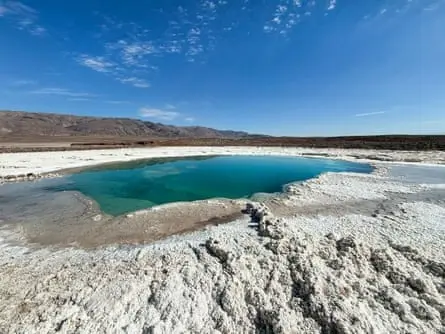
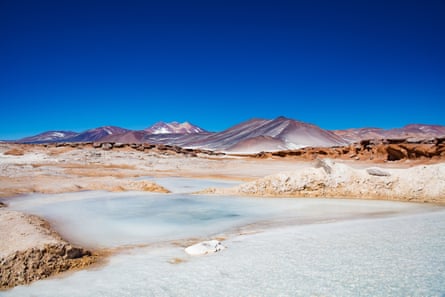
High in the Andes, traversing the borders of Argentina, Bolivia, and Chile, lies one of the most sublime and hostile landscapes on Earth. It is a high-altitude desert plateau characterized by stark contrasts: broad, sweeping basins abruptly cut off by near-vertical ascents, and an atmosphere where the afternoon air is thin, brisk, and pierced by blinding solar radiation. Looming over this landscape is the colossal Licancabur volcano, standing sentinel over a terrain where vegetation and humidity shift rapidly with rising altitude, bringing cooler temperatures, damper air, and denser biological activity.
Yet, this breathtaking wilderness—encompassing dazzling salt flats, fragile wetlands, delicate wildlife, and ancient Indigenous communities—faces an unprecedented paradox. The very environment that holds the key to saving the planet from catastrophic climate change is being quietly destroyed by the extraction efforts deployed to protect it. Suspended beneath the blinding white crust of the Salar de Atacama—the largest salt flat in northern Chile and the third-largest in the world—lies nearly one-quarter of the global reserves of lithium.
Lithium is the indispensable cornerstone of the global energy transition. As the critical component in rechargeable batteries, it plays a starring role in eliminating carbon emissions from transportation and energy generation, the world’s two largest-emitting sectors. However, extracting this "white gold" carries escalating socio-ecological costs. The quest to mine lithium in the Atacama is a microcosm of a planetary dilemma: the expanding extractive frontiers of green capitalism. Across the globe, as mines are carved open to supply the raw materials for a low-carbon future, global climate action directly collides with local environmental preservation and Indigenous sovereignty.
Detailed Chronology: The Natural Genesis and Industrialization of the Atacama
To understand the modern crisis in the Atacama, one must first trace the ancient, multi-stage geological and hydrological processes that forged its lithium deposits.

The Hydro-Geological Genesis
The Atacama is classified as an "endorheic" (internal-flowing) basin. Water can flow down into the basin from the surrounding mountains, but it cannot exit via rivers or streams; its only escape route is intense evaporation.
During the southern hemisphere’s summer months, the region experiences a paradoxical weather phenomenon known as the invierno boliviano (Bolivian winter). Storm fronts originate in the Amazon basin, travel up the steep slopes of the Andes, and are driven by high-altitude winds over the ridges to drench the Chilean high plateau in torrential downpours.
When these rare floods occur, water cascades down the surrounding mountains. During long dry spells, moisture trickles down ravines from precious mountain springs. As this water flows through the volcanic terrain, it leaches lithium out of volcanic rock, captures wind-scoured lithium dust, and carries these elements down to the salar’s nucleus.
The pooled surface water evaporates under the relentless, sun-blasted conditions of the high desert. With every droplet that vanishes into the dry air, the concentration of the remaining lithium-rich brine increases. Without the extreme evaporation rates of the Atacama, these concentrations would never reach the "economical" thresholds demanded by mining corporations.
Subsurface Enrichment and Hydrothermal Systems
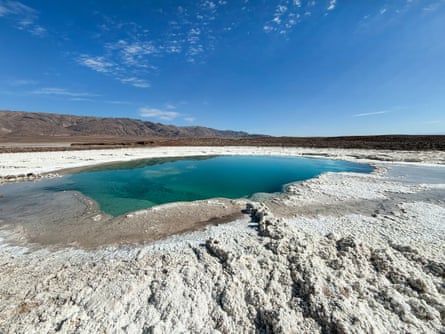
The enrichment process does not stop at the surface. Over millennia, the lithium-laden water seeps deep into the ground, pooling in underground aquifers connected to complex hydrothermal systems. Magma heat from active Andean fault lines drives the circulation of subsurface brine through underground fissures and porous geological strata, dissolving even more lithium directly from the bedrock.
The resulting brine deposits—resting anywhere from four to 200 feet below the salt crust—represent a multi-billion-dollar bonanza. The unique convergence of climatic, geological, geothermal, and hydrological conditions makes the Atacama one of the cheapest places on Earth to extract lithium.
The Industrial Extraction Process
To harvest this liquid asset, mining companies employ a low-tech, water-intensive method often described as "mining water." Operators pump underground brine to vast, man-made evaporation ponds on the surface. Over a cycle lasting anywhere from 10 to 24 months—heavily dependent on weather conditions and brine quality—natural solar evaporation concentrates the liquid, boosting lithium levels 40-fold, from roughly 0.15% to a staggering 6%.
While hailed by industry proponents as a low-cost, low-impact process, this mass displacement of subterranean fluid fundamentally destabilizes a hyper-arid desert water system, placing immense pressure on the surrounding ecosystems and human populations.
Supporting Context & Metrics: The Ecology of a "Polyextreme" Environment
The Atacama is recognized by ecologists as a "polyextreme" environment. Defined by extreme altitude, intense direct solar radiation, radical aridity, massive diurnal temperature swings, and hyper-saline lakes, the desert forces life to adapt through extraordinary evolutionary creativity.
The Trophic Web of the Salt Flats
Despite its harshness, the Atacama supports a delicate, interdependent biological network:
- Microbial Life & Phytoplankton: Blue-green algae and microscopic plants thrive in the hypersaline lagoons, anchoring the entire trophic web.
- Artemia (Brine Shrimp): These resilient crustaceans consume the phytoplankton and bacteria. They serve as the primary food source for the plateau’s larger fauna.
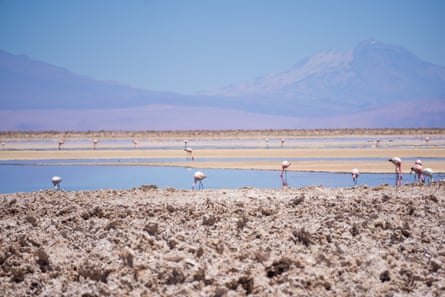
- Chilean Flamingos: Three endemic species of flamingos inhabit the salt flats, migrating across lagoons in search of food and mates—the latter celebrated through elaborate courtship rituals of synchronized dancing. Flamingos have evolved specialized, filter-feeding bills (akin to the lamellar membranes of whales) to strain microscopic organisms from the brine.
Compounding Environmental Pressures
Today, these evolutionary marvels are under severe threat from a dual assault:
- Climate Change: Rising global temperatures accelerate the evaporation of surface waters, reducing the blue-green algae populations critical to the survival of Artemia and flamingos. Consequently, all three endemic flamingo species are experiencing steady population declines.
- Industrial Encroachment: The heavy machinery, relentless vehicular traffic, and continuous noise pollution generated by mining operations directly disrupt flamingo breeding grounds, fracturing ancient migration and nesting patterns.
Researchers note that science is perpetually playing catch-up, documenting ecological degradation long after the damage has taken root. The destabilization of the Atacama’s hydrological balance is a slow-motion disaster with planetary dimensions.
Official Statements and Stakeholder Perspectives
The expansion of the lithium frontier has ignited fierce debates among corporate leaders, government regulators, scientific researchers, and Indigenous communities.
- The Corporate and State Perspective: Proponents of large-scale extraction argue that maximizing lithium output is an absolute moral and ecological necessity to meet global decarbonization targets. Governments in the "Lithium Triangle" (Chile, Argentina, and Bolivia) view the mineral as a historic fiscal windfall capable of funding national development and technological modernization. Industrial representatives maintain that modern evaporation techniques are continually optimized to minimize environmental leakage and respect regional quotas.
- Indigenous Communities and Environmentalists: Local Indigenous groups—such as the Colla and Lickanantay peoples—voice a radically different perspective, encapsulated by local warnings: "The source of all life is here." Indigenous leaders argue that industrial pumping deprives local oases, agriculture, and human settlements of essential freshwater. They contend that the consultation processes mandated by international law frequently fail to secure genuine, free, prior, and informed consent, reducing ancestral territories to sacrifice zones for foreign energy transitions.
- The Scientific Community: Hydrogeologists and ecologists warn that corporate hydrological models often underestimate the interconnectedness of deep brine aquifers and shallow freshwater lenses. They stress that once an endorheic desert aquifer is depleted or contaminated, natural recharge rates are so slow that the ecological damage is practically irreversible.
Future Outlook: Reimagining the Green Energy Transition
The dilemma in the Atacama forces an existential reckoning for humanity’s zero-carbon future. Global supply chains intersect directly with local food chains, industrial production undermines fragile ecosystems, and postcolonial state-building continues to erase ancient histories of continuous Indigenous settlement. The Atacama salt flat is not an isolated geographic anomaly; it is a clear window into our planetary future.
If the global energy transition is to be genuinely just, it must radically rethink how raw materials are sourced. Observers and policy experts recommend several transformative interventions:
- Demand-Side Reductions: Policymakers must promote robust alternatives to private car dependency, reduce urban sprawl, and invest heavily in efficient public mass transit.
- Technological Efficiency: Encouraging the development of smaller, more material-efficient batteries will drastically lower the sheer volume of raw minerals required for carbon-free transportation.
- Mandatory Recycling Infrastructure: Scaling up closed-loop recycling for electric vehicle batteries can dramatically reduce our reliance on virgin mining frontiers.
- Supply Chain Justice: Supply chains must be restructured to prioritize the human rights, water security, and self-determination of Indigenous and local communities over corporate profit margins.
Just as any industrial workplace is simultaneously a site of exploitation and a locus of worker power, and any mine is at once a scene of ecological extraction and community resistance, the supply chains of green technologies represent both a tool of global domination and fertile ground for building a more equitable world. Reconciling climate action with environmental justice is the defining challenge of our era.



