In the high-stakes theater of the global automotive industry, few segments carry the prestige, profit margins, and symbolic weight of the full-size executive sedan. For decades, this category has been the undisputed domain of legacy European luxury titans—chiefly Mercedes-Benz, BMW, and Audi. These heritage brands have long defined the parameters of wealth, engineering prowess, and executive transport.
However, the tectonic plates of the automotive landscape are shifting beneath the weight of rapid electrification. Entering this fray with an audacious mission is BYD’s newly unveiled global flagship: the Da Han.
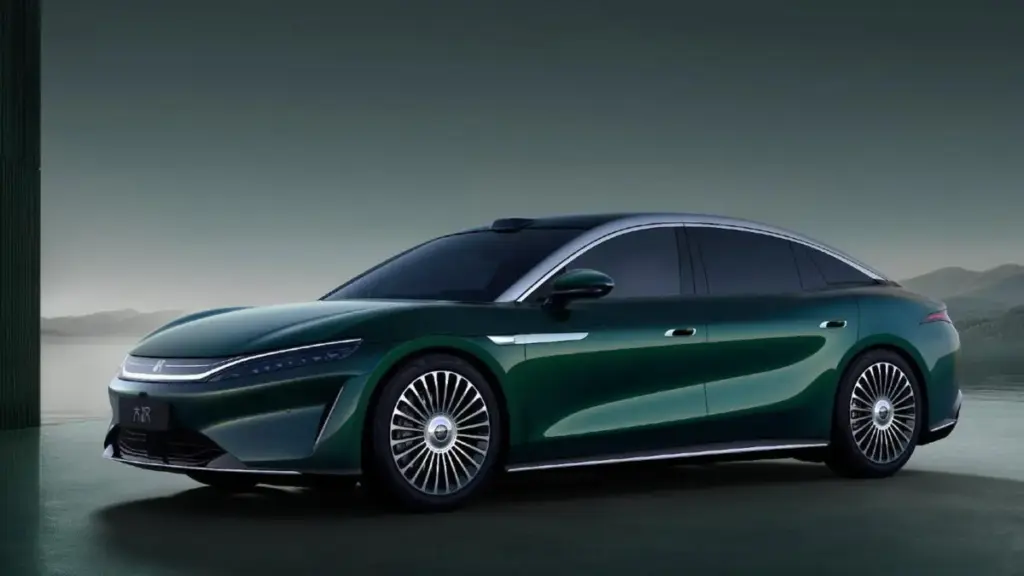
Launched to challenge not just regional rivals, but the absolute pinnacle of Western premium engineering, the Da Han represents a profound maturation of the Chinese electric vehicle (EV) sector. It is not merely an incremental update to the original Han sedan—a vehicle that successfully disrupted the domestic 200,000+ RMB market once dominated by joint-venture gasoline cars. Instead, the Da Han is a statement of intent. Boasting cutting-end 1000V architecture, staggering performance metrics, unmatched aerodynamic and spatial efficiency, and a luxury suite that rivals ultra-luxury offerings, the Da Han has arrived to claim the crown of the world’s premier executive sedan.

Affectionately nicknamed the "Shenzhen Maybach" on Chinese social media, this flagship vehicle sets a new benchmark across dozens of performance metrics, forcing legacy automakers to reckon with a competitor that matches—and frequently outclasses—vehicles costing up to ten times its price.
Detailed Chronology: From Domestic Disrupter to Global Challenger
To understand the magnitude of the Da Han, one must examine the evolutionary arc of the Han lineage within the Chinese automotive market.
The First-Generation Han and the Taxi-Fleet Transition
When BYD originally introduced the Han, it marked a watershed moment. It was one of the first genuinely competitive, electrified offerings from a domestic Chinese brand capable of commanding a price tag upwards of 200,000 RMB (~$29,000+ USD). While early iterations faced minor criticisms regarding refinement, the original Han successfully battered the dominance of long-established Western internal combustion engine (ICE) vehicles.

Quickly becoming the vehicle of choice for premium car services and ride-hailing networks like DiDi—serving as the modern equivalent of the American "black car"—the Han established a reputation for reliability and presence.
However, success brings the challenge of brand dilution. Recognizing that its flagship consumer sedan risked being pigeonholed as a utilitarian fleet vehicle, BYD executed a strategic pivot. The company launched the Linghui sub-brand, highlighted by the introduction of the E9 flagship sedan in May. Designed specifically for commercial fleet operators, the E9 utilizes the durable underpinnings of the older Han generation paired with a modest 135 kW to 150 kW front motor and ultra-fast flash charging. This masterstroke preserves the parts-interchangeability and durability demanded by fleet operators while liberating the core Han brand to ascend into uncompromised luxury.
Clearing the Path for the Da Han
As BYD prepared the market for its ultimate flagship, the older iterations began their graceful exit. The current Han EV saw steep price reductions down to 179,800–187,800 RMB to clear inventory ahead of a planned domestic discontinuation. Meanwhile, the intermediate Han L (priced from 219,800 to 279,800 RMB) bridges the gap temporarily, though industry watchers anticipate it too will soon yield ground.

At the apex of this restructuring sits the Da Han. While it shares a storied nameplate that evokes historical Chinese dynasties, the Da Han is built upon a completely different, ultra-modern plane of existence—elevating the BYD brand into realms previously thought unreachable for a mass-market manufacturer.
Supporting Context & Metrics: Engineering Supremacy on Paper and Asphalt
A closer inspection of the Da Han’s specifications reveals an engineering tour de force designed to systematically dismantle the traditional selling points of legacy luxury flagships.
Powertrain, Performance, and Dynamics
The Da Han offers configuration choices tailored for both enthusiastic drivers and chauffeured executives:

- Rear-Wheel Drive (RWD) Models: Feature a single, highly efficient motor pumping out 370 kW (496 horsepower).
- All-Wheel Drive (AWD) Models: Add a 200 kW front motor, bringing the total system output to an earth-shattering 570 kW (764 horsepower).
The results on the asphalt are staggering. The AWD variant rockets from 0 to 100 km/h in a blistering 3.3 seconds, handles mid-range passing maneuvers with a 100-to-150 km/h sprint of just 3.2 seconds, and tops out at a regulated 270 km/h.
Despite its imposing footprint—measuring 5,256 mm in length, 1,999 mm in width, and 1,510 mm in height on a sprawling 3,130 mm wheelbase—the Da Han boasts a turning radius of just 4.95 meters, matching that of a subcompact BYD Seagull. This wizardry is made possible by standard rear-wheel steering working in tandem with the DiSus-A dual-chamber air suspension. The system actively reads the road ahead, providing up to 100 mm of height adjustment (effectively giving the low-slung sedan SUV-like ground clearance when needed) while dynamically modulating stiffness from supple cloud-like cruising to athletic cornering.
Aerodynamics and Efficiency
Aerodynamic efficiency is the lifeblood of long-range electric vehicles. The Da Han achieves a class-leading drag coefficient of 0.197, trailing only its corporate stablemate, the ultra-exclusive YangWang U7.
This aerodynamic mastery translates into phenomenal battery range via CLTC testing:
- RWD Variant: Delivers an astonishing 1,008 km of range.
- AWD Variant: Delivers 880 km of range.
Both variants are underpinned by an advanced 1000V electrical architecture housing a second-generation 102.326 kWh Blade Battery. True to BYD’s flash-charging legacy, the vehicle can replenish its battery from 10% to 70% in a mere 5 minutes, and 10% to 97% in 9 minutes. Buyers are further incentivized with 18 months of complimentary flash-charging access.
Cabin Luxury and Technology
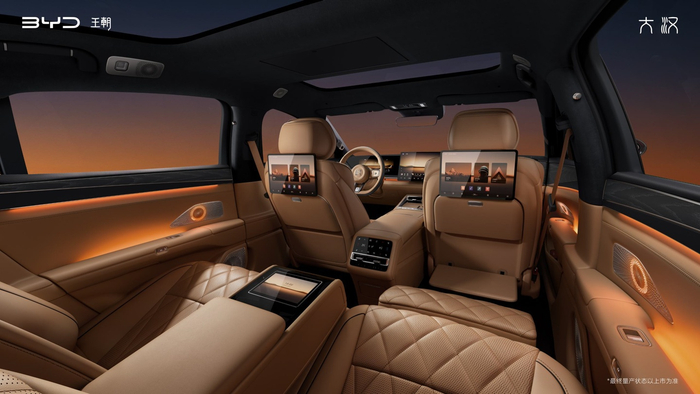
Stepping inside the Da Han is akin to entering a private jet lounge. The front cockpit features a multi-screen layout including a Head-Up Display (HUD), driver instrument screen, central infotainment display, and a dedicated passenger screen. Rear passengers are treated to an equally opulent environment: a ceiling-mounted folding center screen, seatback-mounted entertainment displays, control interfaces integrated into the rear center armrest and console back, a built-in center console refrigerator, and deployable tray tables.

Comfort amenities include:
- Nappa leather seats equipped with heating, ventilation, multi-zone massage, deep recline, and extended power leg rests.
- Hand-polished real white ash wood grain accents paired with authentic metallic touchpoints.
- Electronic smart-dimming black PDLC privacy glass for rear windows and the panoramic sunroof.
- Over 200 distinct noise-reduction measures, including fully laminated acoustic glass.
- An immersive 31-speaker Devialet sound system powered by Dolby Cube Atmos 2.0.
- A secure glove box accessible exclusively via password or voice control.
On the tech front, the Da Han integrates BYD’s LiDAR-equipped God’s Eye B (DiPilot 300) intelligent driving system—with BYD taking full liability for urban navigation and automated parking operations—while in-cabin voice commands and processing are driven by a cutting-edge 3nm AI chip.
Official Statements & Benchmarking: Challenging the Titans
During the official launch presentation, BYD executives did not shy away from direct comparisons with the absolute upper echelons of German automotive engineering. The company boldly benchmarked the Da Han against the Mercedes-AMG S 63 E PERFORMANCE.

On paper, the comparison is eye-opening. The Mercedes-AMG matches the Da Han’s acceleration time but suffers from a longer braking distance, a lower top speed, and an unwieldy turning diameter of 12.4 meters. Furthermore, the AMG lags behind in onboard technology and passenger luxury amenities—yet it starts at an eye-watering 2,674,800 RMB (~$397,620 USD) in China.
Even when compared against the all-electric Mercedes-AMG EQS 53 4MATIC+—which retails for roughly 1.566 million RMB ($232,990 USD)—the Da Han holds all the cards. The EQS features a larger 111.8 kWh battery yet delivers a shorter CLTC range of just 601 km due to inferior efficiency, slower 0-100 km/h acceleration (3.5 seconds), and a polarizing "jellybean" exterior design that has struggled to capture public affection.
By contrast, the Da Han’s pre-sale pricing structure is aggressively democratized:

- Premium RWD: 249,900 RMB (~$37,181 USD)
- Flagship RWD: 269,900 RMB (~$40,156 USD)
- Flagship AWD: 299,900 RMB (~$44,620 USD)
(Note: BYD’s pre-sale figures traditionally trend higher than final official market sales prices.)
When measured against the Tesla Model 3 Long-Range in China—the closest comparable EV in Tesla’s current domestic lineup following the discontinuation of the Model S—the Da Han punches well above its weight class. While a fully optioned Model 3 Long-Range AWD with driver-assist packages approaches 403,500 RMB ($60,033 USD) and offers significantly less range, interior space, and luxury, the Da Han delivers S-Class dimensions, blistering performance, and superior energy efficiency for substantially less capital.
Future Outlook: The Era of Chinese Flagship Sedans
The release of the Da Han is more than just the launch of a new car; it is a historical inflection point. In the 1980s, legacy brands like Lincoln and Mercedes-Benz dominated executive transport by balancing incremental innovations with trusted platforms. Over time, however, automakers that failed to pivot decisively toward future-proof technologies—such as Ford with its aging Panther-platform Town Car—were left behind, eventually exiting the executive sedan market entirely.

BYD is demonstrating the inverse trajectory. By learning from its past success in fleet and consumer markets, the company has engineered a flagship that does not compromise. The Da Han proves that an electric vehicle does not need to make sacrifices for the sake of efficiency; rather, it is a superior automobile precisely because it is electric and efficient.
As China aggressively expands its charging infrastructure—on track to host over 20,000 flash-charging stations and 28 million total charging points nationwide by the end of the year—ownership friction for EVs like the Da Han has effectively dropped to zero, frequently outpacing the convenience of traditional ICE vehicles.
Whether the "Shenzhen Maybach" can conquer global markets will ultimately depend on geopolitical currents, protectionist trade policies, and regulatory hurdles that often seek to shield domestic legacy industries from superior foreign competition. However, in markets where consumer choice and open trade prevail, the Da Han stands ready to rewrite the rulebook. It is a vehicle driven not just by economic value, but by national pride and engineering excellence—signaling the definitive dawn of the era of Chinese flagship sedans.