

Executive Overview
The United Kingdom’s ambitious target to achieve net-zero greenhouse gas emissions by 2050 faces a critical structural threat from a single, expanding sector: aviation. According to formal advice from the Climate Change Committee (CCC)—the statutory independent body advising the UK government on climate policy—emissions from international and domestic flights are on track to consume up to 80% of the nation’s entire allowable carbon budget by mid-century.
While virtually every other sector of the UK economy—from electricity generation to heavy industry—has recorded substantial carbon reductions since 1990, aviation emissions have more than doubled over the same period. This trajectory has been fueled by surging passenger demand and cheap international travel. Despite this divergence, successive administrations have leaned heavily on unproven technological solutions while entertaining major infrastructure expansions, most notably a third runway at London Heathrow Airport.
The CCC’s findings present a stark policy warning: without an immediate, credible shift toward stringent demand management and enforcing the "polluter pays" principle, aviation will paralyze the UK’s broader net-zero strategy. With a final decision on Heathrow’s expansion anticipated by 2029 and a revised national aviation policy required by 2027, ministers face an inescapable tension between infrastructure growth and legally binding climate mandates.
Detailed Chronology: The Decades-Long Divergence
The policy predicament facing the UK government is the product of thirty-five years of rapid aviation expansion coupled with delayed regulatory intervention. Understanding how aviation became the UK’s most recalcitrant emitting sector requires tracing key legislative, economic, and policy milestones.
+-----------------------------------------------------------------------------------+
| CHRONOLOGY OF UK AVIATION & CLIMATE POLICY                                        |
+-----------------------------------------------------------------------------------+
| 1990         Baseline year; aviation emissions begin a continuous upward surge.   |
| 2008         Climate Change Act passed into law; sets long-term emission goals.   |
| July 2022    Conservative government publishes the optimistic "Jet Zero" strategy.|
| Nov 2024     Labour government acknowledges "Jet Zero" assumptions were unrealistic.|
| Mid-2026     CCC issues warning: aviation on track for 80% of 2050 carbon budget. |
| 2027         Deadline for government to publish a revised Net-Zero Aviation Plan.|
| 2029         Final ministerial decision point expected on Heathrow Airport expansion.|
| 2050         Statutory target year for Net-Zero economy-wide emissions.           |
| 2054         Projected completion date for full operation of expanded Heathrow.   |
+-----------------------------------------------------------------------------------+
1990–2021: Growth Without Boundaries
While UK power generation drastically reduced its carbon footprint by phasing out coal in favor of offshore wind and solar power, aviation enjoyed steady expansion. Driven by the democratization of air travel, low-cost carrier business models, and rising real disposable incomes, passenger volumes set consecutive record highs. By the late 2010s, carbon emissions from flights originating in the UK had doubled compared to 1990 baselines.
2022: The "Jet Zero" Strategy
In July 2022, the previous Conservative administration published its flagship "Jet Zero" strategy. The document asserted that the aviation industry could reach net-zero emissions by 2050 without constraining passenger demand. Instead, the framework relied almost entirely on rapid technological advances, including:
- High-volume adoption of Sustainable Aviation Fuels (SAFs) derived from waste feedstocks and synthetic hydrocarbons.
- Early commercial deployment of electric and hydrogen-fueled regional aircraft.
- Continuous fuel-efficiency gains across commercial airliners.
2024–2026: Reality Acknowledged and Policy Shortfalls Revealed
Following a change in administration, climate analysts and government officials conceded that the 2022 Jet Zero strategy rested on unviable forecasts. The initial modeling heavily overestimated the near-term availability of sustainable feedstocks and the commercial readiness of zero-emission planes.
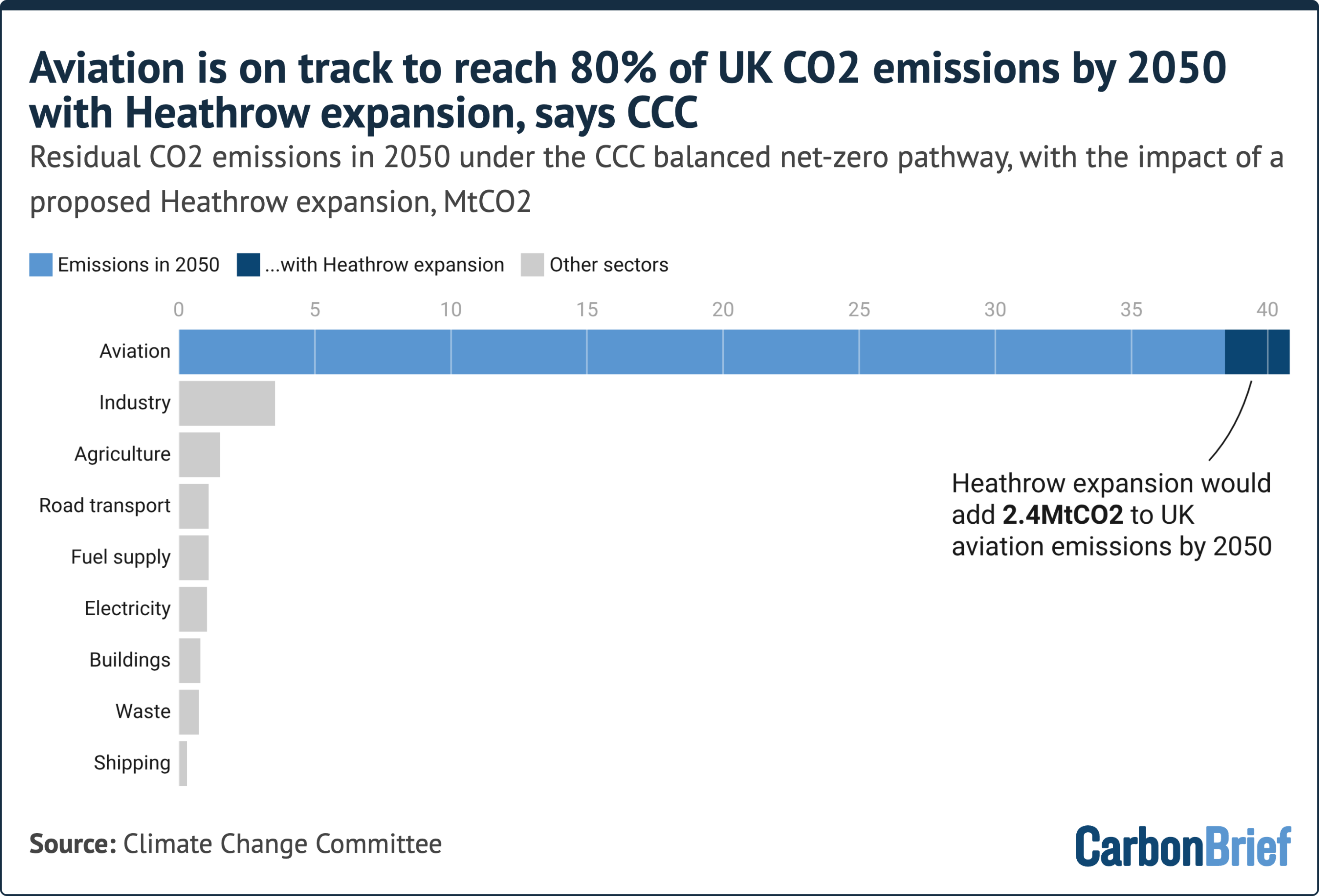
In mid-2026, the Climate Change Committee published a damning assessment detailing that, far from declining, baseline aviation carbon emissions are projected to reach 38 million tonnes of CO2 (MtCO2) per year by 2050—even without airport expansion.
Supporting Context & Metrics: Deconstructing the Numbers
To appreciate the scale of aviation’s impact on the national emissions balance sheet, the CCC evaluated baseline flight projections alongside planned airport expansions and carbon-removal capacity.
Sectoral Carbon Budget Disparity
Under the CCC’s "Balanced Net-Zero Pathway," total residual carbon emissions across the entire UK economy in 2050 must not exceed roughly 45 to 50 MtCO2 annually. These remaining emissions must be matched tonne-for-tonne by engineered and natural carbon removals to achieve net-zero balance.
If aviation emissions remain on their current trajectory, the sector alone will contribute approximately 38 MtCO2 in 2050. Should Heathrow expansion proceed, it would add another 2.4 MtCO2 per year by 2050, escalating to 4.5 MtCO2 by 2054 once the expansion operates at full capacity.
2050 UK Residual CO2 Emissions Target (Balanced Pathway)
+--------------------------------------------------------------------+
| Aviation Sector Baseline: 38.0 MtCO2                       [78-80%]|
| Heathrow Expansion:       2.4 MtCO2                          [5%]  |
| ALL OTHER SECTORS COMBINED (Industry, Agriculture, etc.): ~8.0 Mt  |
+--------------------------------------------------------------------+
Technological Realities: SAFs and Carbon Capture
The government’s reliance on technological fixes faces severe physical and economic constraints:

- Sustainable Aviation Fuels (SAFs): While SAFs generate lower lifecycle carbon emissions than standard Jet A-1 kerosene, global production capacity remains negligible. Producing synthetic SAFs requires massive quantities of zero-carbon electricity and green hydrogen, putting aviation in direct competition with heavy industry and home heating for renewable energy resources.
- Engineered vs. Natural Carbon Removals: The CCC clarifies a crucial policy distinction regarding offsets. Natural solutions—such as woodland creation and peatland restoration—are earmarked to balance residual non-CO2 agricultural emissions (primarily methane from livestock). Consequently, aviation cannot rely on tree planting. To offset flight emissions, the industry must rely exclusively on Direct Air Carbon Capture and Storage (DACCS)—a costly technology that mechanically extracts CO2 directly from ambient air and permanently locks it in underground geological formations.
+-------------------------------------------------------------------------------+
| COMPARED OFFSET STRATEGIES FOR RESIDUAL EMISSIONS                             |
+-------------------------------------------------------------------------------+
| Removal Type      | Target Sector Allocation    | Operational Maturity       |
+-------------------+-----------------------------+----------------------------+
| Natural Solutions | Agricultural Methane /      | Currently Active;          |
| (Afforestation)   | Rural Land Use              | Land Availability Limited  |
+-------------------+-----------------------------+----------------------------+
| Engineered DACCS  | Aviation Fuel /             | Nascent; High Energy &     |
| (Direct Air Capture)| Heavy Industrial Residuals| Capital Expenditure Needed |
+-------------------+-----------------------------+----------------------------+
The Economic Mechanism: Passenger Pricing and Equity
Because engineered removals (DACCS) remain expensive, internalizing the cost of decarbonizing aviation will significantly raise operational expenses for airlines. The CCC estimates that applying the "polluter pays" principle directly to ticket costs to cover required DACCS and SAF supply chains would result in noticeable price adjustments by 2050 (expressed in 2024 monetary values):
- Short-Haul Return Flight (e.g., London to Alicante): Additional cost of approximately £150 per ticket.
- Long-Haul Return Flight (e.g., London to New York): Additional cost of approximately £400 per ticket.
Projected Ticket Cost Increases by 2050 under "Polluter Pays" Framework
+--------------------------------------------------------------------+
| Short-Haul Return (e.g., Alicante)  | +£150                        |
+--------------------------------------+-----------------------------+
| Long-Haul Return (e.g., New York)    | +£400                       |
+--------------------------------------------------------------------+
(Figures in constant 2024 GBP)
This economic strategy also addresses a fundamental social equity concern. Data from the UK National Travel Survey indicates that roughly 50% of the UK population does not fly in any given year, while a small minority of frequent flyers accounts for the vast majority of international trips. Funding aviation decarbonization through general taxation would mean non-flying citizens subsidize the emissions of frequent travelers. Forcing airlines to cover their full carbon removal footprint ensures that those who generate the emissions shoulder the financial burden, naturally dampening unconstrained demand growth.
Official Statements & Policy Controversies
The publishing of the CCC’s advice triggered renewed debates among climate scientists, government officials, and industry representatives regarding national infrastructure priorities.
The Climate Change Committee
In a formal press briefing, Nigel Topping, Chair of the Climate Change Committee, delivered an unambiguous assessment of the current policy gap:
"The UK does not currently have a credible plan to reduce aviation emissions in line with net-zero, so that creates a serious challenge for meeting our climate commitments. Expanding Heathrow would compound the problem unless a robust policy framework is established first."
Topping reiterated that while technology must play a central role, relying on future technological breakthroughs without managing demand is a high-risk policy gamble that threatens the UK’s legal carbon budgets under the Climate Change Act.
Government Position and Political Friction
The Labour administration finds itself at a policy crossroads. On one hand, ministers have signaled support for major infrastructure projects—including Heathrow’s proposed third runway—framing them as essential drivers for national economic growth, trade, and international connectivity.
On the other hand, government officials have publicly acknowledged that the optimistic baseline projections embedded in the 2022 Jet Zero plan were flawed. Ministers now face the challenge of reconciling infrastructure growth with a promised revision of the national aviation strategy set for 2027.
Industry Perspectives
Aviation representatives and airport operators contend that restricting airport capacity or increasing passenger taxes risks harming the UK’s economic competitiveness, particularly post-Brexit. Industry groups argue that government policy should focus on providing subsidies, tax credits, and capital guarantees to accelerate domestic SAF production facilities and scaling DACCS technology, rather than suppressing passenger demand through taxation.
However, environmental legal experts note that under the Climate Change Act, the Secretary of State has a statutory obligation to ensure carbon budgets are met. Should the government approve Heathrow’s expansion without proving how the additional 2.4 to 4.5 MtCO2 will be mitigated, it could face legal challenges in the High Court.
Future Outlook: Key Milestones and Decision Pathways
The UK aviation sector stands at a critical transition point. Over the next three to five years, executive decisions will determine whether aviation can align with net-zero targets or remain a primary obstacle to national decarbonization.
+-----------------------------------------------------------------------------------+
| ROADMAP TO 2030: KEY DECISION POINTS                                              |
+-----------------------------------------------------------------------------------+
| 2027: Publication of Revised Aviation Strategy                                    |
| - Expected inclusion of binding SAF mandates.                                     |
| - Introduction of polluter-pays mechanisms for DACCS funding.                     |
| - Establishing a formal framework for flight demand management.                 |
+-----------------------------------------------------------------------------------+
| 2029: Statutory Decision on Heathrow Third Runway                                 |
| - Final National Policy Statement evaluation.                                     |
| - Assessment of carbon budget compatibility based on 2027 policy updates.         |
+-----------------------------------------------------------------------------------+
| 2030: Interim Emission Milestones                                                 |
| - Testing early commercial scale of domestic DACCS projects.                      |
| - Benchmarking initial SAF integration targets across major UK airports.          |
+-----------------------------------------------------------------------------------+
Crucial Steps Forward
- The 2027 Revised Policy Framework: The upcoming 2027 strategy must transition from optimistic assumptions to binding regulatory frameworks. This includes setting clear carbon caps for airport operators and establishing price-support mechanisms for engineered removals paid for directly by the aviation sector.
- Managing Demand Growth: If technological scaling falls short of target dates, the government will likely be forced to consider explicit demand-management tools. These could include targeted airport capacity constraints, passenger levies, or a frequent flyer levy.
- The 2029 Heathrow Benchmark: The final decision on expanding Heathrow Airport will serve as a key test of the UK’s climate governance. Approving expansion without a proven, fully funded framework for carbon removal will make meeting the 2050 statutory target mathematically unviable.
Ultimately, the Climate Change Committee’s warning leaves little room for ambiguity. The UK cannot achieve its net-zero goals while treating aviation as an exception to carbon constraints. Whether through rapid, industry-funded technological deployment or structural demand management, the true cost of flying must be accounted for if the UK is to maintain its climate commitments.



