

Executive Overview
The global transition to electrified transport reached another major milestone in August 2026, driven by an ongoing divergence between pure battery-electric vehicles (BEVs) and plugin hybrid electric vehicles (PHEVs). Worldwide plugin vehicle registrations grew by 5% year-over-year (YoY) to finish the month at approximately 1.8 million units.

Underneath this headline figure, however, lies a stark polarization. BEVs continue to post robust double-digit growth, expanding 13% YoY, whereas PHEVs have slipped into a deep, sustained downturn, contracting by 12% YoY. Year-to-date (YTD) data further underscores this shift: while overall plugin growth remains modest at 4% YoY, this sluggishness is exclusively attributable to the "PHEV blues," which are down 11% over the same period. Meanwhile, pure electrics are pressing forward with a healthy 12% YTD expansion.

This fundamental rebalancing is reshaping vehicle segment shares. In August, BEVs commanded 73% of total plugin sales—translating to roughly 1.3 million units and marking one of the highest concentrations of pure electric sales in recent years. Consequently, the YTD market breakdown stands at 71% for BEVs and 29% for PHEVs, a ratio not seen in favor of pure electrics since 2022.
Regional anomalies help explain these shifting dynamics. Both China and the United States are currently navigating unique headwinds: PHEVs are losing significant ground in the Chinese market, while U.S. adoption remains hampered by the expiration of federal EV tax credits and weakened domestic automotive policy frameworks. Excluding these two massive markets, global EV sales are soaring, jumping an impressive 53% YoY in July, with BEVs surging by 62% over the same period.
When evaluated against the broader automotive landscape, plugin vehicles achieved a 27% market share in August (20% for BEVs and 7% for PHEVs). This performance keeps the full-year 2026 projection strong, with BEVs tracking at 17% and PHEVs at 7%, yielding a combined 24% EV share. Factoring in traditional hybrids (HEVs) at a 15% market share, an extraordinary 39% of all new cars sold globally in 2026 feature some degree of powertrain electrification.

Detailed Chronology: August 2026 Market Performance
Model Rankings: The Ascent of Small EVs and Export Surges
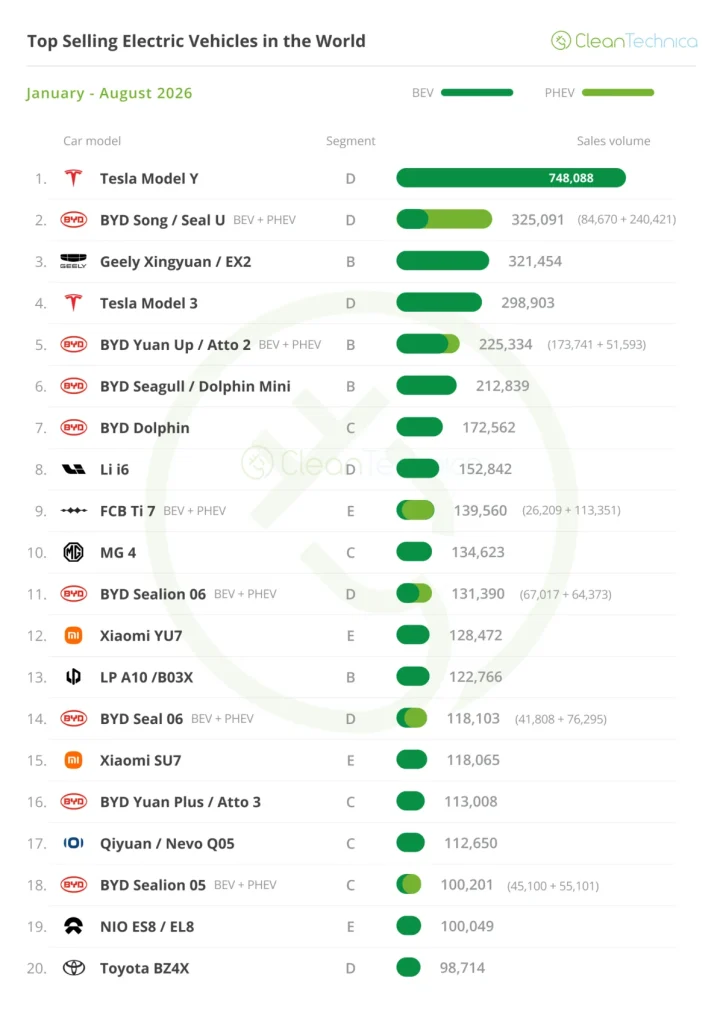
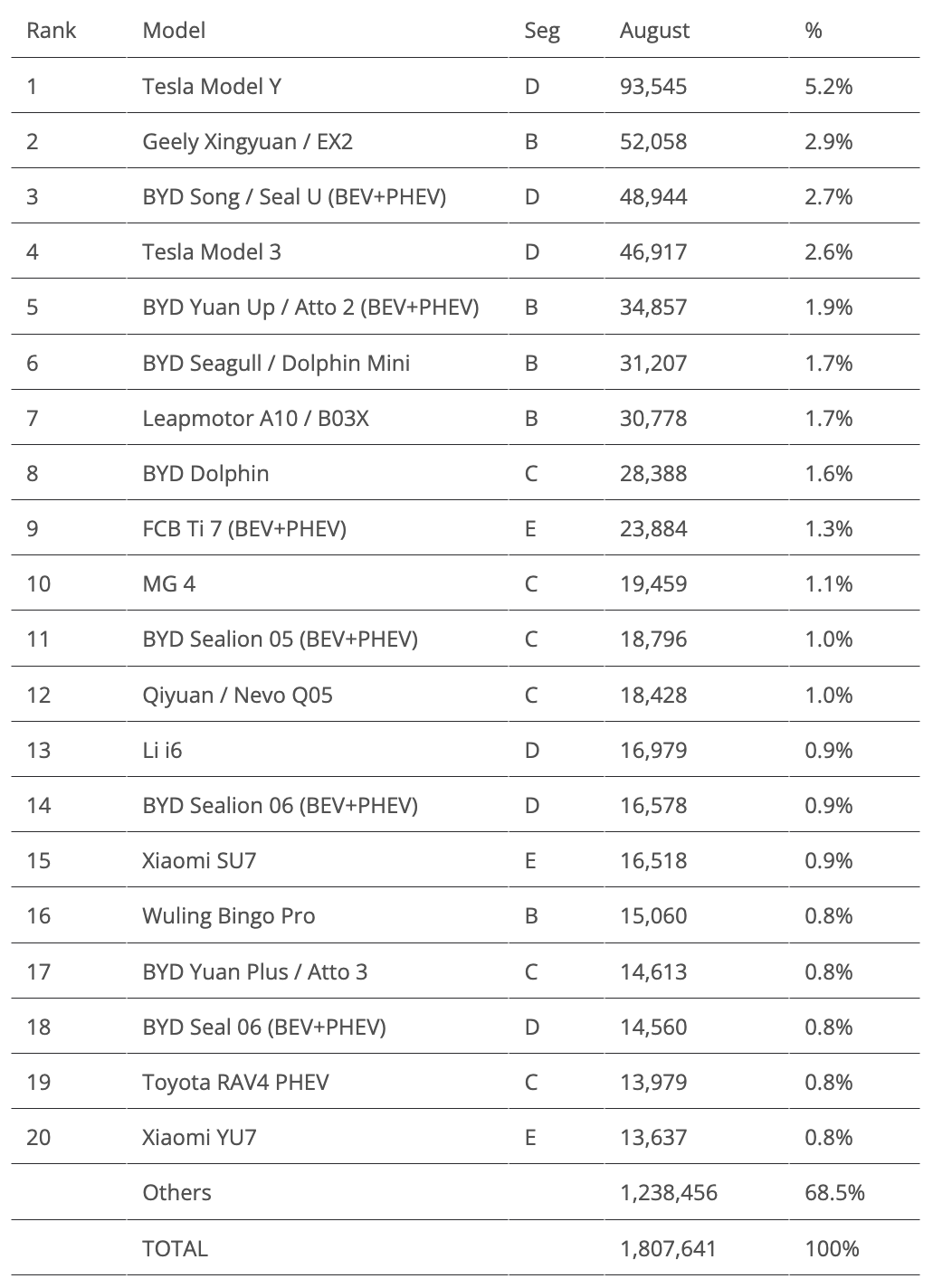
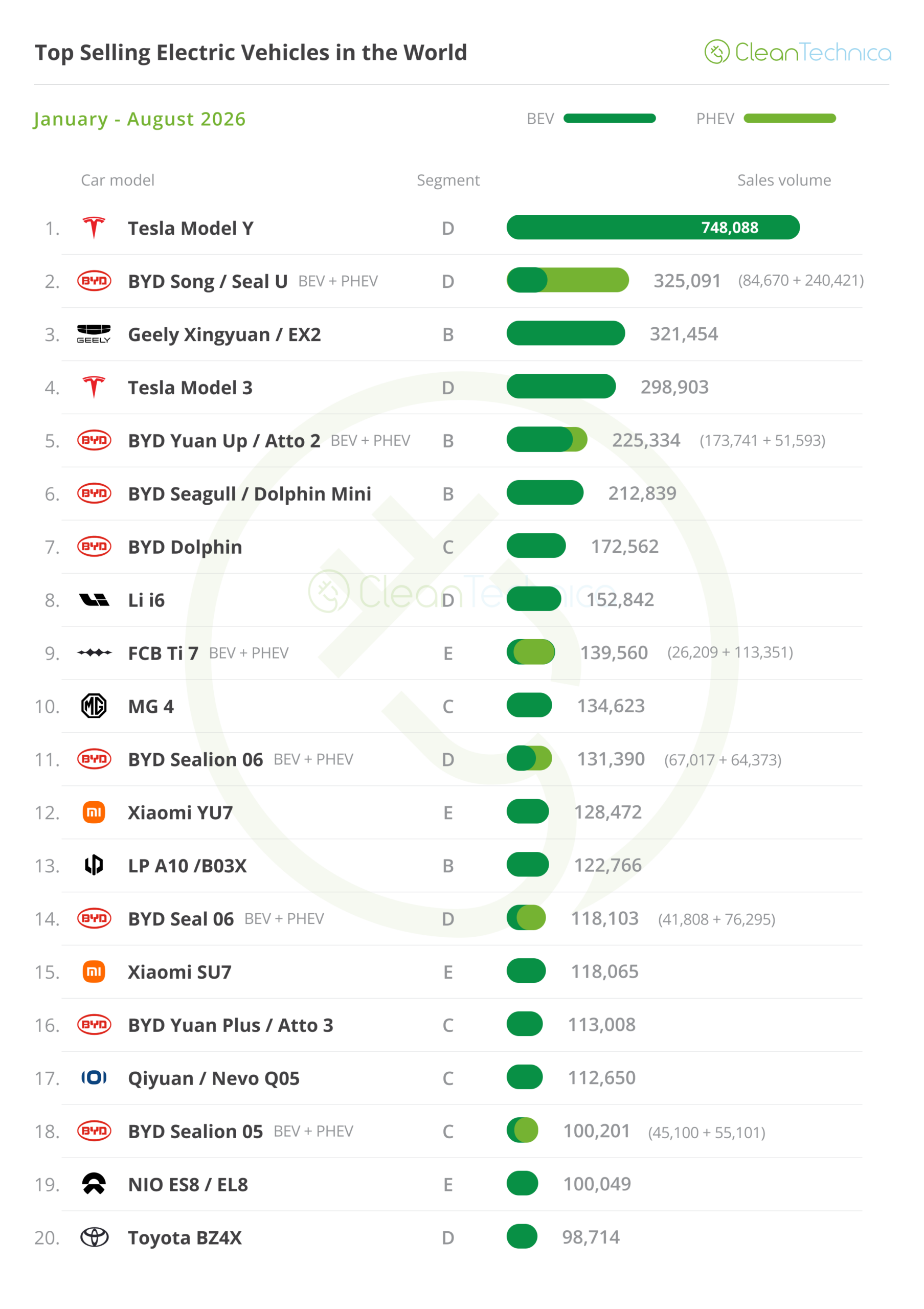
While the Tesla Model Y defended its crown at the top of the global sales charts despite a 12% YoY delivery drop, the lower rungs of the podium and the broader top-twenty table witnessed intense volatility and structural shifts.

- The Geely Xingyuan: Benefiting from robust domestic demand and the launch of volume exports, Geely’s compact hatchback (marketed as the E2 or EX2 abroad) achieved a record-breaking 52,058 units in August. This performance surpassed the BYD Song, propelling the Xingyuan into second place globally. Export momentum was led by Brazil (5,804 units), Thailand (1,770), Indonesia (1,595), and Australia (1,279).
- The BYD Song: Relegated to third place, the Song nonetheless grew 21% YoY with 48,944 registrations. Bolstered by an export push—notably Brazil (6,724 units), Italy (1,477), and Germany (1,466)—and the rollout of a new-generation Ultra body featuring advanced flash-charging capabilities, the Song remains a formidable competitor positioned to challenge the Model Y during off-peak months like October.
- The Small EV Wave: The lower half of the top ten was dominated by compact, efficient city cars occupying positions five through eight: the BYD Yuan Up (#5, sold as the Atto 2 in some regions), the BYD Seagull (#6, also known as the Dolphin Mini, Dolphin Surf, and Atto 1), the Leapmotor A10 (#7), and the BYD Dolphin (#8).
Small EVs are proving that mass-market adoption is finally moving past the early-adopter and luxury phases. The Leapmotor A10 (B03X internationally) is rapidly emerging as a sales phenomenon, with early production scaling suggesting future top-five finishes. Meanwhile, the BYD Seagull notched a year-best 31,000 registrations, supercharged by international markets. Brazil has quickly transformed into BYD’s second home market, absorbing 8,299 Seagulls—nearly matching its domestic Chinese volume of 10,103 units. Similarly, the BYD Dolphin secured 28,388 registrations, its best result since December 2023, anchored by 6,740 sales in Brazil alone.

- Premium Surges and Legacy Surprises: BYD’s luxury brand, Fang Cheng Bao, placed its Ti 7 flagship crossover in ninth place with nearly 24,000 registrations, signaling a direct challenge to established luxury SUV mainstays from Land Rover, Jeep, and Toyota should export volumes scale. Further down the table, the Toyota RAV4 PHEV made a dramatic return to the top twenty at 19th place, registering nearly 14,000 units globally following its long-awaited next-generation global rollout. This figure doubles the peak performance of the previous generation, establishing the RAV4 PHEV as a major profit driver in Toyota’s lineup.
Supporting Context & Metrics: Brands and Manufacturers
Brand-Level Dynamics: Toyota’s Legacy Ascendancy
In the brand rankings, Leapmotor continued its aggressive upward trajectory, crossing the six-digit sales threshold for the second consecutive month. Growing at 81% YoY, Leapmotor surpassed Geely in August, exposing Geely’s heavy reliance on the Xingyuan for total volume. Analysts note that Geely needs to introduce broader portfolio options—such as a midsize SUV to rival the Model Y or a direct competitor to the BYD Dolphin—to secure sustained brand diversification.

Meanwhile, Toyota recorded a historic high of 52,576 registrations, outperforming Volkswagen and claiming the title of best-selling legacy manufacturer for the month. Toyota’s resurgence is underpinned by broad-based volume: contributions from the RAV4 PHEV, the BZ4X (up 116% YoY), and Chinese-market joint-venture models like the BZ7 sedan and BZ3X compact crossover (adding roughly 15,000 units in August alone).

OEM Standing: Diversification and Shifting Market Shares
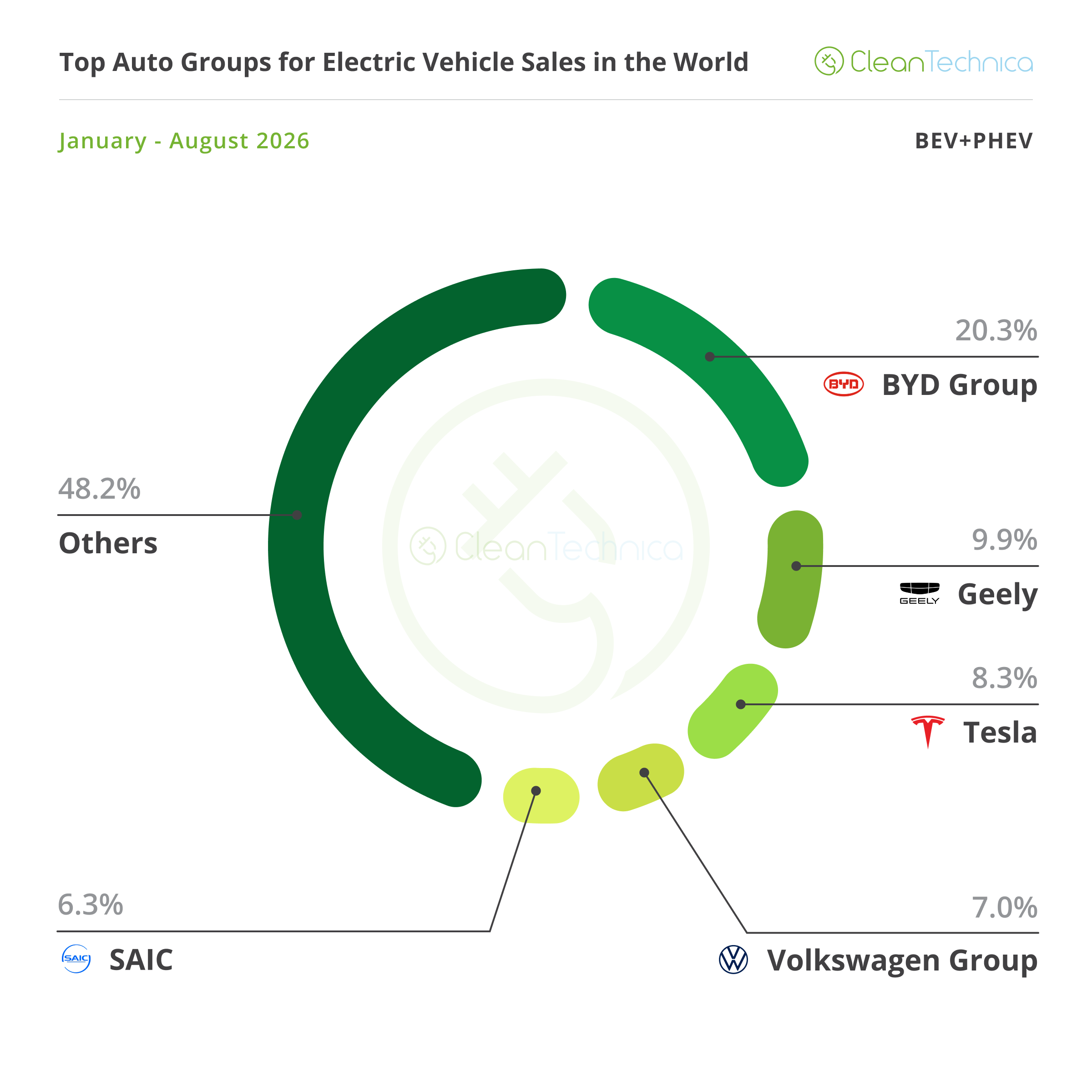
Looking at the original equipment manufacturer (OEM) scoreboard for the January–August period:
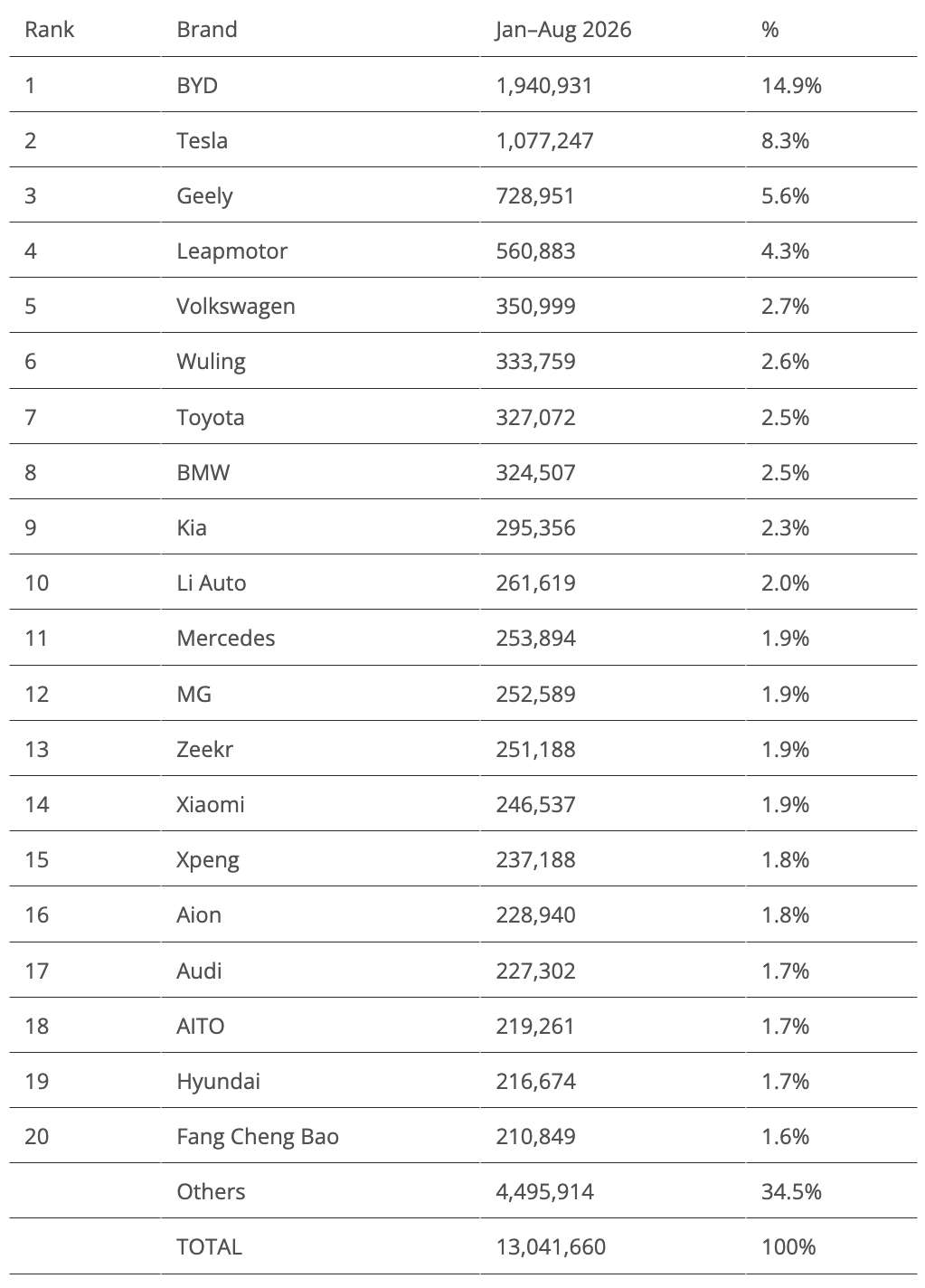
- BYD remains comfortably in the lead, capturing 20.3% of the global plugin market.
- Geely holds second place with 9.9% market share.
- Tesla sits in third with 8.3%.
- Volkswagen Group maintains fourth place at 7.0%, closely shadowed by SAIC at 6.3%.
Notably, all top-five OEMs experienced year-over-year market share erosion, pointing to a rapidly diversifying global market where emerging players are capturing greater slice volumes. Leapmotor has climbed to sixth place with a 4.3% share, widening the gap over Hyundai-Kia (4.0%). Toyota has advanced to eleventh place (2.9%) and is projected to overtake BMW (3.0%) on a full-year basis.
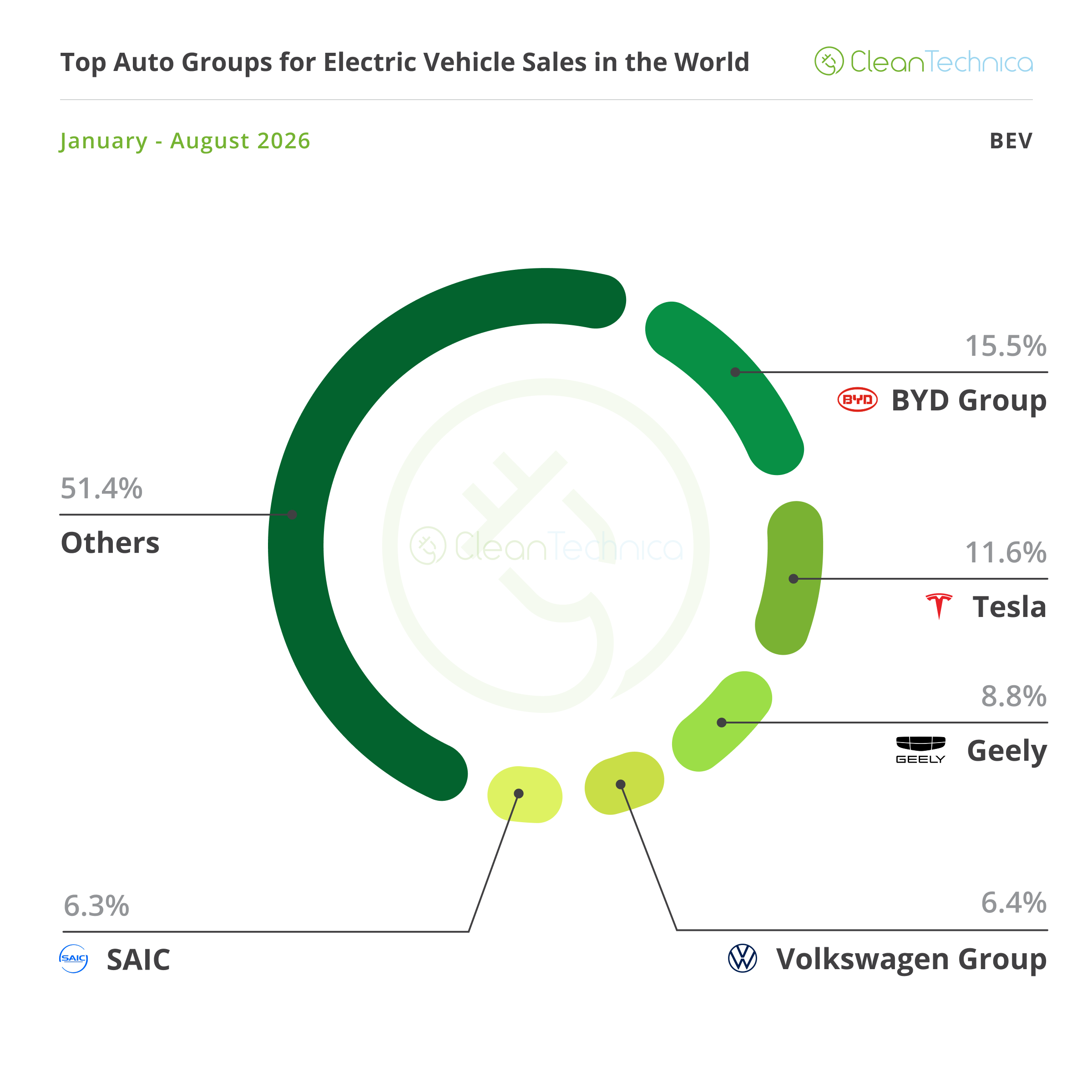
Focusing strictly on the BEV-only landscape (accounting for 9.2 million registrations YTD), BYD leads with 15.5% of the market, followed by Tesla at 11.6% and Geely at 8.8%. SAIC (6.3%) continues to narrow the gap with Volkswagen Group (6.4%) for fourth place.
Future Outlook
As the global automotive industry navigates the final four months of 2026, several critical storylines are set to dictate market trajectories:

- The Battle for Silver and Bronze: While the Tesla Model Y remains in a league of its own as the undisputed global gold standard, the race for second and third place in the YTD model rankings is wide open. The BYD Song, Geely Xingyuan, and Tesla Model 3 are locked in a high-stakes battle that will likely remain undecided until the closing weeks of the fourth quarter.
- Legacy Aggression vs. Startup Momentum: Traditional heavyweights like Toyota are proving that established manufacturing scale and multi-powertrain hedging can yield formidable EV results when backed by dedicated next-generation architectures. Conversely, Chinese challengers like Leapmotor and Xpeng are demonstrating that rapid international expansion—particularly in Latin America and Southeast Asia—can offset localized regulatory hurdles in North America and Europe.
- The Small EV Revolution: The explosive demand for compact, efficient hatchbacks and crossovers demonstrates that the electric vehicle transition has successfully breached the mass market. As charging infrastructure matures and global supply chains adapt, affordability and efficiency will reign supreme, permanently altering what consumers expect from an entry-level vehicle.
With nearly 39% of all new cars sold globally featuring an electrified powertrain in 2026, the tipping point toward a post-internal combustion era is no longer a distant projection—it is the active reality of the global automotive marketplace.



