Executive Overview
The global electric vehicle (EV) landscape is undergoing a profound structural evolution. July global plugin vehicle registrations climbed 7% year-over-year (YoY) to close the month at approximately 1.8 million units. Beneath this headline figure, however, lies a stark divergence in powertrain fortunes: pure battery-electric vehicles (BEVs) surged by 16% YoY, while plugin hybrid electric vehicles (PHEVs) struggled in deep red, tumbling 11% YoY.
This widening chasm has pushed BEVs to account for 71% of total plugin sales for the month—totaling 1.3 million units—and matching their highest year-to-date (YTD) market share breakdown since 2022. When stripping away the unique market distortions found in China (where PHEVs have hit a steep downward correction) and the United States (where adoption continues to reel from the phasing out of federal tax credits), the global EV market is flying high. Excluding these two massive territories, global plugin registrations jumped a staggering 50% YoY in July, with BEVs skyrocketing 61%.
Overall, the global plugin vehicle market secured a commanding 24% market share for the month (17% BEV, 7% PHEV). To put this rapid acceleration into historical perspective, the global EV market share stood at just 6% five years ago and hovered near 1% a decade ago. Mass adoption is no longer a distant horizon; it is the dominant reality of the modern automotive ecosystem, driven increasingly by efficient, affordable small cars and aggressive global export strategies.
Detailed Chronology: July’s Shifting Model Rankings and Market Dynamics
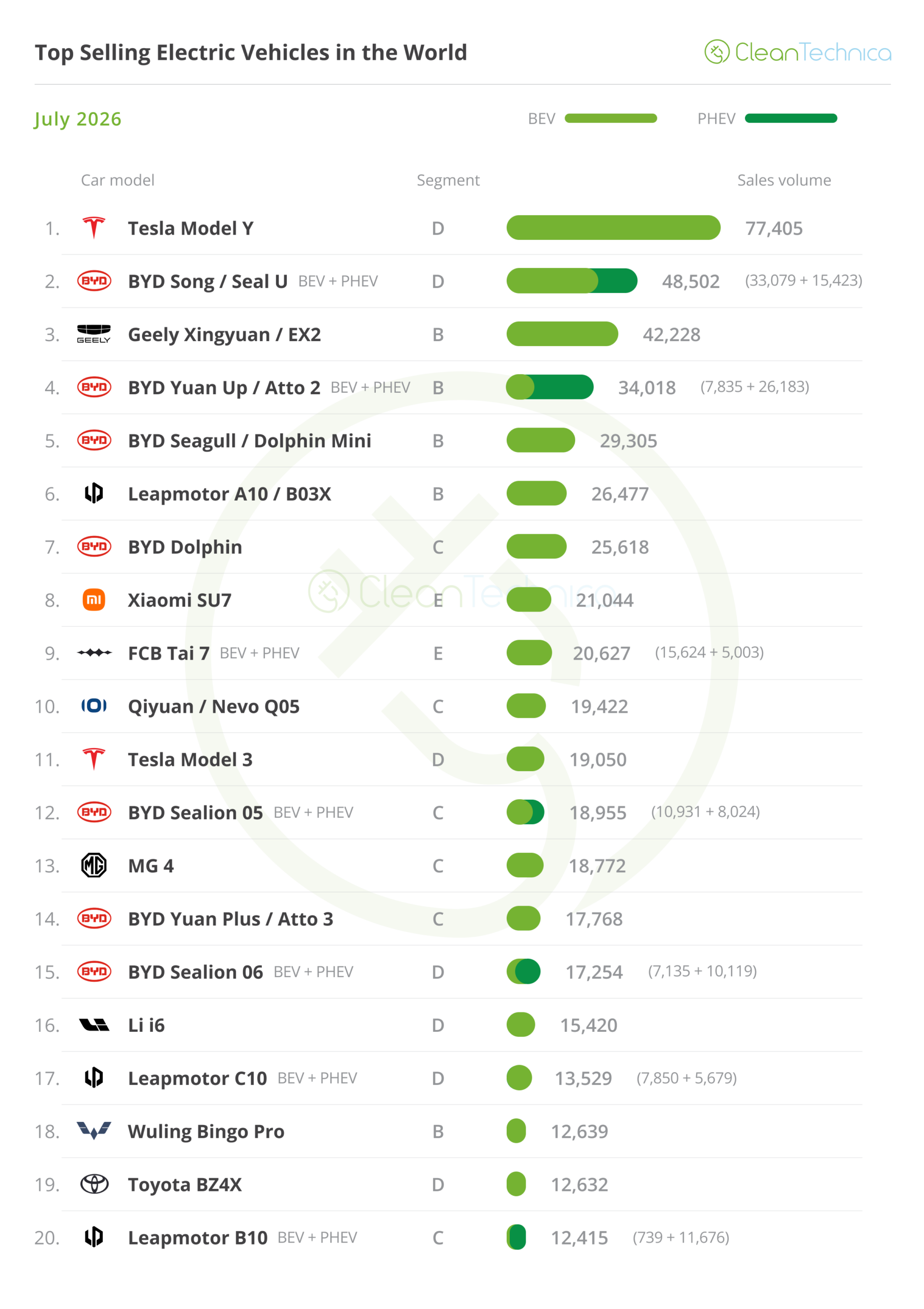
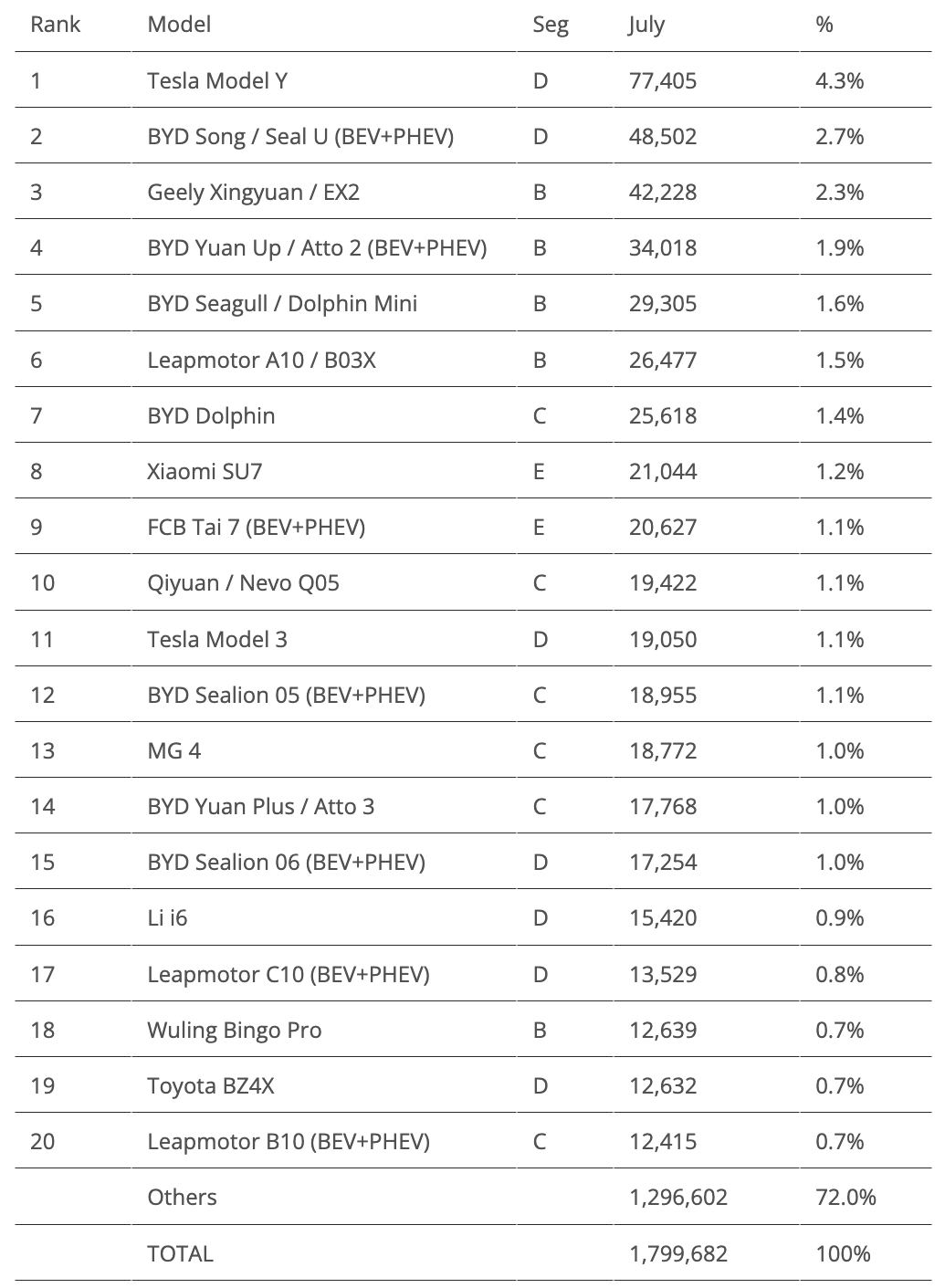
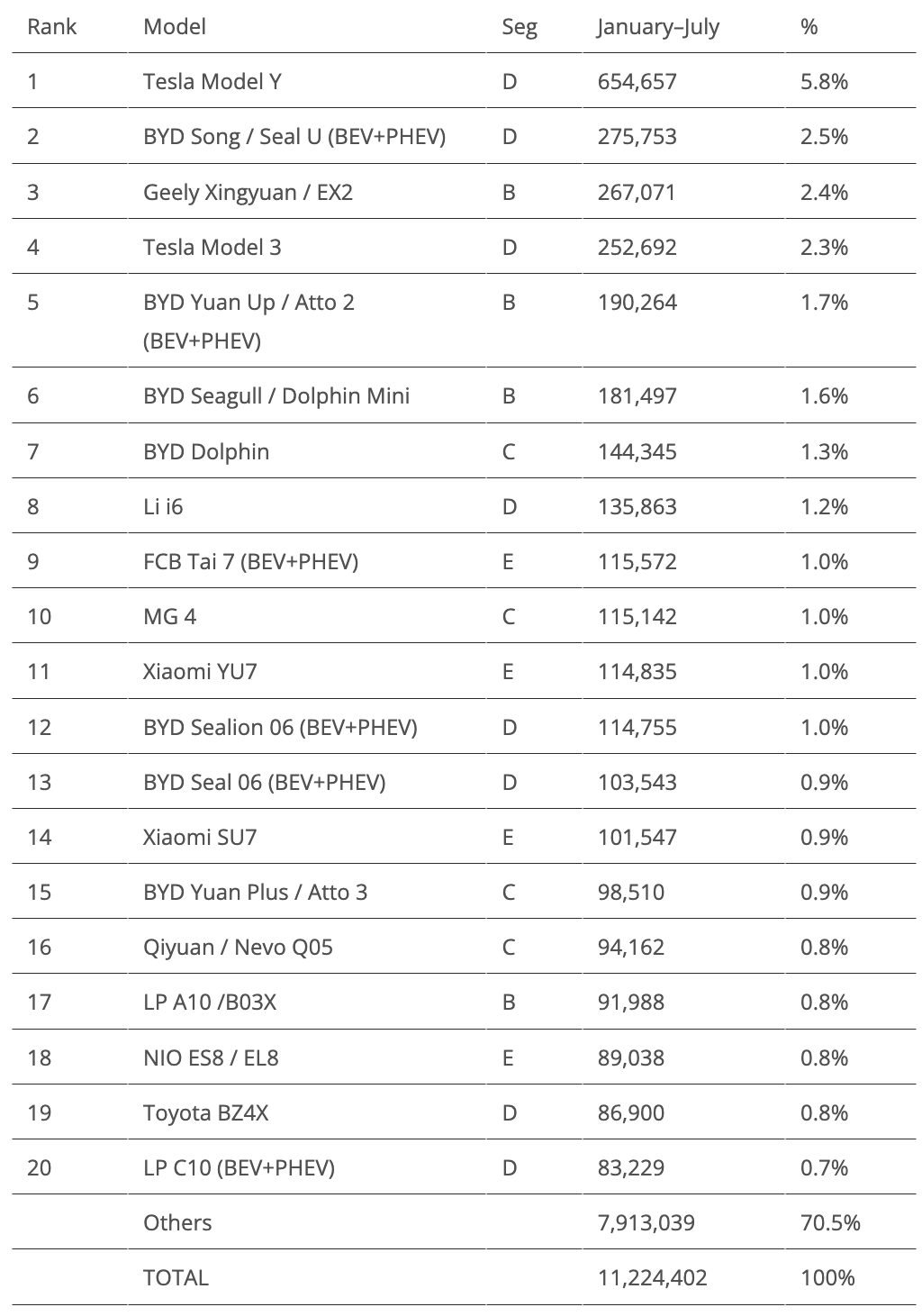
The July sales charts delivered some of the most dramatic upsets and market re-alignments in recent memory. While the Tesla Model Y retained its crown at the top of the global model table—despite a 9% YoY delivery dip—the real story unfolded just beneath it.
The Model 3 Slump and the Rise of the Small EV
The Tesla Model 3 suffered a severe 44% YoY delivery crash down to 19,000 units, sliding to 11th place globally. This marks the sedan’s lowest standing since January 2018, with emerging competitors like the Xiaomi SU7 (8th place, 21,000 units) outperforming it for the month. Analysts attribute the temporary plunge to production line transitions and localized inventory constraints rather than a collapse in underlying demand, meaning a rebound is widely expected in August and September.
Capitalizing on the Model 3’s slow month, a wave of compact and small EVs dominated the table from 3rd to 7th place:
- #3 Geely Xingyuan
- #4 BYD Yuan Up
- #5 BYD Seagull (marketed locally as the Dolphin Mini, logging 7,265 units in July alone)
- #6 Leapmotor A10 (known as the B03X in export markets)
- #7 BYD Dolphin
The BYD Dolphin staged a stellar comeback, pulling in 26,000 registrations—its best performance since last September—bolstered by robust export volumes. South Korea contributed 1,264 units, while Brazil absorbed an astonishing 6,492 registrations, cementing Latin America as BYD’s thriving home away from home.
Meanwhile, the Leapmotor A10 is rapidly emerging as a global sales phenomenon. After dominating domestic sales tables in China, the small crossover is gearing up for aggressive international deployment, positioning itself as a future top-five global contender.
BYD’s Broad Offensive and Legacy Automaker Struggles
BYD’s dominance extended across multiple segments. The BYD Song claimed second place globally, buoyed by an export push and the rollout of its next-generation Ultra body featuring ultra-fast flash-charging capabilities. The Fang Cheng Bao Tai 7—the flagship crossover from BYD’s premium brand—peaked at 9th place with nearly 21,000 registrations, signaling a direct threat to established legacy premium marques like Land Rover, Toyota, and Jeep.
Among traditional legacy automakers, the Toyota bZ4X managed to secure 19th place, representing a rare bright spot for traditional original equipment manufacturers (OEMs) on the top-20 model table. However, compact SUV competition intensified dramatically: the next-generation Toyota RAV4 PHEV reached a record 12,236 registrations, missing a top-20 finish by fewer than 200 units and outperforming several dedicated battery-electric models.
Supporting Context & Metrics: The OEM Power Struggle
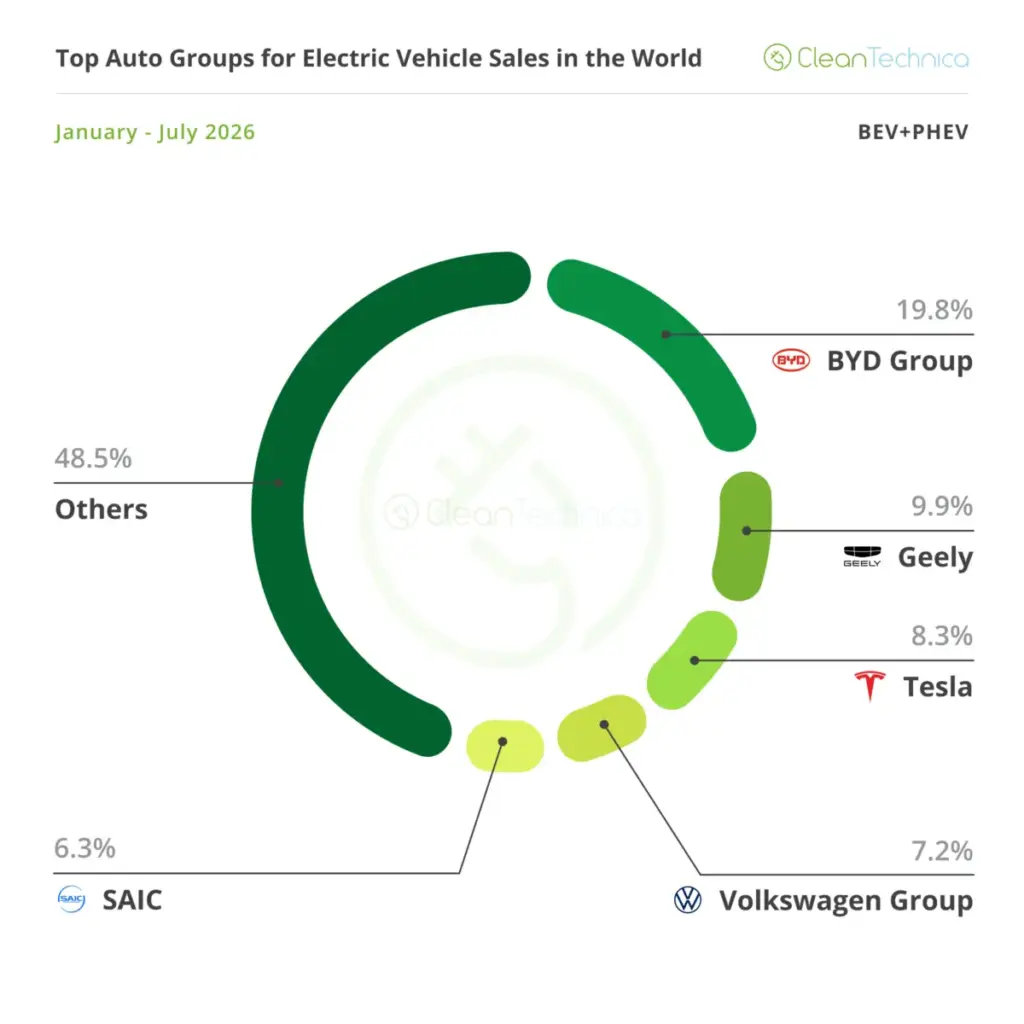
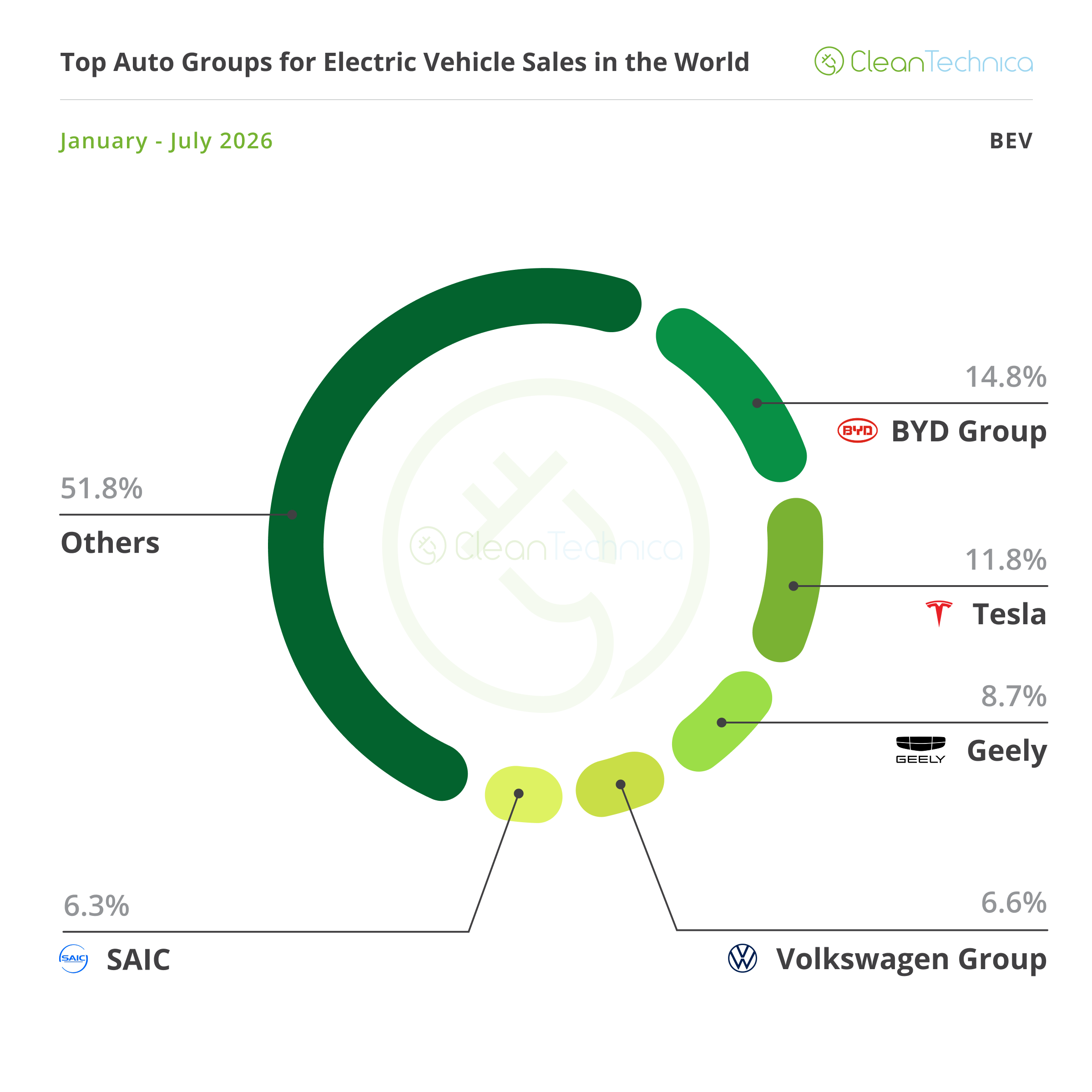
The manufacturer rankings reveal seismic shifts in the global automotive hierarchy. Most notably, American pioneer Tesla dropped to 6th place among global OEMs in July—its lowest monthly standing in nine years.
Leapmotor Joins the "Big Boys Table"
Leapmotor has cemented its status as a top-tier global automotive powerhouse. Achieving a historic milestone, Leapmotor crossed the six-digit monthly delivery threshold for the first time, doubling its output YoY (+102%). The startup narrowly missed the runner-up spot for the month, forcing Geely (108,000 registrations) into defensive operational overdrive.
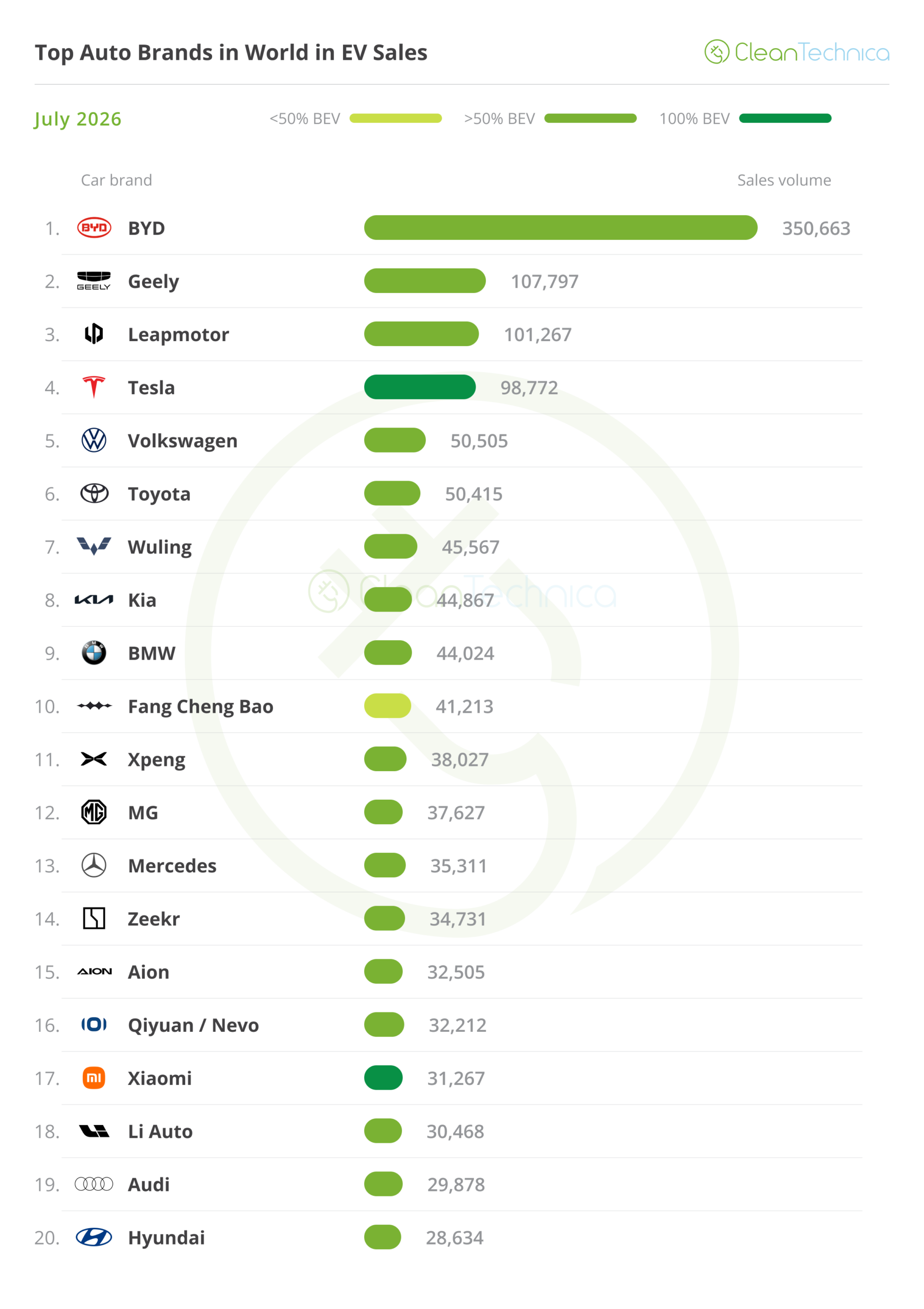
Leapmotor now boasts three models in the global top 20 (the A10, B10, and C10), a feat matched by very few brands. Industry observers frequently compare Leapmotor’s ruthless execution and high-efficiency value propositions to historical sporting powerhouses: they may not always field the flashiest product, but their operational execution and market-fit precision win games.
Toyota’s Ascent and Volkswagen’s Tightening Lead
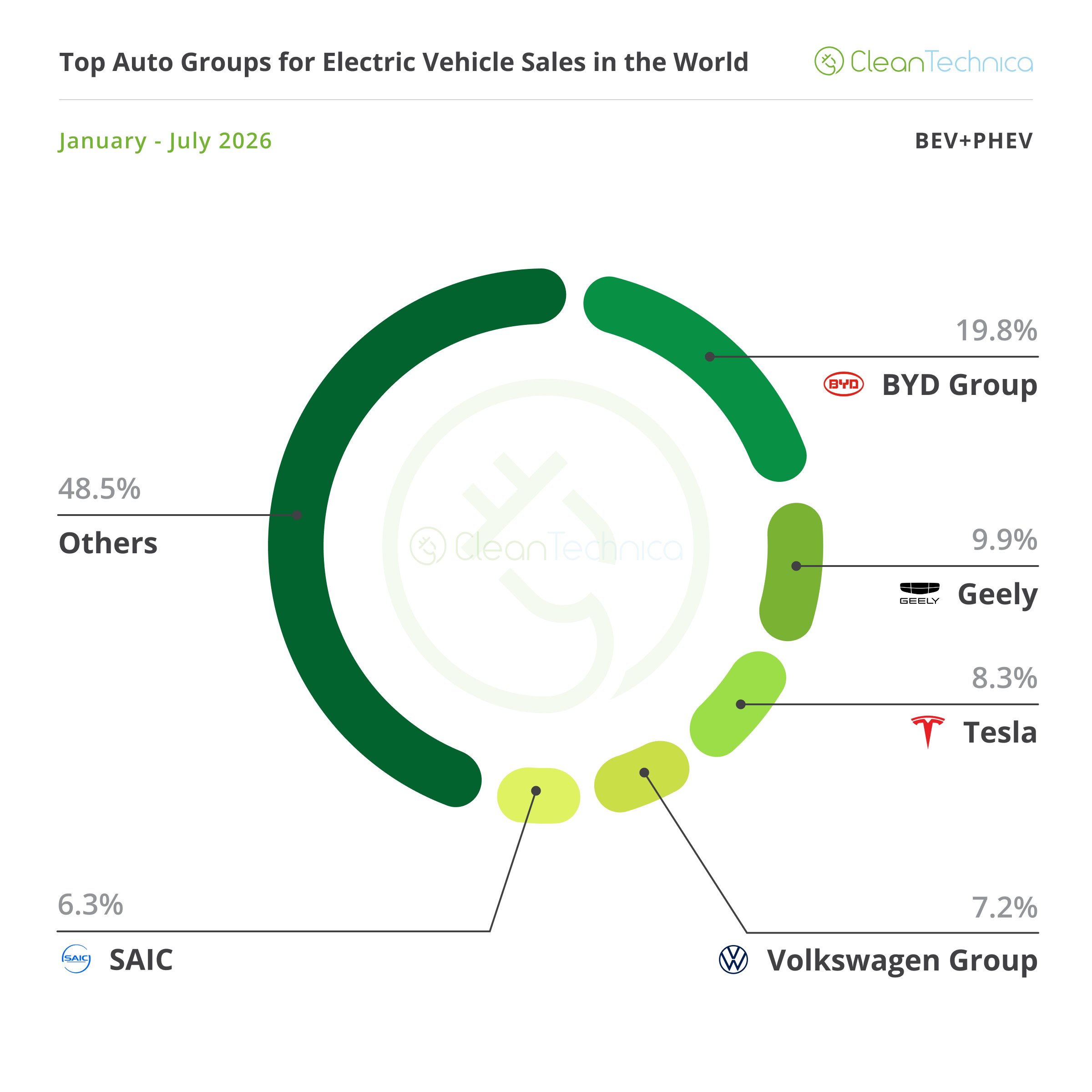
Toyota continues its aggressive charge into electrification, setting a new record of 50,415 registrations in July. This surge brings the Japanese giant within striking distance of the Volkswagen Group, which maintained 4th place by a razor-thin margin of fewer than 100 units.
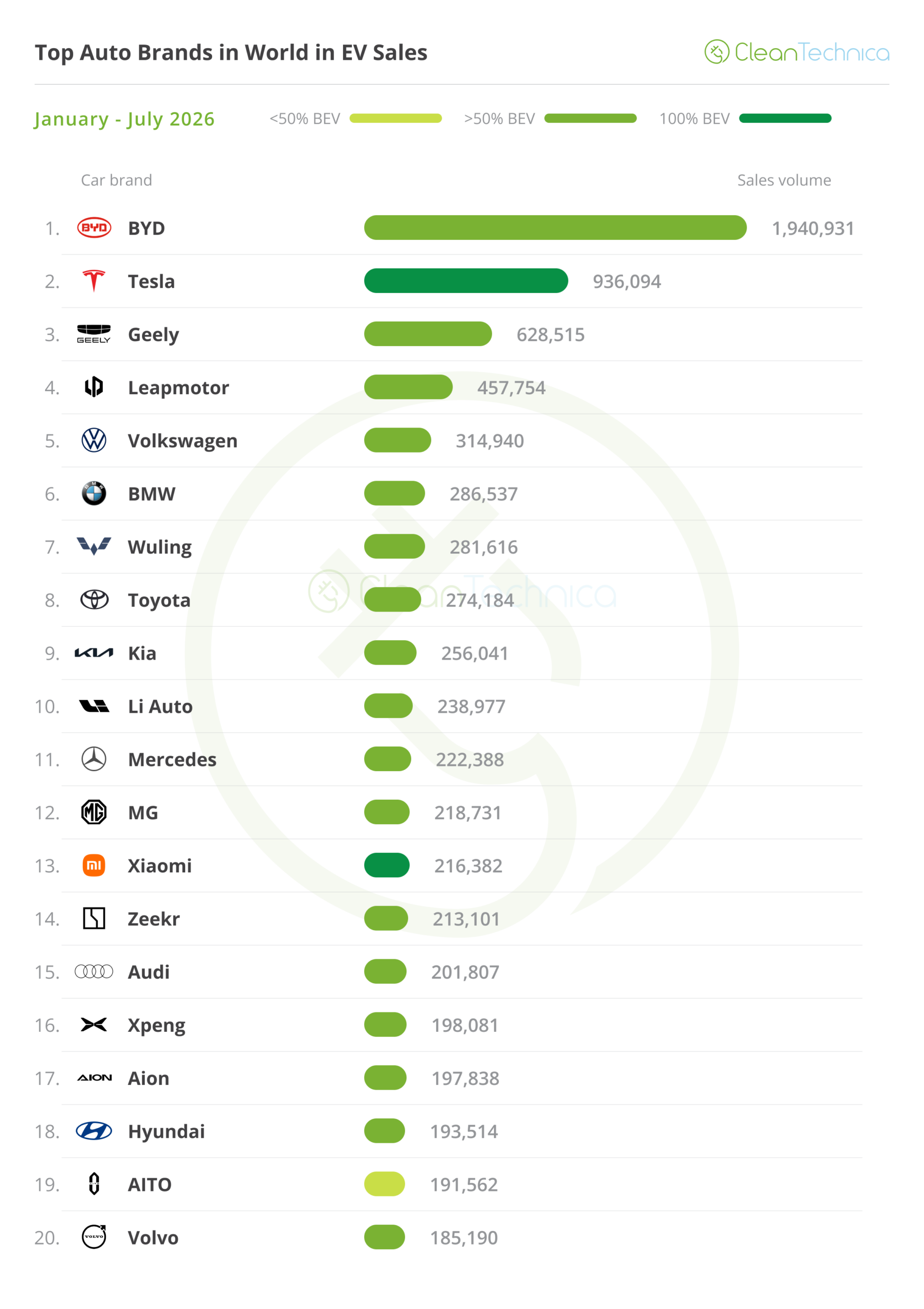
In the battle of legacy Korean groups, Kia outperformed its corporate sibling Hyundai by capitalizing on a dedicated, comprehensive BEV portfolio spanning the EV2, EV3, EV4, EV5, EV6, and EV9. Hyundai, by contrast, saw its market share diluted by a more fragmented investment strategy that included fuel cells and ICE-derived platforms.
Official Statements & Industry Perspectives
Industry analysts tracking the July data emphasize that the transition from elite luxury adoption to mass-market ubiquity is officially underway.
Market researchers note that the rapid proliferation of subcompact and compact EVs—such as the Geely Xingyuan, BYD Seagull, and Leapmotor A10—proves that manufacturers are successfully engineering vehicles tailored to the economic realities of average consumers.
Commenting on the structural decline of PHEVs in key markets, energy transition analysts point to tightening regulatory frameworks and consumer preference shifting decisively toward pure battery systems as public charging infrastructure matures. The data confirms that while plug-in hybrids served as a vital bridge technology during the early 2020s, pure electrics are rapidly reclaiming absolute market dominance.
Future Outlook: Q3 and Beyond
As the automotive industry heads into the final quarters of 2026, several critical storylines will dictate the trajectory of the global EV market:
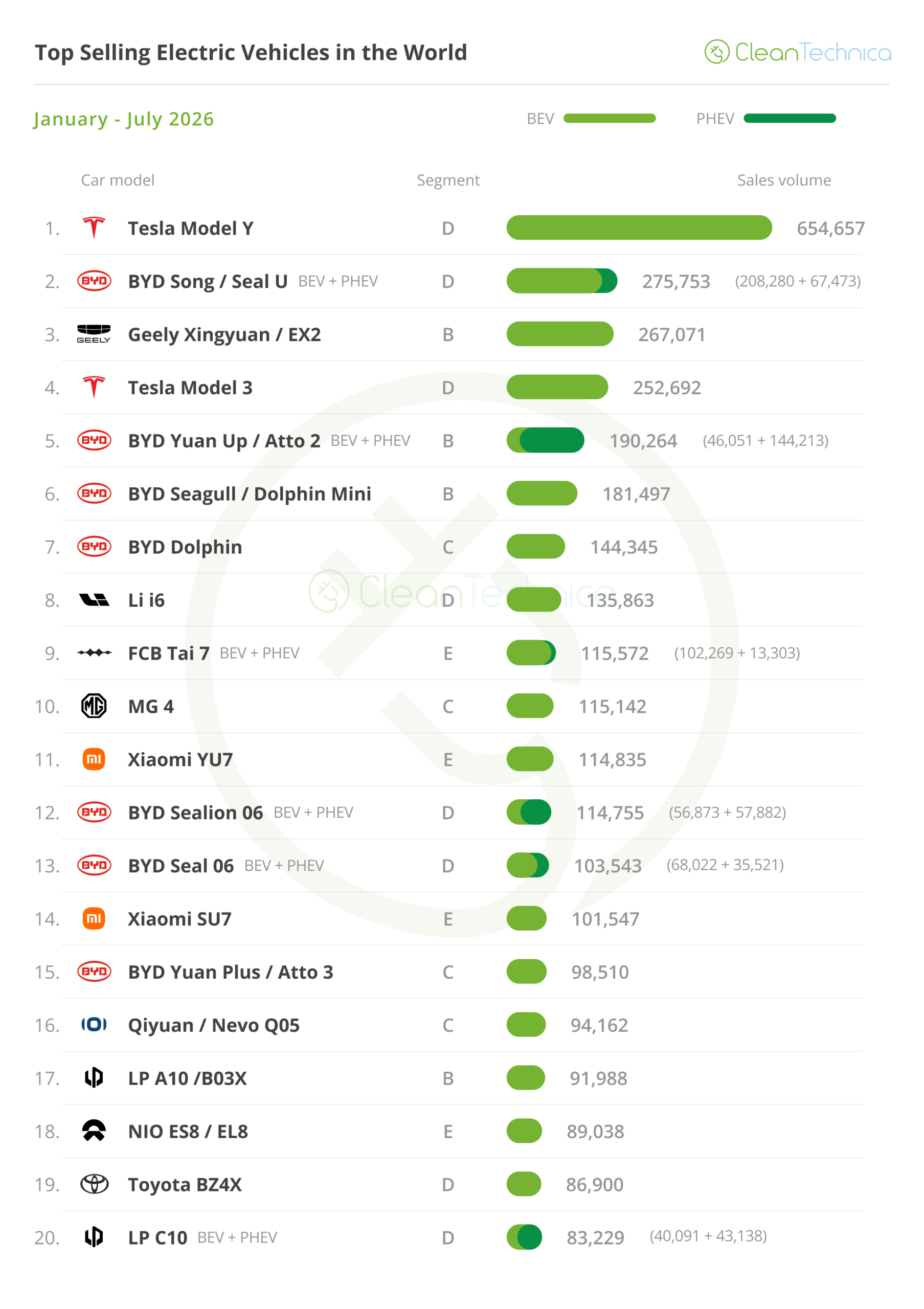
- The Bronze Medal Race: While the Tesla Model Y and BYD Song maintain secure leads in the YTD model standings, the fight for third place between the Geely Xingyuan and a rebounding Tesla Model 3 promises intense competition through Q3 and Q4.
- Legacy Counter-Offensives: Traditional giants like Toyota and Volkswagen face mounting pressure from agile Chinese startups. Toyota’s aggressive push into hybrid and battery-electric crossovers signals that the "sleeping giant" has fully awakened.
- M&A and Strategic Partnerships: Whispers surrounding Leapmotor’s long-term international expansion include potential joint ventures or brand acquisitions within Europe (such as partnering with distressed European legacy assets like certain Stellantis nameplates). If executed, such a move could redraw the map of European manufacturing.
- BEV Share Expansion: With BEVs holding steady at 71% of total plugin sales and threatening to test even higher thresholds before year-end, the underlying momentum of pure electric mobility remains unstoppable, weathering localized policy headwinds in North America with remarkable resilience.