

Executive Overview
For years, the American electric vehicle (EV) market has operated under an unwritten, highly expensive rule: bigger is better, further is mandatory, and luxury is the baseline. Yet, as the domestic transportation sector remains the single largest contributor to United States greenhouse gas emissions, battery-electric vehicles (BEVs) continue to account for less than 10 percent of total new-vehicle sales. Worse still, that momentum has begun to stall.
The traditional automotive playbook—epitomized by heavy, feature-laden, long-range electric SUVs and full-sized trucks carrying price tags well north of $50,000—has failed to capture the mass market. It is against this grim backdrop of declining sales figures, regulatory rollbacks, and a severe national cost-of-living crunch that a quiet revolution is taking shape. Enter Slate Auto, an automotive startup determined to strip away the excess.
Slate is betting its entire existence on a radical proposition: what if Americans don’t actually need a 350-mile battery, power windows, or a chassis the size of a living room to embrace electrification?
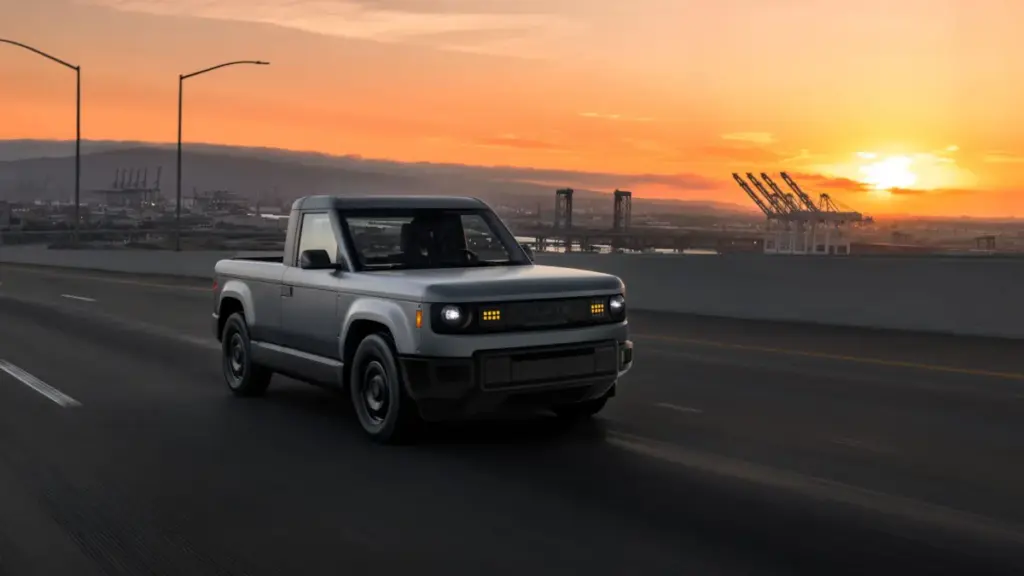
The company’s flagship offering is a compact, two-door electric pickup truck that is shorter than a Honda Civic, features hand-crank windows on its base model, and delivers a modest 205 miles of range. By drastically shrinking the battery pack—the most expensive component of any EV—Slate has managed to engineer a base model priced under $25,000. This is less than half the current average transaction price for a new vehicle in the United States.
Backed by nearly $1.4 billion in venture capital from heavy-hitting investors, including Jeff Bezos, Slate is aiming to deliver its first pre-ordered vehicles by late 2026. As traditional automakers like Ford scramble to retool their strategies following the high-profile demise of luxury-priced electric flagships like the F-150 Lightning, Slate’s austerity-driven model may well be the ultimate test of whether American consumers are ready to trade range anxiety for true affordability.
Detailed Chronology: The Rise, Fall, and Pivot of the American EV Market
To understand why Slate’s minimalist approach is causing such a seismic shift in the industry, one must examine the trajectory of the American EV landscape over the past half-decade. The journey from optimistic hype to sobering market correction reads like a cautionary tale of corporate miscalculation.
2021–2022: The High-Water Mark of the "Hero" EV
The modern era of American truck electrification began with a roar in 2021, when Ford Motor Company announced the F-150 Lightning. As an electric iteration of the nation’s best-selling vehicle for decades, the Lightning was anointed the undisputed hero of the green transition. Wall Street rejoiced, environmentalists celebrated, and consumer pre-orders flooded in.
When the first shipments rolled off the assembly line in 2022, the base model carried an entry-level price tag of roughly $40,000. It felt like a watershed moment: utility, familiarity, and zero tailpipe emissions wrapped into one affordable package.
2023–2025: Inflation, Battery Bloat, and Political Headwinds
The euphoria, however, was short-lived. Over the next three years, the economic realities of building large, long-range EVs caught up with legacy automakers. To achieve a competitive range approaching 300 miles on a massive, heavy pickup chassis, manufacturers had to install colossal battery packs—often double the capacity of smaller, more efficient urban vehicles.
These massive battery packs drove production costs through the roof. By the time the F-150 Lightning entered its final production year, supply chain pressures and manufacturing costs had pushed the price of the base model past $54,000, while fully optioned trims soared much higher.
Compounding these internal pricing pressures were external macroeconomic and political shocks. Following the transition to the second Trump administration, federal tax credits and regulatory incentives designed to stimulate EV adoption were drastically slashed. Demand softened as middle-class buyers found themselves priced out of the market entirely.
December 2025: The Death of the Lightning
The breaking point arrived in December 2025. Just four years after its triumphant unveiling, Ford officially discontinued the F-150 Lightning. The casualty was not merely a single truck model, but an entire paradigm: the belief that American buyers would willingly pay a steep green premium for full-sized, over-engineered electric vehicles during an era of economic austerity.
2026 and Beyond: The Counter-Revolution
Recognizing the vacuum left by the collapse of high-priced EV truck programs, startups and legacy survivors began pivoting toward sanity. Slate Auto positioned itself at the vanguard of this movement, preparing for its late 2026 delivery window. Simultaneously, industry giants like Ford began scrambling to adapt, developing smaller, ground-up electric trucks—such as the upcoming project codenamed Fathom, slated for a 2027 debut at an estimated $30,000 price point. The era of the bloated, ultra-expensive electric truck was officially giving way to the age of rational engineering.
Supporting Context & Metrics: Deconstructing the "Range Myth"
At the heart of Slate’s business model lies a direct challenge to a deeply ingrained consumer psychology: the obsession with driving range. For over a decade, American automotive marketing has conditioned buyers to equate vehicle capability with distance-per-charge. If an EV cannot travel 350 or 400 miles on a single charge—even if that maximum distance is utilized perhaps twice a year during holiday road trips—it is frequently dismissed by consumers as inadequate.
Data, however, tells a radically different story.
The Reality of Daily Driving Habits
According to data compiled by the Oak Ridge National Laboratory’s National Household Travel Survey, the average American driver logs fewer than 35 miles per day behind the wheel. Furthermore, an astonishing 90 percent of all personal vehicle trips in the United States cover a distance of 20 miles or less.
$$beginarrayl
hline
textbfMetric & textbfData Point
hline
textAverage Daily Mileage (US Driver) & < 35 text miles
hline
textPercentage of Trips Under 20 Miles & approx 90%
hline
textAverage Daily Battery Capacity Utilization & < 20%
hline
textSlate Auto Base Battery Capacity & 65 text kWh (205-mile range)
hline
textAverage Range of Chinese EVs (2025) & 247 text miles
hline
textAverage Range of US EVs (2025) & 329 text miles
hline
endarray$$
Recent fleet analytics and behavioral studies reinforce these findings. A comprehensive driving-distance study conducted by Recurrent revealed that typical EV operators consume less than 20 percent of their vehicle’s total battery capacity during a standard daily routine. The vast majority of Americans are hauling hundreds of pounds of redundant, expensive lithium-ion chemistry around town every day, paying for a capability they almost never use.
The Global Contrast: What the US Can Learn From China
This fixation on excessive range is largely a uniquely American phenomenon. In international markets, particularly in Asia, rational vehicle sizing has already transformed the electric transition.
China—currently home to more than 40 million electric vehicles and plug-in hybrids, where roughly half of all new vehicle purchases are electrified—has taken a profoundly pragmatic approach. In 2025, the average new EV sold in China featured a battery range of 247 miles. In stark contrast, the average range for a new EV sold in the United States during the same period stood at a bloated 329 miles, with European buyers falling comfortably in the middle at 281 miles.
By accepting slightly smaller ranges, Chinese manufacturers have unlocked price points that make EVs accessible to the working class, fueling exponential market growth without relying indefinitely on government subsidies.
The American Affordability Crisis
Slate’s arrival in late 2026 intersects precisely with a profound domestic economic squeeze. Polling data paints a stark portrait of financial distress across the United States. Recent surveys conducted by The Guardian and Harris Poll indicate that approximately 95 percent of Americans believe the country is currently mired in a severe affordability crisis. Roughly half of the population reports struggling to pay for fundamental household necessities, including groceries and utility bills.
In this climate, spending $50,000 to $60,000 on a new vehicle is an impossibility for most households. An ultra-low-cost, no-frills electric utility vehicle that eliminates recurring gasoline expenses presents a compelling economic value proposition.
Official Statements and Industry Insights
The emergence of Slate Auto has triggered intense debate across the automotive sector, drawing scrutiny from financial analysts, environmental advocates, and manufacturing executives alike.
Embracing Austerity as a Virtue
Rather than attempting to mask the Spartan nature of its vehicle, Slate has leaned into it as a badge of honor. The inclusion of hand-crank windows on the base model has become a masterclass in viral marketing, sparking widespread media debate about what modern consumers actually require versus what they have been conditioned to desire.
Industry insiders note that by eliminating complex electronic window motors, multi-zone climate control systems, heavy sound-deadening materials, and oversized infotainment screens, Slate has simultaneously slashed production complexity, weight, and failure points.
[Minimalist Architecture]
       │
       ├──> Smaller 65-kWh Battery Pack
       │         │
       │         ├──> Dramatically Lower Material Costs
       │         └──> Reduced Vehicle Curb Weight
       │
       └──> Stripped Interior Components (Hand-crank windows, basic dash)
                 │
                 └──> Final Retail Price: < $25,000
"For years, automakers have been playing an arms race with battery sizes," remarks a leading automotive supply chain analyst. "Slate recognized that the true barrier to EV adoption isn’t technology—it’s price. To fix price, you have to shrink the battery. And to shrink the battery without making the car unsafe, you have to shed every ounce of non-essential weight and luxury."
The Investor Vote of Confidence
Wall Street and Silicon Valley have responded with robust financial backing. Across three major funding rounds, Slate has secured nearly $1.4 billion in capital. High-profile investors, including Amazon founder Jeff Bezos, have signaled that the future of urban and commercial mobility lies not in massive, 8,000-pound luxury tanks, but in efficient, purpose-built utility tools.
Legacy Manufacturers Reassess
The rapid pivot by established players underscores the validity of Slate’s thesis. Ford’s decision to develop a dedicated, lower-cost small electric truck slated for 2027 at a targeted $30,000 price point demonstrates that legacy automakers are actively dismantling their old playbooks. They can no longer afford to ignore the sub-$30,000 market segment if they hope to achieve long-term volume profitability.
Future Outlook: Can Slate Overcome the American Status Quo?
As Slate prepares to open its factory doors—boasting an initial production capacity of 100,000 vehicles in its first year, scaling rapidly to 150,000—the company stands at a crucial crossroads. Thousands of verified consumer pre-orders are already logged in the system, proving that a dedicated cohort of buyers is eager for an alternative to oversized automotive excess.
The Road Ahead: Challenges and Milestones
- Manufacturing Execution: Scaling from prototype development to mass production is notoriously difficult for automotive startups. Meeting the late 2026 delivery timeline without major quality control glitches will be Slate’s baptism by fire.
- Cultural Conditioning: The ultimate unknown is whether mainstream American consumers can psychologically detach themselves from the allure of maximum range and luxury features. Will buyers accustomed to leather seats and digital cockpits embrace a utilitarian, sub-25k runabout?
- Regulatory and Economic Shifts: With federal support for green technology remaining volatile, startups will need to survive on pure product-market fit rather than government tailwinds.
Conclusion: A Pragmatic Blueprint for the Future
Slate Auto’s gamble goes far beyond corporate balance sheets; it serves as a litmus test for the future of American transportation. If the company succeeds in proving that drivers can happily embrace a small, short-range, highly affordable vehicle for everyday tasks, it could rewrite the rulebook for the entire global EV industry.
By trading range anxiety for uncompromised affordability, Slate may have finally found the missing link needed to pull the American automotive sector out of its stall and steer it toward a genuinely sustainable future.



