

Executive Overview
The pursuit of grid-scale energy storage has led innovators down many speculative, unorthodox, and fundamentally physics-bound paths. Among the most heavily promoted mechanical alternatives to traditional chemical batteries and pumped-hydro facilities is rail-based gravity energy storage. Proponents argue that by utilizing heavy electric locomotives or specialized mass cars to haul dense materials up steep inclines during periods of excess renewable generation—and subsequently recovering that energy as the cars descend—we can create a clean, durable, and highly flexible long-duration storage medium.
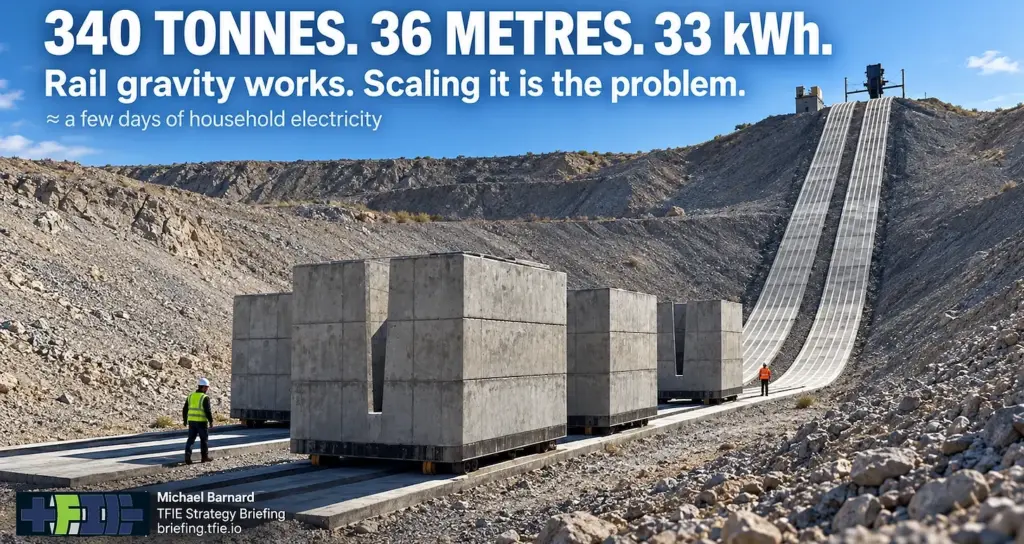
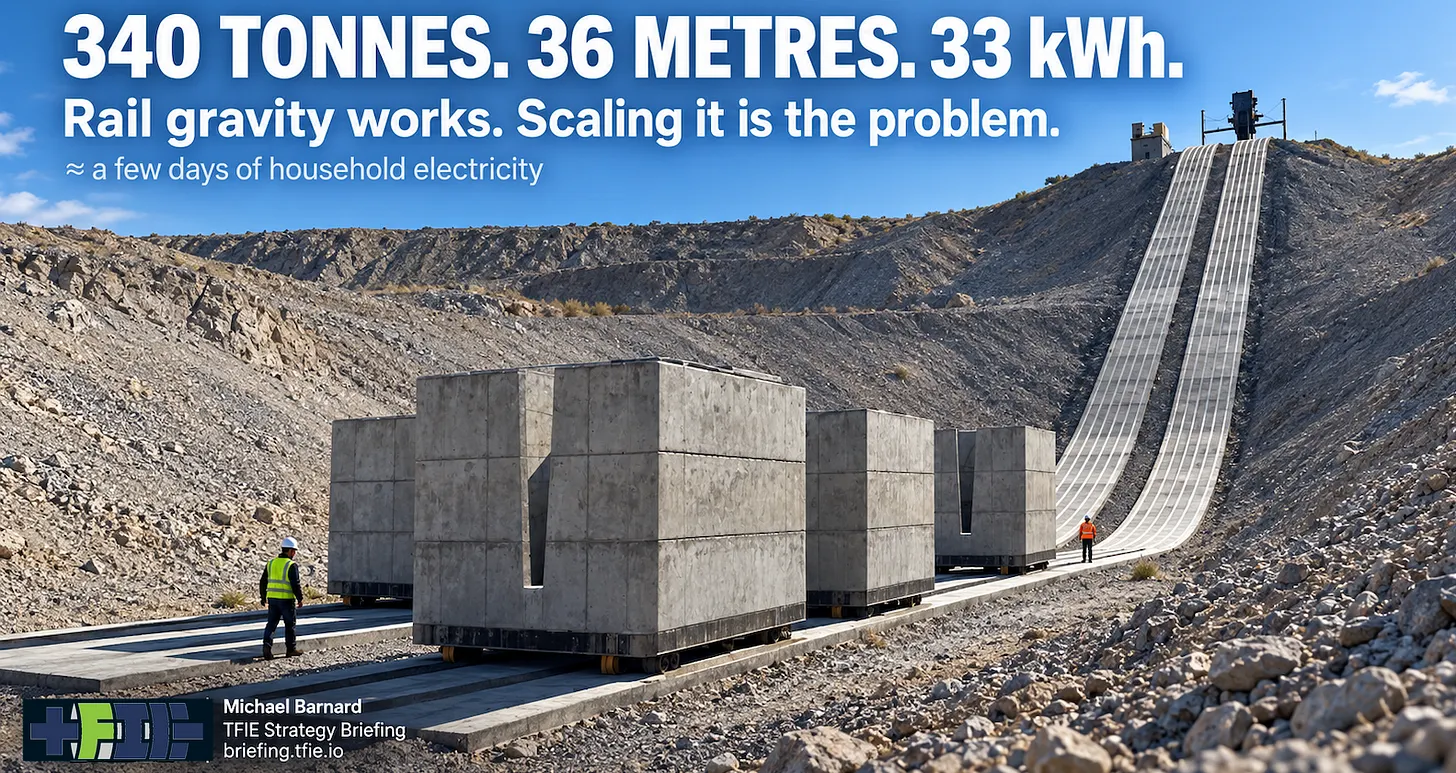
However, recent field demonstrations and rigorous thermodynamic assessments paint a dramatically different picture. Data gathered from ARES North America’s GravityLine system at the Gamebird Pit in Nevada reveals the stark, unavoidable constraints of solid-mass gravity storage. While ARES successfully demonstrated that its stationary motor and chain-drive configuration can maneuver approximately 340 tonnes of mass across a 36-metre elevation change, the resulting energy yield is remarkably modest: a mere 33 kilowatt-hours (kWh) of gross stored energy.
When subjected to fundamental engineering metrics and commercial-scale requirements, solid-mass mechanical storage systems expose deep vulnerabilities. Far from being a cheap, low-impact alternative for decarbonization, rail-based gravity storage suffers from exceptionally low energy density, massive embodied carbon footprints driven by heavy steel and Portland cement infrastructure, and staggering capital complexity. When matched against the operational elegance of closed-loop pumped hydro and the relentless cost declines and manufacturing scalability of lithium-ion battery chemistries—which are already proving viable at durations extending well past a dozen hours—rail gravity storage emerges less as a clean energy solution and more as an exercise in manufacturing excess.
Detailed Chronology and Technical Milestones
To understand the current state of rail-based gravity energy storage, it is necessary to trace how mechanical concepts have transitioned from theoretical proposals to physical, on-site demonstrations, and where those demonstrations ultimately stall against the laws of physics.
The Rise of Mechanical Gravity Concepts
For decades, energy innovators have recognized that gravity is the most abundant and enduring force available for energy storage. Closed-loop pumped hydroelectric storage has leveraged this principle for over a century, moving vast quantities of water between upper and lower reservoirs. Yet, finding suitable geography for pumped hydro—requiring two large water basins with significant elevation differences, minimal environmental disruption, and close proximity to transmission lines—is notoriously difficult.
This geographic restriction inspired entrepreneurs to look at solid masses. Rather than moving water, why not move rocks, concrete blocks, or specialized rail cars up hillsides? Companies like Energy Vault and ARES (Advanced Rail Energy Storage) emerged to commercialize this approach. ARES initially proposed massive funicular-style rail tracks traversing natural mountain slopes. However, practical concerns regarding cable forces, land use, and environmental pushback forced a pivot toward more contained industrial settings, such as abandoned gravel quarries and open-pit mines.
The Gamebird Pit Demonstration
The validation of this shift culminated at the Gamebird Pit in Nevada, where ARES North America deployed its GravityLine system. Evaluated and documented by researchers at Sandia National Laboratories, the facility sought to prove that heavy mechanical mass cars could be reliably controlled on steep grades using stationary motor and chain-drive systems rather than traditional, vulnerable funicular cables.
At Gamebird Pit, ARES demonstrated that a pair of mass cars—weighing roughly 340 tonnes in total—could successfully climb a slope possessing a roughly 55% grade through approximately 36 metres of elevation. Mechanically, the trial succeeded in showing that heavy rolling stock can be safely maneuvered on steep inclines using advanced traction and braking controls.
The Mathematical Reality Check
Yet, while the mechanical milestone was achieved, the thermodynamic output stunned only those observers unfamiliar with middle-school physics. Stored gravitational energy is dictated by a simple, unyielding equation:
$$textStored Energy = textMass times textGravity times textElevation Change$$
Moving 340 tonnes through a modest vertical displacement of 36 metres generated a gross stored energy pool of only about 33 kWh. While such heavy machinery can produce impressive momentary power spikes on its descent—because power is simply energy delivered rapidly—the actual quantum of storable energy remains trivial when vertical displacement is measured in dozens of meters rather than hundreds. The Gamebird demonstration laid bare the core paradox of solid-mass gravity storage: achieving massive instantaneous power output is easy with heavy loads, but accumulating a meaningful energy inventory requires immense vertical height or absurdly compounding amounts of mass.
Supporting Context & Metrics: Scaling Up to Reality
To evaluate whether rail-based gravity storage can genuinely compete in modern energy markets, analysts must scale these pilot systems up to meet real-world grid demands.
The Commercial Benchmark: 20 MW for 20 Hours
When ARES markets its GravityLine technology, it pitches the system as a long-duration energy storage (LDES) solution capable of bridging multi-hour gaps in renewable generation—durations traditionally dominated by pumped hydro and increasingly challenged by advanced chemical batteries.
To test these claims objectively, strategic modeling (such as recent assessments conducted by TFIE Strategy Briefing) scales the technology up to a commercially viable profile:
- Power Output: 20 Megawatts (MW)
- Duration: 20 Hours
- Total Energy Inventory: 400 Megawatt-hours (MWh)
- Effective Elevation Change: 400 metres (granting the system a hypothetical, highly favorable topographical advantage nearly eleven times greater than the Gamebird Pit).
Even in this artificially optimized scenario, the physics of solid-mass storage creates compounding infrastructure nightmares.
The Machinery Burden vs. Cheap Ballast
Proponents frequently frame rail-based storage as an economical enterprise built on "cheap ballast"—surrounding rock, gravel, and dirt loaded into rugged rail cars. However, once a 400 MWh service requirement is specified, the system ceases to resemble simple ballast moving up and down a hill.
To store 400 MWh of energy at a 400-metre elevation head, the system must manage hundreds of thousands of tonnes of mass. This mass cannot simply exist as a monolithic pile; it must be fractionated into thousands of purpose-built carriers, each equipped with heavy steel chassis, braking mechanisms, motor drives, bearings, wheels, and automated control systems.
This introduces a heavy industrial footprint:
- Yards and Terminals: Massive marshaling areas, staging zones, and transfer systems must be constructed at both the upper and lower elevations.
- Mechanical Redundancy: Because moving parts inevitably fail, extensive redundancy must be built into the system so that stored energy remains accessible even when portions of the fleet are undergoing maintenance.
- Dedicated Heavy Industry: Every single site requires the establishment of an on-site heavy rail, cement-forming, and rock-crushing manufacturing and maintenance facility designed to withstand decades of punishing mechanical wear and tear.
The Geographic Trap
A profound contradiction lies at the heart of siting solid-mass gravity systems. A gravel quarry like Gamebird Pit is commercially attractive precisely because it offers existing industrial land, accessible aggregate, and established access roads; however, it suffers from a fatal flaw—insufficient elevation change (only 36 metres). Conversely, a high-head site boasting a dramatic 400-metre mountain cliffside offers the necessary gravitational potential energy, but typically lacks nearby heavy industrial infrastructure, flat staging areas at the upper and lower termini, transmission grid interconnects, and straightforward geotechnical conditions.
The economically viable site for rail gravity storage sits at a nearly nonexistent mathematical intersection: it requires extreme topography married seamlessly to pre-existing heavy industrial flatlands and high-capacity transmission corridors.
Comparative Architectural Analysis
To fully appreciate the structural deficiencies of rail gravity storage, it is instructive to compare its material architecture against its two primary competitors: closed-loop pumped hydroelectric storage and lithium-ion battery energy storage systems (BESS).
| Storage Technology | Material Architecture | Manufacturing & Supply Chain | Geographic Dependency |
|---|---|---|---|
| Rail Gravity Storage (ARES) | Thousands of custom rolling carriers, heavy steel frames, chain drives, winches, electronic controls, and extensive rail networks. | Project-specific heavy industrial manufacturing built on-site; massive local fabrication required. | Extreme; requires steep grades paired with flat staging areas at both high and low elevations. |
| Closed-Loop Pumped Hydro | Water reservoirs, common penstocks, turbines, generators, and concrete dams. | Centralized turbine/generator manufacturing; civil engineering on-site for civil works. | High; requires two large water basins separated by significant elevation and water rights access. |
| Lithium-Ion Batteries (BESS) | Standardized chemical cells, modular racks, inverters, and thermal management systems. | Factory-produced in gigafactories supplying a global, standardized commodity market. | Very Low; can be deployed modularly almost anywhere with grid interconnect access. |
The Pumped Hydro Contrast
Closed-loop pumped hydro utilizes the exact same foundational laws of physics as rail gravity systems, yet its material architecture is infinitely more elegant. Hundreds of thousands of tonnes of water sit passively in natural or engineered basins without requiring individual chassis, wheel bearings, or parking positions. Water naturally finds its level, flows smoothly through a shared conduit (penstock), and remains entirely accessible to common generation turbines even if one component of the water pathway requires maintenance. Water does not suffer from mechanical wear, derailment, or rolling stock fatigue.

The Lithium-Ion Incursion
The economic viability of mechanical alternatives is further undermined by rapid advancements in electrochemical storage. For years, mechanical storage proponents argued that ultra-long-duration applications (spanning 10 to 20 hours or more) would remain financially out of reach for lithium-ion batteries.
That assumption has been decisively dismantled. Procurement data from major grid markets—such as Great Britain’s long-duration storage auctions—demonstrate that lithium-ion battery projects are routinely contracted to deliver sustained discharge profiles stretching well into the teens of hours. Batteries benefit from a global gigafactory manufacturing paradigm: developers receive standardized, factory-tested modules rather than constructing a bespoke, heavy-equipment production plant in a fragile ecological or industrial landscape.
Environmental and Carbon Accounting
Beyond economic and operational hurdles, rail-based gravity storage fails to clear basic environmental sanity checks when subjected to comprehensive lifecycle carbon accounting.
Embodied Carbon Realities
While the literal rock or aggregate moved by rail systems is a low-carbon material, the infrastructure required to move it is carbon-intensive in the extreme. Building a utility-scale rail gravity facility demands thousands of tonnes of high-grade structural steel and Portland cement to construct the massive winches, reinforced rail beds, heavy-duty tracks, and thousands of concrete-filled steel rail cars.
When calculated per kilowatt-hour of lifetime electricity delivered, the embodied carbon debt of building these custom heavy-machinery installations rivals or exceeds the carbon intensity of fossil fuel peaker plants. Rather than serving as an authentic climate solution, rail gravity storage often acts as a carbon sink dedicated entirely to moving rocks up and down a hill.
Regulatory and Public Resistance
The romanticized notion of a quiet electric train effortlessly storing wind and solar energy collapses when communities realize what is actually being proposed. Constructing industrial rail yards, carving massive scarps into hillsides, operating heavy industrial machinery continuously, and managing noise, dust, and visual blight across scenic terrain invites severe regulatory opposition and protracted legal challenges from local communities and environmental stewardship groups.
Future Outlook & Expert Conclusions
The recent demonstrations at Gamebird Pit provide definitive clarity, though perhaps not the kind ARES North America hoped to deliver. The trials successfully answered the primary mechanical question: heavy carriers can indeed be engineered to move reliably along steep alignments using modern chain-drive configurations.
However, answering the mechanical question only brings engineers face-to-face with the insurmountable systemic question: Once the machinery is built, does it make economic, thermodynamic, or environmental sense?
The verdict from energy strategists and independent analysts is overwhelmingly negative. The physics of gravity is immutable, and multiplying energy capacity requires a corresponding, fourfold multiplication of mass, machinery, land use, and embodied carbon. When forced to compete against the liquid fluidity of pumped hydro and the modular scalability and falling costs of chemical batteries, rail-based gravity storage occupies a dysfunctional middle ground. It retains all of the rigid geographic constraints of gravitational storage while adding the catastrophic capital, maintenance, and carbon liabilities of a custom heavy-rail manufacturing plant.
As the energy transition accelerates toward 2030 and beyond, capital markets and grid planners are increasingly prioritizing solutions that offer rapid deployment, low maintenance overhead, and proven scalability. Speculative mechanical curiosities like rail-based gravity storage, despite their intuitive appeal to casual observers, are rapidly being relegated to the history books of energy transition missteps—costly demonstrations that ultimately proved what middle-school science could have told us from the very beginning.



