Deep within the lush, hyper-biodiverse expanse of eastern Panama’s Darién forest, a quiet technological and ecological revolution is underway. For generations, Indigenous communities like the Wounaan and Emberá have stewarded the ancient tropical rainforests surrounding their ancestral villages, relying on traditional knowledge and an intrinsic respect for nature. However, systemic isolation, grinding poverty, a severe lack of viable economic infrastructure, and relentless encroachment from illegal loggers and non-Indigenous farmers have placed immense pressure on these irreplaceable ecosystems.
In response to these compounding threats, four Indigenous communities encompassing some 18,000 hectares of primary tropical forest have taken conservation into their own hands. Guided by Indigenous science and supported by conservation groups such as Health in Harmony and the FSC Indigenous Foundation, these communities have deployed camera traps and bioacoustic monitors to comprehensively inventory their local wildlife. The resulting discoveries—including rare umbrella species like jaguars (Panthera onca), Baird’s tapirs (Tapirus bairdii), and crested eagles (Morphnus guianensis)—have not only transformed local perceptions of their forest homes but have also catalyzed a pioneering move into the emerging, yet heavily scrutinized, global biodiversity credits market.
As these communities partner with the biodiversity credits company Savimbo to monetize and protect their standing forests, they find themselves standing at the bleeding edge of nature finance. While experts hail the initiative as a groundbreaking model for Indigenous-led conservation, the project simultaneously exposes the complex trade-offs, historical distrust, and regulatory hurdles plaguing the nascent biodiversity credit landscape.
Detailed Chronology: From Invisible Wilderness to High-Tech Stewardship
Discovering the Hidden Fauna of Puerto Lara
In late 2025, a motion-activated camera trap strapped to a semi-abandoned path in Puerto Lara—an Indigenous Wounaan village situated north of the Darién forest and close to the Pan-American Highway—captured an image that stunned local residents. The spotted body of a wild jaguar moved across the screen, a creature most villagers had previously only read about in books.
Samuel Cheucarama, a young community member tasked with reviewing data collected by two local cameras every two weeks, was equally astonished. Beneath the canopy of Puerto Lara’s modest 600-hectare forest—an area smaller than two New York City Central Parks—lay an astonishing concentration of wildlife. Cheucarama began cataloging an unexpected cornucopia of species: agoutis, spotted rabbits, wild turkeys, margays, and white-headed monkeys.
This localized awakening mirrored a broader initiative launched across four eastern Panamanian communities managing a combined 18,000 hectares of tropical forest. Frustrated by the absence of support from local and national authorities in combating encroaching illegal logging and agricultural expansion, these communities sought out intervention models that could make forest preservation economically viable. By 2023, they secured vital grant funding to assess the monetary value of their standing timber through natural capital tracking.
Implementing Indigenous Science and Monitoring
Rather than imposing top-down methodologies, the project integrated Indigenous science and traditional ecological knowledge at every operational stage. Collaborating with organizations like Health in Harmony (HiH) and Savimbo, the communities helped design a customized monitoring framework.
Biologist Sabrina Simon, research evaluation lead for Health in Harmony, noted that while a baseline list of 15 key indicator species—such as pumas, capuchin monkeys, collared peccaries, and Central American boas—was established, the study design was built from scratch alongside locals. Community members provided the indigenous names for these animals and detailed their spiritual, economic, and ecological value.
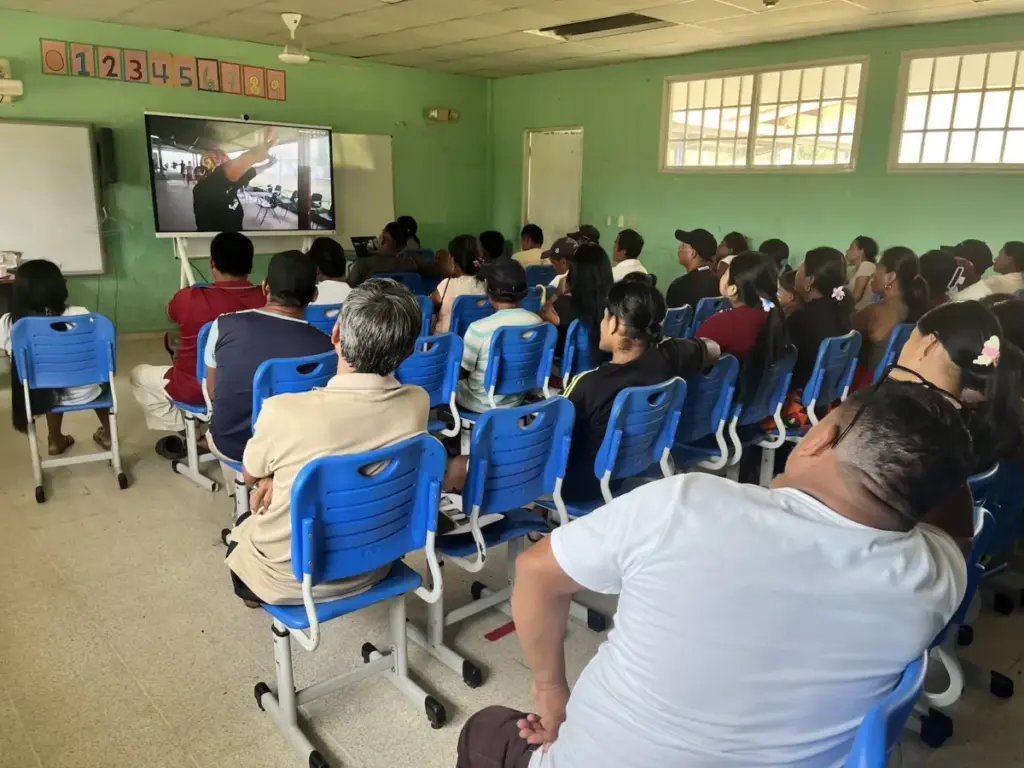
Village-selected monitors determined precisely where to install the equipment, drawing upon their intimate, generational knowledge of the terrain. Between 2024 and 2025, a cohort of 12 local residents was trained to deploy 80 bioacoustic audio recorders and seven rotating camera traps.
The data captured was remarkable. Across the monitoring period, the devices recorded the vocalizations of nearly 200 bird species—81% of which thrive exclusively in healthy, mature forests—along with 73 mammalian and reptilian species. Among them were 15 IUCN Red List threatened species, including the vulnerable mantled howler monkey (Alouatta palliata), Panamanian white-throated capuchin (Cebus imitator), great curassow (Crax rubra), and the endangered brown-headed spider monkey (Ateles fusciceps). Most importantly, the cameras confirmed the presence of the region’s three critical umbrella species: jaguars, Baird’s tapirs, and crested eagles.
Supporting Context & Metrics: Pressures and Peril in the Darién Gap
Deforestation and Land Tenure Insecurity
The urgency driving these communities is underscored by alarming regional statistics. According to data from Global Nature Watch, the Darién has lost 23,000 hectares of humid primary forest over the last 23 years. The primary driver of this loss is unchecked incursions by non-Indigenous farmers and commercial loggers who exploit legal ambiguities and a lack of recognized land titles.
Many Indigenous groups lack formal legal recognition over their ancestral domains. Muriche Yeucarama, head of the Puerto Lara community, points out that such incursions are occasionally tacitly backed by national authorities. The fragmentation is severe: in the Arimae community—home to approximately 170 Emberá and Wounaan families—only 8,191 hectares of primary forest were legally recognized in 2015 out of the 72,000 hectares they traditionally managed. Across the entirety of the Darién, more than 650,000 hectares of Indigenous territories remain locked in prolonged legal disputes.
Economic Desolation and the Subsistence Trap
Poverty and a severe lack of economic opportunity form a shared burden across the four participating villages. Franklin Fogón, a member of the Alto Playón community overseeing biodiversity monitoring, explains that standard livelihood avenues are functionally closed off.
"There’s no demand for jobs," Fogón noted in a video interview. "The roads needed to take produce like plantains, achiote, or cassava to bigger markets are nearly unusable, so they end up selling to middlemen who take a 50% cut. There’s not enough money to sustain us."
Hayro Cunampio, an Emberá-Wounaan community member and free, prior, and informed consent coordinator at the FSC Indigenous Foundation, emphasizes how economic desperation forces difficult choices:
"Since there aren’t many economic opportunities, [some Indigenous] people prefer to log or hunt to solve their immediate needs."
This harsh reality made external exploitation look enticing, but also dangerous. Elivardo Membache, president of the Arimae community, recalls that at least seven different corporate entities previously approached them offering "millions of dollars" for carbon credits. The communities rejected every offer, fearing restrictive covenants that would strip them of their autonomy and traditional lifeways—fears validated by historical failures within Panama’s REDD+ carbon schemes.
Official Statements and Stakeholder Perspectives
The transition from traditional subsistence models to high-tech natural capital markets has sparked intense discourse among community leaders, conservation scientists, and financial researchers.
The Community Perspective: Taking Stock of the Home
For community leaders like Membache, the project has reframed how they view their natural surroundings:
"We have our home, but we never take stock of what’s in it: what exactly do we have in our home, right? It’s the same with the forest: we have the forest, but we don’t know the wealth or potential it holds."
The data has directly altered local behavior. Samuel Cheucarama reports a tangible shift in social norms within Puerto Lara:
"People don’t go hunting anymore. They’re saying, ‘We’re going to put up a “No Hunting” sign.’" Furthermore, upon project completion, the communities retained full ownership of all collected data, cameras, and bioacoustic devices.
Entering the Biodiversity Credits Market
Eschewing traditional carbon credit brokers, the four territories chose to partner independently with Savimbo, a U.S.-based, Colombia-founded biodiversity credits company. Biodiversity credits function as units of habitat preserved or restored, creating a direct financial stream for Indigenous stewards.
Drea Burbank, CEO of Savimbo, emphasizes that building trust required patience:
"We gave communities enough time to decide whether they actually want in by first signing a ‘no-strings attached’ monitoring agreement."
Membache noted that Savimbo won their trust through absolute transparency, translating contracts into local languages, reviewing terms with community lawyers, and establishing clear mechanisms for earnings distribution. Crucially, Savimbo features Indigenous co-founders and advisory board members from the Pijao and Cofán peoples.
Scientific and Regulatory Scrutiny
While community-level enthusiasm is high, academic and financial experts maintain a cautious stance. Richard Field, a professor of biodiversity science at the University of Nottingham and technical co-lead for the International Advisory Panel on Biodiversity Credits, calls Savimbo’s indicator-species methodology "about as good as you can get" for camera-trap frameworks without ballooning costs that would eat into community profits.
However, questions linger regarding third-party certifiers. Savimbo has sought to work with Cercarbono, a Colombian certification company previously implicated in regulatory controversies. In 2024, Colombia’s Constitutional Court ruled that Cercarbono’s protocols for a separate Amazonian carbon project were too vague to protect collective Indigenous rights, reducing certification to a mere "checklist."
When questioned about this partnership, Burbank defended the decision:
"Certifier integrity is of the highest priority. We looked at the case closely. Honestly, that’s part of why we chose to work with Cercarbono: it let us see how they act when something goes wrong, which is the only real test of accountability. And they updated their processes comprehensively rather than minimally."
Cercarbono confirmed that formal certification for the Savimbo project has not yet begun, noting that it has since instituted a heavily revised regulatory framework requiring direct field visits, participatory mapping, and rigorous cross-checking with official state records to verify legitimate community representation.
To prevent internal embezzlement or misuse of funds, the project employs a collective governance guardrail: money cannot be released to community accounts until members officially vote on fund allocation. Communities are slated to receive an initial $4,000 deposit for 34,000 pre-certified credits, with $2,000 already delivered to verify local sources.
Future Outlook: Are Biodiversity Credits a Viable Horizon?
As the communities of the Darién gap navigate the uncharted waters of biodiversity finance, the ultimate viability of their approach remains an open question. Anna Ducros, a nature finance researcher at the U.K.-based International Institute for Environment and Development (IIED), strikes a note of measured restraint:
"Until the credits are sold and enough time has passed to measure the environmental and social impacts of the credits, I’m hesitant to say if Savimbo’s efforts are going in the right direction. In my view, the jury’s still out."
Yet, proponents argue that perfection must not become the enemy of progress. Professor Richard Field highlights the pioneering nature of the endeavour:
"We have to acknowledge that these people are pioneers, you know, there’s hardly any biodiversity credits being sold so far, and we do need to accept that not everything is going to be perfect… These questions are more about could they do even better, rather than, ‘Oh, it’s already rubbish.’"
For Elsa Quiroz, Samuel Cheucarama, and their neighbors in Puerto Lara and Arimae, the cameras and audio recorders have done more than measure ecological wealth—they have illuminated a pathway forward. By proving that their forests harbor jaguars, tapirs, and hundreds of rare bird species, these Indigenous guardians have armed themselves with undeniable data. Whether the nascent global biodiversity credit market can deliver the financial security they deserve remains to be seen, but the people of the Darién have firmly established that their forests will not fall quietly.