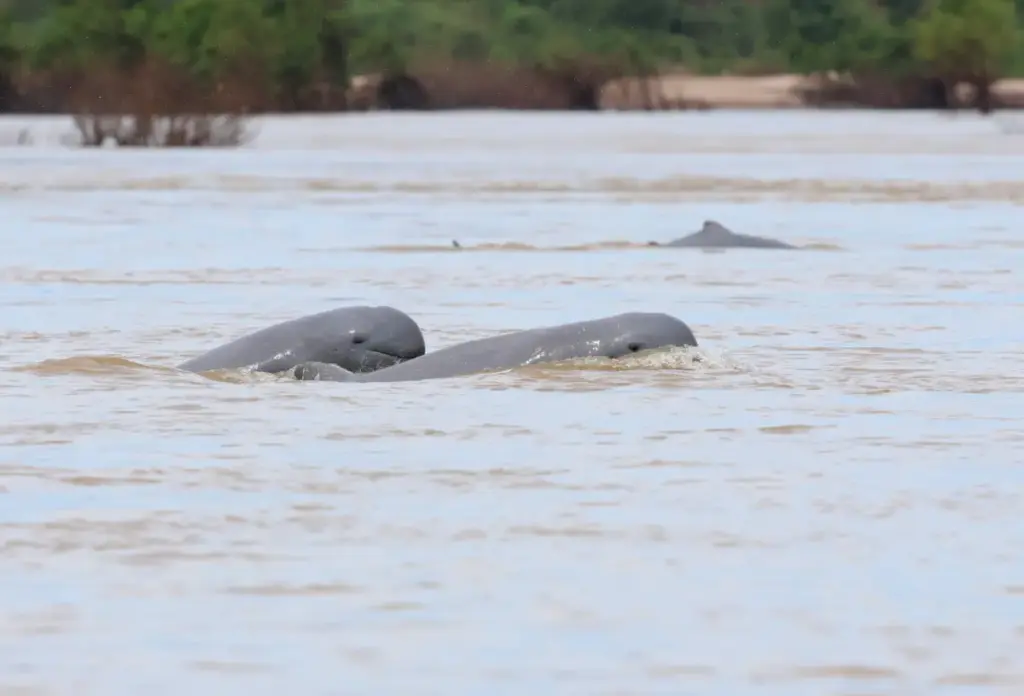
As the morning sun cuts through the heavy tropical haze over the Mekong River in Kratie, Cambodia, boat driver Heang Koeurn cuts his motor, letting his vessel drift in the sluggish current. For 11 years, this has been his ritual. He leans forward, elbows braced on his knees, eyes scanning the dark, glassy surface of the Kampi pool. Moments later, a subtle ripple breaks the water, followed by the smooth, slate-gray curve of a dorsal fin. A collective gasp rises from a nearby tourist boat as a pod of critically endangered freshwater Irrawaddy dolphins (Orcaella brevirostris) breaches for air.
Koeurn’s livelihood—and the economic pulse of his community—depends on these fleeting, magical encounters. But behind the serene facade of ecotourism lies an unfolding ecological disaster. The Mekong River, a continental lifeblood supporting tens of millions of people across Southeast Asia, is fracturing under the combined weight of rampant illegal fishing, climate volatility, and an explosion of upstream hydropower dam construction.
Once numbering around 200 individuals in the late 1990s, the Cambodian population of Mekong Irrawaddy dolphins collapsed to barely 100 before a slight, fragile rebound lifted numbers to 118. In neighboring Laos, the story has already reached its tragic conclusion: the transboundary Anlong Chheu Teal pool lost its final resident in 2022. Today, a fragile coalition of local boatmen, underpaid river rangers, and international conservation groups are locked in a high-stakes, asymmetric war to prevent the total extinction of the Mekong’s most iconic aquatic resident.
Detailed Chronology of a Conservation Crisis
To understand the precarious state of the Irrawaddy dolphin, one must trace the timeline of regulatory milestones, habitat fragmentation, and enforcement battles that have shaped the Mekong basin over the past three decades.
Late 1990s: The golden era of recent history for Orcaella brevirostris in the Mekong. Researchers estimate a stable population of approximately 200 individuals roaming freely across a vast historic range that stretched from the Mekong Delta through the Tonle Sap Lake and deep into northern tributaries.
2007–2012: Accelerated habitat degradation, targeted hunting, and accidental entanglements trigger a rapid population contraction. In response to mounting international pressure, the Cambodian government establishes a 180-kilometer (112-mile) protected core habitat zone spanning Kratie and Stung Treng provinces, prohibiting the use of deadly gillnets. The Fisheries Administration deploys an initial cadre of 72 river guards to enforce the ban.
2014: The Fisheries Administration (FiA) and WWF-Cambodia launch a joint management initiative. This program aims to bridge community survival with conservation by helping fishing households diversify their incomes away from wild-caught river fish, thereby easing pressure on the aquatic food web.
February 15, 2022: A dark milestone is reached. The last surviving dolphin in the transboundary Anlong Chheu Teal pool—affectionately dubbed "the lonely dolphin" by local villagers—is discovered dead after entangling in illegal fishing gear. Its passing marks the functional extinction of the species in the Laos sector of the Mekong. Its bleached bones are later enshrined in a local community hall as a somber monument.
2022: Enforcement efforts peak in intensity as authorities crack down on illegal gear within core habitats. Law enforcement and conservation units confiscate and destroy an astounding 36,000 meters (nearly 118,000 feet) of gillnets, 7,000 fishing hook lines, and 500 meters of mesh nets in a single year.
2025: In a major legal and administrative victory for environmentalists, the Cambodian Ministry of Land Management officially designates the dolphin’s core freshwater habitat zones as state land, providing permanent legal protection against land grabs and commercial encroachment.
Mid-2026: A wave of cautious optimism sweeps through conservation circles. Surveys confirm the birth of at least six new calves—five in Kratie and one in Stung Treng—boosting the estimated total population to 118 and proving that the remaining breeding stock retains reproductive viability.
Supporting Context & Metrics: Threats and Ecology
The Geography of Survival
The Mekong River enters northern Cambodia from Laos through Stung Treng province, cutting through a series of dramatic gorges and deep river pools that provide critical thermal refuges and spawning grounds for megafauna like the giant freshwater stingray. Among these, the Kampi pool in Kratie province—plunging nearly 60 meters (200 feet) deep—serves as one of the last secure redoubts for the remaining dolphins.
However, these deep pools are shrinking sanctuaries. Irrawaddy dolphins are uniquely vulnerable to anthropogenic pressures. Unlike marine cetaceans, river dolphins are boxed into a linear aquatic highway where escape routes are choked by physical barriers and human activity.
The Scourge of Gillnets and Electrofishing
While intentional poaching for meat or traditional trade has declined due to public awareness campaigns, accidental mortality remains the leading cause of adult and calf deaths.
Gillnets: Set illegally within core habitat zones, these invisible nylon walls trap unsuspecting adults. Calves are at an even greater risk, frequently drowning when they become entangled alongside their mothers or wander into nets unassisted.
Electrofishing: An illegal, highly destructive practice utilized by transient fishers from outside local communities. This method indiscriminately kills all aquatic life, severely depleting the forage fish biomass—including species like carps and catfishes—upon which the dolphins rely for survival.
The Hydropower Shadow
Beyond direct interactions with fishing gear, the Mekong’s hydrological regime has been profoundly altered. More than 160 operational dams now choke the Mekong River and its vital tributaries, including 13 massive mainstream structures.
Chief among these is the Don Sahong Dam, situated less than 2 kilometers (1.2 miles) north of the Cambodian border in southern Laos. Operational since 2020, the dam sits directly in the path of critical fish migration routes within the Lower Mekong Basin.
According to Dr. Ian Baird, a professor of geography at the University of Wisconsin-Madison who has extensively studied regional dam impacts, upstream dams may not directly bludgeon dolphins to death, but they fundamentally disrupt the river’s hydrology. They flatten seasonal flood pulses, starve downstream flood forests of nutrient-rich sediment, and alter fish communities. Without a stable, abundant supply of prey, dolphin health and reproductive rates inevitably suffer.
Official Statements and Frontline Perspectives
The fight to save the Mekong’s cetaceans is waged daily on muddy riverbanks, inside poorly funded patrol stations, and across international boardrooms.
"We cannot leave Irrawaddy dolphins behind as they are the Mekong River’s ecological treasure. The use of gillnets is the main threat to them. That is why conservation efforts must be enforced to combat illegal fishing methods. We need everyone, from the local community to the government, working in tandem. Law enforcement does not have full capacity to address these issues alone."
— Veang Tino, Patroller, Kampi Conservation Centre
The human cost of this frontline conservation is severe. River guards like Kem Sophat operate under constant physical threat from armed, desperate illegal fishers who frequently resort to violence to protect their nighttime operations. Furthermore, the financial compensation is starkly inadequate. Patrollers earn a meager $5 to $7.50 per day, often forced to burn their own meager savings on boat fuel, maintenance, and daily meals.
"We come from other parts of Kratie. It is quite far from where we are based to do patrolling. The income is small, but it is out of the goodness of our hearts we keep doing this job because we specialize in patrolling."
— Kem Sophat, River Guard
The existential stakes of this battle extend far beyond regional borders. Frances Gulland, chair of the U.S.-based Marine Mammal Commission, frames the crisis in global terms:
"Intrinsically, they are a very beautiful part of nature. If we lose them, we lose a species—another species lost from the earth, which is like losing a star from the sky. For communities along the Mekong, they provide livelihoods through ecotourism."
The local economic devastation of losing these animals is already visible at Anlong Chheu Teal. Community leader Phoy Vanna notes that since the death of the pool’s last resident dolphin in 2022, tourist traffic has plummeted by over 60%. Visitors who once flocked to see the mammals now find little incentive to make the journey, leaving former boat operators struggling to feed their families.
Yet, institutional resolve remains firm. I Sanaroth, the Kampi fisheries chief, points to recent population ticks as proof that collaborative governance works:
"The population of the Mekong Irrawaddy dolphins has increased due to joint conservation. Our work is not done. Authorities, with support from conservation groups, are stepping up patrols and prosecutions to hold illegal fishers accountable."
Future Outlook: A Precarious Crossroads
The birth of six new calves in early 2026 offers a glimmer of hope, proving that the remaining 118 dolphins possess the biological resilience to rebound if given quarter. Yet, this fragile recovery hangs by a thread.
Long-term survival requires a multi-pronged approach that transcends national borders:
Strengthened Transboundary Cooperation: Because dolphins and fish populations do not recognize geopolitical boundaries, enhanced anti-poaching agreements and intelligence-sharing between Laos and Cambodia are paramount.
Economic Empowerment: Expanding livelihood programs for river-dependent communities ensures that local villagers remain active stewards of the ecosystem rather than economic exiles pushed into illegal fishing.
Rigorous Hydropower Mitigation: Regional planners must reassess the cumulative ecological toll of mainstream dams, prioritizing environmental flows and fish-passage technologies that safeguard the Lower Mekong food web.
Equitable Support for Rangers: Securing fair wages, hazard pay, and modern equipment for community river guards is essential to maintaining round-the-clock protection in core habitats.
Until these systemic shifts take root, the mornings in Kratie will maintain their haunting rhythm. Boat drivers like Heang Koeurn will continue to cut their motors in the damp dawn air, scanning the dark waters of the Mekong, waiting to see if the river’s living legacy will break the surface once more—or slip quietly into the history books.