TOKYO — For Mariko Aoki, the arrival of a new year does not bring quiet reflection or festive cheer; it brings an itch.
"Right after the New Year in January, my nose starts to get a little itchy," Aoki says. "It peaks in March, and the sneezing, runny nose, itchy throat, and itchy eyes are really bad. It lasts all the way until just before Golden Week."
Aoki, a secretary at Japan’s National Diet, is far from alone in her seasonal misery. Hay fever—known locally as kafunsho—is an annual affliction that grips more than 40% of Japan’s population. This infection rate is nearly double that of the United States, turning what is typically considered a minor inconvenience in other parts of the world into a massive public health emergency in East Asia. The symptoms are relentless: red, inflamed eyes, severe nasal congestion, scratchy throats, and deep, debilitating physical exhaustion.
The economic fallout of this collective lethargy is staggering. According to economic surveys, the physical toll of kafunsho costs Japan an estimated 245 billion yen ($1.5 billion) per day in lost productivity during peak hay fever season.
"My head feels so foggy that I can’t concentrate," Aoki says, describing the cognitive strain of trying to work through the allergy peak. "When it gets really bad, I go to the doctor."

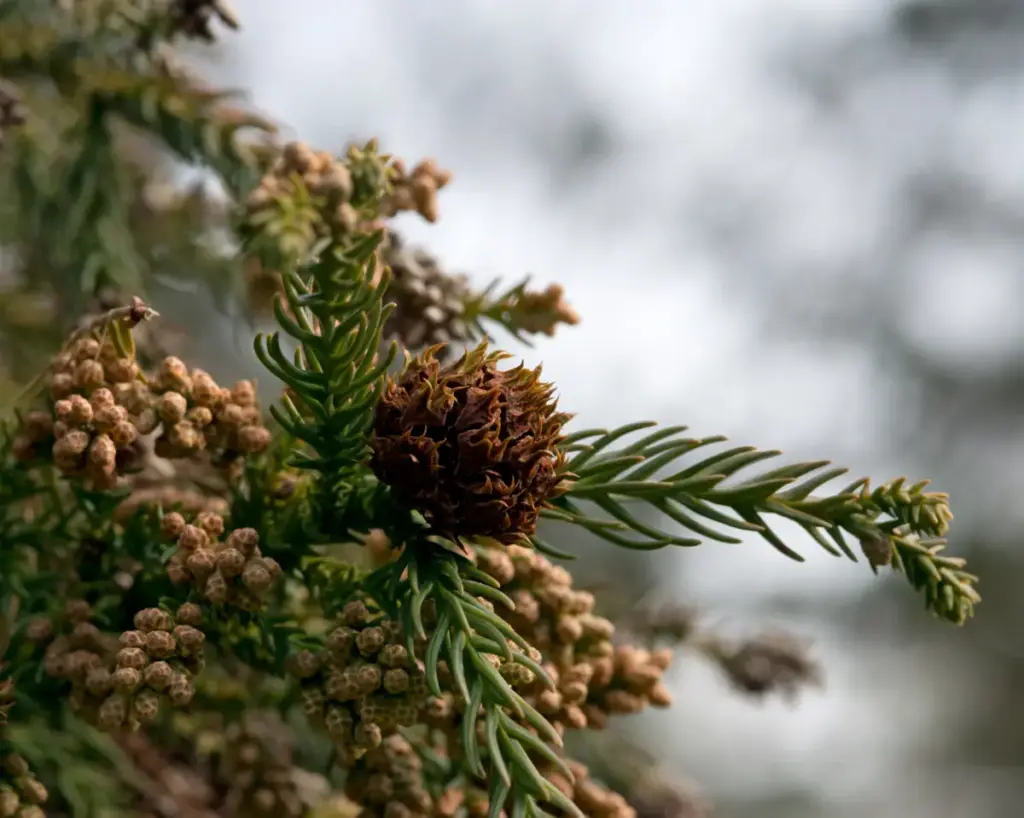
While hay fever is frequently dubbed a "national disease" by Japanese media, it is far from a natural phenomenon. It is an entirely man-made ecological crisis. The overwhelming majority of Japan’s allergy sufferers are reacting to the microscopic pollen of two specific tree species: sugi (Japanese cedar, Cryptomeria japonica) and hinoki (Japanese cypress, Chamaecyparis obtusa). These trees were planted across the nation in massive numbers in the decades following World War II to serve as a desperately needed source of postwar timber.
The trees that helped fuel Japan’s miraculous economic recovery are now, decades later, fueling a chronic national health crisis. Yet, unraveling this botanical trap requires navigating a labyrinth of labor shortages, a declining construction sector, and biological hurdles that make fixing the problem nearly as difficult as living with it.
Executive Overview
Japan’s current allergy epidemic is a cautionary tale of unintended ecological consequences. Approximately 70% of Japan—more than 25 million hectares (61.8 million acres)—is covered by forests, making it one of the most heavily wooded industrialized nations on Earth. However, this verdant landscape is deceptive. Around 41% of these forests are artificially planted, with sugi alone accounting for roughly 40% of planted timberlands (4.4 million hectares, or 10.9 million acres). Another 25% are hinoki.
Driven by climate change, the annual pollen season has grown steadily longer and more severe, with sugi pollen appearing earlier and earlier in urban centers like Tokyo. In response to mounting public health pressures and economic losses, the Japanese government announced a sweeping, aggressive initiative in 2023: fell 750,000 hectares (1.9 million acres) of sugi and hinoki trees by 2033 to cut the problem off at its roots.
Achieving this target, however, requires overcoming monumental hurdles. The Japanese forestry industry is grappling with a severe demographic collapse, plunging domestic housing starts, and the painstakingly slow, labor-intensive process of breeding and planting pollen-free tree variants. For millions of workers like Mariko Aoki, a pollen-free future remains a distant dream while fields of green continue to billow clouds of golden misery across the archipelago.

Detailed Chronology: From Industrialization to Afforestation
To understand how Japan transformed its mountainous landscape into a massive pollen factory, one must trace the nation’s history through successive waves of industrialization and war recovery.
The Pre-Modern and Meiji Eras (Pre-1945)
Forests have always played an essential role in Japanese society, providing natural resources ranging from charcoal for fuel to sturdy timber for traditional housing. According to Taro Takemoto, a senior assistant professor at the Tokyo University of Agriculture and Technology, the intentional cultivation of sugi and hinoki began to take shape during early modern times due to their favorable traits: exceptionally fast growth rates and straight, pliable tree trunks.
These species were distributed more widely during the Meiji era (1868–1912), a period of rapid modernization and industrial expansion. However, the deliberate, large-scale conversion of natural, biodiverse forests into monoculture plantations did not reach its peak until the mid-20th century.
The Post-World War II Reconstruction Boom (1950–1985)
The most critical chapter of the kafunsho story began immediately after World War II. Intensive bombing campaigns by the United States had devastated Japanese cities, leaving the nation with an immediate deficit of roughly 4.2 million homes. Japan embarked on a staggering rebuilding effort, dedicating up to 40% of its national budget to construction projects. By 2020, the construction industry had erected more than 76 million homes and apartments, with detached single-family wooden houses capturing the largest share of the market.
"People wanted wood resources as fast as they could, so planting sugi was a good solution," explains Hitoshi Yonenobu, a tree-ring researcher at the Naruto University of Education in Tokushima prefecture. "It is a rapidly growing species. Ironically, it [also] caused hay fever."

Simultaneously, the widespread adoption of fossil fuels meant that traditional energy forests—which relied on deciduous trees like kunugi (Quercus acutissima) and konara (Quercus serrata) for firewood—suddenly fell out of favor. Between 1950 and 1985, Japan’s planted forests expanded dramatically, eventually covering 10 million hectares (24.7 million acres), or more than a quarter of the nation’s total land area. Natural deciduous forests were clear-cut, used for pulp and paper, and systematically replaced with rows of sugi and hinoki.
"The timing was very good," Takemoto notes. "We switched from energy forests to construction trees like sugi and hinoki. So we cut the deciduous trees, we used the pulp, then we replanted sugi and hinoki trees."
Supporting Context and Metrics: The Scale of the Crisis
The sheer volume of sugi trees currently maturing across Japan explains why the allergy season has reached catastrophic proportions. Nearly all of Japan’s planted sugi trees are now older than 20 years, encompassing roughly 4.3 million hectares (10.6 million acres). These mature trees not only yield prime lumber for the construction industry, but they also produce maximum quantities of pollen.
- National Forest Coverage: ~70% of Japan (25 million hectares / 61.8 million acres) is forested.
- Planted Forest Share: ~41% of total forests are artificial plantations.
- Sugi Dominance: Sugi accounts for 40% of all planted forests (4.4 million hectares / 10.9 million acres).
- Hinoki Presence: Hinoki accounts for another 25%, releasing its pollen later in the spring and thus extending the allergy season well into May.
- Economic Toll: An estimated 245 billion yen ($1.5 billion) in daily economic losses during peak season due to fatigue, brain fog, and reduced productivity.
- Government Reduction Target: The Ministry of Agriculture, Forestry and Fisheries aims to cut 20% of the country’s 4.3 million hectares of mature sugi forests by 2033.
Official Statements and Mitigation Strategies
Facing mounting public dissatisfaction and immense economic drain, the Japanese government has mobilized a multi-pronged strategy to reduce the national pollen burden without completely crippling the forestry sector.
"We will gradually increase the amount we cut each year," says Makoto Nakamura, assistant director of the wood industry division at the Ministry of Agriculture, Forestry and Fisheries. "We’re already cutting 50,000 hectares (123,500 acres) annually; as a result, we’re consistently using about 12 million cubic meters of sugi. We’re accelerating that process—we’re looking to increase production from around 12 million to 16 million cubic meters."

The Felling and Replacement Protocol
The government’s strategy relies on targeted harvesting. Trees located in inaccessible terrain—such as steep mountain slopes or deep interior forests—will be replaced with a diverse mix of native broadleaf species to restore local biodiversity. Meanwhile, trees situated closer to roadsides or processing facilities will be clear-cut and replaced with newly developed strains.
"In areas that remain suitable for forestry, we’re planting sugi saplings that produce less pollen," explains Akimi Kobayashi of the forestry ministry’s forest use and conservation division.
The Search for the "Holy Grail": Pollen-Free Sugi
At the vanguard of this effort is the Forest Tree Breeding Center in the seaside city of Hitachi, Ibaraki prefecture. Here, researchers have successfully identified and bred more than 30 strains of low-pollen and completely pollen-free sugi varieties.
The discovery of pollen-free trees was largely a stroke of historical luck. In 2004, a Niigata University professor researching low-pollen trees stumbled across the first individual sugi tree that produced zero pollen. Other researchers quickly found similar genetic anomalies. These few specimens became the maternal and paternal foundation for all subsequent generations of hypoallergenic trees.
Masahiro Miura, a researcher at the center, spent five arduous years cataloguing trees by evaluating their flower clusters. "I spent five years counting—well, ‘counting’ isn’t quite right—I visually assessed the quantity of flowers using a 55-point grading scale, similar to an A,B,C style report card," Miura recalls. "We classified those that consistently failed to produce pollen throughout that five-year period as ‘pollen-free varieties.’"

Producing these trees on a commercial scale, however, is exceptionally demanding. While cloning (growing trees from cuttings) bypasses genetic roll-the-dice, cross-pollination methods often require spraying trees with plant hormones typically reserved for growing seedless grapes. Even with advanced genetic testing, traditional cross-pollination yields a 50/50 split between pollen-producing and pollen-free offspring.
To separate them, researchers must physically inspect saplings one by one, crushing individual flower buds between their fingers to check for internal yellow dust.
"That’s why this isn’t catching on," Miura admits candidly. "You can’t tell just by looking which individuals will produce pollen and which won’t."
Despite these hurdles, some regions are making headway. Toyama prefecture on Japan’s western coast pioneered early adoption, planting roughly 100,000 no-pollen saplings in mountainous areas within a single year. Other prefectures have gradually followed suit.
Future Outlook: Labor Shortages, Housing Decline, and Realities on the Ground
Even if researchers manage to scale up the production of hypoallergenic saplings, Japan’s overarching plan to conquer hay fever faces two glaring structural roadblocks: a demographic implosion in the rural workforce and a contracting domestic housing market.

The Graying Workforce
The primary forestry sector is in the midst of a severe labor crisis. Japanese census data reveals that the number of forestry workers plummeted from more than 126,000 in 1985 to fewer than 44,000 by 2020. While the rate of decline has plateaued, the government’s ambitious goal to accelerate tree-clearing will place immense strain on an already depleted labor pool.
"Of course, since jobs in the primary forestry sector—working in the mountains—can’t exactly be called popular, we’re likely to face a labor shortage, so we need to raise awareness about the jobs," Nakamura concedes.
To bridge this gap, the forestry ministry is heavily betting on automation and robotics. Officials envision a future where autonomous machinery, remote-controlled harvesters, and unmanned processing facilities shoulder the burden of heavy timber extraction.
Declining Timber Demand
Compounding the labor shortage is a shrinking domestic market for lumber. As Japan’s population ages and contracts, the residential construction industry is facing historic lows. Land ministry data shows that housing starts dropped to a 62-year low in 2025. Furthermore, industry research predicts that the construction of rental housing units in 2040 will plunge 29% below 2025 levels.
To prevent newly felled timber from going to waste, the forestry ministry is working to pivot the sector toward alternative applications. "As demand for housing declines, we’ll increase the amount of domestically produced lumber used in residential construction and also expand the use of wood in a wide range of non-residential buildings," Nakamura explains, pointing to potential expansion in the pulp, paper, and biomass energy sectors.

A Distant Dream
For ordinary citizens like Mariko Aoki, the government’s decade-long timeline feels agonizingly slow. Standing near the edge of a timberland and watching golden clouds of pollen drift across the mountains like smoke, she remains skeptical of a quick fix.
"These trees were planted in such large numbers," Aoki reflects. "When I go to the mountains, I see this incredible amount of pollen floating around like smoke. I wouldn’t say it’s a failure, but I feel like it’s not really going very well."
Until technology, forestry automation, and genetic breeding can outpace the biological legacy of Japan’s postwar recovery, millions of residents will continue to greet each new year not with celebration, but with a tissue box in hand and an inescapable itch.